
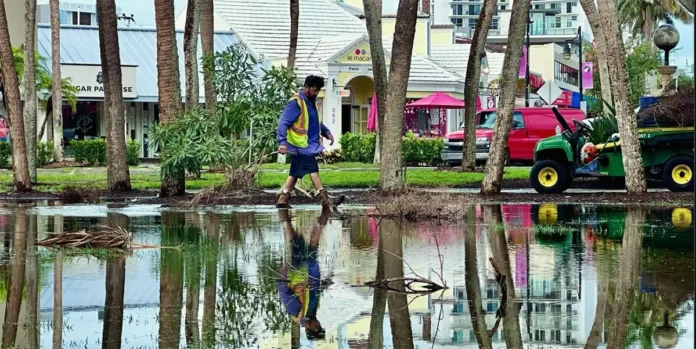
On Dec. 16, the Sarasota County Commission moved forward to fortify areas in the region against future storms by approving approximately $57 million in federal disaster recovery funding.
The decision prioritizes hard infrastructure over aesthetics, and will deliver a $13.5 million lifeline to St. Armands Circle. This move is celebrated not just by merchants, but by thousands of Longboat Key residents for whom the Circle represents the road to safety.
The funds, drawn from a larger U.S. Department of Housing and Urban Development (HUD) block grant tied to Hurricanes Debby, Helene, and Milton, were distributed among nine projects. The approval of the $13.5 million for the St. Armands Resiliency and Flood Mitigation Project marks a decisive victory for the barrier islands, though it fell short of the city’s original $24.5 million request.
The presence of Longboat Key Mayor Ken Schneier and Deputy Town Manager Isaac Brownman at the December Sarasota County Commission meeting signaled the gravity of the situation. Following two hours of public testimony from a coalition of residents, Longboat Key officials, and barrier island employers, the Commission approved the funding—but with strict caveats.
Acting on the advice of County Commissioner Mark Smith, an architect by trade, the Board slashed funding for “underground storage vaults” and “aluminum flood barriers.” Smith argued the barriers should be a private expense and calculated that the proposed $500,000 vaults would hold only 528,000 gallons—roughly 0.6 inches of water across the 132-acre area—rendering them mathematically ineffective.
Instead, the $13.5 million will be funneled strictly into “hard” infrastructure: new high-capacity stormwater pumps, backup generators, discharge piping, and hardened outfalls with check valves.
The debate over the St. Armands engineering specifics became so granular that County Administrator Jonathan Lewis had to summon Stormwater Director Ben Quartermaine back to the meeting while he was driving home.
Upon his return to the podium, Quartermaine validated the Commission’s skepticism regarding the storage vaults. “Because these areas are so low… any storage of rainfall becomes problematic,” Quartermaine explained, noting that watertight vaults in such high water tables risk “popping up” or floating if not perfectly engineered.
Commissioner Teresa Mast drove the “infrastructure first” mandate home, refusing to support a requested $2.8 million for design and architectural services. “The need is so great,” Mast argued, pushing to maximize the spend on physical pumps and generators. The County’s stormwater department will now assume responsibility for the design and construction, ensuring the project focuses on keeping the State Road 789 evacuation route dry.
St. Armands Key is a low-lying, bowl-shaped barrier island and is home to the vital commercial hub featuring more than 140 storefronts and restaurants that support approximately 1,100 jobs and generate $135 million in annual sales. The island’s current stormwater system, which relies on pump stations due to its natural, flood-prone topography, has proven dangerously inadequate.
The pump stations were “overwhelmed and/or not fully operational” during severe flooding in both 2023 and $2024. Moreover, the Key serves as the sole mainland connection for SR 789, a crucial evacuation route handling 32,000 vehicles daily.

