
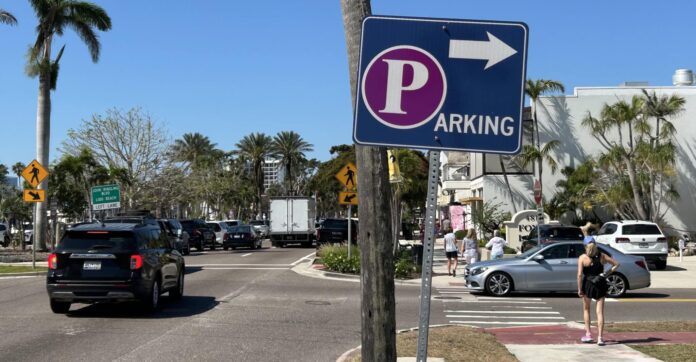
—In cities like San Francisco, Seattle, and Miami, municipal parking is a lucrative, data-driven enterprise that pays for itself and funds local improvements. In Sarasota, it is a persistent drain on the city’s coffers.
Now, facing aging infrastructure, the lingering financial toll of recent hurricanes, and a widening operational deficit, the City of Sarasota is considering a sweeping overhaul of its parking fees. On Monday, March 23, 2026, the City Commission will review a proposal that could see transient parking rates jump by as much as 50 percent, while some downtown and St. Armands workers could see their monthly permit costs triple.
The proposals, outlined in a presentation prepared by Broxton Harvey, General Manager of Parking, lay bare the stark financial realities facing the city’s General Parking and St. Armands Parking Funds. For the upcoming 2026 fiscal year (FY26), the combined parking program is operating at a loss, projecting $6,287,790 in revenues against $6,558,574 in expenditures—a deficit of $270,784. Without intervention, city projections show this combined deficit will balloon dramatically, reaching $2,826,000 by FY28.
A deep dive into Sarasota’s parking economics reveals a system fundamentally at odds with the successful, self-sustaining models adopted by other municipalities across the country.
—The National Contrast: Tech, Turnover, and Reinvestment
Across the nation, successful municipal parking programs share a common blueprint: they view parking as a dynamic asset rather than a static public utility.
• San Francisco (SFpark) and Seattle: Both cities have pioneered dynamic, demand-based pricing. By using data to adjust meter rates on a block-by-block basis, they reduce cruising times and encourage turnover. Seattle specifically uses an “After 5” program that extends high-demand hours to 8:00 p.m. to capture maximum revenue.
• Old Pasadena, CA: This city utilizes a “Parking Benefit District.” All net revenue is ring-fenced and reinvested directly into the immediate area for lighting, cleaning, and landscaping. This creates a positive feedback loop: cleaner, safer streets justify the higher parking costs to merchants and visitors alike.
• Miami and Washington, D.C.: These cities have aggressively slashed labor costs and increased transaction speeds by transitioning to 100% pay-by-cell and pay-by-plate technologies.
In these cities, rates are intentionally higher in high-demand areas to encourage turnover rather than idling, and the technology minimizes the overhead needed to enforce it.
—Why Sarasota’s Program Bleeds Money…
By contrast, Sarasota has historically struggled to make its parking self-sufficient. The city’s internal presentation highlights several specific drains on the current system, ranging from massive transit subsidies to Mother Nature.
—The Transit Subsidy: The Cost of the Bay Runner
Perhaps the most heavily debated line item is the $924,231 that the parking division must pay annually to fund the Bayrunner transit service. From a pure spreadsheet perspective, it is a massive financial drain that generates absolutely zero direct fare revenue, as it is completely free to ride.
However, from a city planning perspective, the open-air trolley is considered a vital public utility. Operating from downtown Sarasota, over the Ringling Bridge, to St. Armands Circle and Lido Beach, its primary goal is to alleviate severe island gridlock. It also serves as an “employee shuttle,” encouraging retail workers to park in underutilized downtown garages and ride the trolley, thereby freeing up premium parking spaces on St. Armands Circle for paying tourists. The public has responded enthusiastically; the Bay Runner transported over 554,000 passengers between its 2022 launch and late 2025.
To stop the financial bleeding without killing the popular service, the city recently voted to transfer the management of the trolley to Sarasota County’s “Breeze Transit” system (rebranding it as Route 78). Because the county is a federally recognized transit agency, this loophole makes the trolley eligible for federal grants, a move projected to save the city $1.9 million over the next five years. Yet, for now, the parking fund remains heavily burdened by its share of the costs.
—Disaster Impacts and Infrastructure Drains
Beyond transit, the division has faced other severe setbacks. Flooding in St. Armands halted revenue collection entirely, as the city postponed parking fees and stopped writing citations. The parking fund is also actively repaying debt owed to the General Fund.
Furthermore, the city is bracing for massive, unavoidable infrastructure upgrades. 2027 will see $1,025,600 in capital expenses, including replacing the State Garage elevator ($750,000) and adding license plate recognition tech ($90,000). In 2028, capital expenses will surge to $1,490,000 to replace the Palm Garage elevator ($750,000) and overhaul on-street meters ($650,000).
The Proposed Fix: Modernization and Rate Hikes
To break the cycle of deficits and catch up to the national standard, the parking division is aiming for the system to break even. At the March 23 meeting, the Commission will debate the next major steps.
—Aggressive Permit and Fine Increases
The city proposes a standard $5 increase across its citation fee schedule, raising the fine for an expired meter from $25 to $30. With an average of 50,000 citations paid annually, this hike is projected to generate an additional $280,750. Employee permits will also jump; downtown workers will go from $20 to $30 a month, while St. Armands workers will see their $10 monthly rate triple to $30. Normalizing these rates will generate an estimated $317,280.
—The Core Debate: Rates vs. Hours
For transient parkers, the city is presenting two options to generate the bulk of the needed funds:
• Option 1 (The Rate Hike): Standard on-street parking would increase from $1.50 per hour to $2.25 per hour. Garages would keep the first hour free, but the second hour would jump from $2 to $3. This is projected to generate an additional $2,493,352 annually. City staff notes that even at $2.25, Sarasota remains cheaper than downtown Tampa’s $4 hourly rate, though more expensive than Bradenton’s $1.80.
• Option 2 (The Seattle “After 5” Approach): Rates stay frozen, but hours of enforcement drastically expand. On-street parking would expand from its current 10-hour window to operate from 8:00 a.m. to midnight, seven days a week. Garages and surface lots would shift to 24-hour paid models. This option yields a slightly higher return, projecting an additional $2,720,653.
Sarasota is at a crossroads. As cities nationwide prove that parking can be a powerful economic engine, Sarasota must decide if it is willing to face public pushback to transition its subsidized infrastructure into a self-sustaining enterprise.

