
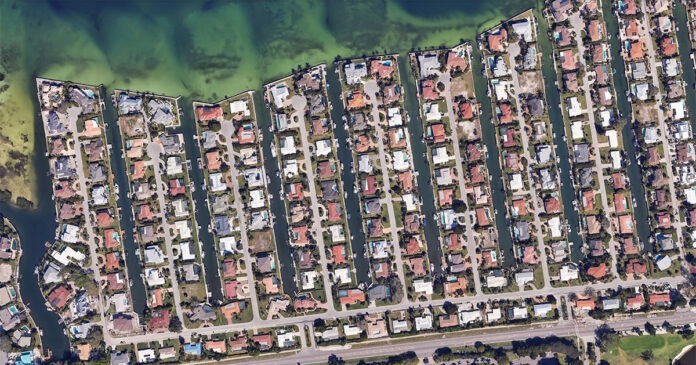
—On Florida’s West Coast, where multimillion-dollar real estate commands international attention, navigable water is the ultimate currency.
Now, for the first time since 2003, Longboat Key is staring down a massive $9 million overhaul of its 88 canals—a move that promises to cement the island’s status as a premier destination for elite homebuyers.
Although canal dredging may be mired in muck and mud, the proposed program represents a monumental victory for waterfront property owners. Given the uncertainty residents and boaters have felt for years regarding the navigability of the silt-laden canals, formalizing a maintenance plan changes the market calculus entirely. If passed, realtors and canal-front owners will at last be able to market their homes on a “town-maintained waterway,” offering buyers a critical guarantee: what is boatable today will be boatable tomorrow.
—A Wave of Island Momentum and Resiliency
The push for pristine canals arrives as Longboat Key rides a wave of historic civic momentum and recovery. Town Manager Howard Tipton has been busy shepherding major projects across the finish line while simultaneously navigating the aftermath of two of the worst storms to ever hit the region.
Storm recovery was an unprecedented undertaking for town staff and the community at large, requiring the removal of hundreds of thousands of cubic yards of debris and destroyed vegetation, navigating emergency permitting nightmares, and assisting residents whose homes were rendered unlivable. Today, Tipton says all the parks—including Durante Park—are opening, amenities are fully functioning, and Longboat Key is 100% recovered and stronger due to increased resiliency in construction.
That momentum extends beyond storm recovery. The town-wide undergrounding of utilities is completely finished. Additionally, the planned community center has morphed into a joint public library project with the county, expanded to include additional meeting space and an outdoor terrace for residents. The operations are fully funded, and construction is slated to begin this fall or early next winter.
For Tipton, who has been with the town for just over three years, the ability to see major initiatives cross the finish line makes the hard work worthwhile. “A bad day on Longboat is better than a good day in a county administrator position,” Tipton said.
Recognizing the economic stakes of the canals, the Town Commission has asked Tipton to explore short-term financing options to kickstart the dredging operations immediately, rather than waiting years for tax assessments to build up in reserve.
—The State of the Waterways: Muck, Red Tide, and Flood Control
—Through a series of town hall briefings, Public Works Director Charlie Mopps and consulting engineers from First Line Coastal have detailed exactly why the canals cannot wait.
“We’ve been kicking this can down the road quite a bit. It’s pretty flat; it’s not rolling anymore,” Mopps told residents. Decades of runoff have left some canals completely impassable at low tide, with recent town surveys handing out an alarming number of D and F grades for navigability.
Beyond property values, the shallow, muck-filled canals present severe environmental hazards. Nutrient-heavy “bio-loads” on the canal floors feed harmful algae blooms, and removing this sediment is a critical step in mitigating red tide.
Manager Tipton is highly focused on the public safety and infrastructure aspects of the project. He points out that for an island community, deepening the canals dramatically increases stormwater capacity. Having been on the front lines during recent hurricanes, Tipton noted that anything that expedites the removal of floodwater from the island out to the Gulf and the Intracoastal is paramount.
“It would also allow the Town to claim FEMA benefits and reimbursements since the town would be maintaining the canals,” Tipton added, solving a historical loophole that previously left the town footing the bill for storm-related canal debris.
—The $9 Million Question: The 80/20 Funding Split
—The core of the current debate centers on the proposed funding methodology, modeled after the town’s 80/20 beach renourishment split.
Under the plan, properties with “direct access” to the canals will shoulder 80% of the project’s cost. This includes an annual Equivalent Benefit Unit (EBU) flat assessment of $620, plus a minor ad-valorem millage rate. The remaining 20% will be funded by an island-wide ad-valorem tax, applying to non-waterfront properties, bayside condos, and commercial spaces. For a non-waterfront home assessed at $500,000, this town-wide millage equates to roughly $30 annually.
While some non-waterfront residents pushed back against paying for waterways they do not live on, town officials argue the 20% contribution reflects the shared, island-wide benefits of flood control and property value protection. After the initial five-year restoration phase, all assessment fees are projected to drop by half as the program shifts strictly into maintenance mode.
—National Lessons: How Other Coastal Communities Pay the Price
—While Longboat Key’s proposed 80/20 hybrid model is unique, the “mud and money” dilemma is a standard feature of coastal governance. Other premier waterfront enclaves across the country highlight the controversies and trade-offs inherent in municipal dredging.
—Cape Coral, Florida (The “Sticker Shock” Assessment): —With over 400 miles of canals, Cape Coral relies on Special Dredging Assessments levied on an as-needed basis for specific quadrants.
—The Pros: There is no recurring annual tax burden.
—The Cons: This creates massive “sticker shock.” Homeowners in older sections have recently been hit with sudden, one-time bills exceeding $10,000 per property.
—The Controversy: Cape Coral faces fierce environmental pushback regarding unfiltered runoff polluting protected natural resource areas and harming manatees.
—Punta Gorda, Florida (The “Slow Bleed” Utility Model): —In Punta Gorda Isles, dredging and seawall maintenance are treated as a recurring municipal utility, much like trash collection.
—The Pros: A recurring fee creates a predictable “slow bleed” rather than a sudden massive bill, allowing the city to maintain a permanent fleet of barges.
—The Cons: Residents shoulder 100% of the cost. Because there is no town-wide contribution, fees can be volatile when disasters like Hurricane Ian strike.
—Huntington Harbour, California (The Intergovernmental Tapestry): —Because the canals border protected wetlands, dredging is funded through a complex mix of County funds, State Coastal Conservancy grants, and Federal U.S. Fish & Wildlife support.
—The Pros: Shifts massive costs away from individual homeowners.
—The Cons: Projects are highly bureaucratic, sometimes taking a decade or more to approve and execute.
—Environmental Protections and a “Win-Win” Mitigation Plan
—Residents concerned about the impact of heavy dredging machinery on local marine life have been offered strict reassurances. By permit, every dredging barge must have a dedicated crew member whose sole responsibility is to monitor for manatees. Furthermore, specialized “turbidity curtains” will be deployed to trap clouded, muddy water within the construction zone.
Before major dredging can begin, environmental permits require the town to establish a 3-acre seagrass mitigation area, requiring 24,000 cubic yards of fill. In a brilliant cost-saving and infrastructure maneuver, the town plans to use the high-quality sand pulled directly from the canals.
“Another benefit of this program is to use some of the clean dredged material to fill the subaqueous pipe across the bay,” Tipton said. “It is a win-win project.”
To further offset the financial burden on taxpayers, the town is actively pursuing a $3 million federal appropriation through the Water Resource Development Act of 2026, with the support of Congressman Vern Buchanan and assistance from Representative Greg Steube.
—What’s Next: The Legislative Timeline
—The program is rapidly approaching its critical legislative hurdles. At the April 6 commission meeting, town officials gave formal guidance to proceed with the 80/20 methodology and move the program forward.
—The upcoming timeline:
• May 4: The first public hearing to formally set the assessment and millage rates.
• May 11: Mass informational mailings will be sent to every Longboat Key resident.
• June: A final public hearing.
—If officially passed, the assessments will appear on Longboat Key property tax bills in November 2026. If Town Manager Tipton is successful in securing short-term financing or federal grants, physical dredging operations could begin much sooner than the originally projected 2029 start date.

