
STEVE REID
Editor & Publisher
sreid@lbknews.com
Ask any charter captain on the Gulf Coast about the “Tax Man,” and the response is rarely printable.
“Man, I don’t know how you offshore charter boat captains deal with this shark problem every day,” one Bradenton-based captain recently vented on social media after a brutal day on the water. “I went offshore today and fished six spots… and got sharked on five of them. Probably lost 20-plus fish.”
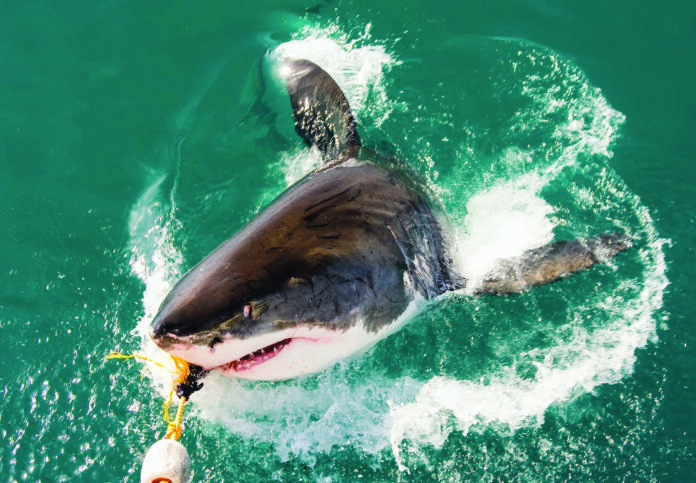
Another Jupiter-based captain, Ray Markham, described the visceral danger of the job: “I’ve seen 15-foot sharks—hammerheads, bulls, and others—that’ll take a tarpon out of your hand when you’re trying to unhook and release the fish.”
For the wealthy retirees and sportfishing enthusiasts of Longboat Key, this isn’t just a fish story—it’s an economic crisis. It’s the heartbreak of a 10-year-old kid reeling in a snapper only to find a severed head at the end of the line. It’s the “tax” paid in lost gear, lost trophies, and lost patience.
But that cycle of frustration and fatality may finally have a technological off-switch.
In a breakthrough study published this week in the Journal of Fish Biology, scientists at Mote Marine Laboratory have demonstrated that a small, electronic pulse device (EPD) can effectively “short-circuit” a shark’s desire to strike, reducing the likelihood of bait consumption by more than 45 times.
It is a discovery that promises to revolutionize the uneasy truce between human commerce and marine conservation, turning a lose-lose struggle into a win-win solution.
The Science of “Short-Circuiting” the Strike
The study, titled “Electronic pulse device deters and delays shark feeding in a depredation context,” moves beyond theoretical deterrents into proven behavioral modification.
The device tested, known as the ‘Shark Guard’ by FiskTek Marine, operates on a principle that exploits the shark’s own evolutionary advantage. Sharks possess highly sensitive electroreceptors—the Ampullae of Lorenzini—which they use to detect the faint electrical fields of prey. The Shark Guard emits brief, targeted electrical pulses that harmlessly overstimulate these receptors.
Think of it as a camera flash in a dark room: it doesn’t hurt, but it causes an immediate, instinctive recoil.
“We’re seeing that a short, controlled burst of electricity can make a big difference in shark behavior,” said Jack Morris, lead author and Senior Biologist in Mote’s Sharks and Rays Conservation Research Program. “It gives fishers precious seconds to reel in their catch and helping reduce conflict with these protected species.”
The data, gathered from 198 controlled trials at Mote’s Marine Experimental Research Facility (MERF) in Sarasota, is stark. When bonnethead sharks encountered bait protected by an active EPD, they were 45 times less likely to bite. Even when they did persist, they displayed “rapid withdrawal”—a sharp, startled turn away from the bait—delivering the crucial delay a fisherman needs to land their catch intact.
Economics Meets Ecology
For the residents of Longboat Key, where real estate values are inextricably linked to the health of the surrounding waters, this is more than a fishing story. It is an economic one.
Shark depredation—the technical term for sharks stealing catch—is a massive drain on the commercial and recreational fishing industries. When guides lose fish, client satisfaction drops. When commercial fleets lose catch, they must fish longer and harder to meet quotas, putting extra pressure on fish stocks.
“Mitigating depredation will obviously benefit people who are fishing,” notes Dr. Demian Chapman, Director of Mote’s Sharks and Rays Conservation Research Program. “But it will also benefit sharks because it will ensure that the strong public support that we see for shark conservation doesn’t erode over time.”
As shark populations in the U.S. Atlantic begin a slow, celebrated recovery after the overfishing of the 1980s and 90s, encounters are increasing. Without non-lethal deterrents, the old animosity toward sharks risks returning. This device offers a way to maintain biodiversity without sacrificing the catch.
A Legacy of Innovation
This breakthrough is deeply rooted in Mote’s DNA. As the only Congressionally designated National Center for Shark Research, Mote is building on nearly 70 years of inquiry that began with the legendary “Shark Lady” herself, Dr. Eugenie Clark.
In the 1970s, Clark stunned the scientific world by discovering that the Red Sea Moses sole released a natural chemical that repelled sharks. Later, former Lab Director Dr. Perry W. Gilbert developed the “Shark Chaser” deterrent for the U.S. Navy.
“Dr. Gilbert and Dr. Clark showed the world that sharks could be studied, understood, and even deterred safely,” Morris said. “Our research continues that same spirit.”
The Next Step
The success of the bonnethead trials is just the beginning. Mote researchers are now planning to expand testing to real-world settings, partnering with fishing guides and commercial crews to see how the technology holds up in the open Gulf.
If the results hold, the tackle box of the future may look very different. Instead of just hooks and sinkers, it might include a small electronic guardian—a device that ensures the fisherman keeps his dinner, the shark keeps its life, and the delicate balance of our blue backyard remains intact.

