
—Here on the barrier islands, the illusion of insulation is one of our most cherished local commodities. We watch the Gulf tides shift and trust that the manicured quiet of Longboat Key will remain untouched by the world’s noisier calamities. But there is a predatory force currently bleeding the domestic economy dry, and it requires no passport to reach our shores. It is the arithmetic of a war that has no goal, no ending, and no basic economic sanity.

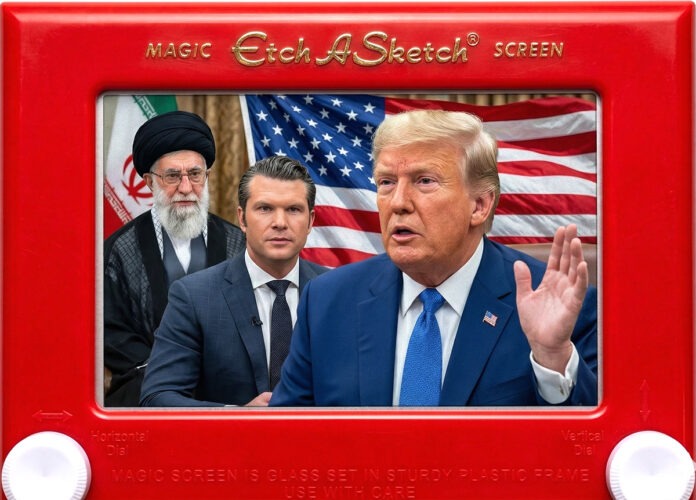
While the President shakes the reasons for this Iranian adventure like a child’s Etch-a-Sketch—one day thumping his chest about regime change, the next muttering about “back-channel negotiations”—the American taxpayer and the global markets are being buried under the debris of his shifting rationales. This is not just a strategic quagmire; it is a full-scale assault on the domestic economy. And for a President who campaigned so vociferously on an “America First” platform of keeping the republic out of endless foreign entanglements, this catastrophic expedition is fast becoming an “America Last” betrayal.
The traditional, fiscal-conservative Republican base—the very voters who pulled the lever to stop the hemorrhaging of the national treasury—are watching in horror as the President goes to Congress, hat in hand, demanding a staggering emergency supplemental allocation to fund a war without a compass. It is a profound political and economic betrayal, and the receipts are arriving daily.
—The Math of Asymmetric Absurdity
—If one wishes to understand the pure, uncut folly of this conflict, do not look to the Pentagon’s sanitized press briefings. Look at the ledger. In a classified briefing in mid-March, military officials confessed to lawmakers that the United States incinerated over $11.3 billion in just the first six days of the conflict. At the onset, the burn rate was a dizzying $2 billion per day, which has since “stabilized” to roughly $1 billion every 24 hours.
But the true absurdity lies in the margins of asymmetric warfare. The United States is currently defending against and retaliating against Iranian Shahed-136 drones. A single Shahed drone, effectively a flying moped with explosives, costs Tehran roughly $34,000 to produce. To knock it out of the sky or strike its launch site, the U.S. Navy is firing Standard Missile-6 (SM-6) interceptors that cost up to $4.9 million apiece, and Tomahawk Block V cruise missiles carrying price tags of up to $3.6 million each.
We are using a multi-million-dollar sledgehammer to kill a thirty-four-thousand-dollar fly. No nation, no matter how vast its treasury, can sustain that ratio of mathematical suicide without plunging its own economy into the abyss.
—The Transubstantiation of Patriotism at the Pump
—The immediate domestic tax for this unforced error is being collected at the gas station. On March 4, the de facto closure of the Strait of Hormuz froze 20 million barrels of crude oil per day—roughly 20 percent of global consumption. The transubstantiation of hollow patriotism into pain at the pump was instantaneous.
The national average for a gallon of regular gasoline has spiked 30 percent in a month, hitting $3.97, the highest since 2023. But the true killer is diesel. Up nearly 50 percent, diesel is the lifeblood of the American supply chain. Because 85 percent of U.S. agricultural goods move by truck, this $1.69-per-gallon surge is a direct, unavoidable tax on every cart of groceries purchased in Sarasota and beyond. Jet fuel has more than doubled, forcing carriers like United Airlines into an emergency posture of slashed flight schedules and skyrocketing fares.
—Supply Chain Shocks and the Market’s Verdict
—Beyond the petroleum panic, the conflict has severed the arteries of modern technology and agriculture. As the spring planting season arrives, U.S. farmers are staring down a catastrophic fertilizer shortage. One-third of the global urea trade passes through the Middle East, with the U.S. importing 20 percent of its supply directly from Qatar.
Simultaneously, Iranian strikes forced the shutdown of Qatar’s Ras Laffan industrial complex. Because Qatar is the world’s second-largest producer of helium, this is not merely a regional crisis—it is a direct blow to the manufacturing of semiconductor chips powering global AI, not to mention aerospace and medical MRIs.
The financial masters in New York and London have rendered their verdict, and it is grim. Global stock markets have spent the last month violently shedding value, recognizing this war not as a calculated geopolitical maneuver but as an erratic, inflationary gamble. The flight to safety has been chaotic. The 10-year Treasury yield has spiked, placing severe upward pressure on mortgage rates and effectively strangling the spring home-buying season in its crib.
Perhaps most illustrative of this chaos is the flight to safety that isn’t. In a normal geopolitical crisis, the gold market is the harbor of choice for terrified capital. Not this time. Since the war began, gold has paradoxically plummeted, trading not as a safe haven but as a volatile “risk asset”—shedding nearly 15 percent of its value in a matter of weeks. The markets recognize that this war is not a standard strategic play but an existential threat to the stability of the global system itself. Even the World Trade Organization (WTO) has sounded the alarm, warning that sustained energy prices could shave 0.3 percent off global GDP growth this year.
—A Delusion Sold to the Base
—The macroeconomic fallout is clear: we are welcoming a vicious wave of “second-order” inflation. As the costs of shipping and fuel bleed into everyday consumer goods, the 3 percent inflation the U.S. was finally taming is poised to roar back to life.
Yet, the President continues to try and sell this Etch-a-Sketch strategy to the American people as a necessary defense of the free world. It is a pitch that rings increasingly hollow to a Republican base that was promised a departure from the neoconservative nation-building of the past two decades. They were promised borders, domestic prosperity, and a focus on the home front. Instead, they have been handed a trillion-dollar tab for a sandbox skirmish that achieves nothing but the enrichment of defense contractors and the immiseration of the American consumer.
The historical parallel is damning. We are repeating the hubris of past decades, but executing it with a financial recklessness that is entirely modern. America is not being made great; it is being made deluded again. And the proof is not in the rhetoric out of Washington, but in the arithmetic at the gas pump, the tumbling global equities, the paradoxical plunge in gold, and the multi-million-dollar missiles fired into the void.
The President can shake the toy all he wants. The bill is already in the mail.

