
—Over the past decade, the City of Sarasota has aggressively approved thousands of new residential condominium units, fueling unprecedented congestion.
In a twist of irony, Sarasota City Hall is trying to slow things down, citing “safety and livability” as the impetus.
For those who live on Lido Key, Bird Key, or along the downtown waterfront, the city’s sweeping initiative is officially dubbed the Traffic Calming Plan (TCP). But for many, that name is merely a euphemism for adding concrete structures in the roadway and slashing speed limits on an already tiresome and beleaguering journey to the beach or downtown. For frustrated commuters, it feels like an ironic antidote prescribed by a city that failed to manage the impacts of its explosive downtown growth.
Make no mistake: some of Lido Key’s and downtown Sarasota’s most desirable neighborhoods will be heavily impacted by these changes.
—What the City is Planning—
At its core, the TCP is an effort by the city’s Engineering and Transportation Planning Divisions, in collaboration with the Sarasota Police Department, to physically alter driver behavior. The strategy includes a two-pronged approach:
• Slashed Speed Limits: Following a recent speed study, the city plans to drop posted speed limits to a crawling 20 MPH on local roadways (where existing average speeds are currently 20 MPH or below) and cap non-local roadways at 35 MPH.
• Physical Roadway Alterations: To force drivers to comply, the city plans to install horizontal and vertical deflections. This means navigating new roundabouts, speed tables, raised intersections, and median islands designed to narrow street widths and restrict routing.
—The Double-Edged Sword: Safety vs. Gridlock—
Traffic calming is a highly debated topic. While City Hall champions the potential benefits—noting that slower, narrower streets lower the likelihood of severe accidents and create a more inviting environment for pedestrians—a look at how these measures have played out in other municipalities reveals a more complicated reality.
—The Unintended Consequences—
• Emergency Response Delays: This is the primary concern for first responders nationwide. Studies show that a single speed table or hump can delay a fire truck or ambulance by up to 10 seconds—critical time during cardiac events or rapidly spreading fires.
• The “Spillover” Effect: When main thoroughfares become bogged down with speed tables and lowered limits, frustrated drivers often reroute through adjacent, previously quiet residential streets, a phenomenon known as “rat-running.”
• Vehicle Wear and Noise Pollution: Vertical deflections cause constant braking and accelerating, increasing wear-and-tear on vehicle suspensions. Furthermore, the noise generated by heavy vehicles braking and hitting speed tables can actually increase noise pollution for the homes located immediately next to them.
—Is Your Neighborhood on the List?—
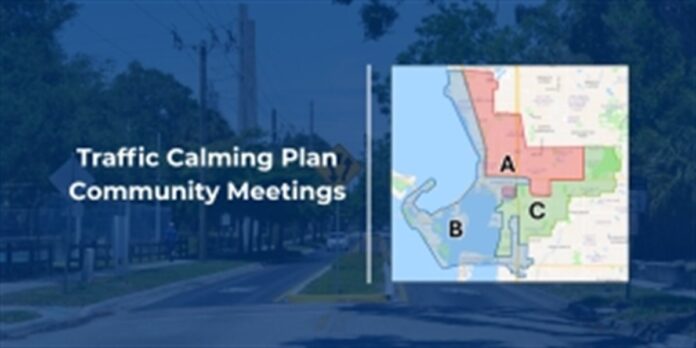
The City is rolling out a phased approach to these changes, but community pushback or support will shape the final maps. The city has been divided into zones for public meetings, and for Longboat Key News and Sarasota City News readers, Area B is ground zero.
If you live in or travel through Area B, your driving habits are on the line. The following associations and communities are directly in the crosshairs of this plan:
• Bay Island Siesta Association
• Bird Key Improvement Association
• Downtown Sarasota Condo Association
• Golden Gate Point Association
• Harbor Acres Community Association
• Indian Beach-Sapphire Shores Association
• Lido Key Residents Association
• Lido Shores Property Owners Association
• Plymouth Harbor Residents Association
• St. Armands Residents Association
• Tahiti Park Neighborhood Association
• South Poinsettia Park Neighborhood
• Other residents living within Area B
• Businesses within Area B
—Make Your Voice Heard: When and Where to Show Up—
The most critical meeting for our readership is rapidly approaching. The city will present the Draft Neighborhood Traffic Calming Map for Area B and host an interactive map review.
Area B Community Meeting Details:
• When: Wednesday, March 18, 2026 | 5:00 p.m. – 6:30 p.m. (Presentation begins at 5:25 p.m.)
• Where: Senior Friendship Center, 1888 Brother Geenan Way, Sarasota, FL 34236
(Note: The city is also holding meetings for Area A on March 24 and Area C on March 26, but Area B covers the critical downtown and island corridors).
—How to Submit Comments—
If you cannot attend the March 18 meeting in person, the city is accepting feedback online and by mail. All comments must be received or postmarked by April 17, 2026, to be included in the formal meeting record.
• Email: Corinne.Arriaga@sarasotafl.gov
• Mail: City of Sarasota, Attn: Corinne Arriaga, Project Manager, 1761 12th Street, Sarasota, FL 34236
• Online: Visit www.SarasotaFL.gov/TrafficCalmingPlan
With the April deadline looming, residents who navigate the bridges and downtown corridors daily will need to decide if the city’s cure for congestion is worse than the disease.

