
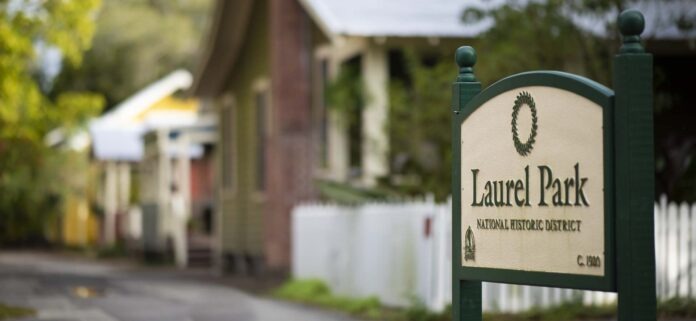
—The ongoing tug-of-war for Sarasota’s soul was on full display at City Hall this week, crystallized in the fate of a modest, 1930s bungalow.
On one side: the relentless march of high-end redevelopment and the sacred cow of private property rights. On the other: desperate preservationists wielding a metaphor about a fragile “pile of sticks.”
Ultimately, the bulldozers won.
In a 4-1 vote on March 23, the Sarasota City Commission approved the demolition of 1668 Oak Street, a single-family home currently functioning as a multi-unit rental. The property sits on the southern edge of the Laurel Park National Historic District. While the house itself lacks individual historic designation, it was officially listed as a “contributing structure” when the neighborhood earned its national district status in 2008.
For property owner and renowned architect Todd DeGarmo, tearing down the structure paves the way for a new, thoughtfully designed home that complies with the neighborhood’s strict overlay rules. But for local preservationists, the demolition represents a dangerous precedent—a signal that developers can chip away at the city’s historic fabric, one contributing structure at a time.
—“Clear as Mud”
—The debate exposed a glaring flaw in Sarasota’s municipal code: the rules governing the demolition of contributing structures are, in the words of legal counsel Jay Daniel, “clear as mud.”
Because the bungalow is not locally designated as a historic landmark—a status that comes with ironclad protections—the Commission was forced to rely on a murky set of criteria derived from a 2024 memo by former City Attorney Robert Fournier. The memo asked commissioners to determine if “reasonable measures” had been taken to save, sell, or relocate the structure before resorting to the wrecking ball.
Charlie Bailey, the land use attorney representing DeGarmo, argued that his client had exhausted all reasonable options. The lot’s strict 35% coverage limit makes expanding the current footprint nearly impossible, the property operates at a financial loss as a rental, and a recent attempt to relocate the house to a nearby vacant lot fell through at the last minute.
“I’m not a developer. This is a house for myself,” DeGarmo told the Commission. “If I was building this for profit, I would not do the project this way.”
—A 40-Minute Procedural Sideshow
—Before the architectural merits of the house were even debated, the meeting devolved into a fiery, 40-minute procedural dispute over who actually had the right to challenge the demolition.
Ron Kashden, representing the Laurel Park Neighborhood Association, filed for “Affected Party” status to cross-examine witnesses. Bailey fiercely objected, noting that Kashden’s paperwork contained a typo (listing the address as 1688 instead of 1668) and that Kashden, a board member, had authorized himself to represent the association rather than securing the President’s signature as dictated by the group’s bylaws.
“I know the applicant would rather me not have affected party status because that would give me the ability to both rebut as well as cross-examine,” Kashden fired back. “I just respectfully ask that you not rewrite your standards for affected parties on the fly right now.”
Resident Martin Hyde captured the absurdity of the bureaucratic infighting during public comment. “There is a certain irony that you spent 40 minutes discussing whether to give someone an extra two minutes to speak,” Hyde said. “It all feels rather heavy-handed, doesn’t it?… The appellant is using every means possible to get the outcome his client wants.”
The Commission ultimately voted 3-2 to grant Kashden his status, but only after pausing the meeting so Kashden could frantically procure an email from the association’s president.
—A “Dubious” Record
—The tension wasn’t limited to the public podium. A rare public clash occurred between Bailey and Historic Preservation Senior Planner Susan Dodd over the very legitimacy of the home’s historic status.
During his presentation, Bailey claimed Dodd’s staff report characterized the home’s inclusion in the historic district as “dubious,” pointing out that early surveys from 1988 and 2003 deemed the property ineligible for historic designation.
Dodd immediately took to the microphone to correct the record, stating she wrote the word “irregular” in her report, not “dubious”. However, following a recess, Dodd had to return to the microphone for a sheepish retraction.
“I wrote ‘irregular’ in my writing, but Mr. Bailey is correct. I used ‘dubious’ in speaking at the [Historic Preservation Board] meeting,” Dodd admitted. “That is why I should not be allowed to go off script.”
—The Pile of Sticks
—Beyond the procedural drama, the hearing underscored a philosophical divide over Sarasota’s future. Commissioner Kyle Battie noted that the city’s real estate culture has fundamentally changed from a place where families buy homes to live in, to a market where buyers “demo it and put what they want there.”
Erin DiFazio, Managing Director of the Sarasota Alliance for Historic Preservation, urged the Commission to hold the line. “When purchasing a historic home that contributes to a National Historic District, it is reasonable to anticipate that you may face some resistance should your goal be to scrape the lot in search of profit,” she said.
Commissioner Jen Ahearn-Koch, who cast the lone dissenting vote against the demolition, used a poignant metaphor to describe the fragility of the city’s historic neighborhoods.
“A historic district is like a pile of sticks,” Ahearn-Koch said. “The pile is only there because there are individual sticks that make up that district. When you start taking away the sticks, the pile falls apart… Where do we draw the line?”
For now, the line has been drawn around 1668 Oak Street, and the bulldozers have been cleared to roll in.

