
—If you read the Town of Longboat Key’s newly released 2025 Annual Report, you might think the last twelve months were a breezy stroll down the beach. Framed under the banner of “Premier Community, Exceptional Service,” the 34-page document reads like a glossy municipal brag book, touting flat taxes, soaring property values, and seamlessly executed infrastructure upgrades.
But peel back the glossy cover, and a much grittier story emerges.
Behind the town’s victory lap lies a year defined by brutal hurricane hangovers, bitter neighbor-vs.-neighbor tax fights, a near-disastrous $33 million sewer crisis, and a high-profile showdown with an ultra-luxury resort. The town survived 2025, but it required bleeding its financial reserves, fending off state mandates, and asking voters to take on massive debt.
Here is the real story of Longboat Key’s last twelve months—the triumphs, the controversies, and the multimillion-dollar battles missing from the brochure.
—The Hurricane Hangover: Drained Reserves and the Spanish Main Nightmare
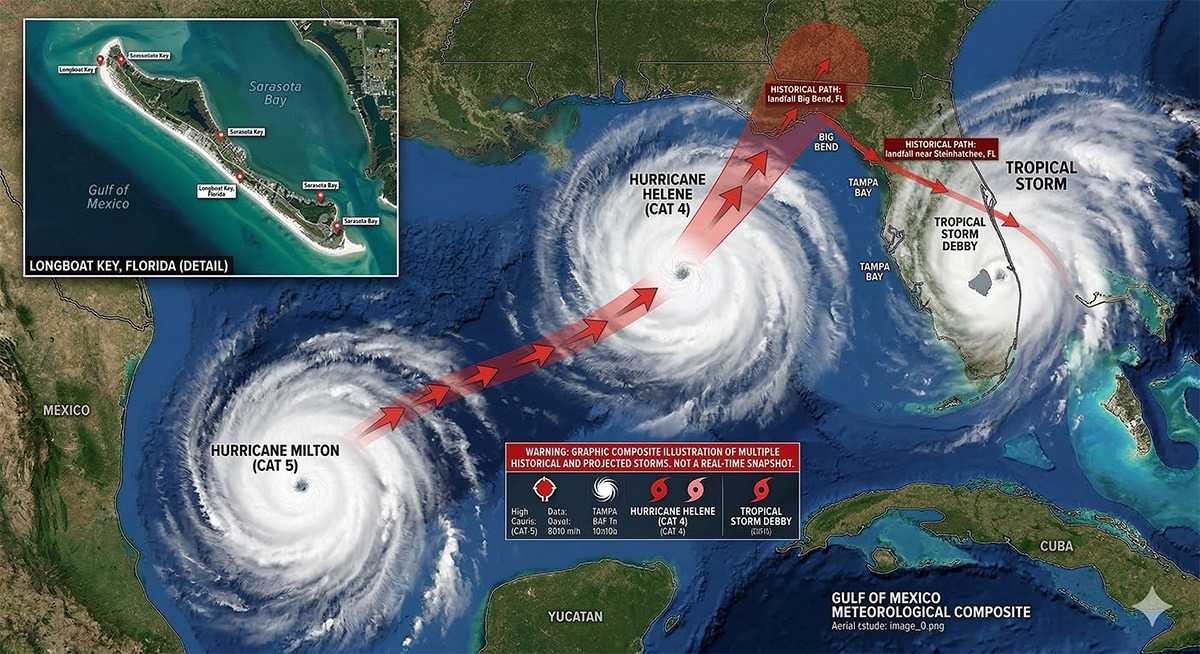
—The Annual Report briefly mentions the town’s “hurricane recovery” efforts following the devastation of Debby, Helene, and Milton. What it doesn’t highlight is the massive $8.2 million the town was forced to drain from its financial reserves to keep the island functioning.
Town Manager Howard Tipton called the staff’s cleanup efforts “Herculean,” noting the town paid $151,000 in overtime for Hurricane Milton alone. Debris removal cost a staggering $4.3 million. And while the town has requested $6 million in FEMA reimbursements, those checks haven’t arrived. So far, the town has only recouped $1.7 million from insurance.
But the truest symbol of the island’s ongoing trauma isn’t at Town Hall; it’s inside the Spanish Main Yacht Club.
Sixteen months after Helene’s storm surge ravaged the 212-unit condominium villa subdivision, the neighborhood remains a chaotic construction zone. The community made headlines when remediation company Servpro hit them with an eye-watering $13.5 million bill—amounting to $63,000 per unit—and placed a lien on the entire community.
While the lien was finally settled in November 2025, the scars remain. Desperate residents entertained offers from developers to buy out the whole neighborhood, and dozens of villas that once sold for over $500,000 have been offloaded at steep discounts.
—The $33 Million Flush: Voters Avert a Utility Disaster
—The Annual Report happily points out the town’s $19.2 million federal grant to replace its Subaqueous Wastewater Force Main—a 50-year-old pipe running 2.8 miles under Sarasota Bay.
What the report glosses over is the sheer panic that preceded it.
The project was born out of a 2020 disaster, when the decaying pipe ruptured, spilling 14 million gallons of raw effluent into the bay and triggering a strict Florida Department of Environmental Protection consent order. Initially estimated at $21.9 million, inflation and construction costs caused the price tag to violently balloon to $33 million.
Facing a financial cliff, the town was forced to put a referendum on the March 2025 ballot, begging voters to authorize a low-interest (2.89%) State Revolving Fund loan. If voters had said no, the town would have been forced to issue revenue bonds at over 5% interest, potentially inflating the project cost to a staggering $58.5 million and forcing a massive hike in residents’ water bills.
Voters overwhelmingly approved the loan (94.7%), dodging a fiscal bullet and allowing the massive dig to finally move forward.
—The Canal Class War: Who Pays for the Mud?
—Longboat Key is currently engaged in a bitter class war over mud.
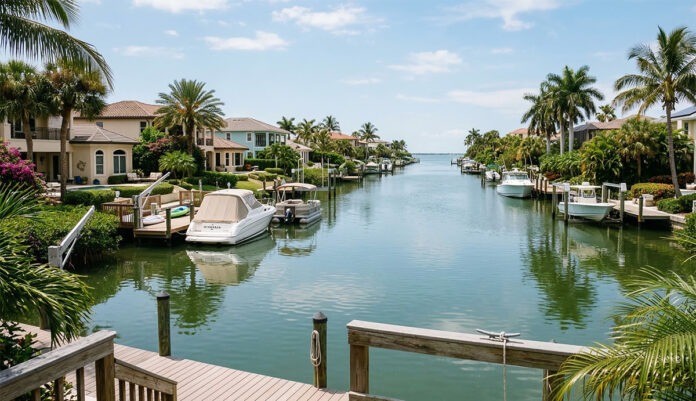
The town’s canals haven’t been properly dredged since 2003, and recent surveys revealed that more than half of the 88 canals earned a grade of C or below, with some so choked by silt that boats are getting trapped on their lifts.
Public Works Director Charlie Mopps managed to slash the initial $17 million dredging estimate down to a $9 million baseline project. But the controversy isn’t about the dredging; it’s about who pays for it.
The proposed funding model, which the Town Commission will vote on in May 2026, forces property owners with direct canal access to cover 80% of the cost via a flat $620 annual fee. But the remaining 20% will be funded by an island-wide ad-valorem tax—meaning condo owners who don’t live on the water and don’t own boats will be forced to subsidize the dredging.
“As a practical matter, I, as a non-canal-homeowner, can only access those canals by boat. I don’t have a boat,” argued resident Trish McDonald. “Is it fair for me to have to assume 20% of the cost?”
Canal-front homeowners have quickly fired back, pointing out that beach renourishment is funded by everyone on the island, even though public access to the private, condo-lined beaches is notoriously restricted.
—Culture Wars: The St. Regis Arch and “Gulf of America Drive”
—Beyond infrastructure, the Town Commission spent late 2025 embroiled in massive fights over the island’s identity.
The most contentious local battle was waged against the ultra-luxury St. Regis Longboat Key Resort. Developers installed a massive, Instagram-ready stainless steel arch on a converted beach groin extending into the Gulf. They didn’t get a town permit, arguing a state DEP permit was sufficient and claiming the structure was a “memorial” for weddings, not a sign.
The town ordered it torn down in August. But following heavy lobbying by St. Regis developer Chuck Whittall, the Town Commission stunningly flip-flopped in December. In a narrow 4-3 vote, they directed staff to rewrite the town’s famously strict sign code to accommodate the resort.
The decision infuriated residents. “Our citizens hate signage,” argued dissenting Commissioner B.J. Bishop. “Our beach is one of those glorious, protected, quiet places where people can be on the beach and enjoy peace and quiet without any commercialization.”
But while the town caved to the St. Regis, they successfully went to war with the state government.
Following a federal push to rename the Gulf of Mexico to the “Gulf of America,” the Florida Department of Transportation began removing signs on the island’s main thoroughfare, State Road 789. Refusing to bend the knee to Tallahassee, the Town Commission voted unanimously in October to retain the historic “Gulf of Mexico Drive” name.
Mayor Ken Schneier noted that changing 5,140 addresses would be a costly administrative “disaster” for condo owners and local businesses. He successfully forced FDOT to back down, proving that while Longboat Key might compromise with luxury developers, they draw a hard line at state overreach.
Ultimately, the 2025 Annual Report is technically accurate: Longboat Key did keep its millage rate flat, crime remained virtually non-existent, and historic infrastructure projects are breaking ground. But the clean, corporate formatting of the report hides the sheer political and financial knuckle-brawling it took tAo get there. It wasn’t just a year of “Exceptional Service”—it was a year of survival.

