
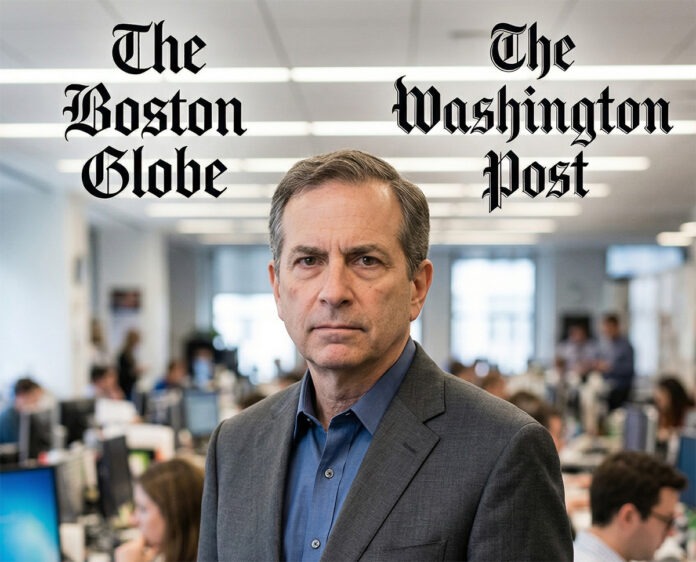
—For decades, Marty Baron stood as the towering figure of American journalism, a quiet but fiercely resolute editor who steered the nation’s most storied newspapers through an era of profound technological disruption and political turbulence. He never hesitated in speaking truth to power.
But last Wednesday, speaking to a sold-out crowd of 204 attendees at the Sarasota Yacht Club under the sponsorship of the Longboat Key Democratic Club, the former executive editor of The Washington Post, The Boston Globe, and The Miami Herald delivered a stark, deeply personal warning about the survival of the American republic.
“I no longer assume that the constitutional order will hold,” Baron told the hushed room. “That the rule of law will prevail. That free expression – not just for the press, but for all Americans – will endure.”
Baron, who grew up in nearby Tampa, is perhaps best known to the public as the editor who spearheaded the Boston Globe “Spotlight” team’s investigation into the Catholic Church’s sex abuse scandal—a role immortalized by Liev Schreiber in the 2015 Academy Award-winning film. Later, under his 11-year stewardship, The Washington Post won 11 Pulitzer Prizes, exposing everything from government surveillance programs revealed by Edward Snowden to the vulnerabilities of the American electoral system.
Yet, looking back at a career that began in the 1970s—an era defined by the press’s role in uncovering the Pentagon Papers and Watergate—Baron confessed a profound shift in his outlook. He is no longer certain the institutions he spent his life defending can withstand the current political siege.
“In the decades since those revelations, I – probably like most of you – took for granted that we would always have a free press in this country: That the First Amendment would guarantee it,” Baron said. “I no longer take any of that for granted.”
—The Erosion of Truth and the Authoritarian Playbook
At the heart of Baron’s address was the alarming disintegration of a shared American reality. He warned that the nation has lost its grip on the Enlightenment principles of education, expertise, experience, and evidence.
“How can democracy flourish, or even survive, when we can’t determine the most basic facts?” Baron asked, pointing to the persistent falsehoods surrounding the 2020 election and the demonization of federal workers and protesters. “Every one of those factors is now being devalued, denigrated or denied.”
Drawing on his experience training journalists in Bogotá, Colombia, and his close ties with independent reporters in Hungary, Baron laid out the parallels between foreign democratic backsliding and the current climate in the United States. He explicitly cited Hungarian Prime Minister Viktor Orbán’s systematic dismantling of independent media as the blueprint now being deployed domestically.
“Trump took Orbán’s playbook, and is running with it,” Baron asserted. He detailed how government pressure and billionaire capitulation are working in tandem to muzzle critical reporting. He pointed to the Federal Communications Commission under Brendan Carr, which he accused of leveraging regulatory power to exact political favors.
Baron recounted the recent merger of CBS owner Paramount with Skydance, heavily financed by Republican megadonor Larry Ellison, as a prime example of corporate buckling. Following a $20 billion lawsuit threat from the president over a “60 Minutes” interview, Paramount settled for $16 million. Shortly after, the merger was approved, unexperienced loyalists were installed at CBS News, and late-night host Stephen Colbert’s show was abruptly canceled.
Quoting Colbert’s own apt observation before his cancellation, Baron noted: “The deal ‘has a technical name in legal circles: It’s big fat bribe.’”
—A “Recklessly Self-Inflicted” Disaster at The Post
The most riveting and emotionally charged segment of Baron’s speech centered on his former employer, The Washington Post, and its billionaire owner, Jeff Bezos. Baron praised Bezos’s initial decade of ownership, noting that the Amazon founder “admirably defied Trump” and provided the investment necessary to turn a financially failing paper into a profitable, cutting-edge powerhouse.
But the tone shifted drastically as Baron addressed Bezos’s recent actions, particularly the decision to kill the paper’s presidential endorsement of Kamala Harris just 11 days before the 2024 election.
“For 16 months now, he has been cozying up to the president in various distasteful ways. I believe the reason is easy to identify: He fears vengeance,” Baron stated bluntly, noting Amazon and Blue Origin’s heavy reliance on lucrative federal contracts.
The fallout, Baron explained, has been catastrophic for the institution he once led.
“Trust in The Post declined. Readership and subscriptions collapsed. Top talent fled,” he said, detailing the recent slashing of the newsroom staff by at least 40 percent, the elimination of the sports department and staff photographers, and the evisceration of the foreign desk.
“This was, as I said at the time, ‘among the darkest days in the history of one of the world’s greatest news organizations,’” Baron lamented. He castigated Bezos for a series of “dreadful decisions,” from attending the inauguration to reorienting the opinion pages to appease the current administration.
“Today, the editorials themselves lack moral fiber. Criticism of Trump is typically muted. His worst abuses are often overlooked, no doubt deliberately,” Baron said. “Never before had I seen brand destruction so rapid, so complete and so recklessly self-inflicted… People ask me: Where did that man go? Honestly, I have no idea. Perhaps ‘missing person’ posters might be helpful.”
—The Criminalization of Journalism
Beyond corporate capitulation, Baron warned of direct, unprecedented legal and physical threats to journalists. He pointed to the Trump administration’s active groundwork for prosecutions, noting former Attorney General Pam Bondi’s removal of constraints on obtaining reporters’ records.
“Expect the Justice Department to regularly pursue reporters’ phone records and emails, and to petition courts to order reporters to divulge their sources,” Baron warned. “Since journalists are unlikely to do that, expect the DOJ to request that they be jailed.”
He cited the chilling mid-January FBI raid on the home of Washington Post reporter Hannah Natanson—the first time the federal government has ever searched a reporter’s home in a national security investigation—and the unprecedented arrest of independent journalists Don Lemon and Georgia Fort while documenting a protest in Minnesota.
“Never before have the federal laws the government cited in this case been deployed against journalistic activity. The administration was criminalizing journalism,” he said.
—Finding Optimism in the Arc of History
Despite the grim landscape, Baron concluded his talk with a surprising pivot toward optimism, grounded in the long, often turbulent history of the American press.
He reminded the Longboat Key audience that efforts to silence the press are as old as the nation itself, from the shuttering of the first American newspaper in 1690 to John Adams’s Sedition Act in 1798, and Woodrow Wilson’s Espionage Act during World War I. Time and again, he noted, the American public eventually rose up against these suppressions.
Quoting the Nobel Peace Prize-winning cardiologist Bernard Lown, Baron said: “‘Only those who see the invisible can do the impossible.’ In other words, what we can’t see can be envisioned. What seems impossible can be achieved.”
He urged his fellow citizens to remember that the core function of the press—as envisioned by James Madison—is the “right of freely examining public characters and measures.” Journalists, Baron insisted, are not stenographers; they are investigators bound by duty to look behind the curtain.
“Vigilance of public officials is, above all, the task democracy imposes on every journalist. If a free and independent press is to survive, holding our public officials to account is a mission we can never forsake,” Baron concluded, turning his final appeal to the attendees in the room.
“And by ‘we,’ I also mean the public, our fellow citizens. Nothing will matter more to the future of a free press than your support for our work. I hope we can count on it.”
—Blake Fleetwood is a former investigative reporter for the New York Times. He has also written for the NYT Magazine, Wall Street Journal, NY Daily News, USA Today, Huffington Post, The Washington Monthly, The Boston Globe, Real Clear Politics, and The Hill.


All this dribble, from the guy who champions FAKE NEWS and it’s censoring.
One only need look, at how the demonrat press covered up the RUSSIA HOAX, Barry Obama’s Role and the declining mental state of Brandon. They actually gave themselves awards, for conspiring with the party liars.
Fake News cowards were all in, with not reporting on Illegals voting, Fake mail in ballots along with Judges and prosecutors who didn’t follow the laws.
Now they have contempt, when the likes of Elon Musk have made it possible to expose these FAKES in a FREE PRESS.
Joe Biden AKA Brandon quote, “We choose Truth Over Fact’s”.