
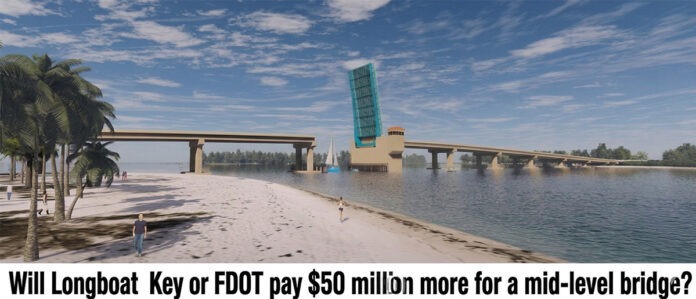
—For the residents of Longboat Key, Florida, the aging 1957 drawbridge spanning Longboat Pass is more than just transportation infrastructure; it is a gateway that physically and symbolically defines their quiet, low-profile barrier island. But for the Florida Department of Transportation (FDOT), it is a structurally deficient liability (with a sufficiency rating of just 42 out of 100) that is long overdue for a cost-effective, low-maintenance replacement.
The resulting standoff has pitted the town against the state. FDOT intends to replace the aging bascule (drawbridge) with a towering, 78-foot-high fixed-span structure stretching nearly a mile. The town of Longboat Key and neighboring Bradenton Beach are fiercely opposing the state’s vision, begging instead for a 36-foot mid-level drawbridge.
As FDOT concludes its Project Development and Environment (PD&E) study, the dispute begs the question: Is the state genuinely considering the town’s pleas, or just politely absorbing the criticism while marching toward its preferred, cheaper alternative? And looking across Florida and the nation, what does it actually take for a state DOT to change its mind?
—The Standoff: Aesthetics vs. Economics
—FDOT’s preference for the massive fixed-span bridge comes down to simple math and engineering simplicity. A high-span fixed bridge will cost approximately $138 million upfront. Replacing the span with a mid-level drawbridge is estimated to cost between $184 million and $194 million. By pushing for a fixed span, FDOT saves between $38 million and $56 million in capital construction, completely removes the perpetual salaries of 24/7 bridge tenders, and drastically reduces mechanical maintenance costs for the 75-year life of the bridge.
However, residents argue the true cost will be paid by the community. Local resident James G. Haft summarizes the island’s frustration, noting that the state’s plan “would destroy the character of the Longboat Key Inlet,” and that “the primary (and perhaps only) reason for a fixed bridge is cost.”
Longboat Key leaders and residents argue that a 78-foot mega-structure will fundamentally ruin the island’s character. Town Commissioner BJ Bishop has been highly critical of the design, warning her colleagues and state representatives that the proposed span “will look like a black diamond hill at a ski resort. It will not be pedestrian or bicycle friendly and quite unsightly.”
Beyond aesthetics, residents fear for safety and utility. Maureen Merrigan, a resident who frequently bikes the bridge, expressed deep concerns to FDOT over the physical demands of the structure:
“The taller bridges are much more dangerous due to the natural acceleration of bikes (electric and manual) and scooters going over the bridge… We have an older community and the tallest bridge being proposed is not conducive at all to an older resident’s activity and fitness level – and will be less safe.”
Furthermore, the engineering itself is under heavy local scrutiny. FDOT claims the fixed-span bridge will have a manageable 4.5% maximum slope. However, residents like Vassyl A. Lonchyna and James G. Haft have challenged these calculations directly to the Town Commission, arguing that the true slope will be much steeper—closer to 6.5%—unless the roadway approaches are extended substantially.
Assistant Town Manager Isaac Brownman has attempted to quell these fears, explaining that because the navigable channel is far to the north, “much of the bridge slope on the Manatee County side will be over land as the grade comes back down,” allowing for a longer run-up and a shallower 4.5% grade. Still, skepticism remains high.
—Is FDOT Just Going Through the Motions?
—Despite public hearings and strongly worded letters from the Longboat Key Town Commission, many residents feel their input is being ignored. Merrigan’s letter to FDOT captured a growing local cynicism: “I know you are only the messenger here, not the final decision maker, but does FDOT really want feedback, as it seems it is falling on deaf ears for this project?”
One only has to look a few miles north to the Cortez Bridge for the answer. For years, the community surrounding the Cortez Bridge fought FDOT over identical issues, pleading for a drawbridge to replace their functionally obsolete 1956 span. FDOT absorbed the criticism, outlasted legal challenges, and recently finalized the design for a 65-foot fixed-span bridge.
FDOT’s mandate is statewide efficiency, safety, and hurricane evacuation reliability. Without a legal or structural roadblock, FDOT appears to be engaging the Longboat community to fulfill its statutory public-comment requirements, but the state’s engineering documents already refer to the 78-foot fixed span as the “Preferred Alternative.”
—The Funding Factor: Will Longboat Key Have to Pay?
—If Longboat Key wants its drawbridge, it will likely require an unprecedented financial commitment from the town. State taxpayers are generally unwilling to subsidize an extra $50 million—plus decades of operational costs—solely to preserve a single affluent community’s aesthetic preferences.
Town Commissioner Steve Branham recently reaffirmed the town’s unified front, noting that a bascule bridge “would better suit our needs and valued aesthetics,” and promised to explore lobbying options in Washington D.C. However, without a financial contribution from the town, lobbying alone rarely closes a $50 million infrastructure gap. Unless the Town of Longboat Key volunteers to bond or tax itself to offset the deficit, FDOT has no fiduciary incentive to choose the bascule option.
—Precedents for Change: When Community Pressure Wins
—While FDOT rarely backs down on bridge designs, there are notable instances across Florida and the rest of the country where community pressure successfully forced a state transportation department to abandon a fixed-span design for a movable one. However, these victories usually hinge on unique leverage:
• St. Augustine, Florida (The Bridge of Lions):
In the early 2000s, FDOT wanted to replace the historic, structurally deficient Bridge of Lions. The community launched a ferocious campaign. Because the bridge was heavily protected by historical registers, FDOT agreed to a highly complex, multi-year $77 million rehabilitation of the existing historic drawbridge instead of a modern replacement.
• New Castle-Rye Bridge, New Hampshire: In 2014, NHDOT proposed replacing a deteriorating coastal bridge with a fixed structure to save roughly $10 million. The community and local mariners pushed back aggressively. NHDOT reversed course and opted to absorb the additional cost to build a new bascule bridge, conceding that the environmental and maritime impacts of a fixed span were too high.
• Norwalk, Connecticut (The Walk Bridge): Connecticut DOT initially explored fixed-span options to replace the 120-year-old Walk Bridge. Local pressure and feasibility studies showed that a fixed bridge would require massive elevation grades that would decimate adjacent properties and the downtown corridor. The state yielded and went with a massive vertical lift replacement.
• The Venetian Causeway, Miami, Florida: Currently undergoing a PD&E study, Miami’s historic Venetian Causeway is slated for bridge replacements. FDOT, recognizing the fierce historical and local protections of the causeway, has already committed to maintaining low-level bascule bridges rather than forcing high-level fixed spans.
—The Verdict for Longboat Key
—The chances of FDOT adapting and changing its mind for Longboat Pass remain incredibly slim. Unlike St. Augustine’s Bridge of Lions or Miami’s Venetian Causeway, the 1957 Longboat Pass bridge lacks the elite historic designation that forces federal and state planners to compromise.
FDOT’s primary driver is the efficient use of public funds and structural resiliency. While the community’s concerns about localized traffic snarls, safety for seniors on bicycles, and the visual disruption of a “black diamond hill” are valid, the state has already shown its playbook. Unless the Town of Longboat Key can introduce new environmental roadblocks, or more likely, commit heavy local municipal funding to subsidize the $50 million price gap, FDOT is expected to absorb the local criticism and build the tower.
—What Happens Next?
—Looking ahead, the new Longboat Pass Bridge is still years away from breaking ground. Once the current Project Development and Environment (PD&E) study wraps up, the project will move into a $4.5 million design phase scheduled for fiscal year 2026. However, actual construction remains entirely unfunded and unscheduled by the state. If residents feel strongly about the bridge and want FDOT to know their opinion as the project moves forward, they can email FDOT District 1 Interim Secretary James Driggers directly at James.Driggersjr@dot.state.fl.us or submit official public comments through the project website at swflroads.com.

