
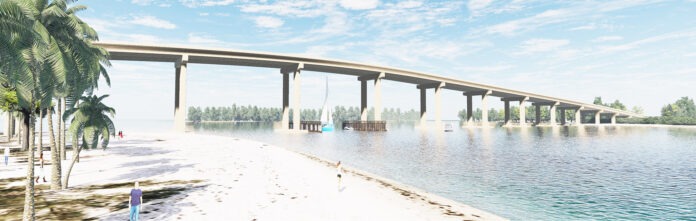
—For the residents of Longboat Key, the nearly 70-year-old drawbridge connecting their island’s northern tip to Bradenton Beach is more than just a piece of aging infrastructure; it is a vital marker of their community’s low-profile, historic character. Now, as the Florida Department of Transportation (FDOT) moves forward with a plan to replace the structure with a towering 78-foot-high fixed-span bridge, Longboaters are mounting a fierce campaign to force the state to reconsider.
During recent Project Development and Environmental (PD&E) study hearings—including an in-person gathering at the Christ Church of Longboat Key on Thursday, March 12, and a virtual session on Tuesday, March 17—state planners laid out their preferred alternative. While islanders universally acknowledge that the 1957 bridge requires replacement, the proposed mega-structure stretching roughly one mile north from North Shore Road has sparked intense local backlash.
—A Disruption to the Village Way of Life
—For over a year, Longboat Key leaders and residents have advocated for a much smaller 36-foot mid-level bascule, or drawbridge. Their preferred design would maintain the current two-lane configuration while adding eight-foot shoulders and a shared-use path for pedestrians and cyclists, minimizing drawbridge openings without dominating the skyline. For perspective, the massive Ringling Bridge in nearby Sarasota stands at just 60 feet high.
Longboat Key Town Commissioner Sarah Karon recently expressed her deep disappointment with the state’s direction, urging transportation officials to spend more time on the ground to truly grasp the community’s culture. She voiced her hope that the state makes one final attempt to explore a drawbridge option that preserves the island’s low-profile aesthetic.
Robert McRae, a Longboat Village property owner since 1986, articulated the neighborhood’s collective dread. He pointed out that dropping a colossal bridge into their small, historic community would be profoundly disruptive, and he pleaded with the state to reconsider the more expensive drawbridge alternatives before finalizing their research later this year.
—The Staggering Financial Divide
—Despite the local outcry, state officials point to severe structural needs and massive cost disparities to justify their high-span preference. According to FDOT presentations, a February 2024 inspection report gave the current bridge a sufficiency rating of just 42 out of 100—well below the 50-point threshold that triggers federal replacement funding. The state maintains that a new bridge is necessary to improve structural integrity, emergency evacuation times, and multi-modal mobility.
However, the state’s estimated price tags present a hurdle that local sentiment has so far been unable to clear:
• High-Span Fixed Bridge: $138 million (FDOT’s Preference)
• Low-Level Bascule Options: $176 million to $185 million
• Mid-Level Bascule Options: $184 million to $194 million
Opting for a drawbridge would cost taxpayers an additional $38 million to $56 million upfront, ignoring the perpetual costs of bridge tenders and mechanical maintenance.
According to the state’s project website, the five-year work program has earmarked funding for the next phase of project design in fiscal year 2026. While the project requires no private right-of-way acquisition, it will demand a permanent 0.23-acre maintenance easement carved out of the Coquina Bayside Park and boat ramp. Currently, there is no funding allocated for actual construction.
—Engineering Flaws Spark Cross-Bay Alarm
—The anxiety over the state’s design is not contained to Longboat Key; officials across the pass in Bradenton Beach are equally alarmed by the proposed traffic patterns, warning that the bridge will cause bottlenecks that impact both islands.
According to the state’s presentation, the massive new bridge footprint will require shifting the current Coquina Beach South driveway approximately 500 feet north. The existing driveway will be converted into an underpass to maintain bay-side recreational access for north and southbound traffic.
Following the March 19 city commission meeting, Bradenton Beach Mayor John Chappie detailed his alarm over the new routing. He explained that funneling boat ramp traffic to the west side of Gulf Drive will force trucks towing large trailers to execute difficult turns and wait for clearings in the traffic flow—a scenario he firmly believes will exacerbate existing backups.
Commissioner Scott Bear, leveraging his background as an engineer, echoed these warnings. He noted that forcing departing boat trailers to cross southbound lanes will likely paralyze traffic in both directions. Bear revealed that when he asked project managers why they had not included an acceleration lane to assist with merging, they admitted they had overlooked the concept.
While state planners have promised to review the feasibility of an acceleration lane for future design meetings, Bear maintained that pushing the bridge further north to accommodate boat clearances underneath, combined with shifting the current boat ramp exit 500 feet, will ultimately worsen the region’s traffic woes rather than solve them.

