
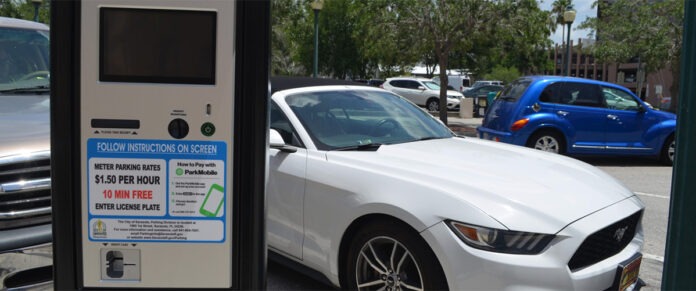
—Facing a ballooning multimillion-dollar deficit in its parking program, the Sarasota City Commission voted unanimously on Monday, March 23, to extend paid parking hours and increase citation fines, while striking down a controversial staff proposal to hike hourly street rates and triple employee permit costs.
The vote capped a tense regular meeting filled with fiery public comment, accusations of municipal overspending, and desperate pleas from local merchants still recovering from recent natural disasters.
Ultimately, the Commission adopted a compromise that spares casual shoppers and downtown workers from rate hikes, but significantly widens the net of when and how the city will collect its parking revenues.
—A System Underwater: The Financial Reality
—General Manager of Parking Broxton Harvey painted a grim picture of the city’s enterprise parking fund, which is legally designed to be self-sustaining. Instead, the combined General Parking and St. Armands Parking funds are projected to operate at a net loss of $270,784 in Fiscal Year 2026. Without intervention, that deficit was projected to skyrocket to $2,826,000 by FY 2028.
City staff blamed the deficit on a perfect storm of recent crises and looming capital expenses. The flooding of St. Armands drastically hurt the bottom line. During that crisis, the city postponed the collection of parking fees and ceased writing citations entirely. Furthermore, the city saw increased expenses due to replacement costs for flooded elevators and destroyed meters.
The parking fund is also currently saddled with the Bayrunner’s annual funding of $924,231, underutilized garages, and steep upcoming capital projects, including a $750,000 State Street elevator replacement in 2027 and a $650,000 on-street meter replacement in 2028.
—To dig out of the hole, staff presented three primary recommendations:
—1. Increase Citation Fees: A standard $5 increase across the board (e.g., an expired meter ticket rising from $25 to $30).
2. Increase Permit Parking: Standardizing employee permits for both Downtown and St. Armands at $30 monthly. Currently, Downtown employees pay $20, and St. Armands employees pay just $10.
3. Adjust Transient Rates: Staff offered two paths. Option 1 would raise on-street rates from $1.50/hr to $2.25/hr. Option 2 would keep rates flat but vastly extend enforcement hours—making on-street parking enforced from 8 a.m. to midnight (16 hours total) and making garages paid 24 hours a day.
—A Slap in the Face: The Public Pushes Back
—The presentation was met with immediate and harsh criticism from the public, who accused the city of bloated spending and blindsiding local businesses.
Resident Eugene Karovski slammed the parking department’s rising budget, calling the proposals an unacceptable burden. “It all sounds like nobody is buying what you guys are selling,” Karovski told the commission. “If an enterprise has trouble financially… they scale down resources, reduce expenses, which is the obvious missing piece in this report.”
The business community was equally alarmed. Rachel Burns, Executive Director of the St. Armands Circle Association, expressed deep frustration over a lack of communication from the city, noting she only found out about the proposed hikes by reading the news. She forcefully reminded the commission that St. Armands merchants are already paying for 50% of a $16 million parking garage bond.
“To just have these kind of changes come in without any conversations is really frustrating,” Burns said. She targeted the proposed employee permit hikes, noting that while an increase to $30 a month might look small on a spreadsheet, it places an undue burden on local labor. “Those are individual employees and business owners who are already struggling and they are already paying half of that $16 million debt.”
The sharpest words of the night came from resident Martin Hyde, who mocked the city staff’s reputation. “You keep using the term ‘dream team’ to describe city staff when a better phrase would actually be ‘nightmarish,’” Hyde stated. He lambasted the proposed 50% hourly rate hike, calculating it would suck roughly $3 million out of the local economy. “This is an absolute slap in the face for the local economy… and you are hurting the very poorest people in our community. This is a disgrace.”
—The Commission Brokers a Compromise
—Faced with intense public backlash, the commissioners searched for a middle ground that would fund the city’s urgent capital needs without crippling the workforce or deterring downtown shoppers.
Commissioner Kyle Battie defended the concept of paid parking as a necessary reality for a growing city. “As the population of the city increases, more parking becomes limited… We build a garage so that we have parking,” Battie explained. “Those garages have to be paid for and this is how they get paid for. It’s not like we just arbitrarily say, ‘Oh yeah, we want to tax people.’”
Mayor Debbie Trice agreed that parking isn’t inherently free, pointing out that structured parking costs the city tens of thousands of dollars per space to construct. She also suggested that staff should look into aggressively raising fines for true public safety violations. “I was picking up obstructing traffic. Why aren’t we charging more for that as a fine? For parking in a fire or emergency lane, why is that a minor pittance where these are really safety problems? I would increase them to at least $50.”
Commissioner Jen Ahearn-Koch emerged as the architect of the final compromise. She acknowledged the necessity of raising funds to build a contingency savings account and to eventually move the Bayrunner trolley off the city’s Economic Development budget. However, she firmly drew the line at punishing employees.
“They are hurting so much right now,” Ahearn-Koch said of local businesses and workers. “It is a small amount of money, but it is a lot to a business and employee at this time. Maybe someday, but I don’t think this is the day to be talking about raising the fees for the employees.”
Ahearn-Koch introduced a motion to move forward with a hybrid approach:
• YES to increasing the citation fines.
• YES to extending the hours of paid enforcement (Option 2).
• NO to raising the hourly parking rate.
• NO to raising the employee permit fees.
The motion, seconded by Commissioner Battie, passed unanimously. While drivers will still pay the standard $1.50 per hour on the street, they will now be on the clock from 8 a.m. all the way to midnight, seven days a week.

