
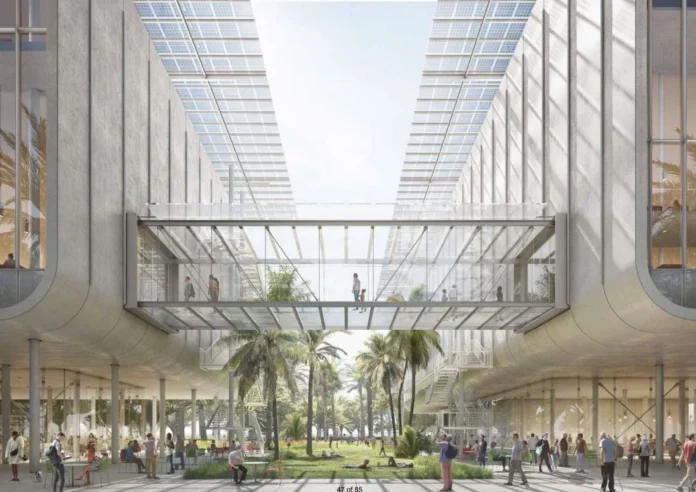
—The vision for the new Sarasota Performing Arts Center (SPAC) has been dramatically scaled back, brought down to earth, and given a much leaner price tag.
But even as city leaders applauded the sweeping architectural concessions presented on March 2, 2026, deep-seated financial and political anxieties threaten to keep the project permanently grounded.
Nearly a year after the City Commission sent the Sarasota Performing Arts Foundation (SPAF) and the Renzo Piano Building Workshop back to the drawing board, the delegation returned with “Concept 2.0.” The new blueprint successfully navigates a minefield of prior objections, but it cannot solve the most pressing issue in the room: paying for it.
—A Forced Retreat from Extravagance
—In March 2025, the foundation proposed a sprawling, multi-building complex elevated on 20-foot piers across the 10th Street boat launch canal. The cost hovered dangerously close to $407 million, and its height threatened a deeded view corridor from a neighboring condominium tower. The commission balked, demanding a cheaper, shorter, and less intrusive facility.
Concept 2.0 delivers exactly what was ordered. The new design consolidates the complex into a single building, shifts it south into the northeast corner of the current Van Wezel parking lot, and slashes 500 seats from the main theater. The resulting cost estimate drops to between $260 million and $295 million.
For the Foundation, the redesign was an exercise in swallowing pride and listening to the critics.
“Concept Design 2.0 is a direct response to your feedback and the feedback from the community,” SPAF CEO Tania Castroverde Moskalenko told the dais. “Our intent has been to deliver a concept that is financially sound and unified, one that meets our community needs, honors the Bay Park master plan, reduces costs without sacrificing quality, and demonstrates a fiscally sound framework.”
Mayor Debbie Trice expressed clear satisfaction that the architects had listened. “Every single line item that was in my memo back in March saying please address these concerns, you addressed every one of them,” Trice said.
Vice-Mayor Ohlrich, however, couldn’t resist pointing out the irony of the building’s new location—which is exactly where it was slated to go in the original 2018 master plan before the architects tried to move it over the water.
“I think this delay has resulted I’m going to say in a better location, although it reminded me of hanging a painting in my house,” Ohlrich deadpanned. “How about here? How about here? How about here? And then you go back to the original location and say, we knew it all along.”
—Raising the Ground, Not the Building
—Rather than hoisting the PAC on expensive concrete piers, the new design leverages the Bay Park Conservancy’s existing strategy to gradually raise the elevation of the entire park with dirt for storm protection. Principal Architect Jerry Sparkman noted the importance of integrating the building naturally.
“It’s serious architecture, but it’s light on the land. Not trying to be imposing on the park. Trying to settle in,” Sparkman explained.
AG Lafley, the founding CEO of the Bay Park Conservancy, joined the meeting remotely to echo this sentiment, acknowledging the sheer difficulty of making all the different elements fit.
“First, and most importantly, we have a site for a design concept that could and should work in the master plan that the City Commission has approved for the entire site,” Lafley said. “That’s important because… we’re trying to put together a lot of different pieces of a Rubik’s cube here.”
Sparkman quickly agreed with Lafley’s assessment. “Rubik’s cube is understatement. Enjoyable Rubik’s cube. Privilege to work on the project.”
—The Financial Sword of Damocles: Tallahassee and the TIF
—Despite the architectural triumphs and the Foundation’s unwavering commitment to privately raise “between 172 and 207 million dollars,” the City Commission only voted to officially receive the presentation. A vote on the critical “implementation agreement” remains unlisted on the calendar.
The hesitation is rooted in severe financial ambiguities. The $88 million public portion relies heavily on revenues from a Tax Increment Financing (TIF) district. But a potential statewide referendum on property tax reform looms on the fall ballot. If Florida voters choose to drastically slash or eliminate homestead property taxes, the TIF revenues carrying the public side of the PAC project could evaporate.
Interim City Manager Dave Bullock addressed the timeline with a dose of stark reality, warning commissioners not to rush into binding contracts while Tallahassee holds the city’s purse strings hostage.
“With my unlimited ability to predict what the state will do, the worst I believe they can do will not be known until November,” Bullock warned. “I think we have a doable project as long as none of those significant barriers present themselves as we move forward.”
When Commissioner Liz Alpert asked why a ticket surcharge wasn’t factored into the current revenue projections to help pay off the debt, Bullock admitted he was playing it safe given the state-level threats. “I think the best way to say it is I like to leave some powder dry,” Bullock noted. “If we need it, it’s definitely there.”
The public commenters were far less diplomatic about the looming financial cliff.
“This is a little bit of a clunker here,” warned resident Peter Blanton. “We have a governor who is hell-bent on cutting homestead taxes… You have to assume our homestead property taxes are going to be cut in the State of Florida.”
Frequent government critic Martin Hyde echoed the cynical reality of putting a tax cut on a public ballot. “The reality is that the thing that separates animals from humanities is that humans will take money every time. You shouldn’t be surprised if 60% of people vote for that… And if 60 percent of people do vote for that, I’m not saying it’s over, but it changes everything.”
—“Hurry Up, But Don’t Come Too Fast”
—Despite the heavy financial clouds, proponents urged the city not to lose faith. Resident David Lough delivered a passionate plea to keep the momentum alive. “Newton tells us that motion stays in motion, that at rest stays at rest,” Lough said. “We have motion again… To pause now risks allowing momentum to dissipate and restarting later will not be easy.”
As the meeting wrapped up, the tension gave way to a surprisingly humorous debate over the aesthetic future of the building. Renderings showed the facility’s distinct sections color-coded in vibrant yellow, blue, and pink, while other slides showed them in flat gray.
Vice-Mayor Ohlrich, ever the pragmatist, immediately zeroed in on the maintenance costs. “I immediately think of additional cost associated with colorizing buildings and additional maintenance associated with that. At what point does a decision have to be made and who makes that decision?”
Moskalenko, sensing an opportunity to pad the foundation’s fundraising goals, couldn’t resist a joke. “Maybe we can for $25 million let somebody choose the color of one of the buildings.”
“Maybe a little more than that,” Mayor Trice shot back, laughing.
Commissioner Alpert chimed in to defend the vibrant design. “I think it’s a very cool idea to have like each building a different color. It’s kind of a great concept. I hope we aren’t encouraging them to do gray.”
Ultimately, the city finds itself stuck in a high-stakes waiting game. They have a design they like and a budget they can stomach, but they are entirely at the mercy of state politics.
Vice-Mayor Ohlrich summed up the city’s anxious paralysis perfectly as he looked at the SPAF delegation. “We have to hurry up, but don’t come too fast because the state is still deciding what they’ll do with our property taxes.”

