
—Last week in the Longboat Key News, we explored the frustrating phenomenon of the “second-set lull.” In many ways, it’s a purely psychological issue; the players remain the exact same, but somehow the pressure sets in, and the set simply slips away.

But what is infinitely worse is watching a dominant player’s complete game start to vaporize. Dominant confidence turns into loss after loss. It’s like watching a superpower that once looked poised to take over the world suddenly slip into full retreat mode, leaving us wondering if it can even hold onto its current borders.
Currently, this is most obvious in Iga Świątek. She started off simply unbeatable. But soon, rivals like Aryna Sabalenka and Elena Rybakina started going head-to-head with her, taking the wins, and now you can see the frustration mount match after match. Recent early exits, like her stunning March losses to Elina Svitolina at Indian Wells and Magda Linette in Miami, show a player searching for answers.
It is arguable that it’s actually harder to turn the tide when you’re playing at the Key Club or the public tennis center here on Longboat Key. After all, when you lose a match on tour, you pack up and fly to the next city. When you lose here, you know you are going to face those exact same people tomorrow. You go home, your spouse asks, “How did you do? Did you win?” and you have to answer. Although there is no prize money at stake, most of us are investing in live balls, clinics, and lessons. We want to do better. We certainly don’t want to watch our games decline as we age, and we don’t even want to flatline.
So, let’s see what Iga does to remedy the problem. Let’s see if we can learn something from it so we don’t retreat home to open a pint of ice cream. Let’s instead reset, refocus, and look at some tips to regain mastery over our friends at the local club.
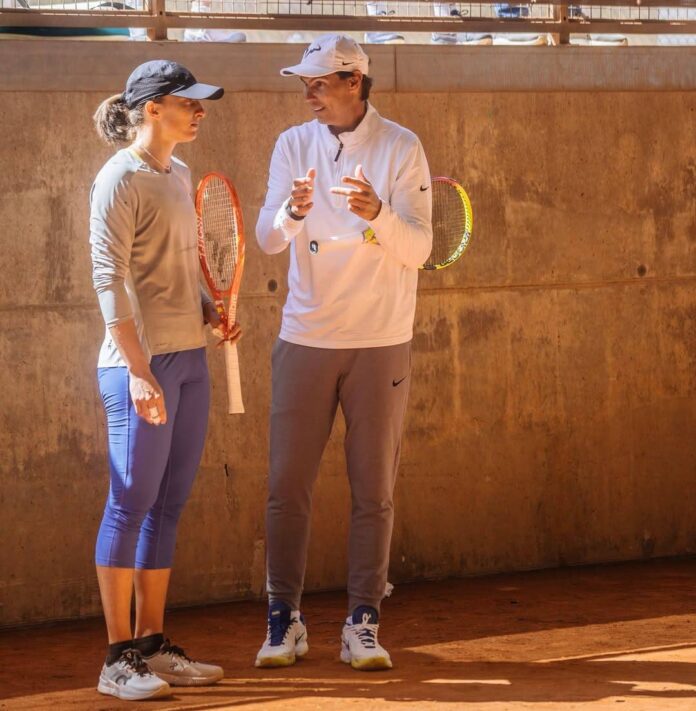
Świątek’s remedy? Fly to the Rafa Nadal Academy in Mallorca and work with the namesake clay-court master himself. Every day, postings surface about her progress, with peers like Danielle Collins musing that the knowledge she is gaining is simply not fair—likening the Nadal blueprint to “insider trading.” She has switched coaches, yet she firmly keeps Daria Abramowicz, her traveling courtside mental health practitioner. Many question whether she needs to switch up that dynamic as well, or whether working with the great Rafa will be enough to turn the tide.
—When the Foundation Cracks
When a player hits this stage, it is no longer about a single set slipping away; it is about a complete collapse in the ability to win matches. A dominant streak ends, and suddenly two or three losses pile up. The psychology shifts dramatically. The court feels smaller, the net feels higher, and opponents who just last week seemed to have a weak puff serve like an octogenarian tossing the ball over the net suddenly seem like Jannik Sinner thumping the ball with overwhelming pace. You feel entirely vulnerable.
The natural instinct is to swing harder, attempting to muscle your way out of the slump and force the ball to do what it used to do automatically. But in tennis, panic breeds deceleration and errors. The muscle memory that once felt bulletproof is suddenly paralyzed by doubt. Professionals understand that a sudden, protracted freefall in form stems from a profound breakdown in trust—trust in the footwork, trust in the swing path, and ultimately, trust in oneself. When the wins stop coming, the mind becomes the greatest liability on the court.
—Local Remedy: Breaking the Streak on the Keys
For the competitive crowds battling it out on the courts of Longboat Key, Bird Key, and Sarasota, breaking a losing streak requires a deliberate mental reset. When the victories dry up and that creeping vulnerability sets in, professionals suggest these anchors to rebuild a shattered game:
—Strip Away the Ego and the Expectations
When you are in a rut, the pressure of trying to maintain your past reputation is toxic. You have to stop trying to play the dominant, flawless tennis of last month and commit to the gritty tennis required today. Recommit to a high-percentage baseline game. If the timing is off and opponents feel like they are hitting harder, generate height and heavy rotation. Trust the AeroPro frame, let the textured strings bite the ball, and aim deep down the middle to neutralize their pace and buy yourself time. Let the racket do the work. As someone once said, aim for the big targets—the open spaces on the court—and stop trying to muscle out winners.
—Redefine the Victory
When you cannot buy a win, stop focusing on the match score. The scoreboard will only induce panic. Instead, change the metric of success to executing specific patterns. Celebrate the heavy, cross-court forehand that pushes the opponent back behind the baseline, even if you ultimately lose the point. Focus entirely on the process of a single rally. Rebuilding a tennis empire starts brick by brick, point by point.
—Control the Controllables
A losing streak creates mental chaos on the court. The fastest way to restore order is to fiercely protect your physical rituals off the court. Take back control of your preparation. Dial in the off-court routine—perfecting that pre-match hydration formula. Controlling the physical chemistry, the diet, and the bag preparation builds a subtle, quiet foundation of confidence before the first ball is even tossed.
Whether you are Iga Świątek retreating to a mountain fortress in Mallorca or a local player grinding through a Thursday morning doubles match, the solution to a slump is never found in panic. You have to embrace the retreat, strip the game down to its raw mechanics, and trust that the foundation is still there, waiting to be rebuilt. One thing is for sure: with patience, practice, and some deep breathing, that local “Jannik Sinner” will eventually vaporize. They will turn back into human form and reappear on the play sheet as the friend from Longboat Key you had no problem beating not too long ago.

