
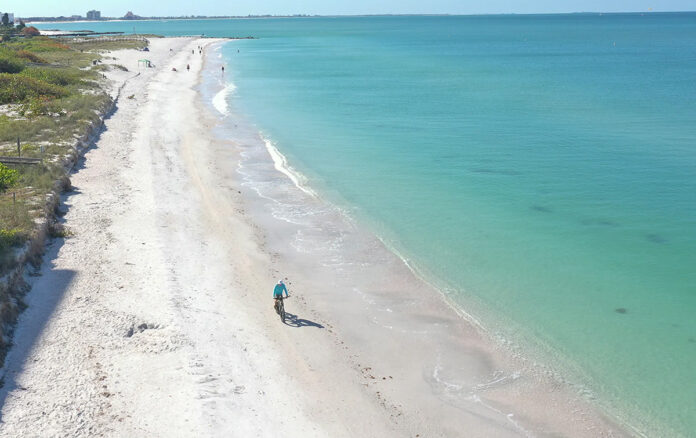
—Stand by the manicured tennis courts at the Longboat Key Club, and you’ll hear the same conversation echoing between serves: the south end beaches are washing away. Take a drive up to Gulfside Road at mid-Key, and the story is the same, only louder. The dunes are flattened, the shoreline is receding, and the Gulf of Mexico is knocking on the island’s front door.
“We have some hot erosion areas and on the southern end of the island,” Longboat Key Town Manager Howard Tipton acknowledged. “It is not across the board, but there are some hotspots.”
Following the devastating back-to-back hits of the 2024 hurricane season—Idalia, Helene, and Milton—which stripped an estimated 400,000 cubic yards of sand from the island, Longboat Key is facing an existential and incredibly expensive crisis. The sand is gone, and buying it back has never been harder, or costlier.
—The Staggering Cost of Sand: 1993 vs. 2028—
To understand the panic on the island, you have to look at the math. Thirty years ago, sand was cheap and plentiful. During Longboat Key’s first major, island-wide renourishment project in 1993, the town pumped a massive 1.95 million cubic yards of sand onto the beaches. The total price tag? Just $9.73 million. That broke down to roughly $5 per cubic yard.
Today, that same sand is treated like white gold.
As offshore sand reserves dried up and environmental regulations tightened, the town grew desperate. By 2016, local leaders resorted to a massive, disruptive trucking operation—literally hauling 200,000 cubic yards of sand from an inland mine in Central Florida just to patch the beaches. The operation became a logistical nightmare. Tipton noted that the town endured a relentless “conga line of trucks.” The sheer noise and disruption as heavy machinery had to find access by slinking between high-end condominiums made it one of the most difficult renourishments in the island’s history.
Now, as the town looks toward its next massive island-wide renourishment, the economics are staggering. The town plans to place just 800,000 cubic yards of sand (less than half of the 1993 volume). The projected cost is $32.9 million—which comes out to roughly $41 per cubic yard.
Complicating the cost is a difficult irony in the business of beach nourishment. The heavy, coarse, and frankly ugly sand—which coastal engineers dub “kitty litter sand”—actually stays in place and builds a resilient beach. However, the pristine, powdery “sugar sand” that puts Longboat Key on tourism websites and realtor homepages can quickly erode or simply blow away in the wind. Yet, strict DEP regulations require the town to use specific, turtle-friendly white quartz sand, which comes at a premium.
—The Terrifying Price of Doing Nothing—
If $32.9 million sounds like a tough pill to swallow, coastal engineers and town officials are quick to point out the alternative. Across the country, communities that have failed to renourish their beaches are paying the ultimate price.
“If you don’t put sand on the beach, the beach comes for the houses.”
Look just a bit north to Pinellas County. In recent years, the Army Corps of Engineers had $42 million ready to drop new sand on towns like Redington Shores and Indian Shores. However, because a fraction of homeowners refused to sign public access easements, the project stalled. When the 2024 hurricanes rolled through, the un-nourished beaches were totally defenseless. The storms shredded the coastline, leaving residents one wave away from water overtaking their homes.
The situation is even more dire in Rodanthe, North Carolina. A 2023 cost-benefit analysis showed that saving the small Outer Banks community with beach nourishment would cost a staggering $120 million over 15 years. Unable to secure that funding, the town was left to the mercy of the Atlantic. Since 2020, more than a dozen beachfront homes have literally collapsed into the ocean, scattering septic tanks, nails, and splintered wood for miles and destroying the local tourism economy.
—The Irony of the Groins: A 30-Year Reversal—
Perhaps the most visually striking change coming to Longboat Key is the return of hard structures.
Thirty years ago, the prevailing coastal management philosophy shifted away from groins and seawalls. The belief was that hard structures disrupted natural currents and were an eyesore. Longboat Key systematically removed its old groins, aiming for a pristine, structure-free shoreline.
But the Gulf of Mexico didn’t cooperate. As Tipton mused philosophically, “Sand does not stay where you want it to, it is subject to weather and winds.” Without structures to hold it, the expensive sand simply washed away with the longshore currents.
Now, the town and the DEP are rapidly reversing course. In 2021, the town installed five permeable rock groins at the north end of the Key. Today, facing the severe mid-Key erosion “hot spot” near Gulfside Road, coastal engineers are actively permitting a dense, multi-million dollar field of up to seven “T-head” rock groins. Tipton confirmed the town is shifting its strategy entirely. They are no longer “just trying to put sand on the beaches, but plan on employing structural solutions as well mid-key.”
While the town has officially been calling this a 2028 project, the timeline is accelerating. “We are looking at starting the groin construction in fall of 2027 and start the beach renourishment in late fall of 2027 — less than two years away,” Tipton told Longboat Key News.
—The Neighborly Tug-of-War Over Sand—
The desperation for sand has also sparked local controversy over where the existing sand goes. Some Longboat residents are questioning why the town shares the sand dredged from New Pass with neighboring Lido Key, which receives the precious resource every other dredging cycle.
The frustration stems from engineering facts that have determined all the sand that accumulates in New Pass actually washes there through longshore drift directly from Longboat Key’s beaches. To many residents, they are simply watching their own sand be given away.
—Homeowners Left to Hold the Line (And the Warning from Massachusetts)—
Because the cavalry isn’t arriving until late 2027, beachfront homeowners and HOA communities are being forced to take matters into their own hands. Many residents are funding their own private dune restorations, paying out-of-pocket to truck in sand and plant sea oats while navigating a labyrinth of strict DEP rules.
But private efforts come with a massive, heartbreaking risk.
In early 2024, a group of frustrated beachfront homeowners in Salisbury Beach, Massachusetts, grew tired of waiting on the government. They banded together and spent over $500,000 of their own money to truck in 15,000 tons of sand to build a massive protective dune. Just three days after the project was completed, a severe storm rolled in. Within 72 hours, the ocean completely swallowed the dune, washing away half a million dollars of private investment. It is a brutal reminder to Longboat Key residents that “band-aid” private sand drops are no match for the ocean without a massive, engineered project behind them.
— —How Will the Town Pay for It? — —
Securing the $32.9 million for the upcoming project is a puzzle of local, state, and federal maneuvering. For the local funding portion, Tipton told Longboat Key News that the town has officially paid off the debt on the 2021 beach project. Now, they are looking to keep the same funding methodology and can raise up to an additional $13 million without going back to voters via referendum.
Tipton laid out the clear order of operations: “We will get some of the tourism money and state grant money and once the groins are done, we will fill in the sand on the beach starting ideally in late 2027.”
Town officials have tentatively mapped out the rest of the funding matrix:
• FEMA Relief: Approximately $12.2 million in federal disaster recovery funds.
• State Grants: Roughly $7 million from the Florida Department of Environmental Protection (DEP).
• Tourism Taxes: Around $5 million allocated from Manatee and Sarasota county bed taxes.
• Local Districts: The remainder will be covered by municipal funds and the aforementioned $13 million capacity.
For Longboat Key, the sand is no longer just a luxury for tourists—it is the only thing standing between the island’s multi-million dollar real estate and the bottom of the Gulf.
Town Manager Tipton hears the concerns loud and clear from the tennis courts to the condominiums. “I completely understand the frustration,” Tipton empathized, “but permitting for the next beach renourishment project and the groins is actually coming together pretty quickly.”
And while Tipton’s favorable disposition and outlook may be reassuring, another hurricane season is rapidly approaching. As always, Longboat Key will soon become fixated on ever-increasing oceanic temperatures and intensifying storm cycles, knowing the island is just one bad storm away from losing the beach and the fragile remaining dunes that stand between the lifestyle residents love and the chaos of a hurricane’s aftermath.
Even if the island remains as lucky this year as it was in 2025 with no named storms hitting the coast, Longboat Key’s identity is inextricably tied to its status as a premier beach community—defined by a ribbon of white, a virtual prayer rug of crystalline sand stretching for 10 miles along its gilded shores. The last thing the island needs is for its residents and visitors to stop focusing on their tennis serves and golf strokes, and instead stare out at the water, wondering with desperate urgency if their scoured shoreline will ever be whole again.


Many years ago, living in Boca Raton, I went to a meeting of politicians on the subject of beach erosion and the cost of renourishment. After listening to a couple of hours of discussion and debate on whether to spend the money, I asked a question. Do you know why we have a beach erosion problem? After listening to comments about the wind, the currents, and the storms, I commented that while these are reasons why we have beach erosion, they are not why we have a beach erosion problem. We have a beach erosion problem because we drew a line in the sand and said, “This is the beach” and then built condos and homes along it, ignoring the fact that Mother Nature was not a party to that decision and never intended for the beach to stay in one place. The day that line was drawn and the condos and homes were built, a decision was made to spend millions on a continuing basis to keep the beach on that line where Mother Nature never intended for it to be.
But that line was drawn years ago, and we are now stuck with the necessity of spending the money to keep the beach where the line was drawn. A beautiful beach is important, but a functional one that protects property and residents is more important. The groins are better than no beach. The coarse sand that stays in place is better than the white sand that washes or blows away. The homes and safety of our citizens is more important than protecting the Turtles. If the EPA wants us to use sand that does not last, they should pay the difference in cost from the coarse sand that will. This is another example of the Federal or State government making requirements that local governments have to pay for. If they make a requirement, they should be prepared to fund it.
As an old engineer, I have a phrase that I have used many times over the years. “Looks good, doesn’t work.” We need to do what works first and make it look as good as possible. Doing what looks good but doesn’t work is a fool’s errand.
Yes since LBK decided 40 years ago to remove the crucial old rock groins ….there has been a constant loss of sand.. The groins definitely need to be replaced along the shoreline to hold the sand.