
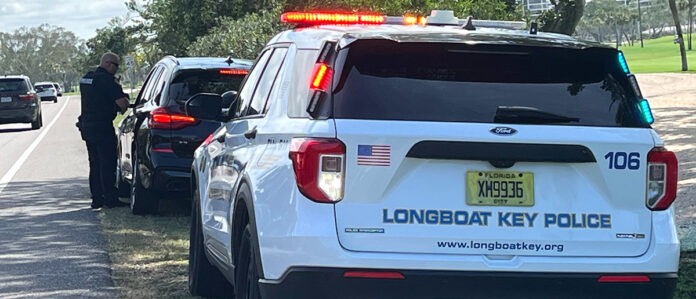
—It is something of a policing paradox. For decades, the Town of Longboat Key, its residents, its businesses, and the local real estate industry have spent countless dollars touting the island’s virtually non-existent crime rate, stunning beauty, and tranquil ambiance. Visitors flock from around the world to leave the cold behind, relax on the beach, play a round at the Longboat Key Club, or indulge at the new five-star St. Regis Resort.
But lately, when drivers descend off the bridge onto the island, they aren’t met with a warm, breezy welcome. Instead, they are greeted by a barrage of flashing blue lights and what is rapidly becoming an aggressive gauntlet of traffic stops. The frustration is conjoined with a confusingly shifting speed limit that morphs from 35 mph heading down the bridge past the BP station, bumps to 40 mph for a short stretch along the hardened medians in front of Country Club Shores, and then jumps to 45 mph for the next nine miles.
For the police chief and some town officials, this heavy, high-visibility presence is an ode to safety—a stern warning to any would-be ne’er-do-wells. But the impact on the people actually driving Gulf of Mexico Drive is quite different. Instead of a peaceful arrival into a manicured, recreational paradise, locals and tourists alike are thrust into a stressful, heavily policed corridor running all the way from the Islandside golf course down to Country Club Shores.
—The 2025 Report: Glossy Stats vs. Gritty Reality
—This paradox is perfectly captured in the Longboat Key Police Department’s newly released 2025 Annual Report. In his “2025 Year in Review” memorandum, Police Chief Russ Mager set a clear operational course for the island’s law enforcement, prioritizing frontline patrols, aggressive traffic enforcement, and modern technology.
But for a growing number of residents, the glossy statistics are masking a deeply frustrating reality: Longboat Key is rapidly feeling less like a relaxed beach town and more like a militarized speed trap.
While the department touts its operational efficiency and strategic restructuring, taxpayers are digging into the numbers and raising serious red flags about the town’s policing priorities. A staggering, nearly 200% surge in traffic enforcement has sparked intense community blowback, prompting locals to ask the hard questions: Is this massive police presence actually making anyone safer, or is it just harassing the people who foot the bill?
—A Strategic Shift to the Frontlines
—When Chief Mager was sworn in, he brought a mandate of modernization and efficiency. A major strategic shift highlighted in his 2025 review was a restructuring of the department to bolster street-level presence. Following the retirement of the Deputy Chief in December 2025, the department consciously chose not to backfill the executive position. Instead, Mager reallocated those resources directly to the Patrol Division without increasing the overall budget.
This administrative move was specifically designed to allow the department to allocate more hours to beach patrols, marine patrols, and proactive community needs. By cutting top-heavy command roles, the department successfully added two new frontline patrol positions.
The strategy was clear: put more cops on the street to tackle the island’s primary hazard—traffic.
—The “High Visibility” Backfire: When Safety Turns to Fear
—While general crime on Longboat Key remains at historically low levels, the department reported a noticeable increase in motor vehicle accidents, rising from 93 crashes in 2024 to 114 in 2025. According to the department’s findings, driver behavior—specifically following too closely, failure to yield, and careless driving—is the dominant factor in these crashes, rather than roadway defects.
In response, Chief Mager made “high visibility” a core objective, unleashing proactive policing efforts to curb bad driving habits.
But residents are pushing back, armed with research showing that the Chief’s strategy may be fundamentally backfiring. According to criminological data actively being shared among frustrated locals in social media groups and email chains, high-visibility policing is only reassuring under specific conditions. When it crosses the line into over-policing, it actively damages public trust.
As one piece of research circulated by residents highlights, the breaking point is a “constant enforcement focus.” “If visibility equals tickets, stops, or confrontations, fear rises,” the research warns.
The community argues that Longboat Key has sprinted past community support and straight into an enforcement crackdown. The 2025 data is jarring: In a single year, the department issued 1,900 traffic citations and a jaw-dropping 4,000 traffic warnings. That is 5,900 traffic stops on an island with roughly 6,000 full-time residents.
The report proudly highlights 20,930 “self-initiated calls” in 2025. In police jargon, a “self-initiated” call means an officer wasn’t dispatched by a 911 operator to help someone in need; rather, the officer actively went looking for an infraction and initiated the stop themselves. That equates to about 57 proactive stops every single day.
Does a 200% increase in flashing blue lights make taxpayers feel safe? Or does it foster a quiet “defund the police” sentiment—born not out of political ideology, but out of sheer exhaustion from being constantly monitored and nickel-and-dimed?
—The “Resident” Question vs. Community Policing
—In his report, Chief Mager emphasized that community policing remains central to the department’s mission, noting that officers are actively participating in HOA engagements, business outreach, and community events to build public trust.
But research shared by the community notes that public perception of police is heavily shaped by “how officers behave (friendly vs. confrontational)” at the point of contact. Lately, the behavior at car windows is drawing intense scrutiny.
The surge in traffic stops has brought disturbing anecdotal reports from the community. Several residents claim that upon being pulled over, officers have explicitly asked them: “Do you own a home here, or are you a visitor?”
If true, the question is highly inappropriate. It leaves the distinct impression of a double standard—that wealthy taxpayers might be let off with a warning while tourists or workers receive the citation. Yet, even full-time residents report feeling treated poorly during these stops, leading to a profound loss of community support. You cannot build a community-oriented police force while actively alienating the community on the side of Gulf of Mexico Drive.
—Tackling Traffic: Bad Drivers or Bad Infrastructure?
—The police department justifies the traffic crackdown by pointing to the spike in crashes and blaming tailgating and failure to yield. But residents argue the data is misleading and the town’s solutions are lazy.
How many of those 114 crashes were actually serious, injury-inducing wrecks, and how many were simply minor fender benders? The town’s own maps show 13 crashes clustered in the Bay Isles area. How many of those were just low-speed bumps in the crowded Publix parking lot? Furthermore, how many of the island’s crashes were directly caused by the chaotic, FDOT-mandated concrete barriers erected during the controversial Country Club Shores turn-lane project?
If traffic flow and safety are truly the goals, residents argue the town should rely on smarter infrastructure, not more tickets. Instead of setting up speed traps, why not install traffic circles at the frustrating three-way stops outside the Longboat Key Club and at the bottom of the bridge? Roundabouts are proven to calm traffic and eliminate the driver frustration that leads to careless mistakes.
Furthermore, if the town is so concerned about safety, residents wonder why officers aren’t prioritizing crosswalks. Having an officer step out of their air-conditioned cruiser to physically stand at high-traffic crosswalks would do far more to protect pedestrians than hiding in a median waiting to write a speeding ticket. If the issue is simply speed, automated speed cameras are significantly cheaper and more efficient than paying a pension-backed officer to run radar.
—Marine Patrols and Missing Data
—The waters surrounding the island remain a heavy focus for the department. Mager’s report highlights that marine patrol operations continue to play a crucial role in environmental protection and the enforcement of boating regulations. In 2025 alone, marine officers conducted 192 vessel stops and responded to 69 other marine-related calls.
But unlike the meticulously detailed, multi-year charts provided for road traffic and EMS calls, the Marine Patrol data lacks any historical comparison.
Why wasn’t prior-year data shown for the waters? Did vessel stops also see a 200% increase? If not, why is the department aggressively policing the roads but taking a softer approach on the water? Boating Under the Influence (BUI) and waterway safety are massive issues in a coastal community. Residents are left wondering if marine safety is simply considered less important than meeting a quota of road citations.
—2026 Tech Priorities and the Budget Paradox
—Looking ahead to 2026, Chief Mager outlined several key initiatives to modernize the force. Top priorities include technology enhancements like body-worn cameras, drones, and upgrading internal records management systems. The department is also aggressively exploring grant opportunities, having already requested over $121,000 in 2025 to secure funds for items like a Sea-Doo, ballistic shields, and bicycle safety programs. Mager also celebrated the department’s strict compliance with law enforcement accreditation standards, boasting two consecutive years of internal mock assessments that yielded zero deficiencies.
But these ambitions highlight the most glaring paradox on Longboat Key: If crime is so incredibly low, why is the police force so big, and why are costs still climbing?
The 2025 report confirms what everyone already knows—Longboat Key experienced zero homicides and zero robberies for the third year in a row. It is one of the safest zip codes in America. Yet, Public Safety consumes an astounding 69% of the town’s General Fund.
How does Longboat Key’s police staffing compare per capita to other luxury vacation destinations with similar populations? How has the police budget ballooned over the last decade, particularly before and during Mayor Ken Schneier’s tenure? As the Mayor himself recently urged during summer budget meetings, the town needs to focus on “needs, not wants” when it comes to personnel. If the police department is primarily functioning as an over-funded traffic enforcement squad, residents are asking if there are leaner, more effective alternatives.
—The Verdict
—Chief Mager concluded his review by reaffirming the department’s core mission: the Longboat Key Police Department remains fully dedicated to providing exceptional service and safeguarding the quality of life for all residents, visitors, and businesses on the island.
But the “customers” of Longboat Key are feeling the strain of his new business model. High visibility is only a virtue when it makes a community feel protected. When it turns into a daily gauntlet of radar guns, warnings, and confrontations, it creates an island that feels distressed, hostile, and harassed. As the Town Commission reviews this data, they will have to decide what kind of community they want Longboat Key to be: a relaxed, welcoming paradise, or a zero-tolerance patrol zone.


When I was in high school in Bradenton in the 70’s, it was well known among my friends “not to go the Longboat Key and do anything stupid because the cops are everywhere!”
I had the pleasure of participating in continuing that “image” for nearly 22 years in the 80’ and into the early 2000’s.
This formula is nothing new. High visibility police patrol has been the formula for safety and low crime on Longboat Key for decades. I personally applaud the Chief for continuing the formula for low crime.
Are there “cheaper” ways to provide police services? Of course, but the tax payers who are questioning the methods and cost need to ask one question. Is red tag closeout discount store policing what you want when to you are used to driving a Bentley?
Thank you Chief Mager and all of the Longboat police officers for being fully dedicated to providing exceptional service and safeguarding the quality of life for all residents, visitors, and businesses on the island.
Mr. Steve Reid the author of this one sided angry article does not speak for my neighbors nor I, NOT EVEN CLOSE. Mr. Reid stop stirring up controversy where there is none.
We love our police officers and I personally love driving onto the island and seeing a police presence. I have always felt very safe on Longboat Key.
Chief Mager – please don’t change a thing, and I also applaud you for continuing the formula for low crime.
Wondering if this article is intended to be humorous….or merely delusional. As someone who has walked GMD daily, witnessed the growing volume of traffic…and have actually seen impatient drivers passing in increasing numbers at speeds in excess of our generous limits. I would hope the majority of LBK full time and seasonal residents would welcome the increased visibility of, and enforcement of traffic safety laws, by our excellent police and public safety departments. Only those guilty of excess speed, tailgating, texting, veering into bike lanes, or other violations of laws intended to keep our residents safe should have an issue with such diligence by law enforcement. Thank you to those dedicated to keeping our streets and community safe.
I have read your article but find John Kintz’s comments somewhat misleading. First as the previous chief of police I think he is bias and perhaps out of date. Also the article is in reference to the south end of the island only. Not a criticism of the police force and all of its efforts which I certainly support. However during 20 years I have lived on longboat the extent of most traffic control was empty cruisers parked on the side of the road. Is that what John suggests was his Bentley service? Until recently no one was getting pulled over tickets or warnings and lights weren’t flashing two blocks apart. Including my own discomfort my visitors ask what is going on. That is an issue we should take note of both as property owners and as hotel operators. People at the north end of the island will not notice this endeavour since it applies to a short stretch of road in front of the entrance to the Longboat Key Club and the St Regis. I think many people support our police but perhaps the two or three cars around Cannon Marina where crime has actually occurred would be most welcomed.
David,
I’m not sure how my comments were misleading but let me help clarify.
High visibility police patrol is not a policing principle that has an expiration date. The Longboat Key Police Department never parked unmanned police cars on the side of Gulf of Mexico Drive during my nearly 22 years on the department. Parking unmanned cars has been tried throughout the country. The effectiveness of these strategies were never truly quantified and the public who would speed catches on to these very quickly.
Our strategy was always actual police officers in cars actively patrolling. The ideal staffing at that time was 3/4 officers on duty 24/7. This level was not achievable at all times due to the use of PTO. Those staffing levels are the “Bentley” service analogy I used to address the article author’s reference to the cost of policing. Looking at the geographic footprint of Longboat Key, those staffing levels are much higher than most police agencies.
The cost of public safety services is expensive. It is today, and it was when I was Chief. The costs are overwhelmingly people driven. The formula to reduce costs is an easy one. Less officers = less cost.
I chuckled at the last line in your comment because that logic is what most people say when they get caught speeding or violating any other traffic law.
“Why aren’t you out catching “real” criminals?”
The police are doing a fine job but I do believe they are hurting their image and ours at the south end of Longboat where friends and hotel guests get their first impression of our paradise. I’m sure there is a much better way to achieve positive results.
I have never seen over policing like this!!
I think we need to look at causation vs correlation here. If longboat key has had a steady amount of policing for the last few years, with zero violent crimes, does it really necessitate in increasing presence? I feel as if there is potential ramifications such as tourists being intimidated and thinking Longboat Key may be a dangerous place. We should be investing this money to look at potential solutions to solving traffic, rather than just ticketing it. The real issue is that it takes roughly an hour and a half to get from Longboat Key to the mainland during this peak season. I am frankly more concerned about that than the visitor from Ohio going 42 in a 35.
Chief Mager – Please don’t change a thing. It’s working. Everyone I know appreciates and supports the job that you and your team are doing. Please keep doing it.
One last comment: It makes sense to have one speed limit on Gulf of Mexico Drive the entire length of the island. That will avoid confusion.
I sit with multiple civil traffic tickets in front of me. One issued because only an electronic version of currently valid insurance was presented, and even though according to the FL Statute he cited (Sec 316.646.1), electronic presentation of insurance is acceptable, the Officer refused to accept it. Other tickets have to do with the state of the vehicle, but nothing that interferes with driving safety or causing other drivers to have safety concerns when encountering the vehicle (no non functioning brake lights etc). This stop was not for speeding or driving erratically. All of the vehicle’s lights are in working condition. It is opined that this Officer profiled and ticketed because of the type and condition of the vehicle. Reading other stories of stops raises questions. Did other people receive tickets, merely warnings, or nothing. Did the woman driving slow in the bike lane receive a ticket or merely an escort home? Did the kids jumping from the bridge receive warnings, tickets or merely asked not to do that again? Are drivers of more expensive vehicles with addresses in more expensive areas more likely to receive a warning rather than a ticket(s)? Since the late 1960s, I have visited or lived on Longboat Key, and through all those years it has always been predominantly safe. Longboat Police forces have always performed well and have never been so bored or revenue conscious to necessitate undue targeting of drivers or generating tickets for revenue. I’m all for policing, but not police bias, profiling or targeting, or police activity that borders on harassment. There are too many diverse populations of seriously good people who drive on or through Longboat Key for various reasons for this to continue occurring.