
STEVE REID
Editor & Publisher
sreid@lbknews.com
Shamans often speak of a transformative experience born of deep pain and insight. Psychologists know that when the shadow is brought to light, new growth can occur. Many of us know that after an injury, a business failure, or a personal crisis, we are faced with a choice: retreat, or birth a new idea.
In a society that rewards talent with immense monetary compensation, walking away from the peak of success is a rare feat. But that is exactly what Marty Hurwitz did.
Hurwitz, a Longboat Key resident, spent 25 years at the apex of Hollywood as an agent to countless movie stars, writers, and creative elites. Yet, he found his true calling not in keeping the Hollywood machine functional, but in helping the impoverished children of Sarasota find their own functionality. Last week, Hurwitz spoke to a gathering at the Longboat Key Club Tennis Gardens, sharing a journey that took him from the glitz of the entertainment industry to the gritty realities of at-risk youth education.
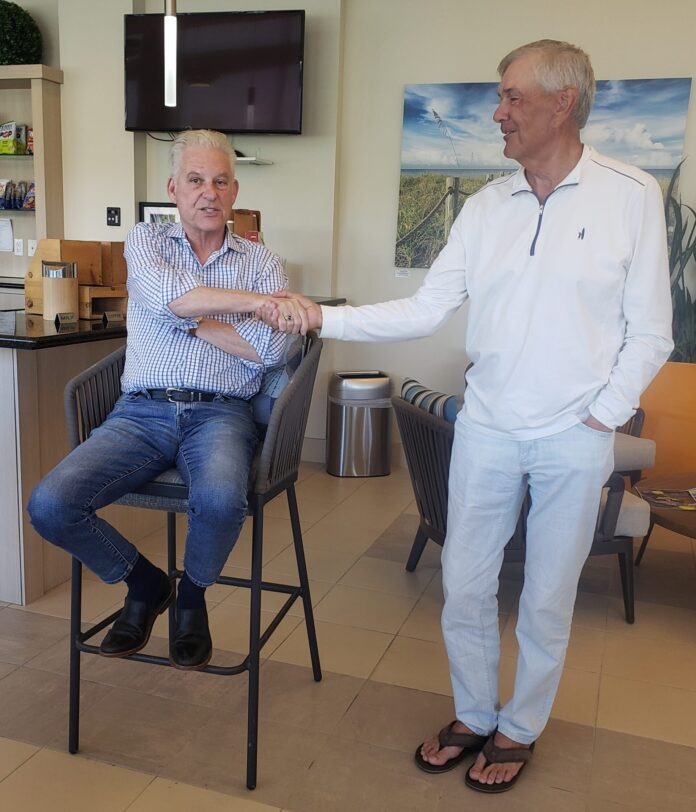
Organized by Mel Rhinelander, a retired healthcare CEO and former champion tennis player, the event was intimate and unscripted. Rhinelander introduced Hurwitz by admitting that when they first met a decade ago at a tennis clinic, he didn’t initially like Marty. But after a cup of coffee, they became fast friends. Rhinelander told the crowd he was fascinated by Marty’s Hollywood life, but deeply moved by his post-Hollywood evolution in Sarasota.
Hurwitz, speaking from the heart, began with a reflection on his path. “We are a product of our journeys,” he told the audience. “It is one of the values of aging.”
The Loafers That Changed a Life
Hurwitz’s journey to Hollywood began, ironically, with a job interview in Texas. Armed with an MBA from the University of Michigan, he was recruited by Ross Perot’s team. Perot generally hired ex-military personnel, so Hurwitz was nervous. He showed up in a conservative blue shirt, red tie, and close-cropped hair. Despite not being military, he was offered the job on the spot.
But as he headed for the door, a staffer made one comment that altered his destiny: “Ross likes shoes that have laces.”
Hurwitz was wearing loafers.
He realized in that moment that he did not want to work in an environment where someone would define how he dressed before he had even started. He declined the offer and headed west.
“I worked in Hollywood for 25 years because Ross Perot did not like shoestrings,” Hurwitz said with a smile.
The Injury and the Epiphany
For two and a half decades, Hurwitz thrived in the entertainment industry, never missing more than five days of work. He learned that famous actors simply want to be treated like people, noting that “Hollywood is always suspicious of an agenda.”
But the frantic pace came to a halt on a tennis court. Hurwitz blew out his knee—a complex injury involving lost cartilage, a torn meniscus, and damaged ligaments. It was during the depths of that physical pain and forced reflection that a psychological reset occurred.
“It dawned on me that if I go back to the office, I will lose my soul,” he recalled.
Six months later, in 2002, he moved to Longboat Key. He didn’t want to go back to the way the industry was evolving. Instead, he turned his attention to a new cast of characters: struggling students in Sarasota.
“Habitude” and the Cycle of Poverty
Upon arriving in Florida, Hurwitz began a second, profound chapter. He started teaching high school, driven by a love for education, though he admitted he was “surprised by how many teachers did not like kids.”
In 2004, he founded Habitude, an organization committed to a “dovetail approach” of life coaching and academic tutoring. He formed interlocal agreements with the Boys & Girls Clubs and Habitat for Humanity to help those embedded in a cycle of poverty.
Hurwitz brought the same intensity to Newtown that he once brought to Hollywood. He realized that for at-risk kids, “access is critical.” The Boys & Girls Club made a difference because they provided transportation—a simple bridge over a massive gap.
During his talk, Hurwitz offered a searing analysis of the poverty culture that schools often fail to recognize. He described a system that removes choices and pins the impoverished to a lifestyle without opportunity.
He pointed out the “poverty tax” inherent in their lives: instead of a doctor’s office, families rely on the ER—the most expensive healthcare delivery system that immediately tags them with debt. He spoke of the “Buy Here, Pay Here” used car lots where imposters charge 25% interest on $500 down payments, knowing they will repossess the car a month later—sometimes selling the same vehicle 15 times a year. He spoke of rent-to-own furniture, where the poor pay for the most expensive, least protected housing imaginable.
“Teaching kids how to balance a checkbook will not undo their life,” Hurwitz said.
He noted that for Title I kids, the only meals they often get are at school. In this environment of scarcity, where furniture and cars are routinely taken away, the only constant remaining are their friends. That, Hurwitz explained, is why friendships are everything in poor communities.
The Power of “Someone”
Hurwitz’s philosophy is simple but radical. He realized that when students act out or become the class clown, they are simply seeking recognition. “Everyone wants to be a success at something,” he said. “Even if it’s being a clown, at least they are recognized.”
Through Habitude, Hurwitz worked to give these students a different kind of recognition. He focused on helping them identify their strengths, believing that success is based on developing good habits and positive attitudes.
“A person can survive and overcome having nothing in their life, but they cannot overcome having no one in their life,” Hurwitz said fervently. For many, Habitude provided that someone.
A New Script
Today, Hurwitz’s life looks very different from his days negotiating movie deals. For the past five years, he has served as an executive coach for the Sarasota City Commission, helping commissioners be more productive and intentional. He operates without a website, preferring human contact and referrals.
“The key is to lead life with values front-facing the world,” he said. “We could be victims, but we don’t have to live in victimhood.”
Reflecting on his evolution, Hurwitz says he feels more self-actualized than ever. “Of the many roles in life I’ve played, I’m most proud of being a parent,” he said.
He views this chapter as the most important in his book. While he once served the most creative individuals in the world, witnessing a child break a cycle of destructive patterns and find their way into college or a career exceeds any monetary remuneration.
“Hope is a theme connecting the creativeness of Hollywood as well as the creativeness all throughout life,” Hurwitz said. “To be a writer is completely free. No one needs to give you permission.”
Marty Hurwitz gave himself permission to rewrite his own story. In doing so, he helped countless young people in Sarasota realize that they, too, have the power to choose their own ending.
Martin Hurwitz is the former Executive Director of Habitude and the founder of Transitioneering. He received his B.A. from Ohio Wesleyan University and his MBA from the University of Michigan.

