
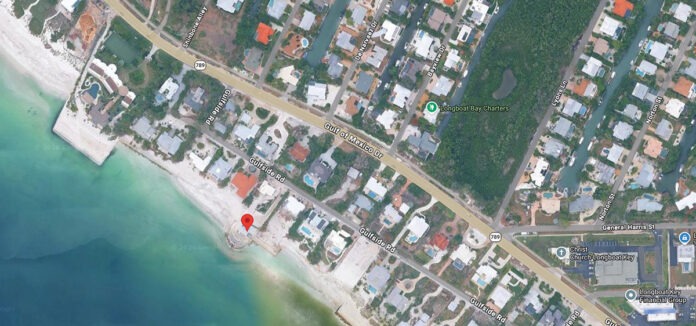
—Drive down Gulfside Road today, and you will see a barrier island that has fought its way back to life. A year and a half after Hurricanes Helene and Milton delivered a catastrophic one-two punch in the fall of 2024, Longboat Key is gleaming once more. Homes have been rebuilt, fresh sand has been meticulously graded, and the lush, tropical landscaping is finally growing back over the storm scars.
But at 6541 Gulfside Road, the recovery stops dead.
Sitting behind a chain-link fence is the “Half Moon House,” a property that once boasted million-dollar Gulf views but is now a rotting, structural carcass. Its battered pilings and fractured frame serve as a grim, daily reminder of the storms’ fury.
Now, the Town of Longboat Key is stepping in, preparing to use a precarious and rarely invoked legal rule to wipe the property off the map—and the Town Attorney is warning commissioners to keep their mouths shut.
—The Nuclear Option: Section 150.21—
This week, the Town’s Building Official slapped the Half Moon House with an official “Unsafe and Unfit” notice, adorning the property with bright red “Danger” placards. Citing severe, unrepaired damage to the home’s structural integrity, the town is moving swiftly toward a forced condemnation and demolition order. The Town’s Fire Marshal has backed the play, declaring the site “unsafe and uninhabitable” and barring any town personnel from stepping foot inside.
But forcing the demolition of private property is one of the most extreme—and legally perilous—powers a local government can wield. Under Section 150.21 of the Town Code, the government can effectively order a bulldozer to a private citizen’s doorstep if the owner fails to abate “unsafe” conditions. It is a precarious high-wire act that pits the absolute power of municipal government against fundamental private property rights.
—The Gag Order—
The stakes are so high that Town Attorney Maggie Mooney has effectively issued a gag order to the Longboat Key Commission ahead of their March 2, 2026 meeting.
On Monday’s Consent Agenda is Item #5F, a request to hire outside special litigation counsel specifically to handle the Half Moon House dispute. But in a sharply worded email to the Commission, Mooney warned leaders not to use the agenda item to publicly debate the condition of the house or the ramifications of tearing it down.
“In my opinion, such a public discussion at this time would be inappropriate and potentially create issues for the Town,” Mooney wrote.
The legal peril comes down to how the property owner decides to fight back. Under the Town Code, there are two distinct pathways for an appeal:
1. The Quasi-Judicial Route (Subsection H): The property owner can appeal the demolition to the Town Commission itself. If this happens, the Commission essentially acts as a judge and jury. Because they would be presiding over a quasi-judicial hearing, the property owner is legally entitled to strict due process. Any public comments or behind-the-scenes conversations (ex parte communications) by commissioners right now could be viewed as bias, potentially handing the property owner a massive legal victory.
2. The Emergency Route (Subsection J): If the Building Official and Fire Marshal bypass the Commission and declare an “Emergency Demolition,” the appeal skips the town entirely and goes straight to a Circuit Court judge.
Because it is not yet clear which legal pathway will be triggered, Mooney strongly discouraged the Commission from engaging with residents or community groups about the property, instead offering to brief commissioners behind closed doors in one-on-one calls.
—Echoes of The Colony—
The Town of Longboat Key knows exactly how bruising this fight can be, and they are hiring a familiar mercenary to fight it.
The last time officials deployed this nuclear option was in June 2018, and the target was legendary: The Colony Beach and Tennis Resort. Once a world-renowned, glamorous vacation destination that hosted presidents and celebrities, The Colony spiraled into bankruptcy and closed in 2010. For nearly a decade, the resort sat vacant—a sprawling, decaying ghost town in the middle of one of Florida’s most exclusive zip codes.
When the town finally moved to condemn and demolish The Colony under the emergency provisions of Subsection J, it ignited a fierce legal battle. The fight ultimately dragged into the Circuit Court, where a judge upheld the town’s right to tear down the hazard, paving the way for a new era of development.
To ensure history repeats itself at the Half Moon House, the town is looking to authorize the hiring of Attorney Martin Garcia of the law firm Garcia Dell—the exact special counsel who successfully defended the town during the bitter Colony condemnation litigation. At a taxpayer-funded rate of $375 an hour, Garcia is being brought back to shield the town from the inevitable lawsuits that arise when a city decides to forcibly bulldoze real estate.
For now, the Half Moon House remains standing, a fenced-off monument to the fall of 2024. But with the legal machinery now grinding into motion—and town leaders bound by strategic silence—the message is clear: the grace period for hurricane recovery is over, and the bulldozers are standing by.

