
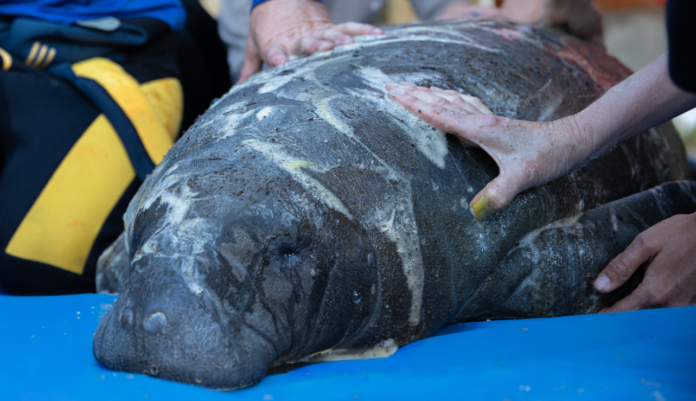
As a brutal winter cold front seized Florida in late January, plunging air temperatures into the 30s and sending water thermometers nose-diving, a silent crisis began to unfold beneath the waves.
While residents bundled up against the chill, Florida’s most vulnerable marine giants were fighting for their lives.
In a heroic response to this environmental emergency, Mote Marine Laboratory & Aquarium has taken in nearly 30 critical patients in just a matter of days—launching a high-stakes rehabilitation effort for three cold-stressed manatees and 25 comatose sea turtles.
The Silent Killer: When Water Turns to Ice
For us, a cold snap is an inconvenience. For a Florida manatee or a green sea turtle, it is a metabolic catastrophe.
Data from the recent “bomb cyclone” event reveals that local water temperatures in bays and estuaries—where these animals forage—plummeted rapidly. When water temperatures drop below 68°F (20°C), manatees, which have surprisingly little body fat to insulate them, begin to suffer from Cold Stress Syndrome.
This condition is far more than just shivering. It is a physiological cascading failure. Their digestion shuts down, their immune system collapses, and their skin breaks out in white, frostbite-like lesions. Without warmth, they eventually become too weak to surface for air, leading to drowning.
For sea turtles, the threshold is even lower but the results are just as deadly. When water hits 50°F (10°C), they experience “cold stunning.” As ectothermic (cold-blooded) reptiles, they instantly lose the ability to regulate their body temperature. Their heart rate slows to a crawl, and they enter a state of forced hibernation, floating helplessly at the surface where they are vulnerable to boat strikes, predators, and pneumonia.
A Lifeline in Sarasota
Mote Marine Laboratory answered the desperate call.
The influx began with three young manatees pulled from the dangerously cold waters of Bear Creek in Pinellas County. On Tuesday, January 27, rescuers fought to save a young male. Two days later, on January 29, a young female and another male were pulled from the same chilling creek. These rescues were a massive coordinated effort involving the Florida Fish and Wildlife Conservation Commission (FWC), Bishop Museum of Science and Nature, Eckerd College Search and Rescue, and ZooTampa.
But the freezing tides brought more victims. On Tuesday, February 3, a convoy arrived at Mote carrying 25 green sea turtles, transferred from Florida’s east coast where the shallow lagoons had turned into icy traps.
“When cold-stressing and stunning occur, the ability to respond quickly and effectively is critical,” said Lynne Byrd, Rehabilitation & Medical Care Manager at Mote. “Mote’s facilities, protocols, and experienced staff allow us to provide high-quality rehabilitative care during periods when multiple species are impacted at the same time.”
Stepping Up When Capacity is Critical
This rescue mission comes at a pivotal moment. Florida’s critical care facilities for manatees are currently overflowing. Recognizing Mote’s world-class expertise, federal and state authorities recently upgraded Mote’s designation to a “light-critical care” facility. This crucial change allows Mote to accept patients directly from rescue sites, clearing a logjam in the system and freeing up space at primary hospitals for the most grave cases.
Mote is saving these animals without a safety net of their own. There is currently no designated federal or state funding for these specific emergency rehabilitations. Mote is diverting its own internal resources—money, staff, and medicine—to ensure these animals do not become casualties of the cold.
As winter’s grip fluctuates, Mote Marine Laboratory remains a beacon of hope on the Gulf Coast, proving once again that when nature turns harsh, human compassion and scientific expertise can turn the tide.
DATA SNAPSHOT: THE BIG CHILL
• Air Temps: Dipped into the 30s°F across Central Florida.
• Water Threat Level (Manatees): <68°F triggers metabolic shutdown.
• Water Threat Level (Turtles): <50°F causes immediate paralysis (cold stunning).
• Patients: 3 Florida Manatees, 25 Green Sea Turtles.
• Status: Critical but stable under 24/7 observation.

