
news@lbknews.com
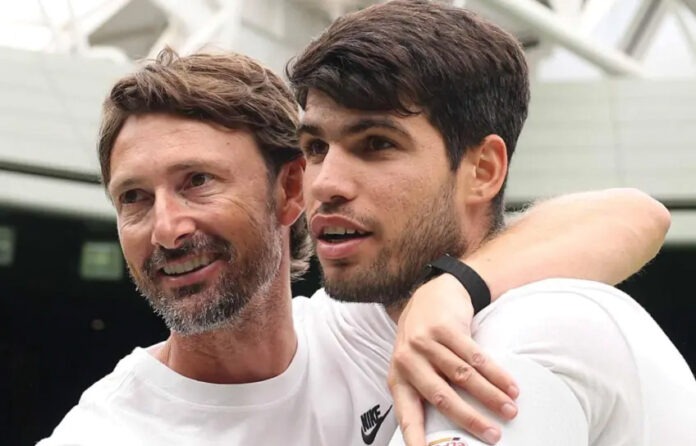
The silence in Carlos Alcaraz’s player box this January will be deafening. For seven years, the piercing gaze of Juan Carlos Ferrero was as much a part of the Alcaraz phenomenon as the thunderous forehands and the audacious drop shots. But as the 22-year-old superstar heads into the 2026 season, that seat will be occupied by a new face, and the tennis world is left grappling with a divorce that feels less like a professional parting and more like a family fracture.
While official statements have been polite—citing contract disagreements and a need for “new adventures”—insiders whisper a different, older story. The sudden split between the six-time Grand Slam champion and his mentor appears to be the classic, tragic collision of two powerful forces: the biological father and the professional father figure. In the high-stakes ecosystem of elite tennis, there is rarely room for two patriarchs.
The Conflict of “Two Dads”
To understand why this partnership dissolved, one must look beyond the baseline. Juan Carlos Ferrero was never just a coach. He was a molder of men. He took a raw, chaotic talent from Murcia and refined him into a world-beater, often employing a “tough love” approach that mirrored parenting. Ferrero was the one who imposed curfews, confiscated phones to ensure focus, and demanded a level of discipline that young prodigies often resent but desperately need.
This dynamic creates a potent, unspoken rivalry with the biological family. For years, rumors have circulated about tension between Ferrero and Carlos Alcaraz Sr. The elder Alcaraz, himself a former player with unfulfilled professional dreams, has been an omnipresent force in his son’s life. As Carlos Jr.’s fame and fortune ballooned into the stratosphere, the boundaries of control began to blur.
Sources indicate that the final straw wasn’t money, but authority. Reports of a “big fight” and a contractual ultimatum delivered to Ferrero suggest a power struggle where the Alcaraz family sought to reclaim the reins. It is a tale as old as the sport itself: the coach builds the machine, but the family owns the keys. When a coach assumes the role of a “third parent”—disciplining the player, managing their schedule, and shielding them from “yes men”—they inevitably clash with the actual parents, who may view this protection as exclusion.
The Weight of the Coaching Bond
In tennis, the player-coach relationship is arguably the most intimate in sports. Unlike team sports where a coach manages a roster, a tennis coach is a travel companion, a psychologist, a tactician, and a confidant, 24 hours a day, 10 months a year. Ferrero’s value was his ability to be the “bad cop”—the voice of reason who could tell the World No. 1 that he wasn’t working hard enough.
This is where the “father figure” role is distinct, and dangerous. A biological father provides unconditional love; a professional father figure provides conditional approval based on performance and discipline. Alcaraz thrived on Ferrero’s approval. We have all seen Carlitos look to his box in moments of panic, seeking not just tactical advice, but emotional stabilization from Ferrero.
By removing Ferrero, the Alcaraz camp has removed the one voice in the room willing to say “no.” The danger now is that Alcaraz surrounds himself with a team that serves the family hierarchy rather than the brutal necessities of the tour. History is littered with careers derailed when the “family business” took precedence over professional detachment.
The Shadow Over 2026
As Alcaraz prepares to defend his ranking in 2026, the absence of Ferrero presents a terrifying variable. The technical adjustments—such as the new service motion currently being supervised by replacement coach Samuel López—are minor compared to the psychological void.
The challenges for Alcaraz in 2026 will be internal. When the fifth set deepens at the Australian Open and the legs get heavy, who will anchor him? Ferrero’s stoicism was Alcaraz’s mirror; without it, will the young Spaniard’s fiery temperament burn too hot? Critics like Todd Woodbridge have already predicted a potential “Grand Slam-less” year, fearing that Alcaraz will feel “unsure of himself” without his longtime compass.
Furthermore, the timing is perilous. Rivals like Jannik Sinner are surging, sensing blood in the water. Sinner’s team is a model of clinical, corporate efficiency, contrasting sharply with the emotional upheaval currently rocking Team Alcaraz.
Carlos Alcaraz is now a grown man, as former World No. 1 Yevgeny Kafelnikov recently noted. He is free to make his own choices. But in siding with his bloodline over his sideline mentor, he has taken the biggest gamble of his career. He has regained his autonomy, but he may have lost his armor. The 2026 season will reveal whether the King of Clay can rule without the man who built his crown.


What a wonderful article Looks like an X-rays in how tennis is managed inside the players world