
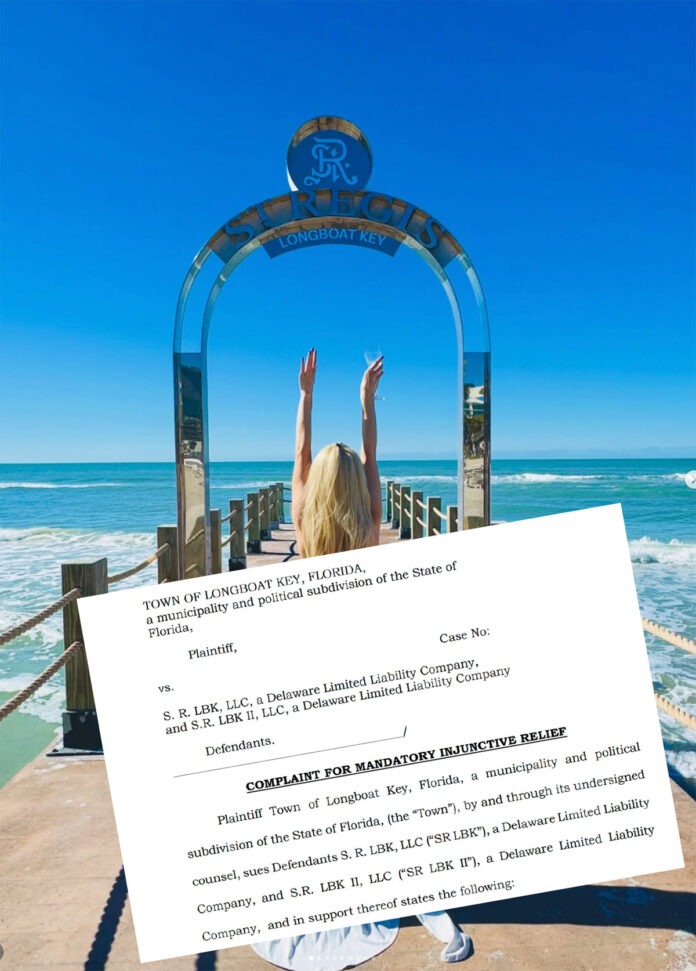
The case has a number now. At 2:19 p.m. on Friday, May 15, special counsel Martin Garcia electronically filed the Town of Longboat Key’s Complaint for Mandatory Injunctive Relief in the Twelfth Judicial Circuit in and for Sarasota County. The defendants are SR LBK, LLC and SR LBK II, LLC — Chuck Whittall’s Delaware entities. The relief sought is the demolition of an arch and sign Whittall told the Town Manager last Friday he would not take down. A judge will now decide who is right.
For a year, the dispute over the St. Regis arch lived in memos, draped fabric, ordinance drafts, Planning and Zoning Board denials, and a phone call between two men. As of 2:19 p.m. Thursday afternoon, it lives in the Twelfth Judicial Circuit, Sarasota County as a thirteen-page Complaint for Mandatory Injunctive Relief, signed by attorney Martin Garcia of GarciaDell, P.A., on behalf of the Town of Longboat Key.
The complaint names two defendants: SR LBK, LLC, the Delaware entity that holds title to the St. Regis property at 1601 Gulf of Mexico Drive, and SR LBK II, LLC, the entity identified in the construction permits for the groin. Both, the Town pleads, are “controlled and managed, directly and/or indirectly, by Charles Whittall.”
It asks the court to enter “a Permanent Mandatory Injunction directing and ordering that SR LBK, LLC and SR LBK II, LLC immediately remove the arch and sign which have been illegally installed on the groin.”
The structure that Whittall told this newspaper “will be here for generations” now has a deadline that will be set by a Sarasota County judge, not by him.
The Trapdoor: Whittall’s Own 2022 Permit
The single most powerful paragraph in the Town’s complaint is not about the arch. It is about a permit Whittall sought four years ago.
In 2022, after obtaining what the Town calls a “De Minimis Exception” from the Florida Department of Environmental Protection for rebuilding the existing groin, SR LBK II nevertheless applied to the Town for a building permit. On December 16, 2022, the Town issued one. The work was completed by April 2023 and inspected and approved on April 12, 2023.
Two years later, in February 2024, Unicorp returned to the Town for another permit — this time for the “post and rope” handrail Whittall now describes as part of the same project as the arch. The Town issued Permit PB24-0117 on March 5, 2024. The handrail work was completed and finaled on July 17, 2024.
The complaint hammers the point home: “SR LBK II also sought and obtained a building permit from the Town, recognizing that the groin was within the Town’s jurisdiction and that the rebuilding of the groin was subject to the Town’s Code of Ordinances.”
This is the trapdoor. Whittall has spent the last two weeks arguing — to this newspaper, to the Town Manager, to anyone who will listen — that the groin sits in state waters, that the Florida DEP is “the proper agency,” and that the Town has no jurisdiction over what is built on the groin. The Town’s complaint replies, in essence: You agreed it was our jurisdiction. Twice. In writing. On your own permit applications.
As the complaint phrases it: “The groin itself is within the Town’s territorial and regulatory jurisdiction, which SR LBK/SR LBK II acknowledged by seeking, and obtaining, from the Town a building permit in 2022 for the repair of the groin as well as a building permit in 2024 for the installation of the rope handrail on the groin.”
The Field Permit That Came With Strings
Whittall’s secondary argument — that a February 19, 2024 FDEP “Field Permit” authorizing the installation of “post, rope and sign” pre-empts Town jurisdiction — runs into a problem the Town quotes from the face of the permit itself.
The Field Permit, attached to the complaint as Exhibit 2, includes a Special Permit Condition stating that it “is valid only after all applicable federal, state and local permits are obtained and does not authorize contravention of local setback requirements or zoning or building codes.”
A second special condition adds: “Structure should be installed per local governmental ordinances.”
And then there is the matter of Whittall’s signature. On the Field Permit application, dated February 21, 2024, Whittall personally certified — in his capacity as agent for SR LBK II — that he “shall obtain any applicable licenses or permits which may be required by federal, state, county or municipal law prior to commencement of the authorized work,” and that he accepts “responsibility for compliance with all permit conditions.”
The Town’s argument from there is a closed loop: the state’s own permit told Whittall he needed a Town permit. He signed the form acknowledging he would obtain one. He did obtain one — for the handrail. He never applied for one for the arch.
The complaint puts this in two sentences side by side: “SR LBK II thereafter complied with these conditions in the FDEP Field Permit when it undertook the construction of the handrail, with the posts and rope, by obtaining a Building Permit from the Town for such work in 2024. SR LBK II, however, failed to comply with the FDEP Field Permit conditions prior to and as a condition for installing the arch and sign.”
What Was Actually Drawn — and What Wasn’t
Buried in the exhibits is a detail that may matter more than its placement suggests. The Field Permit application Whittall submitted to FDEP, the Town pleads, contained “plans provided details as to posts being installed on the surface perimeter of the groin, including how the posts would be affixed to the surface of the groin.”
But: “it does not appear that the plans contained any details as to the installation of any sign or arch on the groin. Rather, the only indication in the plans as to sign or arch was a computer generated rendering of the groin with the posts and ropes installed along with an arch on the groin with a sign.”
In other words: the engineering drawings showed posts and ropes. A separate artistic rendering showed an arch. The artistic rendering, the Town argues, is not engineering, and it is not a permit application. A judge will be asked to consider whether a watercolor of two people holding hands beneath an archway, attached to a Florida state field permit application, constitutes regulatory authorization for a 14-foot welded marine-stainless structure.
The same problem repeats at the Town level. When Duncan Seawall, Dock and Boat Lift, LLC, submitted SR LBK II’s handrail building permit application to Longboat Key in February 2024, the complaint states, the application “did not include details or a request for the arch structure with signage.” It depicted “3’ 6” high, 8” x 8” timbers with holes in the timbers for 2” synthetic rope.” The arch appears nowhere in the technical drawings — only, again, in an artistic rendering on a single 8.5” x 11” sheet tucked into the file.
The Town’s position is that an arch you decline to engineer is an arch you never permitted.
The Four Code Violations
The complaint identifies four specific provisions of the Town’s Code of Ordinances the arch and sign are alleged to violate.
Zoning Code Section 158.094(C) — the arch and sign “constitute a structure which was constructed seaward of the Erosion Control Line.”
Zoning Code Section 158.099(A) — the arch and sign on the groin “constitute a structure over water, which is required to be permitted in accordance with the provisions of that Chapter.”
Sign Code Section 156.05 — “the Town has never issued a permit to authorize the permanent sign, as required by Section 156.05.”
Sign Code Section 156.07(C) — “the sign itself is prohibited under Section 156.07(C).”
These four numbered code citations, taken together, are the legal architecture on which the Town hopes to stand. The complaint concludes that “SR LBK/SR LBK II’s failure to remove the arch and sign, after demand, and without having obtained a permit and/or a zoning exemption from the Town constitutes a violation of the Town’s Zoning Code and Sign Code.”
“Doubled Down”: The Faux Greenery Comes Off
The most evocative single word in the complaint is doubled. It appears at paragraph 44.
“Not only did SR LBK/SR LBK II not remove the arch and sign by that deadline,” the Town writes of Friday’s 5:00 PM deadline set by Town Manager Howard Tipton, “it ‘doubled down’ by removing the faux greenery which it had previously placed over the sign portion of the arch.”
That is news. During the months when SR LBK was pursuing the now-withdrawn Text Amendments, the company had agreed to cover the signage portion of the arch with faux greenery — fabric and silk foliage designed to obscure the “St. Regis” lettering and crown insignia from the beach. That covering, by Whittall’s own gesture, was the public-facing concession that the sign was at issue. Its removal — pleaded in the complaint as a deliberate act after the deadline passed — has now been entered into the court file as evidence of defiance.
For a circuit court judge weighing the equities of a mandatory injunction, “doubled down” is the kind of phrase that does work.
A Footnote on a Footnote: Did the State Permit Even Apply?
In Footnote 1 of the complaint, attached to paragraph 31, the Town raises a second, more technical attack on Whittall’s reliance on the FDEP Field Permit.
The Field Permit, on its face, expired on February 19, 2025. The arch and sign were constructed in August 2025 — six months after expiration. Florida law allows certain construction permits to be tolled and extended under § 252.263(1)(b), Fla. Stat., typically in connection with a declared state of emergency. But the Town says it has seen no evidence that SR LBK II ever filed the written notice that statute requires.
“While the Town currently presumes SR LBK II exercised its rights under §252.263(1)(b), Fla. Stat., to toll and extend the Field Permit beyond 2/19/2025,” the footnote reads, “the Town currently does not have any evidence of a written notice being provided to the FDEP in compliance with that statute. If no such notice was given, SR LBK II’s reliance on the Field Permit as its basis for installing the arch and sign is wholly unfounded for the simple reason that the Field Permit had expired by August 2025.”
Translated: the Town is reserving the right to argue that the state permit Whittall keeps invoking was not even in effect on the day the arch went up.
The Master Sign Permit That Wasn’t
The complaint also addresses, and dispenses with, an argument Whittall had floated earlier in the dispute — that the arch was covered under the existing master sign permit for the St. Regis development.
When the Town’s Director of Planning, Zoning & Building, Allen Parsons, first contacted SR LBK after the August 2025 installation to tell the company the arch was non-compliant, the complaint pleads, “Mr. Whittall responded that he was told the arch and sign was included within the master sign permit which the Town had previously given for the St. Regis development.”
Parsons replied, the complaint continues, that “the groin arch and sign was not part of a master sign permit, and that while Mr. Parsons was willing to talk to Mr. Whittall as to how he could seek to amend the Town’s Code of Ordinances, the sign would have to be removed, either permanently or until a Town Code change allowed the structure and sign to be located on the groin.”
The Town pleads that “SR LBK/SR LBK II did not remove the arch and sign as instructed by Mr. Parsons.”
Why “Irreparable Harm” Is Already Won
A plaintiff seeking a mandatory injunction in Florida normally has to prove four elements, one of which is irreparable harm — the kind of injury that cannot be undone with money damages. In ordinary litigation, that is a high bar.
In code enforcement litigation, the bar collapses. The Town’s complaint cites the Second District’s 2005 decision in Ware v. Polk County, 918 So.2d 977, for the proposition that “as SR LBK/SR LBK II has violated one or more of the provisions of the Town’s Code of Ordinances, and because the Town is seeking injunctive relief, irreparable harm is presumed and any alternative legal remedy is ignored.”
That single citation is the procedural reason this case is moving fast. The Town does not have to prove damages. It does not have to quantify lost tax revenue or aesthetic injury. It has to prove that the arch violates the code. If it does, under Ware, the injunction follows almost automatically.
The Defendants’ Address — and a Telling Land Map
Exhibit 1 to the complaint is an aerial map of the Town’s territorial boundaries, marked in red, depicting Longboat Key from its north end on Anna Maria Sound to its south end at New Pass. The Town has filed it to make the affirmative case that the groin — and the structures on it — fall within municipal jurisdiction.
Exhibit 2 is the eight-page Florida DEP Field Permit Whittall has been citing as his authority. It is the document whose own Special Conditions, the Town now argues, refute the very position Whittall has built around it.
Exhibit 3 is a developer’s sketch of the arch itself, prepared by K&G Marine of Davie, Florida, for “Unicorp National Developments Inc., Att.: George Giebel, St Regis Sign,” dated April 28, 2025. It depicts the structure in cross-section: a flanged I-beam frame, twelve feet tall, with welded marine stainless steel, the letters “ST. REGIS” across the apex, “LONGBOAT KEY” below it, and the crown medallion on top. The arch shown in Exhibit 3 is the arch the Town wants demolished.
That an internal engineering drawing exists, dated April 2025, prepared months before the arch was installed in August 2025, will likely become its own piece of evidence. It establishes the structure was professionally designed and detailed — and that the design, with all its specifics, was never submitted to the Town for permit review.
What the Court Is Being Asked to Do
The complaint’s “WHEREFORE” clause — the formal statement of the relief sought — asks the court to do four things:
First, to enter a Final Judgment finding that SR LBK and SR LBK II violated Sections 158.094(C), 158.099(A), 156.05, and 156.07 of the Town’s Code of Ordinances.
Second, to enter a Permanent Mandatory Injunction “directing and ordering that SR LBK, LLC and SR LBK II, LLC immediately remove the arch and sign which have been illegally installed on the groin.”
Third, to reserve the court’s jurisdiction to enforce the terms of that injunction — a standard provision that allows the judge to hold further hearings and impose sanctions if the order is ignored.
Fourth, to award costs in favor of the Town and against SR LBK and SR LBK II.
Notably, the complaint does not ask for attorney’s fees in its WHEREFORE clause — consistent with what Town Attorney Maggie Mooney told the Town Commission on May 4: “I cannot guarantee this commission that we will recover attorney’s fees and costs.”
The Town wants the structure down. It wants its costs back. Beyond that, it is asking the court for nothing it has not been promised by statute.
Litigation Is the Substrate of This Property
Anyone surprised that the St. Regis arch is heading to court has not been paying attention to the eighteen acres on which it stands. Litigation is not an interruption of life on this parcel — it is the geological layer beneath everything built on it. Strip away the cabanas, the wedding lawn, the porte-cochère, the boardwalk, and the groin, and what you find at the bedrock is forty years of legal filings. In 1988, Colony founder Dr. Murray “Murf” Klauber sued the Town of Longboat Key after the Town pulled his building permit for a luxury spa condominium called The Reserve. Eight years later, a federal jury awarded him nearly $9 million for civil rights violations, and the Town settled for $6.5 million in cash in March 1997. In 2007, Klauber sued his own Colony condo owners over $14.1 million in disputed repair costs. In 2009, Bank of America foreclosed on him. By 2010, the Colony was closed; by 2013, Klauber had thrown three of his Colony companies into Chapter 11 to stall a Sarasota foreclosure hearing. The bankruptcy court eventually wrested the property from his hands. He died in 2018, the same year the buildings came down.
Then came Whittall’s turn at the wheel. After buying the wreckage in 2016 for $22 million, Unicorp spent the next five years in court against Tennessee developer Andy Adams, who controlled seventy-five units and refused to sell at Whittall’s price — a dispute the local press christened the Colony’s “Battle of Gettysburg.” Other unit owners filed their own motions and their own threats to challenge the Town’s approval of the project. Judge Hunter W. Carroll spent years parsing the resulting tangle before the condominium association was judicially terminated in 2021. By the time Whittall settled with Adams that April for somewhere north of $15 million, he estimated his total spend on the property and demolition — before a single new wall went up — at approximately $80 million. Now, having battled the Klaubers’ aftermath, the holdout unit owners, and the bankruptcy court, Whittall is set to battle the Town that approved his project in the first place. The arch dispute is not the first courtroom this parcel has seen. It is just the next stratum.
What Whittall Said Last Week
Against the backdrop of the complaint, Whittall’s statements to this newspaper last week now read as the public-relations companion to a position about to be tested in court.
“The state gave us a permit to build a groin, do ropes and columns and put a sign on it,” Whittall said. “Maggie Mooney said she does not agree. The state said they are the proper agency. We believe we have rightly built the sign.”
Garcia’s complaint replies: the state permit said the opposite. The state permit said local codes apply. Whittall’s own signature certified it.
“It is not offensive — it is beautiful,” Whittall said. “It looks like a 1950s Monaco pier.”
The complaint does not address beauty. It addresses Section 158.094(C).
“We will fight it on every level, whether it’s the Florida Supreme Court,” Whittall said.
He may yet. But the appellate ladder begins in the Twelfth Judicial Circuit, and the rung labeled Town of Longboat Key v. SR LBK, LLC and SR LBK II, LLC has now been set in place.
What Tipton Said
Town Manager Howard Tipton, after Whittall’s Friday 5:00 PM phone call telling him the arch would not come down, declined to escalate the rhetoric.
“I appreciate that he created a great resort out of the dilapidated Colony, and so much effort to buy the individual units,” Tipton said. “Chuck wants to work together. It is not going through Town Code Enforcement. It is going straight to circuit court.”
Thursday afternoon, that prediction became a docket entry.
What Happens Next
SR LBK and SR LBK II will be served with the complaint and summons in the coming days. Florida’s Rules of Civil Procedure give them twenty days from the date of service to file an answer or a motion to dismiss. Given Whittall’s stated litigation posture and the depth of Unicorp’s legal bench, a motion to dismiss is likely — testing the Town’s jurisdictional theory before the case ever reaches discovery.
If the motion to dismiss is denied, the case will move to discovery: depositions of Whittall, of Parsons, of Mooney, of Tipton, of Duncan Seawall personnel, possibly of the K&G Marine designer who drew Exhibit 3. Document production will likely reach into Unicorp’s correspondence with FDEP, with K&G Marine, and with the Town’s own Planning and Zoning office.
A hearing on the Town’s request for a permanent injunction — and possibly an earlier hearing on a temporary injunction — will eventually be set by the assigned judge.
Whittall has promised to take the case to the Florida Supreme Court if necessary. The Town has promised to pursue cost recovery without guaranteeing it. The arch, draped no longer in faux greenery, now bears the more permanent covering of a case caption: Town of Longboat Key, Florida, Plaintiff, v. SR LBK, LLC, and SR LBK II, LLC, Defendants.
A judge will decide the rest.
The Complaint for Mandatory Injunctive Relief was filed at 2:19:05 p.m. on May 15, 2026, in the Twelfth Judicial Circuit in and for Sarasota County, Florida. Filing # 248297089. Special counsel for the Town is Martin Garcia of GarciaDell, P.A., 1819 Main Street, Suite 300, Sarasota.

