
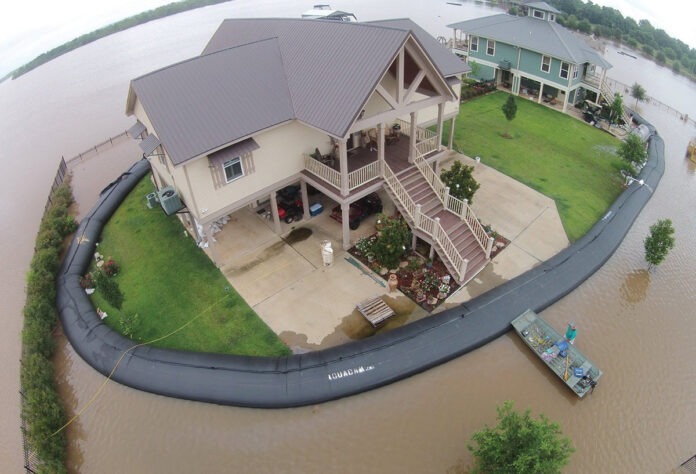
Two years after Hurricanes Helene and Milton ravaged the island, Longboat Key officials are preparing to tackle a growing trend: homeowners deploying massive freestanding flood barriers. But as the Town Commission will discuss next Monday, one resident’s salvation could become a neighbor’s destruction.
Two years have passed since the skies over Longboat Key darkened and the Gulf of Mexico rose to claim the land. The devastating twin blows of Hurricanes Helene and Milton remain etched into the memories of every homeowner, business owner, and town official on this fragile barrier island. The storms didn’t just rip roofs from homes or wash sand over Gulf of Mexico Drive; they tore into the financial and emotional fabric of the community. As noted in the Town’s mid-year financial update, the catastrophic toll slashed the municipal fund balance dramatically—from $15.3 million down to $9.4 million. Yet, even as the community rebuilt, the existential dread of sea-level rise and future massive storm surges lingered heavily in the salt air.
—Today, the town is no longer just reacting; it is desperately searching for ways to hold back the tide. Next Monday, on May 18, 2026, the Longboat Key Town Commission will convene for a critical Regular Workshop. At the heart of the agenda is Item 4A—an actionable discussion that cuts straight to the core of island survival: the deployment of freestanding flood-control barriers, commonly known as “Aqua Dams”.
—As climate-charged storms become more frequent and insurance costs skyrocket, desperate property owners are turning to modern, rapid-deployment solutions. Traditional sandbags are being replaced by an exploding market of freestanding flood barriers. According to Town Planning, Zoning & Building Director Allen Parsons, the U.S. market for these fillable barriers is projected to grow by 7.4% annually, reaching $600 million by 2033. Florida, naturally, is anticipated to be among the highest in adopting these measures.
—The Rise of the Aqua Dam
—Homeowners and businesses are investing heavily in various systems to ring-fence their properties against the rising waters. The most common types include:
•Modular and L-Shaped Barriers: Interlocking systems that brilliantly use the weight of the floodwater itself to anchor the units to the ground.
•Water-Filled Tubes: Heavy-duty PVC tubes filled with onsite water to create a massive, durable berm that can be stacked to reach significant heights.
•Inflatable and Air-Filled Barriers: Lightweight membranes that use air to conform to uneven terrain.
—</span•Door & Window Shields: Temporary structures that provide a watertight seal for entryways without requiring permanent hardware.
—A False Sense of Security? The Hidden Dangers
—But as the old island saying goes, water always wins. Trying to cheat the ocean can sometimes lead to disastrous, unintended consequences. Recognizing this, the Town engaged Del Schwalls, an environmental engineer with 25 years of experience in floodplain management, to investigate the real-world implications of these barriers in hurricane storm-surge environments. His findings, which will be presented to the Commission for direction, serve as a stark warning.
—The core issue lies in the brutal physics of a hurricane. Freestanding barriers that rely on hydrostatic pressure (the force of standing water) are not designed to resist hydrodynamic pressure (the violent force of moving water and crashing coastal waves). Schwalls noted a particularly dangerous scenario: inflatable barriers filled with air or fresh water are inappropriate in saltwater environments, as they will have significantly increased buoyancy and a greater chance of failure due to flotation. In the midst of a tidal surge, these barriers can easily detach and transform into massive, destructive storm debris.
—The Neighbor Effect: When Protection Causes Destruction
—Even more concerning is what experts call the “neighbor effect.” When perimeter barriers are erected around multiple properties, they displace the massive volume of floodwater. In a storm surge, when violent waves encounter a solid freestanding wall, the wave energy doesn’t simply disappear—it is diverted.
—This diverted energy potentially increases the storm surge velocity and scour on adjacent, unprotected properties. It forces the water vertically or horizontally, often resulting in devastating damage to the upper floors of neighboring buildings that would otherwise be safely above the inundation level. In their desperate attempt to save their own properties, well-meaning residents could inadvertently be flooding and destroying their neighbors’ homes.
—Charting a Course for Safe Resilience
—Currently, under guidance from the Florida Division of Emergency Management and FEMA, the deployment of freestanding flood-control measures that do not involve altering or modifying a building does not require permits. But given the life-safety issues and the unique threat of coastal storm surge, Schwalls and Town staff are investigating whether the Town should consider some form of permitting or helpful guidance.
—To prevent chaotic and dangerous deployments, the Town is exploring requirements that would mandate an engineering evaluation by a registered professional engineer before these barriers can be used. Homeowners would need to definitively prove through analyses that their barriers will not increase flood depths, wave action, or scour on adjacent properties. Furthermore, the barriers would need to be certified to withstand the calculated surge, wave, and wind forces of Longboat Key’s specific coastal environment, ensuring they are properly anchored.
—The intense, actionable discussion scheduled for next Monday represents a turning point for Longboat Key. It is a sobering acknowledgment that as the waters continue to rise, the community cannot afford a “Wild West” approach to flood mitigation. Survival on the barrier island will require more than just individual ingenuity; it will demand collective responsibility, strict engineering standards, and a unified front against the encroaching sea.

