
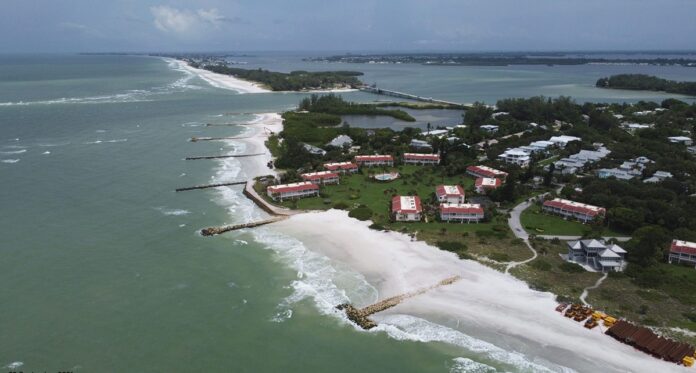
For most of its history, Longboat Key paid its own way to the water. Residents taxed themselves to truck in sand, groomed their own shoreline, built their own parks and kept access intentionally quiet. For most of its history, Longboat Key paid its own way to the water. Residents taxed themselves to truck in sand, groomed their own shoreline, built their own parks and kept access intentionally quiet.
—The bargain was simple: pay for the beach, keep the beach. The mainland could go to Lido, Siesta or Cortez.
— —That bargain is over — and a small but vocal group of residents around Bayfront Park is just now reckoning with what replaced it.
— —The complaint that surfaced again at recent town meetings — too many beach cars, too many tents and grills, too much noise where pickleball players, dog walkers and shuffleboard regulars used to have the run of the place — is, at its root, a complaint about the cost of partnership. The town no longer writes the check for its beach alone. It writes it with Tallahassee, Washington and Sarasota County. And every co-signer brings a condition.
— —The End of an Insular Era
— —Longboat Key’s beaches were, for decades, a self-funded project. Voters approved a $16 million bond in 2011 to keep sand on the shoreline. The town levied its own erosion-control tax to pay it back. Renourishment cycles, dredge schedules and dune work were Longboat’s expenses to bear, and Longboat’s alone.
— —The trade-off was control. The town chose how big the public access points would be, where the parking would sit, how visible to invite the rest of the region to be. It chose modest.
— —What changed wasn’t the philosophy. It was the price.
— —The Deal: Sand for Parking
— —The most expensive condition lives in the asphalt across Gulf of Mexico Drive from the recreation center.
——To qualify for state beach renourishment dollars, Florida requires meaningful public access — parking, restrooms, the works — within a defined radius of the funded shoreline. Bayfront Park is the only spot on the 11-mile island that has the room. So it is the lever the town pulls to unlock state participation in a project that, in 2028, is currently scoped at roughly $32.9 million and 800,000 cubic yards of sand.
— —The state’s slice of that 2028 project is about $7 million. FEMA is in for $12.2 million. Tourist development taxes contribute roughly $5 million. The remainder rolls in from earlier renourishment funds.
— —Town Manager Howard Tipton, in an interview, framed the long-run trade in plainer terms.
“They pay millions toward the town’s beaches,” Tipton said. “It’s a small price to pay for the beach.”
— —In Tipton’s accounting, the state has historically delivered something on the order of $10 million every seven or eight years — money that exists on the ledger only because the town keeps the bathrooms open, the spaces striped and the gate, in effect, unlocked.
— —Why Sand Has Stopped Being Cheap
— —That money matters more every cycle, because the commodity itself has gotten brutal.
— —Longboat Key’s first island-wide renourishment in 1993 placed 1.95 million cubic yards at roughly $5 per cubic yard. The 2028 project is budgeted at about $41 per cubic yard for less than half the volume. The 2024 hurricane season alone — Helene and Milton, principally — stripped an estimated 400,000 cubic yards from the island.
“The cost of sand continues to scale,” Tipton said.
— —In a market where sand has become a regional scarcity and offshore borrow areas are increasingly contested, every outside dollar the town can pull in is a dollar it doesn’t have to raise from its own taxpayers.
— —The County’s Deal: Parks for Parking
—The state isn’t the only outside check the town now cashes.
— —Sarasota County wrote a $2 million one in 2016 to help build out the 3.54-acre Bayfront Park addition — the parcel the county itself had acquired in 2007 for about $8 million through its Neighborhood Parklands program. The playground, the picnic shelters, the docks, the rain garden, much of the parking now under dispute: county money, county parcel, town management.
— —The Town Center Green library now in design is the next chapter. Sarasota County is paying for the roughly 8,000-square-foot core building and will operate it on a 50-year lease. The town is fundraising privately for the enhancements. When that opens, it will sit alongside the Bayfront Park complex as another public-facing amenity — and another draw for cars.
—The pattern is consistent. When Longboat Key paid for everything itself, it could keep things small. The minute outside money started flowing in — for sand, for the park addition, for the library — outside expectations of public access came with it.
—Each grant, each county contribution, each FEMA reimbursement carries a covenant. Build it. Open it. Park them.
“An Existing Situation”
— —Tipton has heard the parking complaints before, and he draws a careful line around them.
— —The Bayfront Park stretch, he noted in our interview, is the most heavily trafficked public area on the key. The beaches are open until 11 p.m. The pickleball courts, the dog park and the rec center have always been town amenities open to anyone who shows up. The added parking has, indisputably, brought more people. But the park itself, and the public’s right to use it, predates almost every nearby objection.
“Some of the loudest complaining moved into an existing situation,” Tipton said. “People are using a town amenity.”
— —That doesn’t dismiss the trash, the cigarette butts, the dogs where they shouldn’t be or the tents left behind — code issues the police department has answered with extra foot and ATV patrols this month. It does, however, locate the parking debate where it actually sits: not as a question of whether Bayfront Park became a public beach, but of how a town that wanted to stay insular ended up codifying public access in exchange for the dollars that keep its sand in place.
— —What’s Coming in 2028
— —The next renourishment is not a routine refill. It is, by Tipton’s description, a structural intervention.
—The 2028 project will pair sand placement with a groin field on the most erosive stretch of the island — the Gulfside Road shoreline immediately south of the Ohana seawall, where downshore wave action and a hard sea floor have ground the beach away faster than anywhere else on the key. Tipton said the rate of nourishment in that segment now requires permanent structures, not just imported sand.
—The North-End Proof
—The model is a few miles north. The seven-groin field at the north end — two permeable adjustable groins installed in 2015, plus the T-head groins added in 2021 — is, in Tipton’s word, performing. Satellite imagery four years on shows much of the 2021 sand still in place even after the 2024 storm season.
“The north-end groins have demonstrated their use,” Tipton said.
— —If the southern field works as the northern one has, the math improves: less sand needed per cycle, longer intervals between projects, lower per-cubic-yard pain. None of that, however, lessens the parking calculus at Bayfront. The state’s formula doesn’t care which end of the island is being rebuilt. Within a mile of the funded shoreline, the spaces have to be there.
— —What Residents Are Actually Asking
— —The neighbors are not asking the town to give back the state’s check. They are asking whether the parking burden can be redistributed — whether expansion can be spread across the smaller beach access points up and down Gulf of Mexico Drive instead of concentrated at the one park where the rec center, the dog park, the courts and the playground already compete for the same pavement.
— —It is a reasonable question. It is also a question with a hard ceiling. The state grant follows a defined radius from a qualifying access point, and Bayfront is the only point on the island with the footprint to hold the count. Smaller satellite lots can supplement. They cannot substitute.
— —That is the trade Longboat Key made when it stopped paying for the beach by itself. The sand comes in. The groins go up. The check clears. And the cars line up across the street from the recreation center, where they will keep lining up for as long as the island wants someone else to help pay for the shoreline that defines it.

