
This is not a routine zoning dispute. This is a confrontation between two legitimate and powerful claims on the same small barrier island — the economic power of a half-billion-dollar resort that has fundamentally transformed Longboat Key, and the legal and moral authority of a community that built one of the most carefully preserved beach environments in Florida and intends to keep it that way.
—It has been draped in fabric since code enforcement officers came calling — a 14-foot metallic arch bearing the unmistakable crown logo of the St. Regis hotel brand, standing at the end of a boardwalk jutting into the Gulf of Mexico, shrouded now like a piece of furniture in a house where someone has died.
—On Monday, May 4, the Longboat Key Town Commission decides whether it stays or goes.
—That simple sentence does not capture what is actually at stake. This is not a routine zoning dispute. This is a confrontation between two legitimate and powerful claims on the same small barrier island — the economic power of a half-billion-dollar resort that has fundamentally transformed Longboat Key, and the legal and moral authority of a community that built one of the most carefully preserved beach environments in Florida and intends to keep it that way.
—It is a story of big money, big principle, and a footnote in a law firm’s application letter that no one has talked about publicly — a footnote that turns Monday’s vote into something far more consequential than a planning board recommendation.
—A lawsuit is waiting in the wings. The question is whether the Town Commission opens that door or closes it.
—Where This Started: The Old Colony Groin and a Crown Logo
—Before there was a St. Regis on Longboat Key, there was the Colony Beach Resort. And before there was a St. Regis arch, there was the Colony’s groin — a rock structure extending into the Gulf from the Colony property, which by the time Unicorp National Developments purchased the site was, in the company’s own words, “in very poor condition.”
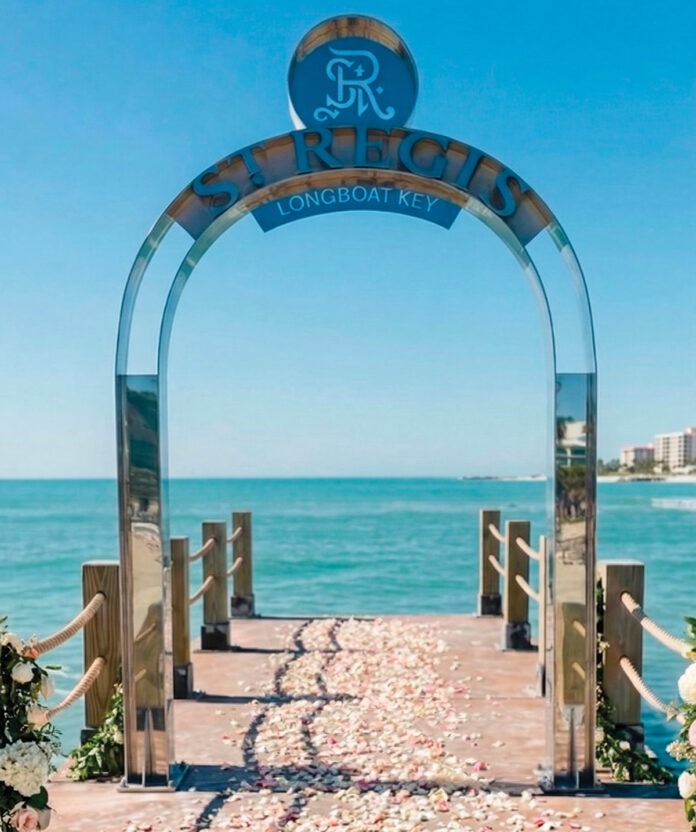
—Unicorp CEO Chuck Whittall repaired it. He added a pedestrian boardwalk with rope railings on top. And in August 2025, he topped that boardwalk with a gleaming metallic arch bearing the St. Regis crown logo and the words “ST. REGIS — LONGBOAT KEY” in polished lettering framing an open view to the Gulf horizon.
—He did not have a Town permit for the arch or the sign.
—The State of Florida, for its part, had approved it. When Unicorp applied to the Florida Department of Environmental Protection in 2024 for groin repair permits, those application materials included the archway and sign. The DEP issued the permit. The sovereign submerged state lands on which the groin sits — because all land seaward of the Erosion Control Line belongs to Florida, not to Unicorp — were cleared for the structure by the state agency responsible for them.
—What was missing was Town approval. Town staff informed Unicorp that the arch and sign needed to be added to the Town’s own permit — and that, in staff’s reading, the Town Code did not allow this type of structure. The remedy, staff advised, was to apply for amendments to the Town Code itself.
—So Unicorp did. Two companion ordinances — Ordinance 2026-07, amending the Zoning Code, and Ordinance 2026-08, amending the Sign Code — are before the Commission Monday on first reading. Both must pass for either to take effect. Both are being considered over the explicit denial recommendation of the Planning and Zoning Board, which voted against them 4-1 and 3-2 in March.
—The Litigation Threat Nobody Is Talking About
—Here is the sentence that changes everything about Monday’s vote.
—Buried in footnote 2 of the January 23, 2026, application letter submitted by Unicorp’s attorney, Brenda L. Patten of Berlin Patten Ebling PLLC, is this: “Unicorp and SR LBK do not agree that the Town Code prohibits the groin sign and arch, but are applying for the Zoning Code amendments to avoid further delay. In the event the proposed amendments are denied by the Town Commission, Unicorp and SR LBK reserve all rights to challenge the application of the Town Codes to the groin sign and arch in any subsequent Town or circuit court proceedings.”
—Read that carefully. Unicorp is not conceding the Town had the right to require them to cover the arch in the first place. They are pursuing the ordinance amendments as the path of least resistance. If the Commission says no, they are explicitly notifying the Town that a circuit court lawsuit follows.
—This transforms Monday’s proceeding. The Commission is not simply deciding whether a 14-foot arch looks right on a Longboat Key beach. It is deciding whether to resolve this dispute through the legislative process — or to walk into an expensive, prolonged circuit court fight against one of the most well-resourced developers in Florida.
—Unicorp’s legal theory, if they litigate, would likely be that the existing Town Code does not expressly prohibit the arch in the first place. The 150-foot ECL setback, they argued at the March P&Z hearing, applies landward — it was not written with the expectation of governing structures extending into the Gulf. Whether that argument prevails in court is impossible to predict with certainty, but the cost of finding out would fall on Longboat Key taxpayers regardless of the outcome.
—The Arch Itself: What You’re Actually Looking At
—For months, the arch has been discussed in the abstract — a “14-foot metallic structure,” an “embedded sign,” an “archway.” The application photos now in the Town’s public record make the reality concrete.
—The arch is striking, elegant, and unmistakably commercial. It is a curved, polished metal span rising from the boardwalk surface on two tapered columns, at the apex of which sits the St. Regis crown — the same interlocked monogram that appears on hotel stationery, bathrobes, and key cards at St. Regis properties worldwide. Below the crown, in lettering that reads clearly from the public beach, the sign says “ST. REGIS” with “LONGBOAT KEY” beneath. It frames a direct view of open Gulf water. It is stunning. It is also, by any honest visual assessment, a luxury brand advertisement on sovereign state land.
Unicorp’s own application letter is candid about its commercial function. Attorney Patten describes the arch as something that “will draw attention to the property, promoting visitors and tourism,” providing “a focal point for photos and memories, drawing more visitors and tourists to the hotel or motel.” Beach walkers and boaters passing the property, she writes, “will also see the archway and sign, encouraging them to use the amenities of the hotel or motel.”
—That is, word for word, the definition of commercial advertising.
—The False Hurricane Claim
—There is one more element of the application record that demands attention, because it is sworn, notarized, and factually wrong.
—In Patten’s January 23, 2026, application letter — submitted under her notarized signature — she writes: “As an example, the archway and groin sign at the St. Regis Resort withstood hurricanes Milton and Helene without coming loose or causing damage to surrounding properties.”
—Hurricane Helene and Hurricane Milton both struck the Gulf Coast in September 2024. The arch was installed in August 2025 — nearly a year after both storms. The arch did not exist when the hurricanes hit. It could not have withstood them.
—At the March 17 P&Z hearing, board members called this out directly. Whittall apologized and said he had been misinformed by his team. The false claim remains in a sworn, notarized document in the Town’s permanent public record — submitted by a developer whose application was already the subject of community complaints about a pattern of acting first and seeking approval later.
—A Supreme Court, a Content Neutrality Problem, and a Clever Workaround
—The reason these two ordinances are drafted the way they are — why they never mention “tourism” or “resort amenity” or “wedding venue” — traces directly to a 2015 U.S. Supreme Court case that most Longboat Key residents have never heard of.
—In Reed v. Gilbert, 576 U.S. 155 (2015), the Supreme Court struck down unanimously a municipal sign code in Gilbert, Arizona, that classified signs based on their content — whether they were political, ideological, or directional. The Court held that content-based sign regulations require the most demanding constitutional scrutiny, a standard the Gilbert code could not survive. The Reed decision effectively established a national rule: sign codes must be content-neutral.
—Town Attorney Maggie Mooney’s March 9, 2026, legal memorandum — addressed to Planning Director Allen Parsons and attached to the May 4 agenda packet — walks the Commission through the constitutional implications in careful detail. Longboat Key revised its own sign code in 2018 to comply with Reed. Since that revision, the code has not been amended once.
Mooney’s memo also analyzes a 2022 Supreme Court case, City of Austin v. Reagan National Advertising, 596 U.S. 61, which upheld the distinction between on-premises and off-premises sign regulations provided the distinction is based on “physical or locational criteria” rather than message content. On-premises vs. off-premises distinctions, Austin confirmed, are subject to the less demanding standard of intermediate scrutiny — easier for municipalities to satisfy.
—The St. Regis arch is, legally, an off-premises sign. The hotel property sits landward of a public beach. The groin extends seaward. An intervening public beach strip lies between the hotel and the arch. Under current Town code, an off-premises sign is classified as an “Outdoor Advertising Sign” — prohibited.
—Mooney’s constitutional solution is elegant. If the ordinance is drafted not to authorize “tourism advertising” but to authorize “content-neutral ownership identification for public safety purposes” — helping emergency responders locate the structure, and helping the public know who is accountable for the private groin they are walking on — then the amendment clears the Reed constitutional hurdle. Neutral identification signage, she notes, is routinely upheld: think building permit postings, health inspection grades, occupancy notices.
—This is why the applicant’s original proposed language — which explicitly referenced “T-6 Zoning District” hotels and motels, and said signs could “identify a hotel, motel, and related amenities” — was stripped out by Town staff before the ordinances reached the Commission. Content-specific tourism references cannot survive Reed. Staff removed them. The applicant agreed to the modifications.
The resulting ordinances authorize an “archway structure with an embedded sign identifying the responsible entity for the structure and groin.” That is the legal frame that holds the whole thing together — and that the Commission, on Monday, must decide whether to accept.
—What the Ordinances Do
—The two companion ordinances work in tandem, and only take effect if both pass.
—Ordinance 2026-07 amends the Zoning Code in two places. First, it adds a new exception to the 150-foot Gulf waterfront setback requirement, allowing a single archway structure with an embedded identifying sign seaward of the Erosion Control Line on a privately owned and permitted groin with a pedestrian walkway. Second, it adds specific construction standards to the Structures Over Water section: the arch cannot exceed 14 feet in height; the columns cannot exceed 8 inches by 8 inches; the structure cannot form a wall, roofed shelter, or enclosed structure; it must withstand 150-mph winds; it cannot be illuminated; and maintenance is entirely at the owner’s expense.
—Ordinance 2026-08 amends the Sign Code to create a new sign category — “Private Groin Sign,” defined as “an archway-shaped sign erected and maintained on a privately owned and permitted groin that includes a pedestrian walkway that extends over sovereign submerged lands in the Gulf of America” — with the same design standards mirrored from the Zoning Code ordinance.
—Both ordinances apply town-wide. Currently, only the St. Regis has a privately owned groin with a pedestrian walkway. Planning Director Parsons notes that permitting any future such structure through DEP and the Army Corps of Engineers is “a very challenging process,” but the language is written to capture any that may come.
—If both ordinances pass Monday on first reading, a second reading and final public hearing is scheduled for June 1, 2026.
—The Planning Board Said No. The Planning Director Says Yes.
—One of the most striking tensions in Monday’s agenda is this: the Town Commission’s advisory Planning and Zoning Board voted to recommend denial of both ordinances. The Town’s professional Planning Director is recommending the Commission approve them anyway.
The P&Z Board’s March 17 hearing was pointed. Board Member Lapovsky called the public safety justification for the sign “silly.” Board Member S. Jay Plager, a retired federal judge, said he had written “BS” in the margin when he read the safety rationale, “because it was so obviously bull.” Plager then immediately said he personally found the arch tasteful and would have voted yes regardless. Board Member Gladding led the denial push, warning that approval set dangerous precedent and could turn the island into the “Jersey Beach.” The formal denial recommendations passed 4-1 and 3-2.
—Planning Director Allen Parsons, AICP, came to a different conclusion. His April 9, 2026, memo to Town Manager Howard Tipton recommends forwarding both ordinances to the Commission for approval, finding them consistent with the Town’s Comprehensive Plan goals of promoting health, safety, and the welfare of the community — and with specific Conservation and Coastal Management policies requiring that structures in the Coastal High Hazard Area meet safety standards. “Staff can be supportive of allowing a structure with an embedded identifying sign,” Parsons writes, “provided the public purpose is to identify the entity responsible for both the private groins.”
The professional planning staff supports it. The advisory planning board does not. The Commission decides.
A Commissioner Has Already Drawn Her Line
Among the commissioners who will hear arguments Monday, at least one has made her position unmistakably public.
—Commissioner BJ Bishop began raising concerns about the arch when it first appeared, months before any ordinance was drafted. In a recent email exchange that became part of the public conversation, Longboat Key resident William Pepe wrote to Bishop placing the arch in context: “Many residents have already been troubled by the resort’s issues involving sea turtle lighting compliance and the circumstances surrounding its temporary certificate of occupancy. In that context, this latest action feels less like an oversight and more like part of a broader pattern of noncompliance.”
—Bishop’s reply was unambiguous: “I first raised this issue when the sign went up and I will continue to urge my colleagues we follow our sign code and have this removed. I believe it is scheduled for our May meeting and I urge you to attend.”
—One commission vote committed to removal means Whittall needs four of the remaining six. He is publicly confident he will have them.
—What Whittall Says
—From the Sebring International Raceway pits, moments before strapping into a Ferrari 296 GTB, Whittall was characteristically direct.
“If someone else spends a half-billion dollars to build a resort, they should have the right to ask for a wedding arch. It will not be an issue.”
—He dismissed the Planning Board’s Jersey Shore comparison as “ridiculous and unfair,” noting that the ordinance applies only to privately owned groins with pedestrian walkways — of which there is exactly one on the island. He called the board “not forward-thinking.” He described the arch as “an integral part of the wedding experience” that is “open to the public — anyone can walk up and take pictures there.”
—On the resort’s inaugural season: “tremendously successful,” “doing huge,” with both room rates and occupancy “top of market.” On the economic ripple effect: the owner of The Met clothing shop on St. Armands Circle has told him business has tripled since the St. Regis opened.
—Whittall is betting the Commission sees things differently than the planning board did. He may be right. He may not be. If he is wrong, his attorney has already told the Town what comes next.
What Is Actually at Stake
—Step back from the ordinance language, the Reed case, the 150-mph wind ratings, and the footnotes. Here is the real question Monday’s vote puts to the Longboat Key Town Commission:
—Does Longboat Key’s famously strict, carefully maintained system of land use controls — the regulatory architecture that has protected this barrier island’s character through decades of development pressure — apply equally to everyone? Or does a large enough economic contribution buy enough flexibility that the rules can be rewritten around a fait accompli?
—The public interest in a pristine, uncluttered beach — free from commercial branding on sovereign state land — is real and legitimate. It is not NIMBYism. It is the accumulated civic will of a community that has chosen, consistently and deliberately, to preserve what it has. The residents who oppose the arch are not wrong to worry that this precedent, once set, does not stay contained.
—The economic interest the St. Regis represents is equally real. A half-billion-dollar resort that is full, that is driving business up and down the island’s commercial corridors, that pays taxes, and that has put Longboat Key on the international tourism map — that is not nothing. Whittall built something extraordinary here, and the community is better for it. That is also true.
—Both things are true simultaneously. And that is why it is consequential — not just for Longboat Key, but as a case study in what happens when a community’s strongest legal tools meet an opponent willing to test them all the way to a courthouse.
The Longboat Key Town Commission Regular Meeting is Monday, May 4, 2026, at 1:00 PM, Town Hall, 501 Bay Isles Road.
—The St. Regis arch ordinances — Ordinance 2026-07 (Zoning Code) and Ordinance 2026-08 (Sign Code) — are Agenda Items 6-C and 6-D.
—The meeting is live-streamed at longboatkey.org. If both ordinances pass on first reading, a second and final public hearing is scheduled for June 1, 2026.

