
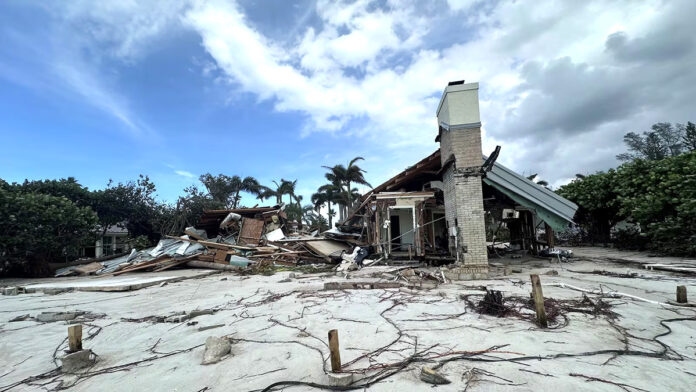
—The sky can be cloudless, the Gulf of Mexico calm, and still the water comes. It pools in the streets of the Village, backs up into the low corridors of Sleepy Lagoon, and sits stubbornly in the Buttonwood neighborhood until it has nowhere left to go. No hurricane required.
This is the new normal on Longboat Key. And Longboat, being a slender barrier island separating Sarasota Bay from open water, increasingly struggles to keep that water at bay.
—Town officials have been quietly grappling with what they call “sunny day flooding” — the chronic, tidal inundation that creeps into low-lying streets during king tides and modest rain events — since at least 2021. The question of how to pay for the infrastructure needed to stop it has grown more complicated, and more costly, with each passing year.
—A Problem That Preceded the Storms
—Though each of the three target neighborhoods requires a different engineering approach, the remedies share common elements: raising road elevations, adding drainage structures, and optimizing how water moves through the system. Town staff has been careful to note that these projects are not designed to defend against the kind of catastrophic storm surge that Hurricanes Helene and Milton delivered in 2024 — they are aimed at the quieter, persistent flooding that happens when the tide simply runs too high or a summer squall drops two inches of rain on streets that sit barely above sea level.
—Charles Mopps, the town’s director of public works, has described the core problem with blunt precision: in the lowest-lying sections of these neighborhoods, floodwaters have no exit. The elevation is too minimal, the drainage infrastructure too aged, and the cumulative effect is streets that turn to shallow canals not during emergencies but during routine tidal cycles. The practical consequences extend beyond inconvenience. Before recent resilience work began, high tides and rain events regularly blocked emergency personnel from accessing flooded roads — a public safety failure in a community where the median resident is well past retirement age.
—The Funding Maze
—The engineering plans exist. The designs for Sleepy Lagoon, Buttonwood, and the Village are largely complete or advancing rapidly. What remains stubbornly unresolved is the money.
—Longboat Key has pursued flood-mitigation funding with considerable ingenuity. The town secured a $2.8 million federal grant from the state’s Division of Emergency Management to address roughly 3,000 feet of the lowest road segments in the Village, with plans that include raising roads by up to 1.1 feet and installing a new stormwater management system with inlets, pipes, and updated one-way valves. A dedicated grants coordinator, hired in mid-2023, has helped the town piece together tens of millions of dollars across multiple programs. In the current fiscal year alone, the town has already received $13.3 million in grants — more than double the previous year — though most of that money is directed at a separate wastewater infrastructure project.
—Community Project funding — the congressional mechanism formerly known as earmarks — has also played a role, helping to cover the design phase of resilience improvements in low-lying neighborhoods. Federal and state programs rarely pay for planning and design, but having shovel-ready projects is often the prerequisite for competing for the larger construction grants that follow. The town has learned to work that pipeline methodically, funding design first, then returning to grant agencies for construction dollars once costs are verified — a process that is labor-intensive and, as officials have discovered, subject to inflation-driven recalculations at every stage.
—The town’s five-year Capital Improvement Plan reflects the scale of the undertaking: $1.4 million budgeted in fiscal year 2026 for Norton Street drainage construction in Sleepy Lagoon; roughly $987,000 for Buttonwood Phase 1, followed by $2.6 million in FY27; and more than $6 million earmarked across multiple phases of Village improvements stretching into FY28. Those numbers, however, have already proven unreliable as guides. Initial estimates for several projects have approximately doubled, according to Mopps, compressing the town’s financial maneuvering room and pushing timelines further out.
—Residents Losing Patience
—For homeowners in the affected neighborhoods, the planning retreat schedules and budget workshop calendars feel increasingly abstract. They have watched the water come, recede, and come again, and they have heard variations of “we’re working on it” for the better part of four years.
—Barbara Moschetta, who lives in one of the flood-prone areas, has become a pointed voice for a constituency that is tired of being asked to wait. She frames the issue not merely as one of inconvenience but of financial survival — pointing to the insurance claims, the structural damage, and the ongoing household costs that chronic flooding imposes. She has questioned publicly why the town would prioritize aesthetics, such as streetscape improvements along Gulf of Mexico Drive or the construction of a new library that many residents opposed, over drainage work that she argues is fundamental to the island’s habitability and to the fiscal health of its property owners.
—Her frustration touches a real tension in municipal governance: the competition between projects that are visible, popular, and politically legible — widened sidewalks, landscaped corridors, civic buildings — and the unglamorous infrastructure work that happens underground or beneath road asphalt, invisible until it fails.
—The Larger Stakes
—Longboat Key’s flooding challenge is, in miniature, a case study in the fiscal and logistical pressures facing coastal communities across the country. FEMA’s Hazard Mitigation Grant Program, one of the most significant federal funding sources available, distributes money only to municipalities that have an approved local mitigation plan in place — a requirement that Longboat Key has addressed by renewing participation in the multi-jurisdictional plans maintained by both Sarasota and Manatee Counties, the two counties that divide the island between them.
—The town’s updated Sea Level Rise and Recurring Flooding Resilience Plan, revised in 2025 following the devastation of Hurricanes Debby, Helene, and Milton, documents both the accelerating risk and the adaptation work already underway — including 27 permits issued to raise seawall heights and three stormwater management projects now in active development.
—Budget hearings are scheduled for May and June, and town officials say the drainage projects will be central to those discussions. There is no construction start date on the calendar. What is clear, Mopps has said, is that the town intends to be ready the moment funding materializes — designs approved, permits in hand, contractors on notice. In a competition for scarce federal and state dollars, the towns that move fastest are the ones that planned earliest.
On the streets of Buttonwood and Sleepy Lagoon, residents are banking on that preparation paying off before the next king tide proves, once again, that the water does not wait.

