
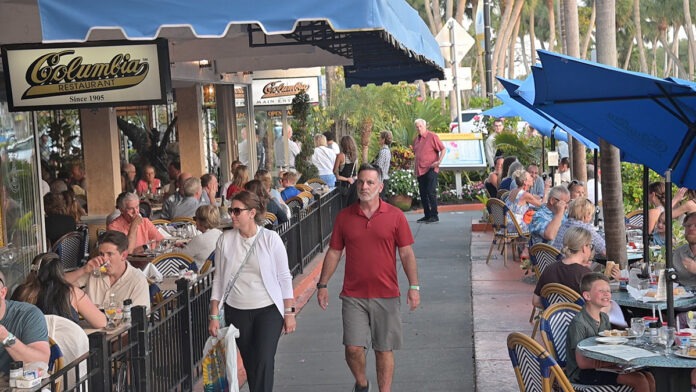
A full account of the second St. Armands Circle visioning session, in which 150 people learned that everything they needed to know is on an interactive digital map, the flooding will be fixed in approximately five years, the new speed humps are a triumph of civic engineering, and would everyone please just stop asking questions and look at the map.
Everything felt different and somewhat disorienting as we rode the elevator up to the Keating Center at Mote Marine for the second of the City of Sarasota’s St. Armands Circle “visioning sessions.” And I mean that literally, because the elevator — and I say this as someone who grew up in New York City, where elevators travel between floors at roughly the speed of a moon rocket — appeared to be moving at a pace that could only be described as “government-funded.”
—The display said we were going to Floor 3. I had time to check my email, reconsider several life choices, briefly contemplate learning Portuguese, and compose a short mental letter to my accountant before we arrived.
This was, in retrospect, the perfect overture for the evening ahead.
—Willie Nelson Opens the Meeting
—The session was facilitated by David Brain — which is either his real name or the most optimistic professional branding decision in the history of consulting — who is the consultant/facilitator/behind-the-scenes ideas man who, now that his consulting work is technically done, has naturally developed several exciting new ideas that will require more consulting. He opened by apologizing for his laryngitis. Someone cranked the microphone way up, producing a vocal quality that could only be described as Willie Nelson meets a carton of Chesterfields and a very long night of late-night bourbon. It was arresting. It was unique. It was, frankly, the most interesting part of the meeting. It was the voice of a man who had seen things. Important things. Zoning things.
—The Ai Tried. It Really Tried.
—The session opened with an AI-generated visual montage — a dreamlike collage of what people said they wanted St. Armands to look like in 20 years, assembled from all those little cards filled out at the first session. Apparently someone fed everything into a generative AI, which dutifully produced a swirling, slightly scrambled series of images that we all stared at for approximately three minutes before it was hastily clicked off the screen.
It looked like what would happen if Google Gemini tried to imagine a wealthy coastal Florida shopping district based entirely on the emotional responses of 150 people who hadn’t slept well since Hurricane Helene. Which is, come to think of it, exactly what it was.
—The sun was streaming in through the windows, baking everyone’s foreheads at a temperature somewhere between “outdoor yoga” and “slow roast,” until mercifully someone pulled the shades. The scrambled AI montage and the blazing solar radiation were, together, a fitting prologue to the discussion that followed — which was also somewhat scrambled, and also somewhat blinding.
—The Trojan Horse Question
—Your wary neighborhood newspaper editor had written, prior to this meeting, that the whole thing might be a Trojan Horse — a velvet-gloved attempt to get developers and property owners what they wanted (read: taller buildings, upstairs rental units, a parking garage with a valet and several layers of hotels stacked above it like a real estate napoleon pastry) while residents smiled and nodded and ate their complimentary cheese cubes.
—It wasn’t quite that bad. But it wasn’t not that bad, either.
—Brain made an early observation: after reading all the comment cards from the first session, he concluded that commercial property owners — arguably one of the most important constituencies in any discussion about what to do with a struggling commercial district — were conspicuously, almost heroically, absent from these meetings. He proposed a separate consulting session just for property owners and business interests, run in conjunction with the city’s Economic Development coordinator, a genuinely lovely woman who got up and explained, with great warmth and sincerity, that they just wanted to understand what incentives and zoning flexibility might be needed to encourage property owners to finally invest in the Circle and turn things around.
—She didn’t say “turn this crap hole around.” But essentially.
—Brain noted that of roughly 200 people in the room, only about 3% appeared to be commercial property owners. Someone did the math. Three percent of 200 is six people. Six people, out of 49 total commercial property owners on St. Armands. Which is, as someone helpfully noted, actually a higher participation rate percentage-wise than the barrier island residential community managed to turn out — but these kinds of statistical nuances became boring very quickly, and the mob was getting restless.
—The Lottery. Except with Flooding.
—If you have ever read Shirley Jackson’s “The Lottery” — the one where the whole village seems perfectly normal and civic-minded right up until the moment they stone someone to death — you have a reasonable framework for what happened next. The crowd, which had been politely absorbing PowerPoint slides and consultant-speak, suddenly and collectively decided it had had enough.
—The targets of the evening’s frustration were, in roughly equal measure: flooding, and the new traffic speed humps.
The flooding grievances were existential and completely legitimate. People are still dealing with the aftermath of the 2024 hurricanes, nearly 18 months later. They wanted to know when the drainage grates were going to be cleaned. They wanted to know about the pumps. They wanted to know why standing water still accumulates. They wanted to know why they’d been told to wait five years, and what exactly “five years” means to someone whose ground floor still smells faintly of the Gulf of Mexico.
—A Triumph of Speed Hump Engineering
—The speed humps were a different kind of frustration — more comedic in nature, though no less real.
The city engineer took the podium and announced, with the unmistakable pride of a man who has achieved something genuinely significant, that the new speed humps on St. Armands were a highlight — an exciting development, a cause for celebration, a crown jewel of the city’s resiliency efforts.
The room received this announcement with the kind of silence that has its own texture.
Then a resident, and then another, and then essentially the entire room, explained that the speed humps do not work. They are — and this is a technical term used by multiple attendees — “whoop-dee-dos.” You can take them at speed. You can arc over them in a graceful, almost balletic trajectory, actually gaining momentum on the descent, arriving on the other side traveling faster than when you started, in an improved position to mow down pedestrians and cyclists with additional authority.
The speed humps are, in short, the infrastructure equivalent of a firmly-worded letter. The city engineer nodded thoughtfully. This would be revisited.
—Five Years. Five. Years.
—The flooding discussion turned darker when residents learned that the real fixes — the meaningful, substantive work on the stormwater system — were five years away. The $13.5 million in Resilient SRQ funding, it turns out, will take half a decade to actually be invested in stormwater infrastructure. The room absorbed this information the way you absorb finding out your flight has been canceled: a brief moment of disbelief, then a kind of cold, focused fury.
—It also emerged that the city controlled very little of this directly, as the project had migrated into county jurisdiction. There was, apparently, a newly hired flood coordinator who regretted being unable to attend because he was — and I am only partially joking here — reportedly studying shoreline conditions somewhere in the vicinity of Lake Pontchartrain. Which is either inspired field research or the most perfectly timed vacation since Noah took a boat trip.
—The Map. Please Look at the Map.
—Running graceful, patient, nearly saintly interference throughout all of this was a Sarasota County employee — part of the new flood team, which is either very reassuring or a sign of how bad things have gotten, depending on your disposition — a woman of seemingly limitless composure who had, on approximately 75 separate occasions across the evening, sprinted to the microphone when a resident asked a pointed drainage question.
Her answer, delivered each time with the calm of someone who has made peace with her mortality, was some variation of the same theme: We have a map. And also: transparency.
—Transparency was, it turned out, the word of the evening. Possibly the word of the year. The map, she explained, existed to provide transparency. The county’s entire approach was built on transparency. The goal — and she wanted to be transparent about this — was transparency. When someone asked why the drainage grates hadn’t been cleaned, she wanted to be transparent: it’s on the map. When someone asked about the pumps, she wanted to be transparent: also on the map. When someone asked a question so convoluted it involved three separate flooding events, two different jurisdictions, and a swale that may or may not legally exist, she leaned into the microphone and said, with great warmth: “I want to be transparent with you.” Then she mentioned the map.
—By my count she used the word “transparent” or “transparency” no fewer than eleven times. I stopped counting at eleven because I wanted to be transparent about the fact that I had lost track.
—The map itself was, she explained, a digital marvel — a living, interactive document on which everything had been catalogued. Every drainage grate. Every swale. Every pothole. Every flood vulnerability. All of it mapped, all of it transparent, all of it — if you would just go online and look — fully explained, including timelines, costs, and projected completion dates. For things not yet scheduled? Also on the map. The map would tell you. The map was the answer. The map was, in a very real sense, the whole point of having a county flood team at all, because once you have a map this good, what else do you really need?
—You really need to look at the map.
—It was a masterpiece of calm bureaucratic communication. She earned every cent of her salary, her pension, her health insurance, and whatever retirement benefits Sarasota County provides, and she earned them all in a single evening. When residents asked questions that even the map could not answer — and a few did, because residents are creative and their basements are very wet — she smiled and said, “that’s a good question — we’ll get back to you,” which is the municipal equivalent of “I love you, but I need some space.” Transparently speaking.
—Where Were the Heavy Hitters? (Checking in at The St. Regis, Apparently.)
—A suspicious number of people noted that the city’s heavy hitters were absent. The interim city manager had been at the first session. Senior planning staff were nowhere in evidence. The big flood-infrastructure guns had apparently fired their rounds at the previous meeting and retreated to wherever big flood-infrastructure guns go when they are done being fired, which in Sarasota apparently involves a valet.
There were, in fact, rumors. Multiple sources — and I am being generous with the word “sources” — reported sightings of city planning staff conducting what can only be described as pre-consulting fieldwork at the St. Regis, at CW Prime, at Ocean Prime, and at various other fine establishments on and around St. Armands Circle. The fieldwork, by all accounts, was going extremely well.
—Picture the scene, if you will. A candlelit table. A developer — let’s call him Klaus, because developers who want to build hotels on barrier islands are often named Klaus — leaning forward over a beautifully seared piece of Chilean sea bass, gesturing upward with his fork in the universal gesture of a man explaining how many floors he intends to build. Across from him, a city planning staffer, nodding thoughtfully, raising a glass of Prosecco. They clink. They gaze out at the Circle, shimmering in the evening light. Klaus sighs contentedly and says: “Three stories. Maybe four. A boutique flag on top. Rooftop bar, obviously. Very tasteful. Very St. Armands.” Another sip of Prosecco. A distant look in the eye that could only be described as vertical.
—Critical questions, you see, needed answering in the field. What would it take to get developers to finally invest in the Circle? How many hotel rooms are we talking? How much parking? What zoning flexibility would make Klaus — and the other Klauses, there are always other Klauses — feel truly comfortable going vertical? These are not questions you can answer in a conference room. These are questions that require atmosphere. They require the tasting menu. They require a second glass of Prosecco and a long, meaningful look at the skyline and a quiet toast to what this place could be, aesthetically speaking, if you just removed a few of the current zoning restrictions and one or two of the existing single-story buildings and possibly the objections of approximately every resident on the island.
—I want to be absolutely clear: I am not suggesting that anyone is on the take. These are dedicated public servants. They are hungry. They are hungry for answers, and also for the branzino. It is purely a coincidence that the answers to Sarasota’s most pressing development questions tend to congregate in the private dining rooms of five-star establishments on a barrier island. This is simply where the data lives. Klaus has the data. Klaus is ordering dessert.
—Meanwhile, back at Mote Marine, everyone’s forehead continued to bake, the map lady was on her forty-seventh mention of transparency, and the flood coordinator was studying shoreline conditions in Louisiana.
—The Voice of Geological Experience
—The leader of the Lido Key homeowners association rose to speak with the weary authority of a man who has been attending these meetings since approximately the Pleistocene. He had lived on these barrier islands for what appeared to be thousands of years, he said, and it was always the same thing: fix the infrastructure, maintain the character and scale of the community, manage the traffic, and do not, under any circumstances, turn a fragile barrier island into a high-rise development pressure cooker. Enough was enough. Fix the drainage. Keep it pretty. Get the traffic under control.
—The woman at the microphone was on her feet before he had fully returned to his seat.
—You really need to look at the interactive map.
—A Personal Confession: I Also Have a Map
—And here is where I must make a personal confession, because I believe in transparency, and also because my wife will read this eventually and she deserves to know that I have been thinking about her concerns very carefully, and I have made a map.
—Sitting there in the Keating Center, gently baking in the residual heat while residents spoke of drainage grates and five-year timelines, I had an uncomfortable realization: the City of Sarasota and I are running exactly the same operation. The same deferred investments. The same optimistic timelines. The same answer, delivered with a calm smile, to anyone who asks about the current state of affairs.
I too have a home full of deferred infrastructure. I too have a map.
—The Pool Pump: A Eulogy in Progress
—The pool pump groans through the night with the tortured, metallic keening of something dying — not, let me be clear, the satisfying groan of marital bliss and two bodies riding ecstasy through the night, but the industrial death-rattle of metal grinding on metal, the sound of a machine that has given up on life and is determined to take the pool wall with it on the way out. My neighbors are aware of the pool pump. My neighbors’ neighbors are possibly aware of the pool pump. Somewhere, a sound engineer is aware of my pool pump.
—It sounds less like mechanical failure and more like my mother-in-law used to sound, yelling from another room that she was thirsty — and just like that noise, anyone within earshot will do absolutely anything to make it stop. Someone always rushes to the refrigerator. The pressure is relieved. Everyone disperses. The underlying problem remains unaddressed.
—The pool itself is held together by a heroic program of ad-hoc grout repairs that I perform while floating in the cold water — I am essentially conducting underwater tile conservation while simultaneously doing the backstroke — supplemented, on ambitious days, by targeted applications of epoxy putty. The pool is a testament to the human spirit. Also to structural denial. It is on the map.
—Then there is the irrigation system, which has developed a deeply complicated relationship with the root systems of the large, beloved trees on my property. The roots hate the irrigation. The irrigation hates the roots. I have resolved this conflict by abandoning the irrigation entirely and replacing it with soaker hoses wherever possible, which is either a creative adaptive solution or a complete and unconditional surrender, depending on your perspective. It is on the map. It is labeled “pending.”
—The Appliance Situation (Non-Negotiable)
—The appliances do not match. My wife finds this troubling in a way I have never fully understood, because they function. The washer washes. The dryer dries. That they are different brands, different finishes, and occupy the laundry room with the awkward energy of two strangers on a first date — I genuinely do not see the problem.
—My philosophy: if it works, keep it. Like the good people at Plymouth Harbor or Sarasota Bay Club — you don’t throw someone out just because they’re aging and don’t match the updated decor. You keep them going. You celebrate their remaining functionality. I hold this view with great conviction. I will continue to hold it until the washer dies, and possibly beyond. This is the hill I will die on, along with the fence.
—The fence, for the record, is what I would describe as high-end ramshackle — an eclectic, evolving composition of repurposed boards, creative structural improvisations, and what a generous observer might call “layered character.” There is no consistent fence line across any of the properties I own. I do not intend to create one. A fence doesn’t need to be consistent; it needs to be present. I am very much in the “present” camp on fencing.
—The German Cars: A System of Organized Denial
—I drive German cars, because I enjoy the experience of a precision warning light illuminating to inform me that something is wrong with a system I cannot identify, cannot locate, and absolutely cannot afford to fix. The O2 sensors. The catalytic converter. The various items that cars apparently require and that I have been deferring for what the dealership gently describes as “an extended period” and what I prefer to call “a philosophical position on maintenance.”
—My full name, in automotive terms, is Worse-Than-Murf-Klauber-At-The-former-Colony.
—All of this — the pool, the pump, the irrigation, the appliances, the fence, the cars, my son’s vehicle (still pending; listed on the map under “funding aspirational”), the flooring from a previous decade, the crack in the wall my wife spotted last Tuesday, the college debt, the countertops she has mentioned with increasing frequency — all of it is mapped. All of it is tracked. All of it has a timeline, and many of those timelines are, like St. Armands’ drainage fixes, approximately five years out, pending funding that remains, at best, optimistic.
—I am, in short, running a household on the same model as a mid-sized Florida municipality. I have simply not yet hired a consultant to confirm this.
—Late Night. The Map Cannot Come to the Phone.
—Late at night, as I drift toward sleep — and when you have been married for 30 years and have six children, sleep is genuinely one of the things that happens in the bedroom — my wife begins to ask questions. Good questions. Reasonable questions. Infuriating questions.
—What are we going to do about the flooring? Did you hear the pool pump tonight? Christopher still needs a car. There’s a crack in the wall — I saw it today. I think the foundation is moving. The appliances don’t match, and I know you think that’s fine but it is not fine.
—And as I dissolve into the warm fog of unconsciousness, I tell her about the map.
—It’s all on the map, I say. You really need to look at the map. It’s all about transparency. Everything is on there — timelines, costs, current status, projected completion, funding availability. Just go online. Don’t ask me. Look at the map. It’s interactive. You can click on anything.
—She is quiet for a long moment.
—Then, from the darkness: “You know, I’ve been able to see right through you for thirty years.”
—Which is, come to think of it, exactly what the residents of St. Armands Circle have been trying to say to City Hall all along.


Great article. Thanks Steve
What can I say?
Hilarious, so well written, and unfortunately so applicable to this and many other organizations.
Steve, as always, we’ll written with the sense of humor I’ve come to know after over 25 yrs. ❤️
Well written – hilarious! Thanks
Best thing I’ve read in a long time and totally SPOT ON!