
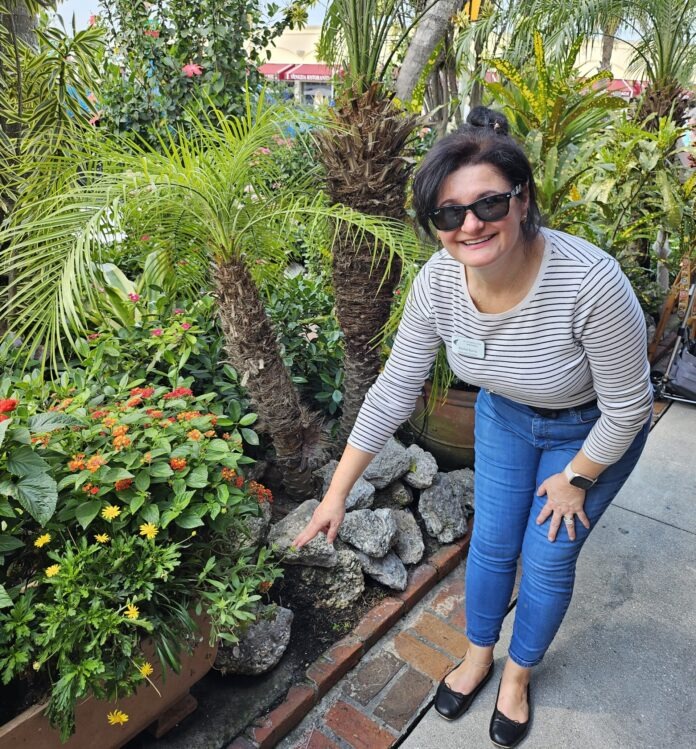
—While Developers Circle and the City Dithers, Merchants Association President Rachel Burns Walks Every Cracked Inch — and Has a Plan. Does Anyone Have the Will to Listen?
—On a warm afternoon in Sarasota, the scene at St. Armands Circle is nothing short of enchanting. Couples stroll past Italian statuary beneath swaying palms. The scent of gelato drifts across brick-lined walkways. Children press their faces against boutique windows while their parents settle into sidewalk café chairs, cocktails in hand, with the kind of unhurried ease that only happens when a place feels genuinely special. Laughter carries across the roundabout. The light is perfect. The vibe, as it almost always is here, is a little bit European, a little bit Old Florida, and entirely its own.
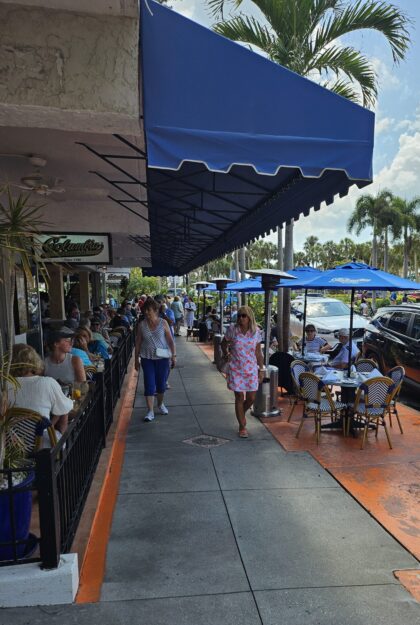
—This is St. Armands Circle at its best — and its best is extraordinary
—But walk the Circle now — really walk it, the way Rachel Burns does — and you will begin to see what the tourist brochures and national rankings don’t show you: broken concrete patched over broken pavers patched over cracked asphalt. Sidewalks that tilt and heave. Pedestrian bottlenecks created by misplaced planters. Storefront facades set at inconsistent depths. A parking-to-beach promenade so pinched on one side that visitors are forced into the street. And most urgently — most damning — a drainage system so inadequate that after the 2024 hurricanes, standing water sat in the St. Armands shopping district for days after it had receded everywhere else.
“There is no drainage,” said Burns, president of the St. Armands Circle Merchants Association, in the flat, factual tone of someone who has said it many times before and has stopped being surprised that the situation hasn’t changed. “There is simply no adequate drainage.”
—Burns is arguably the most clear-eyed person in any room when it comes to what ails this extraordinary place — and what it will take to fix it. This reporter walked the Circle with her recently, and the experience was equal parts inspiring and sobering.
—A Year of Reckoning
—To understand why the stakes of this moment are so high, you need to understand what happened here in 2024.
—Back-to-back flood events from Hurricanes Helene and Milton virtually shut down St. Armands Circle for months and forced many residents out of their homes. The Circle flooded three times during the 2024 hurricane season alone — and had been suffering repeated freshwater flood events for years before that, driven by the consistent failures of an overwhelmed pump and drain system. Storm surge engulfed the Circle with several feet of water, forcing nearly all retailers, restaurants, and other businesses to close for weeks and in some cases months. Of some 130 street-level commercial spaces, approximately 90 are currently open for business. The rest are reminders — boarded storefronts and darkened windows — of what was lost.
—The human cost was vivid and wrenching. Business owners described cleaning up after Helene, getting contractors lined up, wrapping their minds around the damage — and then getting hit again by Milton two weeks later, and starting over from nothing. Some did not come back.
—Among the departures was one of the Circle’s most beloved anchors: Tommy Bahama, a coastal lifestyle retailer and restaurant that had operated on St. Armands for over a decade. In a public statement, the owners cited malfunctioning pumps that left standing water inside their store for days after the storm and what they described as a lack of urgency from the city in addressing infrastructure failures. The infrastructure, they said, had remained largely unchanged for years. They closed their St. Armands location permanently. They were not alone.
—That kind of departure — from a business that genuinely loved this place — should have served as a five-alarm fire. Instead, eighteen months later, the city is holding visioning sessions with consultants, floating the idea of separate developer-only meetings, and delivering the news that $13.5 million in stormwater funding will take five years to deploy.
—Five years.
—Fortunately, private investment isn’t waiting for the city to catch up. Sources told Longboat Key News that the former Tommy Bahama building will reopen and has been leased by Pinchers, a regional seafood restaurant group. Across the Circle, construction is already underway at the former Chase Bank building and the site of the former deli, where Tom Leonard is actively renovating and rebuilding. Leonard is bringing a new Shore location to the site, which will feature a retail space on the ground floor and the restaurant on the second floor. These multi-million dollar projects offer a much-needed vote of confidence in the district’s future, but they also underscore a stark contrast: business owners are moving forward while municipal solutions lag far behind.
—The Second Visioning Session: Frustration in the Room
—The city’s second and final community visioning session for St. Armands drew more than 150 people — residents, merchants, Lido Key neighbors, and stakeholders from across the barrier islands. What they heard did not sit well.
—Chris Goglia, president of the St. Armands Residents Association, laid it out plainly in a letter sent afterward to a broad coalition of residents, merchants, and commercial property owners — because, as he wrote, “this topic affects us all and we must work together to protect the future of St. Armands.”
“My overall impression: It seemed that City staff wanted to use last night’s session to update the community on all of the resiliency projects and initiatives that are currently being worked on,” Goglia wrote. “But it also seemed that staff did not expect the frustration, bewilderment, and anger expressed throughout the evening.”
—The frustration had a specific and legitimate focus. The city’s Business Relations Coordinator announced that officials are planning an additional session with just St. Armands business and development interests — explicitly to discuss “zoning or code considerations.” The optics were immediately inflammatory. A previous attempt at exactly that kind of closed-door process — without resident participation — had triggered the public outcry that produced these community-wide workshops in the first place. Now the city appeared to be reverting to form.
“The top concern of many was confirmed,” Goglia noted.
—Beyond the political alarm, what emerged from the meeting was a portrait of a community that feels abandoned. Residents were stunned to learn the five-year timeline for the stormwater funding. Nobody believes the new speed bumps are effective. The consensus was that St. Armands is not ready for the next heavy rain event — eighteen months after two catastrophic hurricanes made landfall. As Goglia put it with devastating plainness: “The consensus opinion was ‘no.’”
—That answer is a civic failure. It demands accountability, urgency, and action.
—Walking the Circle With Rachel Burns
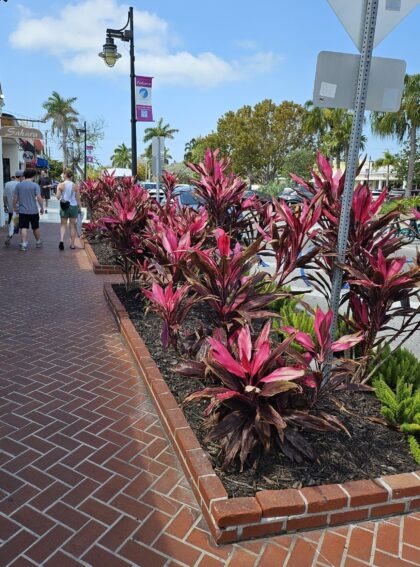
—Rachel Burns doesn’t manage the merchants association from a desk. She walks the Circle. She knows every heave in the sidewalk, every inconsistency in the paving surfaces, every place where pedestrians are pushed toward the curb by a misplaced planter or an uneven grade transition. She photographs problem spots. She tracks maintenance failures. She has spent years cataloguing what is wrong here — and years longer imagining how to fix it.
“In an ideal world, it would all be European-style cobblestone,” she said, gesturing at the patchwork of surfaces underfoot. “But you look around and you have textured concrete patched over interlocking pavers, then poured concrete, then open planting areas with rocks and mulch that aren’t even contained. Everything tells a different story — none of them cohesive.”
—Walk the Circle with her observations in mind and you start to see what you’d previously strolled past without registering: old city-installed medallions sitting alongside inlaid brick alongside rectangular concrete alongside painted surfaces alongside interlocking pavers, all in various stages of decay, all producing a visual and tactile experience more reminiscent of an archaeological dig than a world-class shopping destination.
—The dysfunction is not merely cosmetic. Everything from the building face to the curb is the private property owner’s responsibility to maintain — even when it sits on what is technically public right-of-way. The result is a wild spectrum of maintenance standards and finishes. Burns described planters that teenagers knocked apart in a video she reviewed, leaving loose bricks scattered across the sidewalk. Tree roots buckling the pavement. Weed barrier showing through eroding soil cover.
“Everybody is doing Band-Aids,” she said. “And it looks shabby because a lot of the curbing is interlocking pavers that get hit by cars and people and water — and it becomes an overlapping maintenance issue with no one clearly responsible for the whole picture.”
—The raised planters present a particular paradox. Visually, Burns said, she loves them — they create vertical interest and lushness. But they create pedestrian bottlenecks, backing up foot traffic in a place designed to feel open and welcoming. Her solution is elegant and immediately actionable: replace fixed elevated structures with large moveable containers — pots that tenants and owners can reposition to open pedestrian flow while maintaining the visual richness. Simple. Inexpensive. Doable this season.
—On the west exit toward Lido Beach, she pointed to a sidewalk so narrow on one side that visitors routinely walk in the street. “People park in that garage and walk to the beach. That’s the natural behavior and it should be. We should be designing for it. Right now, one side of that exit is so tight it’s almost hostile.”
—The new deputy park manager, John De Pazos, she said, has been a genuinely engaged and productive partner — the kind of operational responsiveness the Circle has long needed. “He has been phenomenal to work with,” Burns said. That kind of responsiveness, scaled up and given structural authority, is precisely what the Circle’s governance model requires.
—The Drainage Crisis: Ground-Level and Urgent
—When Burns talks about drainage, her voice shifts — more serious, more urgent, more resolved. This is the existential issue. Everything else flows into it.
“The water stays in this district for several days after it has receded from everywhere else,” she said, stopping near the south side of the Circle. “There are absolutely no drains on this side. The water has nowhere to go.”
—The stormwater drain and pump system on St. Armands is managed by Sarasota County via an interlocal agreement with the city, and its repeated failures have resulted in flooded businesses and ground-level homes on a regular basis — not just during tropical storms, but during ordinary heavy rain events that would barely register anywhere else. An entire district, ranked among the best shopping destinations in America, sits in a bowl with no drain.
—Burns has spent serious time thinking about structural solutions that don’t require tearing up everything and starting over. Her most compelling idea: re-pitch the sidewalks upward to meet building entrances at grade level, which would allow the streets themselves to be re-pitched toward the center — where properly installed French drains could run continuously, carrying stormwater away rather than letting it pool for days.
—She points to a downtown Sarasota streetscape project as a working model — French drains running the entire length of a roadway in front of a prominent residential building, with water flowing into them continuously. The technology is not exotic. The principle is not complicated. What has been missing is the will, the coordination, and a unified plan to apply it at St. Armands.
—She is also alert to smaller, incremental interventions: the inconsistency in sidewalk slopes as you enter storefronts like the Wyland Gallery or Kilwins, where the grade change is steep and abrupt; the disparity in how far back building frontages are set from the street, which creates an uneven, fragmented pedestrian experience; the narrow angled walkway connecting St. Armands to Lido Beach, which Burns believes should be transformed into a far more prominent, welcoming pedestrian arrival corridor.
“If you’re going to invite people to walk from their car to the beach and back,” she said, “give them a walkway worthy of the destination.”
—The Deeper Problem: No One Is In Charge
—What emerges most powerfully from a long conversation with Burns — and from Goglia’s pointed letter — is not any single fixable problem. It is the fundamental governance vacuum at the heart of St. Armands.
“Getting anything done on the Circle is very difficult because it’s a conversation with planning, it’s a conversation with engineering, it’s trying to get various entities on board,” Burns said. “But there’s no point person. There’s no one who has responsibility. There’s no unified ongoing vision.”
—The Business Improvement District, when it existed, could sometimes scrape together around $300,000 for landscaping and maintenance. That is not a budget for a world-class shopping district — and both Burns and those familiar with the situation know it. Downtown Sarasota has the financial infrastructure to set aside real money for cohesive streetscape planning. St. Armands never has.
“There has just never been the financial resources,” Burns said. “They’ve been lucky to get $300,000 when they had the BID board. So everything becomes piecemeal. The vision gets pushed forward in fragments — and lately it’s just been development incentives — while the core starts becoming dilapidated.”
—It shows on every block. Redevelopment is further complicated by the fact that several buildings have multiple owners, meaning any significant project requires either separately constructed fire walls or unanimous agreement on a development plan — regardless of whatever height limits or other constraints apply. That complexity makes organic private investment slow, difficult, and uncertain.
—Meanwhile, the city’s instinct — to convene separate meetings with developers and property owners to discuss zoning incentives — is precisely backwards. Burns noted the buildings that have already been built to maximum allowable height on the southwest side of the Circle. Most of the Circle remains one and two stories. The human scale, the walkability, the sense of a place designed for people and not for revenue maximization — these are the qualities that earned St. Armands its national reputation. They cannot be manufactured. They can only be preserved or surrendered.
—As Goglia wrote in his letter: “Flood-proofing buildings is easy and inexpensive compared to encouraging property owners to knock down and rebuild with three stories and upstairs rentals, forever changing the character of St. Armands Circle.”
—That is precisely right. And it is the core of what is at stake in every meeting, every visioning session, every conversation about zoning that happens without the full community at the table.
—What Can Be Done Now — and What Is Worth Fighting For
—Here is the uncomfortable truth that all parties — residents, merchants, property owners, and the city — must confront simultaneously: not everything requires $13.5 million and five years. A significant portion of what ails St. Armands is addressable now, affordably, with coordination and political will.
—Burns outlined a set of practical, near-term interventions that require neither developer subsidies nor rezoning battles:
• Moveable Planters: Replace fixed elevated planters with large moveable container plantings that can be repositioned to open pedestrian flow while maintaining the visual character that makes the sidewalks feel inviting. —
• Unified Surfaces: Adopt a unified sidewalk surface standard — not replacing everything at once, but establishing a consistent materials plan and beginning to apply it block by block, starting with the worst sections, using interlocking pavers as the consistent finish wherever repair is needed. —
• Pedestrian Promenade: Widen and formalize the pedestrian connection on the west exit toward Lido Beach — creating the promenade that visitors instinctively want, connecting the parking garage to the beach with the kind of walkable corridor that turns a parking transaction into an experience. —
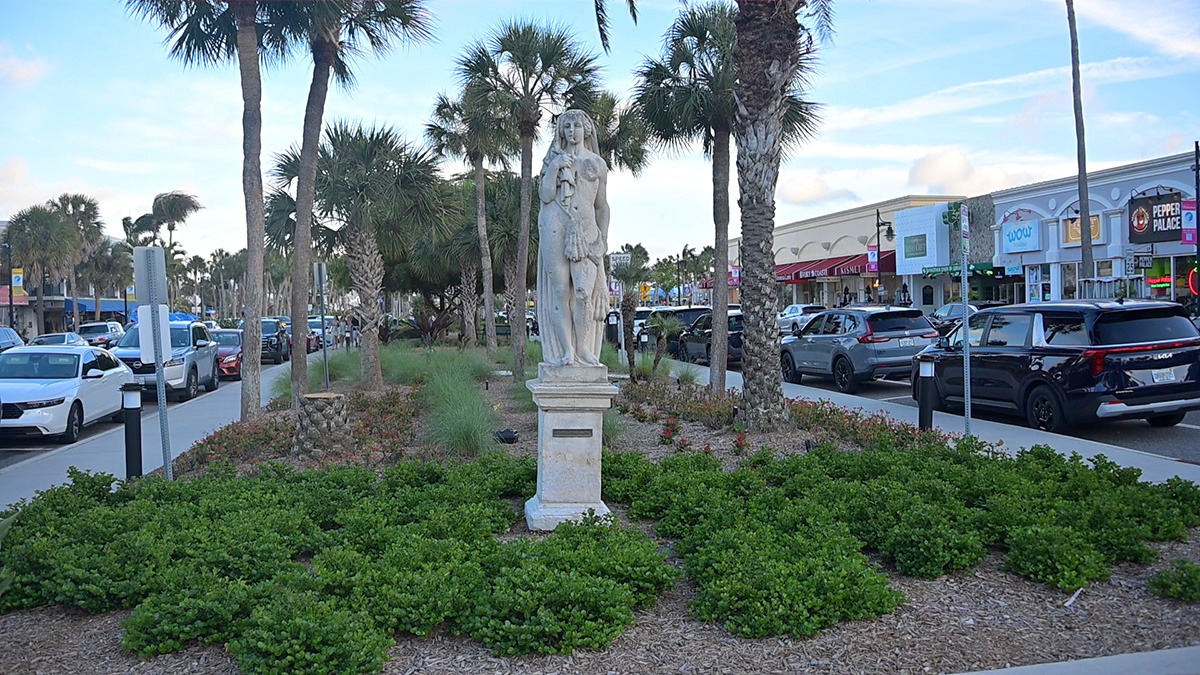
• Median Landscaping: Plant and landscape the medians that currently sit underutilized. The visual impact is immediate. The cost is manageable. —
• Interim Drainage: Install interim French-drain capacity on the blocks with the most severe standing-water problems — particularly on the south and west sides of the Circle — while the larger infrastructure upgrade works through its five-year pipeline. —
• Maintenance Accountability: Clarify maintenance responsibility at the property line in a formal, enforceable way so that broken planters, encroaching tree roots, and eroding surface materials in the public right-of-way fronting private properties are addressed systematically, not haphazardly. —
• Unified Leadership: Designate a single point person — a position, not a committee — with actual authority to coordinate across city planning, county engineering, the stormwater authority, private property owners, the merchants association, and the residents association. The bones for collaboration are present. What is missing is structural clarity about who leads. —
—The Stakes Are Real and the Clock Is Ticking
—It is worth pausing here to remember — fully, concretely — what exactly is at stake.
—St. Armands Circle was born from one of the most audacious acts of civic imagination in Florida history. In 1917, circus magnate John Ringling purchased St. Armands Key and envisioned a European-style luxury shopping and residential district, its streets radiating from a central park roundabout, adorned with Italian statuary from his personal collection, lined with rose-colored curbs, humming with cosmopolitan energy. He used circus elephants to haul the bridge timbers. He led the opening parade across his own causeway in 1926 with a circus band playing in the roundabout.
—The man built a dream on a mangrove island — and nearly a century later, that dream is still standing. Still drawing millions. Still producing the kind of joy that makes people close their laptops and linger. More than 30 sculptures grace its streets, one-third of which belonged to Ringling himself. The Harding Circle Historic District at its center was designated a place on the National Register of Historic Places. This is not just a shopping center. It is a living piece of American history.
—It is also, by any honest economic measure, a regional powerhouse. Tourism in Sarasota County generates billions in annual economic impact and supports tens of thousands of local jobs. St. Armands sits at the very center of that ecosystem — widely regarded by county tourism officials as one of the most visited tourist attractions in Sarasota County, and previously ranked by USA Today among the top outdoor shopping destinations in the nation. It is the gateway to Lido Beach, an evacuation corridor for barrier island residents, and an economic engine whose health reverberates across the entire region. When St. Armands floods, when businesses close, when visitors don’t come back — everyone from the restaurant server to the hotel housekeeper to the county tax collector feels it.
—And yet the 2024 hurricane season did not create the infrastructure crisis at St. Armands — it exposed one that has been building for decades. Businesses that survived two major hurricanes and months of closure are operating with hard-won resilience and finite patience. The empty storefronts still visible around the Circle are not abstractions. They are warnings.
—The community that showed up in force — 150-plus people, night after night — to the city’s visioning sessions did not come because they want St. Armands to become something different. They came because they want it to become what it always should have been: fully functional, beautifully maintained, fiercely protected, and worthy of the dream that a circus ringmaster and his elephant work crews conjured on a mangrove island a hundred years ago.
“Almost in spite of itself,” Burns said, near the end of our walk, looking out at the Circle in the late afternoon light, “it’s actually a beautiful, funky place.”
—That phrase should embarrass every official responsible for its condition. And it should inspire every person who loves it — resident, merchant, visitor, and elected official alike — to demand that this remarkable place finally receive the sustained, intelligent, well-resourced care it has always deserved and almost always been denied.
—Rachel Burns has walked that dream one cracked sidewalk at a time. She knows what it needs. The question — the only question that matters now — is whether the people with the authority to act will stop studying the problem and start solving it.

