
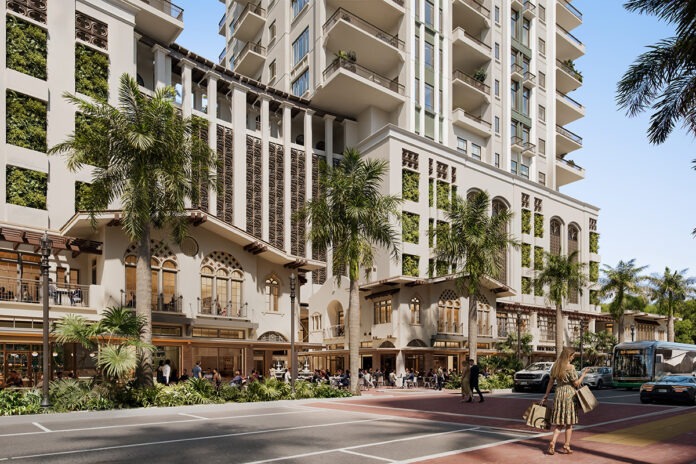
There are buildings, and then there are landmarks. Sarasota’s Mira Mar has long been the latter — a structure so woven into the city’s founding narrative that its fate became a matter of civic debate, not just real estate economics.
Now, with a formal construction permit issued by the City of Sarasota and crews mobilizing along South Palm Avenue, the century-old building has cleared what may have been its highest hurdle yet.
—The timing is notable. Downtown Sarasota is in the middle of one of the most intense luxury residential building cycles in its history, with major projects rising or selling from The Quay to Main Street. Cranes mark the skyline. Branded towers carry names associated with global luxury hospitality. Into that environment comes the Mira Mar project that started not with a glass curtain wall and an international brand, but with a century-old building on the verge of structural failure — and a developer who chose, after initial resistance, to restore it rather than replace it.
—A City in the Middle of a Residential Renaissance
Downtown Sarasota is in the midst of a luxury residential building cycle with few precedents in its modern history. It is reshaping downtown’s upper residential tier. Mira Mar Residences enters that marketplace with a fundamentally different value proposition — one rooted not in brand licensing but in the specific history of the block it occupies.
—The Permit that Changes Everything
—In early April 2026, the City of Sarasota issued the construction permit for the twin 18-story towers that form the financial engine of the Mira Mar Residences project, developed by Sarasota-based Seaward Development. All former commercial tenants have vacated the more than 100-year-old structure. Work has begun.
“This is an incredibly important milestone that has been years in the making,” said Patrick DiPinto, owner of Seaward Development. “It officially kicks off the rehabilitation portion of the project and to be stewards of the history and legacy at this site is an incredibly humbling position that we take very seriously.”
—DiPinto and his team are deeply local. “Our team members have lived in Sarasota for 30 to 40 years. We are deeply rooted in this community. Rather than trying to be the biggest, our goal is to be the best.” Full project completion is targeted for the end of 2028. The permanent sales gallery is open at 1258 North Palm Avenue.
—Born In 1922: The Building That Launched a City
—In 1922, Chicago developer Andrew McAnsh arrived in Sarasota and moved quickly. The Mira Mar Apartments rose along Palm Avenue as the largest building project in the city’s history at that time — erected on a literal foundation of beach sand in a round-the-clock construction effort that became part of local lore. By January 1924, the Hotel and Auditorium had opened. Marketed as “The Aristocrat of Beauty,” the hotel drew clientele arriving by rail from Chicago and New York. The auditorium became Sarasota’s first significant civic cultural venue, hosting Metropolitan Opera performances in 1926. The original campus included a casino, a cigar factory, and the city’s earliest retail and fine dining establishments along nearly 400 feet of South Palm Avenue frontage.
“Mira Mar was Sarasota’s first hotel, home to its earliest retail and fine dining, and one of the city’s first true luxury compounds,” DiPinto said. “There were so many amazing aspects of the building. We learned quickly that we were onto something truly special.”
—Decades of Decline and a Near-Miss With a Wrecking Ball
—The trajectory from opening-night prominence was not smooth. The hotel closed in 1957 as travelers shifted to newer motor lodges along U.S. 41. The auditorium was demolished in 1955. The hotel structure itself came down in 1982, leaving only the original apartment building standing. That survivor cycled through uses and ownerships for decades, most recently serving as commercial space for roughly 48 tenants before Mira Mar Acquisition Company, LLC purchased it in 2023 for $17.5 million. By then, structural assessments had raised serious concerns — foundational stabilization work was needed before anything else could proceed.
—When Sarasota Said No — And Something Different Emerged
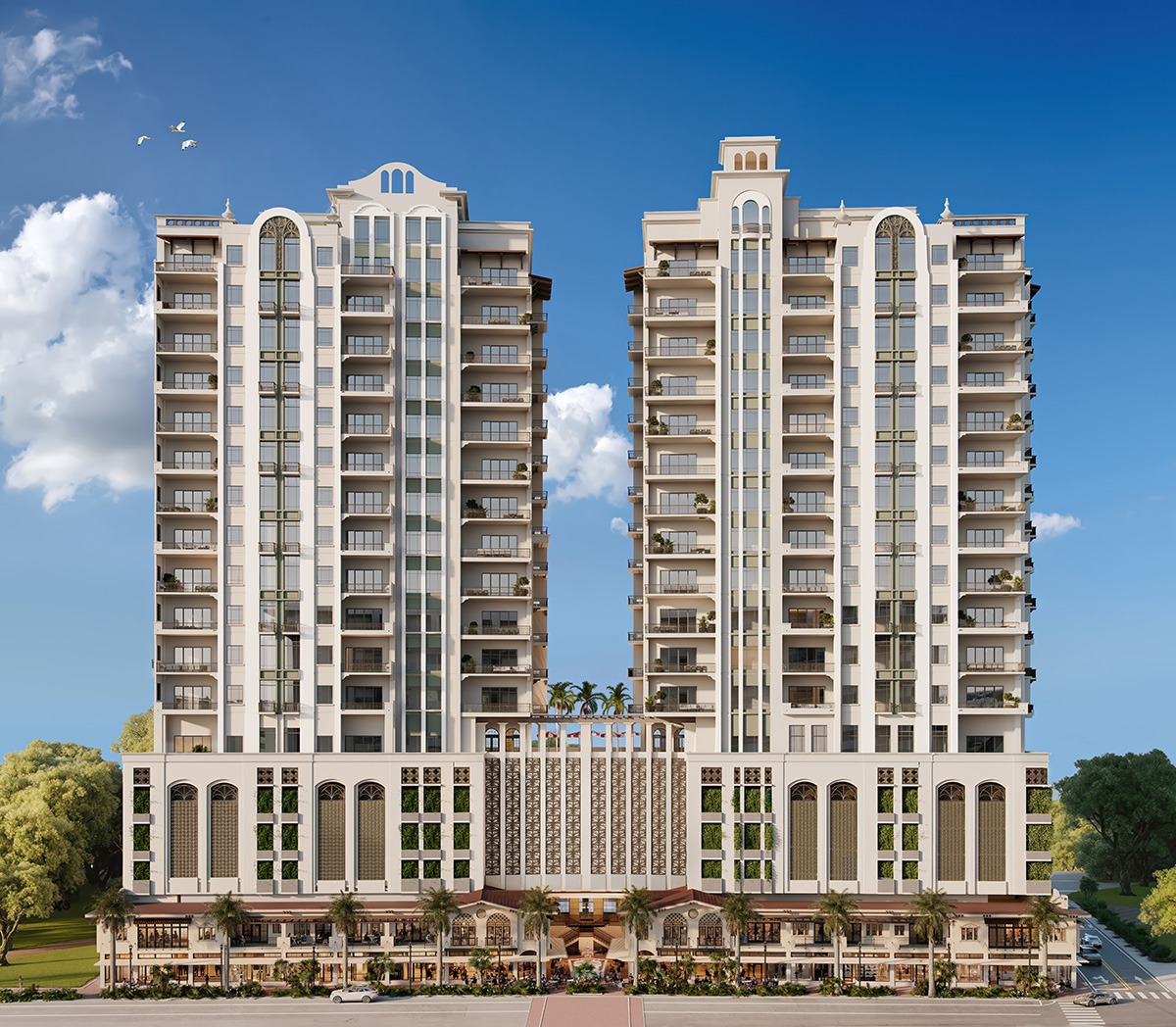
—When Seaward Development sought permission to demolish the building in 2022, the City of Sarasota’s Historic Preservation Board said no. Rather than appeal, DiPinto and his team spent nearly two years developing an alternative: preserve and fully restore the historic structure while constructing two residential towers on the rear of the 1.2-acre site, using condominium revenues to fund the $29 million rehabilitation.
—The plan required rezoning the property from Downtown Core to Downtown Bayfront. That process was contentious. Residents of the adjacent Mark condominiums objected. City planning staff recommended against approval. After two public hearings, the Sarasota City Commission voted unanimously — five to zero — on both the comprehensive plan amendment in May 2025 and the rezoning in July 2025.
—Mayor Liz Alpert noted that under existing zoning, the site could have accommodated a monolithic structure built lot-line to lot-line with far greater neighborhood impact. “We have to remember that not all development is evil,” she said, “and all of these things help move our city forward.” Commissioner Jen Ahearn-Koch was equally direct: “A lot of parts of our community came together to make something happen. I very much hope this project does come together as it has been promised.”
—The extended regulatory process, for all its friction, produced a project with a substantially different relationship to the street than a by-right development would have delivered — one that will shape the west end of Palm Avenue for a generation. DiPinto called the commission’s support humbling. “Our entire team is passionate about making this not only a legacy project for Sarasota, but a case study for other municipalities around the country.”
—The Numbers, The Team, And The Legal Structure
—The $29 million historic rehabilitation is funded through revenues from 70 luxury condominium sales. Rick Gonzalez of REG Architects leads the preservation work. Igor Reyes of Nichols Architects — whose firm restored the St. Moritz Hotel in Miami Beach and converted the Seville Hotel into the EDITION Miami Beach — serves as project architect. General contractor Suffolk Construction, whose recent work includes the billion-dollar restoration of the Waldorf Astoria in New York City, is the builder of record.
—The rezoning came with binding conditions: tower coverage above the podium is capped at 60 percent; second-story commercial space must rent at 50 percent or below market rate for a full decade; and no certificate of occupancy may be issued for either tower until the historic restoration is complete. The towers cannot be occupied until the old building is saved — a legal mechanism tying the project’s financial model directly to its preservation obligations.
—The Market Position: Scarcity as a Strategy
DiPinto is direct about how Mira Mar is positioned. “My partner Michael and I spent years assembling 1.5 acres with nearly 400 feet of frontage on South Palm Avenue — an offering that simply cannot be replicated. Calling Mira Mar a trophy asset is an understatement.”
—Early buyers, he says, understand the distinction clearly. “Experienced buyers are choosing Mira Mar because they truly understand real estate. They recognize Mira Mar as the last great address on Palm Avenue. Our buyers are deeply drawn to the century-old legacy of the property. That level of scarcity and authenticity positions the property for exceptional long-term value.” The 70 residences are offered in three- and four-bedroom configurations across two 18-story towers, priced from the high $3 millions. Upper-floor units deliver unobstructed bay views.
—The Street Level: Where the Community Impact is Most Direct
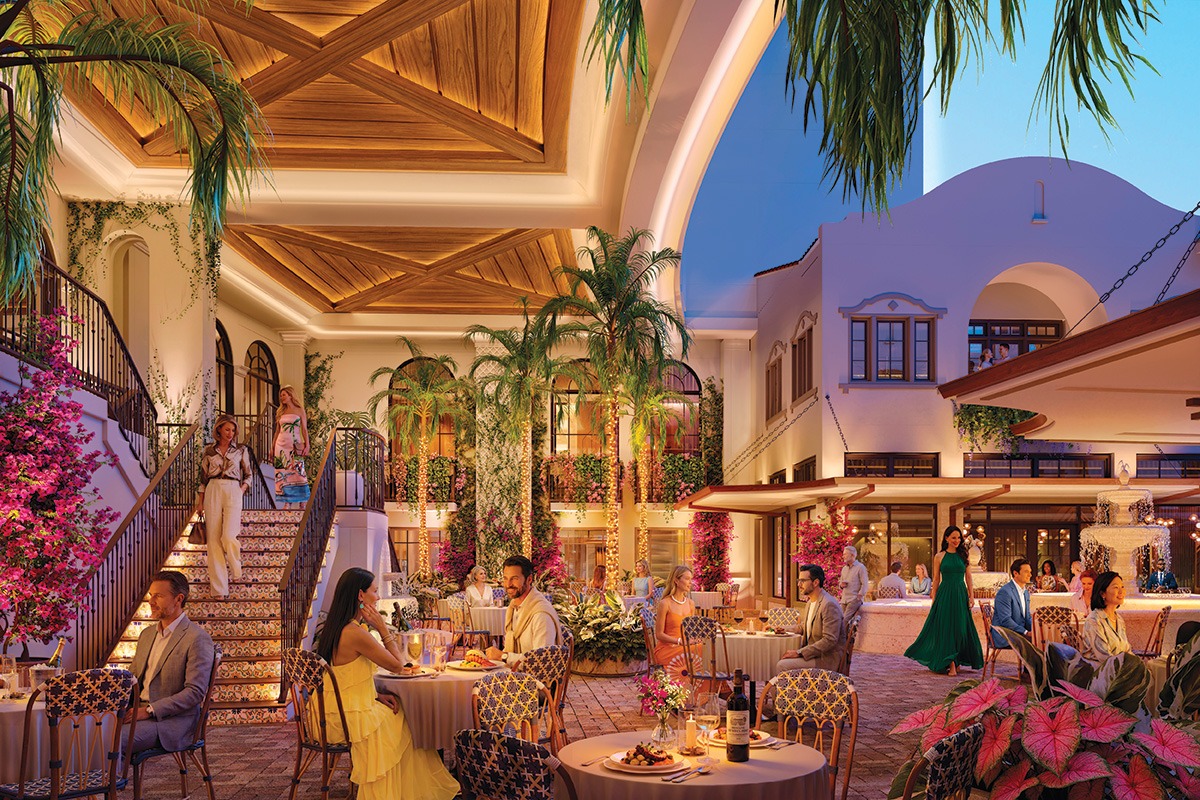
—For residents who will never own a unit in either tower, the more immediate question is what the restored Mira Mar delivers at street level. The historic building’s 400-foot frontage will become retail, restaurant, and office space framed by wide sidewalks, generous setbacks, and outdoor dining areas. The street level will also allow for a level to overlook the courtyard and outside dining as well.
—Seaward is in discussions with dining and retail operators described as first-to-market for Sarasota. Second-story tenants receive rents discounted 50 percent below market for a decade — designed to attract operators who might not otherwise afford a Palm Avenue address.
“This project is like nothing else being built in Sarasota,” DiPinto said, “with its extensive setbacks that will allow for an open-air lobby, outdoor dining for lunch and dinner, shopping at street level, and wide sidewalks, offering connection and activation in this exclusive downtown location.” Pedestrian passageways between the towers will move light and bay breezes through the block — public access through what is currently a largely impermeable stretch of downtown.
—Construction Timeline and What Comes Next
—Initial work centers on structural stabilization and historic rehabilitation — the most technically demanding phase of the project. Tower construction follows once that work is sufficiently advanced. Suffolk project executive Brian Stathers has said the team will use digital modeling and real-time project controls to manage the complexity of simultaneous historic and new construction on the same site. Full completion is targeted for the end of 2028.
—What the Project Means for Sarasota
The branded towers rising elsewhere in downtown reflect genuine demand and will deliver quality product. They will also, in most cases, produce buildings that could be built in any number of coastal markets where the same brands operate. Mira Mar’s identity is specific to this block, this city, and this history in a way that cannot be replicated elsewhere or at a later date.
—DiPinto frames it plainly: “We believe preserving the century-old tradition of the Mira Mar adds incredible long-term value to the community, and ultimately, our owners are the beneficiaries of this vision.”
—What is clear is that Sarasota — its residents, its preservationists, its elected officials, and ultimately its developers — chose the harder and better path here. They chose to rescue a building that carried the city’s earliest identity rather than erase it. They chose a streetscape with soul over a footprint of maximum density. And when the restored Mira Mar facade opens along South Palm Avenue, with its outdoor cafes and first-to-market retailers and bay breezes moving through pedestrian passageways that did not exist before, it will stand as evidence that a city’s history and its future do not have to be in competition with each other.
—For Sarasota, that is no small thing. For Palm Avenue, it may be everything.

