
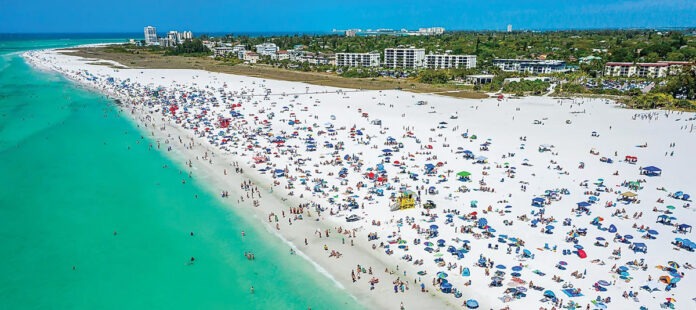
Siesta Key just topped America’s best-beach list again. For Longboat Key and the Sarasota barrier islands, the real story is what that crown is worth — and who’s cashing in.
The sand at Siesta Beach is 99 percent pure quartz, so fine it squeaks underfoot and stays cool even in a Florida August. Geologists believe it washed down from the Appalachian Mountains over millennia, deposited here by rivers and ancient currents. You cannot manufacture that. You either have it or you don’t.
—This spring, U.S. News & World Report confirmed — again — that nobody has it quite like Sarasota County. In its 2026 Best Beaches in the U.S. rankings, evaluating more than 1,500 destinations using expert judgment and traveler data, Siesta Beach came out on top. No. 1 in the country. Maui behind it. Malibu behind that. Anna Maria Island, the barrier island just to our north, took No. 3. Florida claimed six of the top fifteen spots. But it was this coastline — these three barrier islands, this county — that stood alone at the summit.
—For readers of this paper, the accolade is not news in the surprising sense. It is news in the confirming sense. Rankings season arrives on the Gulf Coast as predictably as sea turtle nesting, and every year, one name rises. Siesta Beach was named best in America twice by coastal geographer Stephen “Dr. Beach” Leatherman. Tripadvisor put it at No. 1 nationally and No. 4 in the world in 2025. Condé Nast Traveler readers ranked it No. 8 in the country earlier this year. The suspense is never whether Siesta will appear. The suspense is how high it will land.
—What is worth examining — particularly for an audience that understands what rankings do to real estate markets, hospitality revenues, and destination brand equity — is what this particular honor means right now, in this particular moment for our islands.
—The Three Islands and What They’re Selling
—It is worth being precise about geography, because each island in this chain operates as a distinct market with a distinct value proposition.
—Siesta Key is the engine. Seven thousand permanent residents, two bridges to the mainland, a village of open-air restaurants and boutique shops arranged around the premise that the beach is the natural center of life. The ranking amplifies what the island already is: a family destination with broad demographic reach, strong short-term rental demand, and the kind of organic repeat visitation that no marketing budget can buy. Families from Ohio and Michigan return the same week every year. They have been doing it for twenty years. The U.S. News ranking is the permission slip that convinces the family that hasn’t been yet to finally book.
—Lido Key is the middle chapter. St. Armands Circle — conceived by John Ringling in the 1920s and now a mature retail-and-dining corridor of genuine quality — anchors an island that draws a more local crowd and a more discerning visitor. Lido Beach is quieter than Siesta, its parking lots full of Sarasota residents rather than rental-car tourists. The restaurants are better than they need to be. The whole island has the quality of a place that doesn’t particularly need to advertise.
—Longboat Key is the statement. Twelve miles of the most private coastline on Florida’s Gulf Coast, a single road running its length, gated communities, championship golf at the Longboat Key Club, and — the development that has changed the conversation more than any other in recent memory — the St. Regis Longboat Key Resort. With standard room rates that routinely clear $1,000 per night and suites approaching $7,000, the St. Regis has not merely added luxury inventory to the county. It has repositioned what this island means to the affluent traveler who once defaulted to Palm Beach or the Florida Keys. The effect on bed tax revenue alone has been measurable. Longboat Key already accounted for 7.5 percent of all tourist development tax collected countywide before the St. Regis opened. That share has grown.
—The Numbers Behind the Sand
—Visit Sarasota County reported a total economic impact of $3.6 billion from tourism in fiscal year 2025. That figure includes not only the $2.37 billion in direct visitor expenditures on lodging, dining, shopping, and activities, but also the downstream multiplier effects through the broader economy. For context: 2.71 million visitors generated that output in FY25, a figure that is down 6.3 percent from the prior year’s 2.89 million. Visitor spending is down 7.1 percent year-over-year.
—Those declines deserve an honest read. Some of the contraction reflects the inevitable cooling from pandemic-era peaks, when Florida was open while most of the country was not and every coastal market saw historically anomalous numbers. Some of it reflects legitimate competitive pressure — other destinations have invested aggressively in the years since, and domestic travel has re-globalized as pandemic restrictions faded. Some of it, specifically on Longboat Key, reflects the damage inflicted by Hurricanes Helene and Milton in fall 2024, which cost the island an entire season and sent contractors rather than tourists through local doors for much of 2025.
—But the pre-pandemic comparison is the more honest benchmark. Visitor spending and economic impact both remain substantially above 2019 levels, by more than $488 million and $498 million respectively. The Sarasota-Bradenton International Airport is on track to handle 4.5 million passengers in calendar year 2025 — more than double its 2019 volume of 1.9 million. Fewer people may be staying in hotels. More people are landing here.
—Quality Over Quantity — And Why That’s the Right Call
—Visit Sarasota County CEO Erin Duggan has been consistent in articulating a strategic posture that this audience will recognize immediately: the county is not trying to maximize visitor volume. It is trying to optimize visitor value.
—“We talk a lot about quality over quantity,” Duggan has said publicly. “We would rather have fewer visitors spending more money than more visitors spending less money.” The agency’s marketing for fiscal year 2026 — backed by approximately $46.25 million in anticipated tourism development tax revenue — is deliberately targeted at the arts enthusiast, the international traveler, the sports event participant, the convention attendee who fills shoulder-season rooms. The St. Regis guest. The Ritz-Carlton group booking. The European couple on a two-week Florida itinerary.
—This is not a strategy born of complacency. It is a strategy born of a destination that has looked at what it has — the geology, the golf, the cultural infrastructure, the restaurant scene, the arts institutions that make Sarasota genuinely unusual for a city of its size — and made a rational decision about whom to invite. The U.S. News ranking is, among other things, a powerful recruiting tool for exactly that target market.
—After the Storms
—Any clear-eyed account of where these islands stand right now requires acknowledging what happened in the fall of 2024 and the year that followed. Helene and Milton were severe. Longboat Key bore significant damage. The 2024-2025 season was the quietest in recent memory for many island businesses. The Lazy Lobster — a Longboat institution — reported a 12.5 percent revenue drop for the year, which its owner described as painful but better than feared.
—By the spring of 2026, however, the rebuild is largely complete. The Longboat Key Club’s managing director, Rick Konsavage, characterizes the current season as a return to normal. “Now, since most of the contractors are finished, we’re coming back to normal,” he said recently. “We are very optimistic. It’s not going to be a banner year, but it’ll be slightly above last year.” That is an honest assessment from someone who has been in Gulf Coast hospitality long enough to know what normal looks like and how hard it is to restore.
—What the Ranking Actually Does
—There is a tendency in local coverage to treat beach rankings as feel-good validation — a ribbon for the wall, a line in a press release. That is not what U.S. News No. 1 is, and readers of this paper understand the difference.
—A ranking of this magnitude, from a publication of this credibility, functions as third-party validation in a media environment saturated with promotional noise. It reaches the meeting planner in Chicago weighing Sarasota against Scottsdale. It reaches the travel agent in Frankfurt building a two-week Florida package. It reaches the family in Columbus that has been meaning to try something different this summer. It reaches the prospective second-home buyer in the Northeast who has been looking at properties on the key and wondering whether the investment thesis holds.
—The thesis holds. The geology holds. The county’s deliberate pivot toward value-over-volume is the right call for this market, at this moment. And the Sarasota-Bradenton airport numbers — 4.5 million passengers, more than double the pre-pandemic baseline — suggest that the long-term trajectory of inbound interest is not in question, even if the short-term hotel occupancy charts look lumpy.
—The sand is still the same. It is still cool in August. It still squeaks. U.S. News says it is the best in America. The market, as it tends to do, agrees.

