
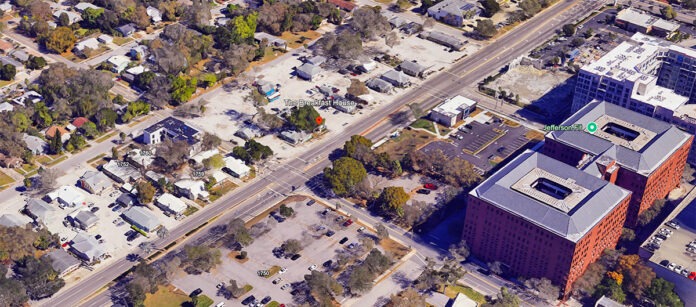
Sarasota needs housing. A Tennessee developer has a plan. And standing in the way are seventeen small businesses, two massive oak trees, and a block of 1920s bungalows that never forgot what this city used to be.
You know the block. Anyone who has driven into downtown Sarasota from the north knows the block — the riot of painted bungalows hugging the north side of Fruitville Road near US 301, the hand-lettered signs, the live oaks throwing shade across mismatched roof lines, the waft of pancakes drifting into the parking lot. It doesn’t look like much from sixty miles per hour. It looks like everything once you stop.
—That block is now under contract to a developer from Franklin, Tennessee. And if the math works out the way Bristol Development Group intends, those cottages, those oaks, those pancakes and the sixteen other businesses that share this improbable little corner will be replaced — perhaps by early 2027 — by a five-story, 324-unit apartment complex with a six-level parking garage, a gym, a clubhouse and a pool.
—The project is called 1899 Fruitville Road. It had its first hearing before the city’s Development Review Committee in March. No public vote is required, because the site is already zoned for exactly this kind of development — a fact that has left neighbors and business owners with the unnerving realization that the city may have no formal mechanism to stop it.
—A century of survivors
—The cottages along Fruitville Road date to the 1920s — built during the same land boom that made Sarasota the city it became, in the same era that John Ringling planted his circus on the city’s north end and left his mark on everything from the architecture to the social register. Local lore holds that some of these bungalows once housed Ringling circus performers. Whether or not every story checks out, the buildings carry that particular Florida-cracker DNA: small, practical, adaptable, surprisingly durable.
—The property is made up of 22 parcels assembled over decades by Marlene and Alex Lancaster, who acquired lots from 1996 through 2018 at prices ranging from $17,500 to nearly a million dollars each, according to county records. Lancaster has reportedly been candid with tenants for years that he never intended to hold the property forever. The tenants understood. That didn’t make the news easier when it finally arrived.
—Today the block hosts seventeen businesses — Siegfried’s Restaurant and German Biergarten, The Artful Giraffe, BlueAloe Day Spa, The Breakfast House, Discover Sarasota Tours, The Crystal Stargate, a yoga studio, salons, a bubble tea shop, artisan galleries and more. Together they serve more than twenty thousand customers a month. They are an incubator for Sarasota’s quirky retail identity — the kinds of businesses that define a city’s personality and almost never find their way back once the rent moves up.
—The Breakfast House
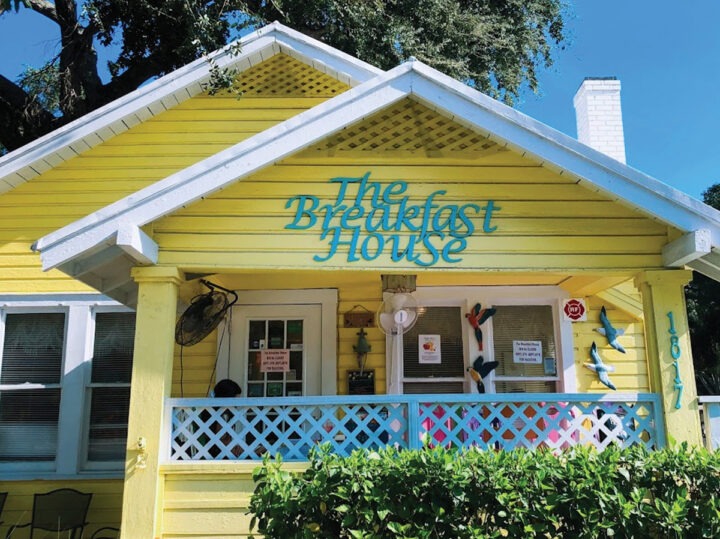
—The Breakfast House has become the emotional center of this story, perhaps because its origin is so perfectly Sarasota. In 2008, Jazz Wingard’s mother was driving down Fruitville Road, spotted a small dilapidated bungalow and decided she could make something of it. Her family thought she was joking. They went to college. They came back. They are still there, sixteen years later, serving eggs and pancakes out of a cottage that has been the one constant thread of their lives.
—That kind of story doesn’t fit on a pro forma.
—Wingard says she wasn’t entirely surprised — her landlord had been honest with her for years. But knowing something is coming doesn’t make it land gently. Other tenants at a recent Gillespie Park Neighborhood Association meeting described the experience of sitting in Fogartyville Community Media and Arts Center, looking at renderings of the building that will replace their livelihoods, as something between grief and disbelief. —
“These are livelihoods for people,” one business owner told reporters. “This is how we make money, this is how we live, and to take that from us — that’s hard.”
—Another called the proposed building “beautifully designed for this time period, but completely out of place for a neighborhood as historic as Gillespie Park.”
—What the Developer Says
—Bristol Development Group has developed apartment communities across the Southeast for twenty-six years and describes itself as a builder of high-quality, amenity-rich urban living at attainable prices in growing Sunbelt cities. Sarasota, they say, has been on their radar for a long time.
—In a statement, the company expressed enthusiasm for the project and said its design and legal teams have been diligently following proper procedures for developing in the city of Sarasota. Construction is projected to begin in early 2027, pending administrative approvals expected throughout the rest of 2026.
—The project’s lead designer framed Fruitville Road itself as part of the problem — a wide, fast arterial that has long functioned as a hard edge between downtown and the historic Gillespie Park neighborhood to the north. The new development, he argued, offers an opportunity to soften that barrier with wider sidewalks, shade trees, underground utilities and improved pedestrian infrastructure. Two of the site’s massive grand oaks — with trunk diameters of 67 and 72 inches — are intended to be preserved in a courtyard that could become a semi-public gathering space.
—The project also carries a social-equity component: utilizing the city’s downtown attainable density bonus program, 36 of the 324 units — roughly eleven percent — would be reserved for households earning between 80 and 120 percent of area median income. For a single person in Sarasota, that means incomes roughly between $60,000 and $129,000. In a region where the gap between wages and rents has become one of the dominant civic conversations, that is not nothing.
—The Trees, the Rules, and the Room Where it Gets Complicated
—Not everyone is ready to accept the developer’s framing on the oak trees. Local organizer Kelly Franklin has been pressing the city publicly on its Grand Tree Ordinance, arguing that the developer’s plans would require removing five protected grand oaks, not two — and that the city has an obligation to enforce its own rules regardless of what the developer proposes.
—The city’s Historic Preservation Senior Planner has notified the applicant’s attorney that the city continues to encourage relocation or salvage of any structures that can be preserved. It is, in the language of municipal bureaucracy, a nudge rather than a mandate.
—Because the site sits within a downtown edge zone district and requires no rezoning, the approval process is administrative — meaning it flows through the city’s Director of Development Services rather than through elected officials. There will be no public hearing in the traditional sense. The community’s leverage is limited to the comment process, relationships with city staff and, ultimately, the political will of city leadership.
—Three technical adjustments are being sought by the developer. One reduces a facade requirement along Fourth Street to accommodate the preserved trees. Another reduces the required depth of habitable space adjacent to the parking structure. A third seeks relief from the city’s restriction on structured parking visible from primary streets. These are the kinds of asks that, in a quieter development process, would be negotiated between architects and planners out of public view. In this case they are being scrutinized by a community that feels it has no other lever to pull.
—The Bigger Picture on Fruitville
—The 1899 Fruitville project does not exist in isolation. Nearby, a 274-unit multifamily building called Fruitville Gateway is proposed just to the east. To the west on North Osprey Avenue, a project called The High Line is planned at eleven stories with 142 residential units. Together these projects sketch the outline of a corridor being remade — not quite downtown, not quite neighborhood, but trending rapidly toward mid-rise density in every direction.
—This is not a coincidence. It is the map of a city being rebuilt, block by block, by the mathematics of land cost, density bonuses and construction financing. Sarasota is growing. It has been growing for decades and the pace has only accelerated. The people who love it most — who moved here for its scale, its Gulf light, its arts community, its particular brand of civilized informality — are watching the calculus play out in real time and finding that the things they came for tend not to survive it intact.
—Whether that’s a tragedy or simply history is a matter of perspective. Cities change. They always have. The question Sarasota is navigating — the question every desirable mid-sized American city is navigating right now — is whether the growth pays for itself in kind. Whether the version of the city that emerges from this particular decade of pressure will still be worth the drive from Longboat Key.
—What Comes Next…
—The development review process is expected to continue through the remainder of 2026. No sale has been finalized, no permits issued, no bulldozers scheduled. For the seventeen businesses still operating at 1899 Fruitville, that timeline is both a mercy and a prolonged uncertainty that is nearly impossible to plan around.
—Some tenants say they are simply trying to make the most of the time they have. Others say they cannot begin to imagine starting over somewhere else — and mean it. A few are watching the adjacent development wave roll toward them and wondering whether there will be anywhere left in the city’s core that still feels like the Sarasota they built their businesses inside of.
—Meanwhile, the cottages are still there. The pancakes are still good. The live oaks are still giving shade, their trunks wider around than most people can reach. If you haven’t been, go. If you have been, go again.
—This version of this corner won’t be here forever. Very few things are.

