
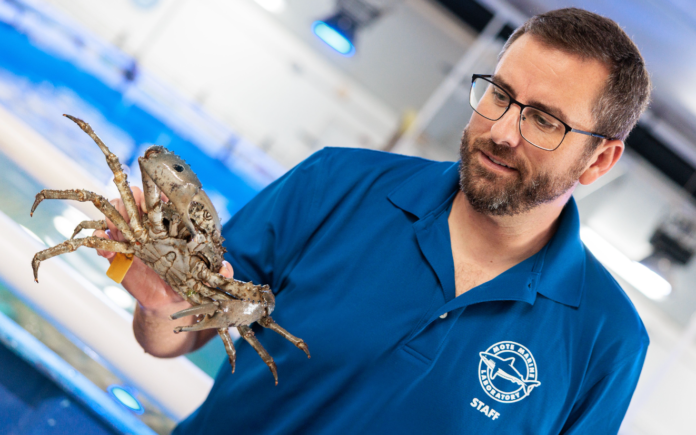
—For Longboat Key residents who love the ocean — and there are a few — a piece of news arrived quietly in late March that deserves a second look. On March 28, scientists from Sarasota’s own Mote Marine Laboratory waded into the waters of the lower Florida Keys and released something no one had ever released onto a coral reef before: Caribbean king crabs born and raised in captivity.
It sounds modest. It may be enormous.
—The crabs — spiny, rust-colored creatures that can grow to about a foot across — were hatched and raised at Mote’s Aquaculture Research Park in eastern Sarasota County, roughly 30 miles from the shores of Longboat Key. The 6,000-square-foot facility is the first and only fully operational Caribbean king crab hatchery of its kind anywhere in the world, and it currently houses more than 300 adult crabs. The goal, over time, is to produce up to 250,000 juvenile crabs annually.
—The reason they matter comes down to one word: algae.
—Florida’s Coral Reef — the third-largest barrier reef system on the planet — has lost more than 90 percent of its living coral over the past 75 years. Overfishing, disease, warming seas and algal overgrowth have all taken their toll. The 2023 marine heat wave alone was the worst on record in Florida’s history, pushing water temperatures in the Keys to levels that caused 100 percent bleaching at multiple reef sites. By October 2025, the University of Miami declared staghorn and elkhorn corals — two iconic reef species — functionally extinct in the region.
—When algae takes over a reef, it smothers coral, blocks light and makes corals more vulnerable to disease. That’s where the king crabs come in. They are, in the language of marine science, elite grazers — capable of consuming more algae than any species of parrotfish in the Caribbean. More importantly, they eat the chemically defended and calcified algae that other herbivores won’t touch. Early studies found that when these crabs were introduced to test sites, algae cover dropped by 50 to 80 percent.
“As we placed the crabs on the reef, nearly every one of them grabbed a piece of algae, put it in their mouth, and darted for cover,” said Dr. Jason Spadaro, Mote’s Coral Reef Restoration Research Program Manager.
—This first release was intentionally small — roughly 25 crabs — designed to let researchers study transport methods and observe the animals’ behavior once they hit the water. But Mote has already planned a larger deployment for later this month, and the hatchery’s production is ramping up.
—The effort is part of the broader Mission: Iconic Reefs initiative, a federal partnership led by the National Oceanic and Atmospheric Administration, which aims to restore seven key reef sites across the Florida Keys. NOAA and the National Marine Sanctuary Foundation are helping fund the work.
—Mote’s connection to this story runs deep. The institution has been transplanting hand-grown corals onto the reef since 2008, and after the devastating 2023 heat wave, researchers surveyed those sites and found that 75 percent of the corals Mote had planted over the previous 15 years survived — and many were still growing and reproducing. It was a rare piece of good news in an otherwise grim chapter.
“There is some hope,” said Dr. Spadaro. “But we don’t need hope. We’ve got science telling us that what we’re doing is working.”
—For Longboat Key, the stakes in all this are easy to understand. Florida’s coral reef is not just a scenic wonder. It is the engine behind the state’s marine economy — tourism, recreational fishing, commercial fisheries, and diving all depend on a living reef. What Mote is doing in the Keys, it is doing with Sarasota science, Sarasota staff, and crabs raised just up the road.
—Mote’s research campus on City Island — familiar to anyone who has passed over the bridge heading toward St. Armands — is now home to cutting-edge work on red tide, sea turtle conservation, manatee health, and coral restoration. The lab’s newer public-facing facility, the Mote Science Education Aquarium, recently opened at Nathan Benderson Park near University Town Center, bringing that science to an even wider local audience.
—The king crab project represents something Mote’s leadership has been pushing toward for years: not just replanting corals, but rebuilding the ecological conditions in which corals can survive on their own.
“For decades, Mote has worked to shift the paradigm of coral restoration science,” said Dr. Michael P. Crosby, Mote’s President and CEO. “Now, by actively restoring not just corals but the ecological balance of the reef itself, we are advancing solutions that address the root causes of reef degradation.”
One reef at a time. One crab at a time. Born in Sarasota.

