
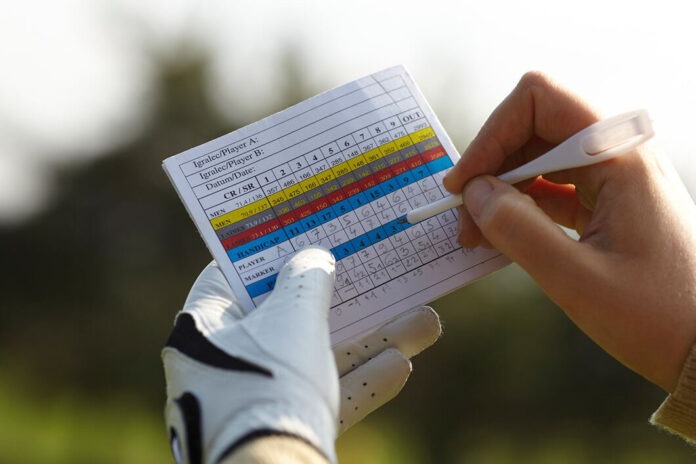
—As all of us know Golf is a tough game. What’s great about the game is that two players can play each other head to head with far different abilities but with an established handicap those same two players can play each other either in a match play or stroke play event and compete against each other.

What is a handicap? It is a numerical score that measures the golfer’s ability. In the US the USGA (United States Golf Association) oversees and manages this system. Having an established handicap allows golfers of any ability play together or against each other whether in a social or competitive situation.
—The handicap that you have reflects the number of strokes a player is expected to take above or below the golf courses actual par. If Player A is a 25 handicap the USGA system is saying that golfer will shoot on average somewhere from 97-102. If Player B is a 4 handicap the system feels that the golfer will shoot on average rounds between 76-79.
—In the old days the USGA would recalculate handicaps every two weeks. That gave those who are sometimes known as “sandbaggers” (we will discuss this later in another issue) a two-week window to play friends or in competition and take advantage of them. Now the system updates the GHIN handicaps daily to avoid this type of activity.
—The Maximum handicap that the USGA allows for a male golfer or female golfer is 50.4. That is a lot of strokes but brand-new players can use this system to monitor there improvement as they learn the game.
—Do you need a handicap to play a round of golf? In the US definitely not. In fact, when you first start learning the game you won’t have a handicap at all. Many countries won’t let a new golfer on the course unless they have proof of a handicap. The main reason behind this is someone who is new can really cause a major backup on a golf courses pace of play policy.
—After you have established a handicap you will notice that not all golf courses are the same. A wide-open course with no water and very little out of bounds with shorter holes will be much easier to score on opposed to a course with lots of water, longer in distance and many more difficult factors. That is why the USGA has created a course rating which allows a person with a handicap to travel and play other courses and have a new handicap based on its difficulty.
—The USGA determines a course rating by evaluating a courses length and 10 specific obstacle factors for both scratch (0 handicap) and bogey (roughly 20-24 handicap). Licensed regional teams use standardized formulas to calculate the average “good” score for a scratch player (Course Rating) and a bogey player (Bogey rating) typically reassessing courses every 10 years.
—The Key factors that the USGA uses to come up with the final ratings is based on these items.
—Raw yardage, Topography (stance & Lies), Fairway width, Green target (visibility), rough, Bunkers, crossing obstacles (water/ravines) trees, green surfaces (speed/slope) and psychology.
—As you can see lots of information go into calculating a fair rating so that your “game” can travel and stay competitive. Hopefully today you learned a little more on what goes into creating a handicap.
—Terry O’Hara is entering his 17th year as Director of Golf at the Longboat Key Club. A 28-year member of the PGA of America, Terry is originally from Worcester, Massachusetts, and now lives in Sarasota. Terry and his wife, Lisa, have two children, Jack and Ava. His son, Jack, is also a teaching professional at the club. Terry is a diehard Boston sports fan and loves supporting all of his hometown teams.

