
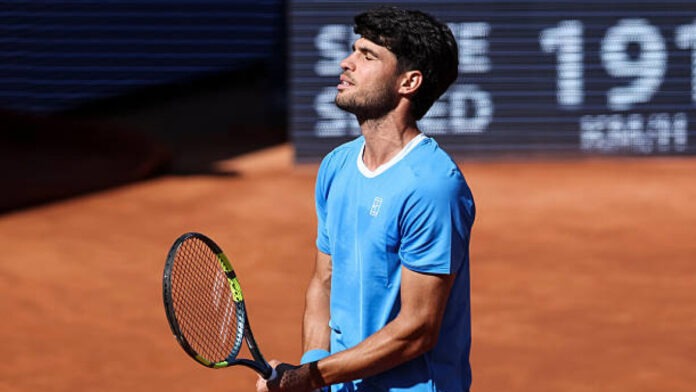
—By the time the European spring yields to the Parisian summer, the narrative of the ATP Tour is usually carved into the red dirt. But as we approach Roland Garros this year, a massive shadow that has been looming over the Bois de Boulogne has finally dropped—the official withdrawal of two-time defending champion Carlos Alcaraz.
—Now that the Spaniard’s right wrist injury has officially forced him out of the French Open, the draw doesn’t just open up; it radically reshapes the tactical landscape of the entire tournament.
—Without the sport’s most dynamic clay-court titan to defend his crown, World No. 1 Jannik Sinner becomes the undisputed man to beat. But clay is a living, breathing surface that rarely respects linear logic. With Alcaraz now confirmed to be confined to the sidelines, who genuinely possesses the tactical toolkit to threaten Sinner over best-of-five sets on Court Philippe-Chatrier?
—The Mechanics of a Sidelined Defending Champion
—To understand the void Alcaraz leaves behind, we must first understand the specific cruelty of the injury that derailed his title defense. Suffering a right wrist injury at the Barcelona Open earlier this month, Alcaraz has been forced to make the agonizing decision to prioritize his long-term career over a potential three-peat in Paris. For a modern clay-courter, this is perhaps the absolute worst physical ailment to endure.
—Clay demands heavy topspin to push opponents behind the baseline and open up the geometry of the court. Alcaraz’s game is built on a devastating, whip-like forehand that generates massive RPMs. That shot relies heavily on the aggressive snap and pronation of the wrist and forearm through the contact zone. On hard courts, a player can occasionally get away with flattening out their strokes to protect the joint. On clay, doing so is tactical suicide. Without the ability to unleash his inside-out forehand or his heavy kick serve without severe discomfort, Alcaraz’s kinetic chain is broken. By withdrawing, the tournament loses the one player whose peak physical and tactical ceiling matches—and often disrupts—Sinner’s relentless baseline aggression, famously outlasting the Italian in last year’s grueling five-and-a-half-hour final.
—The Linear Assassin on a Lateral Surface
—Jannik Sinner’s relationship with clay has always been one of adaptation rather than natural marriage, but recent results—including his victory over Alcaraz at the Monte-Carlo Masters this spring—prove he has solved the puzzle. Sinner plays linear, first-strike tennis. He hits flat, takes the ball exceptionally early, and absorbs pace better than anyone in the world.
—Traditionally, the heavy conditions of Roland Garros neutralize flat hitters, allowing pure dirt-ballers the time to set up their heavy, looping groundstrokes. But Sinner has evolved. By improving his drop shot, enhancing his physical endurance, and learning to slide into his shots rather than just out of them, he has turned his flat pace into a weapon that rushes opponents even on the slowest surface. Without Alcaraz’s chaotic brilliance to drag Sinner into a grinding, multi-directional dogfight, Sinner will dictate the baseline terms against 95 percent of the locker room.
—So, who makes up that remaining five percent?
—The Prime Contenders: Who Can Derail the Express?
—If Sinner is to be beaten in Paris without Alcaraz standing in his way, it will require a player capable of withstanding extreme baseline pace while possessing a weapon heavy enough to push the Italian off the baseline.
—Alexander Zverev: The Heavy-Artillery Threat
—Alexander Zverev’s game translates dangerously well to the conditions of Philippe-Chatrier. The sheer height of his contact point, particularly on his world-class two-handed backhand, allows him to handle Sinner’s crosscourt pace without being pushed out of the strike zone. Furthermore, Zverev’s massive first serve wins him free points—a critical necessity against Sinner’s elite returning. Zverev’s heavy, high-bouncing groundstrokes can force Sinner to hit from above his shoulders, a zone where it is significantly harder to generate flat, piercing winers. If Zverev serves at over 70 percent, he poses the most immediate stylistic threat to the Italian.
—Casper Ruud: The Traditional Dirt-Baller
—You do not reach multiple Roland Garros finals by accident. Casper Ruud represents the antithesis of Sinner’s game. The Norwegian plays with immense height over the net, relying on a forehand that kicks violently off the surface. Ruud’s strategy against Sinner would be pure attrition: pin Sinner deep in the ad-court, loop heavy forehands to Sinner’s backhand, and refuse to give him the waist-high pace he craves. The question is whether Ruud can withstand the sheer velocity Sinner will send back his way. Ruud’s backhand can break down under sustained pace, and Sinner will target it mercilessly.
—Novak Djokovic: The Eternal Variable
—Even in the twilight of his career, discarding Novak Djokovic at a major is a fool’s errand. While he lacks the week-in, week-out physical dominance he once had, a two-week peak in Paris is never off the table. Sinner has turned the tide against Djokovic on hard courts, but best-of-five on clay is a different beast. Djokovic’s unparalleled ability to absorb pace, change down-the-line direction, and tactically dissect an opponent’s movement makes him a latent threat. If he finds his legs in the second week, Djokovic remains the ultimate chess master on the terre battue.
—The Verdict: A Tournament of Margins
—Now that Carlos Alcaraz has officially withdrawn, the narrative undeniably shifts from a two-horse rivalry to Sinner versus the field. Sinner’s flat, suffocating baseline game makes him the heavy favorite, but Roland Garros is a tournament of physical margins.
—To beat Sinner, an opponent must either out-serve him, out-grind him, or successfully drag him into a tactical war of attrition. Zverev has the power, Ruud has the spin, and Djokovic has the intellect. Yet, it will take a near-perfect performance to dismantle the Italian’s pristine baseline mechanics. The French Open without its defending champion loses its most electric spark, but it sets the stage for a fascinating tactical chess match: Can the traditional weapons of clay-court tennis hold off the cold, calculated execution of Jannik Sinner?

