
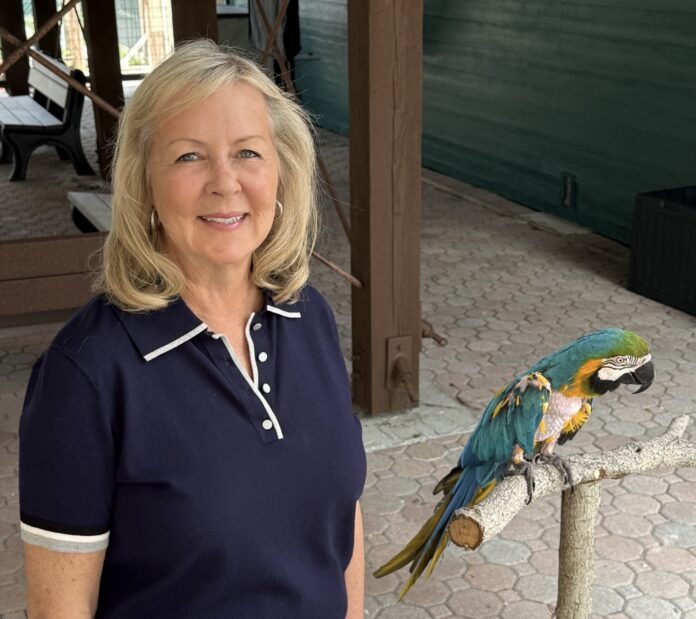
Longboater Linda Mitchell Didn’t Plan to Chair a Bird Rescue Organization. Then She Saw the Seabirds.
Linda Mitchell has a phrase she has lived by for most of her adult life: bloom where you are planted.
—It sounds simple enough — the kind of thing you needlepoint on a pillow or write in a card. But for Mitchell, it has been an actual operating philosophy, a quiet but firm commitment to look around wherever life has put her, find what needs doing, and do it.
—When she and her husband Bill moved to Queens Harbour in Bay Isles on Longboat Key in 2019, she looked around. She found the binoculars first. Then the birds. —
“We were both blown away by the beauty of the seabirds,” she says. “You see them all over Longboat Key — on the docks, in the shallows, riding the thermals over the Gulf. Once you start paying attention, you can’t stop.”
—Paying attention, it turned out, was the beginning of something much larger.
—Today, Mitchell is the board chair of Save Our Seabirds, the Sarasota nonprofit that has quietly become one of the most important wildlife rescue operations on Florida’s Gulf Coast — a Four-Star Charity Navigator organization that fields more than 5,000 distress calls a year, treats roughly 1,000 to 1,200 injured birds annually in its on-site avian hospital, and provides permanent sanctuary to nearly 100 non-releasable birds on its campus at 1708 Ken Thompson Parkway on City Island. It is open 365 days a year, free of charge, to anyone who wants to walk the campus and spend an hour in the quiet company of brown pelicans, roseate spoonbills, great blue herons, sandhill cranes, and the occasional crested caracara.
—It is, by any measure, an extraordinary place. Mitchell is one of the reasons it keeps getting better.
—The Call that Found Her
—At the time, a bird rescue organization was not on her radar. She was looking, as she puts it, for “something that would call to me.” She had been active in her community in Greensboro, North Carolina — involved in food scarcity initiatives, various nonprofits, the kinds of hands-on civic work that reflects a person who takes seriously the idea that you owe something to the place you live. She arrived on Longboat Key open, as she says, to whatever presented itself.
—What presented itself was Save Our Seabirds, via a mutual friend and a conversation about board membership. She spoke with then-board chair Jim Curtis, checked out the organization, and joined the board in 2022. She was asked to serve as vice chair. Then, as these things tend to go when you are good at what you do, she became chair. —
“I’m good at strategically looking at the operational aspects of an organization,” she says, with the matter-of-fact modesty of someone who has spent decades actually fixing things rather than describing how she might fix them. “And to some degree, marketing.”
—What she found when she arrived was an organization of remarkable mission and considerable challenge. The campus, originally established in 1988 as the Pelican Man Sanctuary under the late Dale Shields, had been rebuilt as Save Our Seabirds in 2008 by co-founders Lee Fox and Ann Anderson after the original sanctuary closed in 2006. The core mission — rescue, rehabilitate, release — was being met with remarkable consistency. The infrastructure was another story.
“The operational budget was a challenge. The facility was tremendously aging — original wooden structures throughout all of the aviaries. A limited board. Tight resources,” Mitchell says. “And yet despite all of those challenges, we were still achieving our core mission of treating more than a thousand birds a year. That was amazing to me.”
—What the Numbers Mean
—The numbers behind Save Our Seabirds are quietly staggering. More than 5,000 distress calls a year — that’s nearly 14 a day, every day, from people across Sarasota and Manatee counties who have found an injured pelican on their dock, a hawk tangled in fishing line, an owl that has fallen from a tree. SOS has a corps of trained volunteer rescuers — people who keep boots and a transport cage in their car at all times, who will drive across the county on a moment’s notice to help a bird they have never met.
“They are extraordinary,” Mitchell says. “They are not people who have done this all their lives. Many of them came to it later — retirees, professionals who wanted to give back to something meaningful. I know a man who retired from a corporate career, had some carpentry skills, started building shelves at the facility — and then began singing to the birds and the birds sang back.”
—The birds that make it to the hospital are treated by a senior rehabber who holds the state license, supported by a consulting veterinarian. The goal is always release — getting the bird healthy, keeping it wild, returning it to its natural habitat. Many of the injuries SOS treats are human-caused: fishing line entanglement, collisions with vehicles and buildings, poisoning from rodenticide that works its way up the food chain into eagles and hawks. Save Our Seabirds’ social media team has made a particular point of sharing these stories — the owl caught on a glue trap, the eagle sickened by rat poison — not to shame, but to educate.
“We have to intercede because of what we have done to their natural environment,” Mitchell says simply. “Whether it’s golf balls or fishing line or pesticides — we’ve altered the world they live in. Somebody has to help.”
—Why Birds?
—It’s a question she has fielded often enough that she has a considered answer ready.
“Not because they are more important than hungry children or struggling families,” she says. “Not more important. But also important. Somebody has to help with environmental issues, with wildlife. Somebody has to pay attention.”
—The numbers suggest that not many do, proportionally speaking. Only about three percent of all charitable giving in the United States goes to animals and environmental causes. Of that, only one percent goes specifically to wildlife. Save Our Seabirds operates, like most wildlife rescue organizations, on the thinnest of margins — supported almost entirely by donations, with limited grant funding available, because in a world of competing needs, birds typically are low on the list.
“If you are a funder looking at food scarcity, homelessness, children’s health — and then a bird rescue organization — the birds come last,” she acknowledges. “That is the reality. Which is exactly why we need people who care specifically about this, who will show up specifically for this.”
—The Longboat Key Club has been a significant supporter, as has the Longboat Key Garden Club, which Mitchell credits with meaningful on-the-ground involvement. But the organization relies heavily on visitor donations, event fundraising — including an annual Fundraising Gala and a collaboration with 3 Car Garage Brewing that produced the Laughing Gull Lager — and the generosity of individual donors who walk the boardwalk, see what’s being done, and feel compelled to help.
“When people come and visit — truly, when they leave reviews on TripAdvisor, when they tell their friends — they are always in awe,” Mitchell says. “That is the number one thing. Come see it. Come walk the boardwalk. Because when people see what we’re doing, they want to be part of it.”
—Full Speed Ahead
—The storms changed things. Hurricanes Helene and Milton in 2024 brought roughly three and a half feet of storm surge to the SOS campus, killing vegetation, flooding enclosures, forcing emergency bird evacuations. Staff secured a boat from the Sarasota Police Department just to check on the birds in the aftermath. All of them survived — a fact Mitchell recounts with visible pride.
—But the storms also accelerated what Mitchell and executive director Brian Walton had already identified as an urgent need: the campus has to be modernized, and it has to be made resilient. The first five new aluminum aviaries — replacing the aging wooden structures — are near completion, with 32 total on the campus eventually needing replacement at roughly $35,000 each. A master site plan developed with DSDG Architects envisions a fully reimagined campus, including a new avian hospital built on an elevated footprint to protect against future flooding, new water features and a renovated pelican area at the center of campus, a Bird Walk, and upgraded facilities throughout. A ribbon-cutting for the initial phase is targeted for later this year.
“Going forward — full speed ahead,” Mitchell says, echoing Walton’s words at a recent community gathering. “We have survived two major hurricanes in a matter of weeks. We came back. The birds came back. And now we are building something better than what was there before.”
There are also quieter moments that stay with her — the ones that remind her why she is doing this.
—She tells the story of two bald eagles brought in with their talons locked together, embedded in each other from a midair territorial confrontation. Staff worked meticulously, removing one talon at a time, treating the wounds. At the end of the day, both eagles survived. Both were eventually released.
—Mitchell tells another story about a sandhill crane hit by a vehicle, the phone calls that flew back and forth after hours, the coordination that brought the bird in. She was on the periphery of that rescue — watching the network activate, watching people respond. “I was so proud of the coordination,” she says again, and you get the sense she says it often, and means it every time.
—How to Help.
—For Longboat Key residents, Save Our Seabirds is a short drive across the bridge — and for many, Mitchell says, it might as well be in another county for how little they know about it.
“On Longboat Key, you see these birds everywhere — every dock, every shoreline, overhead every morning,” she says. “But in broader Sarasota, people aren’t necessarily aware that this place exists or what it does. Broadening that awareness is a next step.”
—The organization is open daily from 10 a.m. to 5 p.m., with no admission fee. The daily pelican feeding is at noon; the raptor program runs at 1 p.m. Volunteer opportunities range from bird rescue (training classes are offered several times a year, no prior experience required) to facility maintenance, event support, docent work, and an intern program developed in partnership with area colleges.
“The first thing I always say is: come to Save Our Seabirds,” Mitchell says. “Come enjoy the Bird Walk. See what’s there. People are always amazed by what they find. And then — if you like what you see — consider a donation, or get involved. There are so many ways in.”
She pauses.
“I have learned over many years that if everybody could just do a little something for the larger picture — something beyond their own immediate circumstances — that is how things actually get better. That is how communities work. You bloom where you are planted. And then you help the things around you grow.”
—Save Our Seabirds is located at 1708 Ken Thompson Parkway, Sarasota, on City Island near Mote Marine. Open daily 10 a.m. to 4 p.m. Free admission. For information on visiting, volunteering or donating, visit saveourseabirds.org or call 941-388-3010. After-hours bird emergencies: 941-416-4967.

