
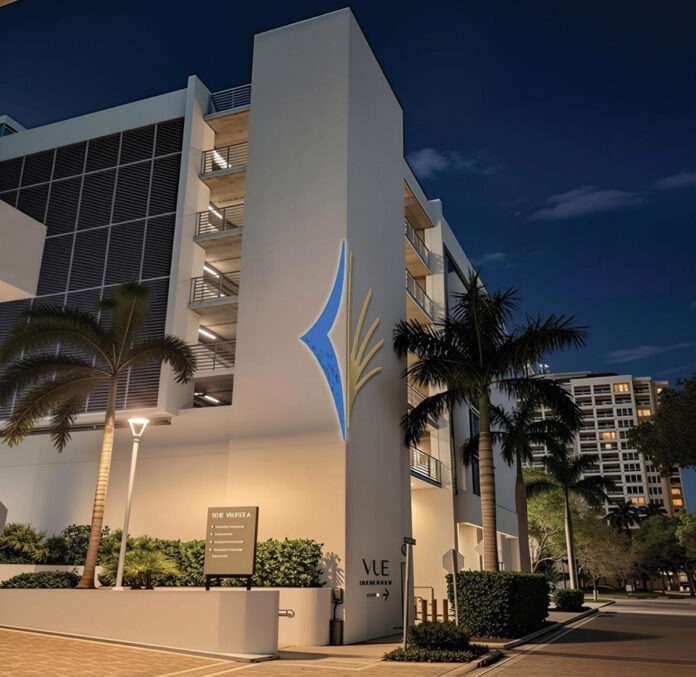
A 23-foot sculpture is coming to one of Sarasota’s most-seen towers. But it faces the entrance off the Ritz-Carlton connector road, where residents and Westin guests arrive — not the 40,000 cars rounding the highway.
—There is a particular logic to the public sculpture proposed for the Vue, and it is a geographic one — a decision about who, exactly, the art is for.
—The Vue is among the most-seen buildings in Sarasota. The 18-story, 141-residence tower stands at the northwest corner of the U.S. 41–Gulfstream roundabout, the busiest intersection in the city — more than 40,000 vehicles a day funnel through it, the sole gateway between downtown and the barrier islands, the road that carries airport arrivals into the city and everyone else out toward St. Armands, Lido and Longboat Key. If you have driven into Sarasota from the north, you have already noticed the Vue. It is, for tens of thousands of drivers daily, the building that announces arrival.
—The artwork, however, does not face them.
—The 23-foot-4-inch aluminum sculpture by Sarasota artist Chad McGowan — a corner-wrapping abstraction of blue and champagne, lit from behind at night — is proposed not for the prominent face that fronts the roundabout, but for the north flank of the building’s parking podium: the side that turns toward the Vue’s own entrance. That is the approach off the small connector road leading to the Ritz-Carlton, the drive that carries residents and visitors into the condominium and brings guests to the adjacent Westin. It is, in other words, not a hidden corner. It is the doorstep. Everyone who lives at or comes to the Vue will pass beneath it; so will the steady traffic to the Westin and the cars threading the Ritz approach. What it forgoes is the highway audience — the 40,000 who sweep past without slowing.
—The result is a quietly revealing choice. The most-trafficked corner in the city is about to acquire a substantial work of sculpture, and the building has aimed it not at the crowd rushing by, but at the people actually arriving.
—A Half-Percent of the Skyline
—How the piece came to exist at all is a small lesson in how a city of considerable cultural ambition pays for the art that decorates it.
—Sarasota, like a growing number of American cities, runs a “percent for art” program: developers building at scale must set aside a fraction of construction cost for public art, either by commissioning a piece for their own site or paying into a city fund that places art elsewhere. The idea, imported from a 1960s federal model, rests on a simple bargain — private development imposes itself on the public realm, and in exchange contributes something to it.
—In Sarasota, the requirement applies to projects exceeding $1 million in construction value, set at one-half of one percent. That percentage is the key to the numbers attached to the Vue. The two building permits driving the proposal — 2024-002686 and 2025-012313 — carry public-art obligations of $8,384.05 and $6,560.63, a combined $14,944.68, with roughly $17,000 placed in escrow. Run the half-percent in reverse and the permits imply something close to $3 million in associated construction value. The art contribution is, by design, a rounding error against the cost of the work that triggered it.
—That is the tension the figure exposes. For a building of the Vue’s stature — residences that trade well above $2 million, a tower that has been one of the defining shapes of the downtown skyline since the Kolter Group completed it in 2017 — a five-figure art set-aside can look less like a civic gesture than a toll. The sum does not, on its face, seem commensurate with either the building or the corner it commands.
—Why So Little — and Why It May Soon Be More
—The modesty of the number is not an oversight. It is the ordinance working as written, and the city has noticed the gap.
—City planners who oversee the public-art program have argued for some time that a half-percent no longer stretches as far as it once did. Construction costs have climbed; so has the cost of fabricating serious sculpture. As the city’s public-art manager has put it, the same steel that raises buildings also raises art, and a fund built on yesterday’s percentages cannot commission tomorrow’s centerpieces. The city’s public-art fund has at times hovered around $150,000 — a sum, officials concede, that does not buy much monumental work in the current market.
—That reasoning drove the city’s Public Art Plan 2030, under which the commission approved doubling the developer contribution from 0.5 percent to 1 percent for qualifying projects — an effort to bring Sarasota in line with peer jurisdictions and to sustain a collection that now numbers well over 90 works. Notably, the increase drew little organized opposition from developers, a fact commissioners read as evidence that the fee was never the burden critics imagined. The Vue’s contribution reflects the older, lower figure — a snapshot of the program as it was, even as the city moves toward a more demanding standard.
—It is worth being precise about what the ordinance does and does not do. Individual condominium units and attainable-housing components are excluded from the calculation, which is part of why a luxury tower’s headline value does not translate dollar-for-dollar into an art obligation. The contribution is pegged to qualifying construction value — not to sale prices, not to views, and certainly not to traffic counts.
—The Difference Between a Fund and a Façade
There is a second choice buried in the proposal, and it matters more than the dollar amount — and bears directly on where the piece will sit.
—Developers may satisfy the requirement two ways: write a check to the city’s fund, or commission an approved work for their own property. The Vue has chosen the latter — bringing forward an actual object, by a named artist, fixed to the building, rather than feeding an anonymous pool. And because the work lives on the Vue’s own walls, the placement is the building’s call as much as the city’s: the sculpture goes where the architecture and the association want it, which is how a major piece ends up over the entrance rather than the highway face.
—For years the city leaned toward in-kind art of exactly this sort, and for years it discovered the catch: developer-placed work, once installed, was not always maintained. Pieces languished. The city’s more recent thinking has tilted toward cash contributions precisely so that the program — not a condominium board — controls placement and upkeep in perpetuity. Seen against that backdrop, the Vue’s decision to mount its own sculpture is the more old-fashioned path, and one that places the burden of maintaining a 23-foot aluminum work, in salt air, at the foot of a bay bridge, squarely on the association — and one that also let the building decide the work would mark its own front door.
—What the city gets in return is site-specificity — art made for this corner rather than parked on it. That is the case McGowan’s proposal makes for itself.
—The Work Itself
—McGowan, a Ringling College graduate who has built sculpture for two decades and whose recent work appears in the Ritz-Carlton Residences, the BLVD, Epoch and the St. Regis, describes the piece as an abstraction of Sarasota’s own landscape — lush foliage and fluid motion rendered in metal, a form that does not merely decorate the wall but “engages the corner, the street, and the night.”
—The proposal calls for marine-grade 6061-T6 architectural aluminum, finished in a durable powder coat that pairs vibrant blue with champagne tones chosen for color depth and reflectivity, and engineered to survive the tropical exterior. The composition wraps the podium corner, trading sharp edges against rolling curves, with negative space and cast shadow treated as compositional elements in their own right. At night, backlit 4000–5000K LED illumination is meant to shift the work from sculpture to something closer to luminous architecture — a transformation staged, fittingly, for the people arriving home and the guests pulling up to the door.
—It is engineered like a building, because at that scale it effectively is one. The structural connection to the Vue’s existing masonry has been signed and sealed by a licensed engineer; the design accounts for a 150-mph basic wind speed, the standard for a coastal structure of its risk category. The total artist fee, per the proposal, is $18,000 — more than the public-art contribution that nominally triggered it, the gap covered by the association, along with additional sums the city requires for architectural drawings and sealed engineering.
—A Small Piece of a Larger Puzzle
—It would be easy to file the Vue sculpture as a minor item — a five-figure line on a meeting agenda, a single object on the side of a single building. That reading misses what the program is for.
—Sarasota’s identity as an arts city is not the product of a few monumental commissions. It is the accumulation of dozens of modest decisions like this one — a copper sculpture outside City Hall since the 1960s, a string of works tucked into the roundabouts along U.S. 41, the slow assembly of a public collection that a half-percent at a time has grown past 90 pieces. The city’s cultural reputation, the thing that helps sell the very towers that fund the art, is built from exactly these small, individually unremarkable contributions.
—Which makes the placement its own kind of statement. A more calculating developer might have angled the piece toward the highway, claiming 40,000 daily impressions as a marketing dividend. The Vue has instead set its sculpture over the entrance, where the people who live there, the guests who visit, and the traffic to the Westin and the Ritz approach will meet it at eye level and at a human pace — art for the threshold rather than the billboard. It is a quieter ambition, but not a smaller one: a piece meant to be lived with rather than glimpsed at speed. Fifteen thousand dollars does not seem like much. Placed at the front door of one of the most-seen buildings in Sarasota, it may turn out to be among the best-positioned $15,000 in the city.

