
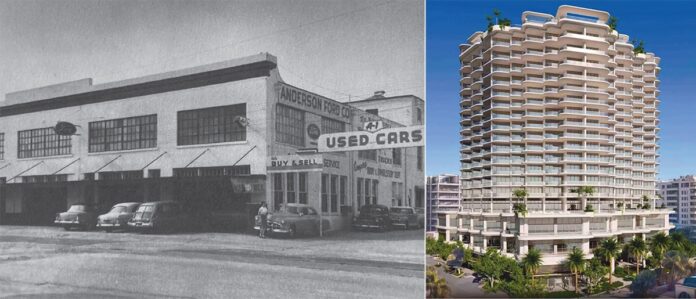
City faces Aug. 5 deadline to rule on the Adagio site plan while a circuit court challenge hangs by a thread.
—The fate of one of downtown Sarasota’s oldest commercial buildings may come down to a single sheet of paper.
—The U.S. Garage building at 330 S. Pineapple Ave., built in 1925 as the first automobile garage in Sarasota and possibly in Florida, stands in the footprint of the Adagio, a proposed two-tower condominium project by Naples-based Lutgert Companies. To clear the site, the city issued a demolition permit for the building through an administrative process, with no public hearing and no review by the city’s Historic Preservation Board.
—The city’s justification for that shortcut is now the subject of a lawsuit, a pending motion in circuit court, and pointed accusations from preservation advocates that staff approved the demolition of a Florida Master Site File structure based on a document that does not support the weight placed upon it.
—The Single Page
—Because the U.S. Garage is listed on the Florida Master Site File, the state’s inventory of historic and cultural resources, city code requires a historic review before staff can authorize demolition. Under Zoning Code Section IV-823(a), the Neighborhood and Development Services Director may approve demolition of a non-contributing Master Site File structure “once the historic review has been completed.”
—The document the city has produced as evidence of that review is a one-page City of Sarasota form titled “Application Package: Demolition of Florida Master Site File Structures,” attributed to Dr. Clifford Smith, the city’s longtime senior planner for historic preservation, and bearing a handwritten date of July 5, 2023.
—A copy of the form reviewed by Longboat Key News is almost entirely blank. The lines for the applicant’s name, the FMSF demolition application number, the building or demolition permit number, and the application date are empty. The only handwritten entries are the Pineapple Avenue property address, the words “Demolition of Building” as the proposed action, and the July 2023 date on which a historic review was purportedly completed.
—Dr. Smith died in 2024, making it impossible to ask him what review, if any, stood behind the form.
—Ronald Kashden, a board member of the Sarasota Alliance for Historic Preservation and a former candidate for Sarasota City Commission, has been among the most vocal critics of the city’s reliance on the document. In correspondence with Longboat Key News, Kashden contends that the city’s description of its documentary evidence “bears little resemblance” to the document itself, and that staff has treated the single page as though it were the historic review the code requires.
“They have offered no evidence that any review was actually performed,” Kashden wrote, saying the city has relied on verbal assurances from former Development Services Director Steve Cover rather than any written analysis. When the Alliance asked staff to conduct an actual review, Kashden said, staff refused.
—The timeline raises a further procedural question. The July 2023 form predates the current demolition effort by more than two years. According to a March 20, 2026, technical review memorandum from Acting Development Review Chief Planner Rebecca Webster and Historic Preservation Senior Planner Susan Dodd, the demolition application the city actually received arrived on Nov. 4, 2025, and is catalogued in city records as 26-FMSF-10. Lorrie Muldowney, a past Alliance president who sits on the city’s Historic Preservation Board, has argued publicly that city processes require a fresh review each time a demolition permit is requested, meaning a new review should have occurred in late 2025. No documentation of such a review has surfaced in public records.
—The City and Developer Response
—City officials maintain that proper procedures were followed. Staff points to previous consultant surveys in 2003 and 2010 that found the U.S. Garage ineligible for local or national historic designation, largely because of alterations to its facade during a 1982 adaptive reuse renovation, an irony not lost on preservationists, since that renovation was performed by celebrated Sarasota architect Frank Folsom Smith, who converted the old garage into the office and retail building that remains fully occupied today.
—Robert K. Lincoln, the Sarasota attorney representing the developer, has defended the permit, telling the nonprofit newsroom Suncoast Searchlight that Dr. Smith reviewed the property’s history, visited the building and met with representatives of the buyer before the purchase, and that his determination was consistent with the earlier survey findings. Lincoln has argued that allowing the Alliance to force a historic designation review would set a precedent affecting property owners citywide.

—Shut Out at the Board of Adjustment
—The Alliance appealed the demolition permit, No. 2026-000658, to the city’s Board of Adjustment. On April 29, after more than an hour of legal argument from Alliance representatives, the board voted unanimously that the group lacked standing to bring the appeal. The merits of the case, whether the historic review actually occurred and whether the building deserves protection, were never heard.
—The Alliance then took the fight to the 12th Judicial Circuit Court, filing suit in June and asking the court to review the Board of Adjustment’s standing decision. A circuit judge granted the city’s motion to dismiss. The Alliance responded with a 34-page motion for relief asking the judge to reconsider, and that motion, still pending, is what keeps the legal challenge alive. If the judge denies it, the preservation effort likely ends. If the judge grants it, the question of whether the city followed its own demolition procedures could finally get a hearing.
—The Adagio Marches On
—While the court fight continues, the Adagio itself keeps advancing through the city’s administrative pipeline. The project received partial sign-off from the Development Review Committee on May 20, with staff still pressing the development team on unresolved items, including a city code requirement that the attainable housing units be indistinguishable in exterior appearance from the market-rate units. Webster herself flagged differences between the two towers, noting aluminum railings on the attainable building’s balconies versus glass on the market-rate tower.
—The project proposes an 18-story tower with 113 market-rate condominiums and a 9-story building with 76 attainable units, 189 residences in all, plus roughly 31,315 square feet of commercial space on about 2.24 acres bounded by Ringling Boulevard, Palm Avenue and Pineapple Avenue. The developer is using the state’s Live Local Act to exceed the Downtown Core district’s 10-story height limit, paired with the city’s downtown attainable housing density bonus. Of the 76 attainable units, only eight would be priced for renters earning below the area median income; the remaining 68 would serve households earning up to 120 percent of it, roughly $130,000 for a family of four.
—Under a fourth extension agreement signed in May, the city must approve, approve with conditions, or deny the Adagio’s administrative site plan and administrative adjustments on or before Aug. 5. Because the project is proceeding administratively, it requires no City Commission approval and no public hearing.
—Which brings the dispute back to where it started. For opponents, the issue was never simply the height of the towers or the loss of a beloved building. It is that a century-old landmark, one the Alliance placed on its Six to Save list and that remains structurally sound and fully occupied, can be cleared for demolition on the strength of a nearly blank form filled out by a man who can no longer be asked about it, with no public process at any step along the way. Whether that is lawful is now a question for a circuit judge. Whether it is good government is a question Sarasota voters may weigh themselves.

