
Commissioners are drafting HOA mailers on Town letterhead, lobbying Tallahassee and pointing at $30 million in hurricane bills. Sarasota, where the mayor is already skipping conferences, and Venice and the county are running the same play, each with a bigger number.
—Longboat Key has decided how it wants to fight Amendment 3. It is not going to fight it, exactly. It is going to explain it, in writing, to every homeowner it can reach, with the Town’s own figures attached.
—That is the strategy that emerges from a stack of Town emails reviewed by Longboat Key News, and it puts Longboat in the same posture as nearly every city and county on the Suncoast. Florida law bars local governments from spending public money to campaign for or against a ballot question. It does not bar them from telling residents what the question would cost. So the campaign against the largest property tax cut in a generation is being waged one “informational” letter, one budget workshop and one town hall at a time, and Longboat Key’s version of it is now landing in Country Club Shores mailboxes.
—What the amendment does
—Amendment 3, placed on the Nov. 3 ballot by the Legislature during a two-day special session in June, would raise the homestead exemption on non-school property taxes from the current $50,000 to $150,000 in 2027 and $250,000 in 2028, with inflation adjustments after that. It would cut the annual cap on assessment increases for non-homesteaded property, meaning second homes, rentals and commercial buildings, from 10 percent to 5 percent. It would also give a future Legislature the authority to set a schedule for counties and cities to push the exemption all the way to a property’s full assessed value, which is the mechanism critics describe as a path to eliminating non-school property taxes on homesteads entirely.
—The amendment needs 60 percent of the vote to pass. State economists put the recurring cost to local governments at roughly $12 billion a year once the $250,000 exemption is fully phased in. Nothing in the amendment replaces that money.
—The Country Club Shores letter
—The Longboat Key end of the effort runs through Commissioner Gary Coffin, whose district takes in Country Club Shores, and Savannah Cobb, the assistant to the Town Manager who drafted the letter he wanted sent.
“Looks great let’s send it to the 1,2,3,4, and 5 Country Club Shores Association presidents,” Coffin wrote to Cobb. “They will see that their homeowners receive a copy.”
—Cobb replied that she had already run the draft past new Town Manager George Landry and folded in his edits. Coffin came back with two requests: that Landry’s review be included, and that the letter say he was “available to meet with the associations at their convenience prior to the election November 3rd.” He then sent the identical email a second time, which suggests either an eager commissioner or a very slow Outlook.
—The letter itself is careful. It opens by describing the amendment neutrally and acknowledges that it “would reduce the taxable value of qualifying homesteaded properties.” Then it turns to what the Town would lose.
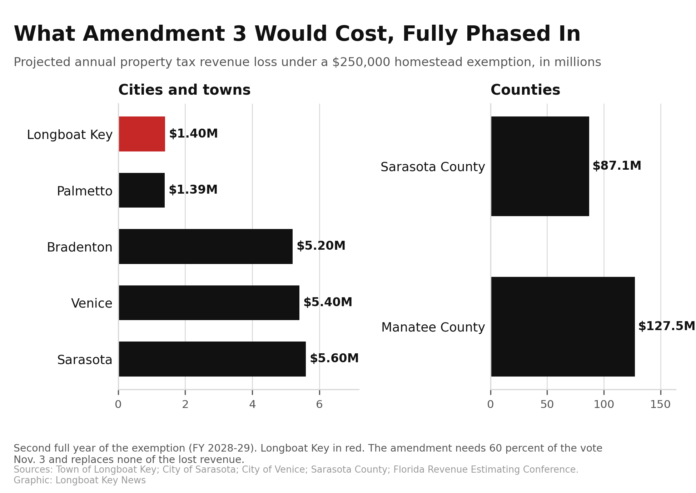
“For Longboat Key, the Town anticipates approximately $1.4 million in reduced annual General Fund revenue once the higher exemption is fully implemented,” Coffin wrote. “A loss of this size could affect the Town’s ability to maintain current service levels and fund future priorities.”

—The leverage is the 2024 hurricane season.
“Our experience with Hurricanes Helene and Milton is an important example of why maintaining adequate local resources matters,” the letter continues. “The 2024 storms resulted in nearly $30 million in costs to the Town, including beach-related expenses. With continued uncertainty surrounding future federal disaster assistance and FEMA reimbursements, communities may be required to assume a greater share of recovery costs in the future.”
—Coffin also passed along a warning from the county that “significant reductions could affect parks and libraries, including the Sarasota County Longboat Key Branch Library,” and noted that local governments facing shortfalls “may have to consider service reductions, changes to property tax rates, non-ad valorem assessments, or other revenue sources.”
—Nowhere does the letter tell anyone how to vote. It closes with a promise to “continue to gather and provide factual information regarding the amendment so residents can make their own informed decisions.” That sentence is doing legal work as well as rhetorical work.
—Where the $1.4 million comes from
—The figure is not new, and it is not Coffin’s. Finance Director Sue Smith calculated it in June, when the Town began building a budget around a revenue picture it could not see. Her estimate was a $705,000 loss in the first year under a $150,000 exemption, rising to $1.4 million in the second year when the exemption reaches $250,000. The Town’s official Property Tax Facts page rounds the first-year number to $750,000 and keeps the $1.4 million.
—That page is the clearest statement of the Town’s strategy, and it reads like a template for Coffin’s letter. It lists every General Fund service that property taxes support, from police and fire rescue to parks and planning, and then lists what could give: deferred maintenance, smaller capital budgets, thinner staffing in Public Works and Planning, and “consideration of alternative funding sources, such as special assessments.” It notes that Longboat Key “is still waiting to see the first dollar from FEMA for the 2024 storms,” and that the reserves which let the Town waive storm-repair permit fees for more than a year exist only because of tax revenue. A disclaimer at the bottom says the information is “provided for educational purposes.”
—On an island where a great many homes are assessed well into seven figures, an extra $200,000 of exempt value is a modest slice of the tax roll. Former Town Manager Howard Tipton said as much in June, complaining that the state was applying a one-size-fits-all fix to communities that are nothing alike. Longboat’s problem is less the size of the cut than the timing: the Town is simultaneously raising its base millage from 1.960 to 1.999, adding a new canal maintenance levy and rebuilding reserves that Helene and Milton drained. Final adoption of that budget is set for Sept. 28, five weeks before voters decide whether to take $1.4 million a year back out of it.
—Bishop takes it to Tallahassee
—While Coffin works the HOAs, Commissioner BJ Bishop is working the Legislature. As president of the Manasota League of Cities, she wrote to state Rep. James Buchanan, whom she expects to be “sitting in the State Senate chair in January,” to preview the League’s 2027 priorities. She did not bother with the informational framing.
“Much will depend on our ability to defeat Amendment 3 in November,” Bishop wrote, before listing home rule, state grant funding, sovereign immunity and short-term rentals as the issues the League would take up at its meeting this week.
—Then she raised the number that sits underneath the whole Longboat argument. “None of our municipalities have been paid by FEMA for the 2022 and 2024 hurricanes. LBK is owed over $28 million and we are not seeing any movement from Washington to deal with these issues,” she wrote. “If DC is going to hand FEMA funds to the State, will we be able to have some resolution of these long outstanding debts to our towns?”
—That is the case in one paragraph: the Town fronted $30 million for storm recovery, is still waiting on $28 million of it, and is being asked to give up $1.4 million a year in the revenue that made fronting the money possible.
—The Manasota League has been on this since summer. On July 9, in Longboat Key, Florida League of Cities lobbyist Matt Singer told League members that 85 of Florida’s 411 municipalities could not fund public safety at current levels under a $250,000 exemption, and that a state trust fund to backfill lost revenue had been discussed in Tallahassee and dropped. “One person’s tax exemption is another person’s tax increase,” Singer said. The statewide League’s slogan, repeated on its Amendment 3 resource page, is that the measure is not a tax cut but a tax shift.
—The line every local government is walking
—Gov. Ron DeSantis, who spent more than a year touring the state describing property taxes as “paying rent to the government,” said in June it would be “totally inappropriate” for local governments to spend taxpayer money opposing the amendment. Florida law already prohibits it. What the law allows is the factual presentation of impacts, and that is the space in which every local government is now operating.
—Sarasota County Administrator Jonathan Lewis walked the line in public at an August budget workshop, telling commissioners “it’s not my job to tell people how to vote” moments after laying out $46.85 million in lost revenue in fiscal 2028 and $87.09 million in fiscal 2029. His presentation applied the cut proportionally across departments to show what it would look like: about $35 million from the Sheriff’s Office, $17.5 million from Emergency Services over two years, $8.6 million from the environmentally sensitive lands program. He was careful to say no such cuts had been decided. He was equally careful to say that a $350,000 homestead would save about $1,000 a year, or roughly $80 a month.
—The county’s own Amendment 3 web page goes further than Longboat’s, warning residents that lost revenue could mean “park fees, library fees, or increases to the bus system,” higher taxes on rentals that get passed to tenants, and a lower credit rating that raises borrowing costs. It names all four municipalities, Sarasota Memorial Hospital and the water management district as taxing authorities that would take a hit alongside the county.
—The City of Sarasota: 37 police officers
—The City of Sarasota has put its loss at $5.5 million to $5.6 million by fiscal 2029, and its staff report translates that into a unit residents understand: 37 police officers. City Manager Karie Friiling, who arrived this spring just as the special session convened, has called her first three months on the job a “doozy,” and the city has already declined a county offer to take over Ted Sperling Park and Nora Patterson Bay Island Park “for now,” in part because it cannot see its revenue two years out. The city and county commissions met jointly on Sept. 18 at the county’s new Fruitville Commons headquarters, the first time in 18 months they had shared a room, with Amendment 3 on the agenda alongside stormwater, transit and parks.
—The chill has already arrived at City Hall
—The amendment has not passed, and may not, but inside Sarasota City Hall it is already spending money that has not been lost yet.
—Mayor Debbie Trice came home from last year’s National League of Cities summit enthusiastic about The Other Side Village, a Salt Lake City program for chronic homelessness, and this month the group’s leadership institute invited her and Commissioner Jen Ahearn-Koch to a spring 2027 symposium in Utah to compare approaches from around the country. Trice did not forward the invitation to staff. She forwarded it to a nonprofit.
“I know that sending someone from the City to attend this conference is impossible with the looming shadow of Amendment 3,” Trice wrote to City Manager Karie Friiling. “Rather than miss the opportunity to bring more valuable knowledge and ideas to Sarasota, I passed the conference information along to Erin Minor of Gulf Coast Community Foundation.” Minor is also part of the Harvest House family, which Trice called “one of the most successful programs in our area ending chronic homelessness.”
—That is what a $5.6 million shadow looks like in practice: a conference the city will not attend, outsourced to a foundation that can. It is a small line item, and that is the point. Nobody at City Hall is waiting for Nov. 3 to start behaving as if the money is gone.
—The same shadow falls on the parks district the commission has been discussing since spring. City Attorney Joe Polzak sent Commissioner Kyle Battie a draft ordinance establishing a City of Sarasota Parks and Recreation District along with a legal memo from special counsel Chris Roe that, by Polzak’s description, covers the statutory process, the implications for millage allocation under the city’s ten-mill cap, and “the potential impact of Amendment 3.” The district was conceived as a way to give parks their own funding stream. Under Amendment 3, the exemption would apply to that levy too.
—Meanwhile the city has been rehearsing. Trice thanked Friiling and staff for turning out to a Friday “dry run” of the city’s Amendment 3 presentation, a dress rehearsal in which, as she put it, everyone played two roles: a member of the public gathering information before voting, and a member of the city team. She and a colleague she identified only as Jennifer are incorporating the feedback. The polished version is the one that will go before residents in the weeks before the vote, on the same education-not-advocacy footing as Longboat’s letter to Country Club Shores.
—Trice, who is counting down her final seven and a half weeks in office, put it plainly to staff: “I’ve got a lot to do over the next 7 and a half weeks.”
—Venice, North Port and across the bridge
—Venice estimates a $5.4 million cut, about 10 percent of its general fund, and has posted an FAQ explaining why it cannot simply raid utility or impact-fee accounts to cover the gap, since each fund is legally restricted to its purpose.
—North Port, a largely residential city with a thin commercial base, stands to lose a bigger share of its budget than Sarasota does. Fire Chief Scott Titus told a League of Women Voters forum at Selby Library on Sept. 22 that in some jurisdictions public safety alone could consume most of what property tax revenue remains, leaving almost nothing for parks, libraries or animal control, and he faulted the state for never running a fiscal analysis of how the cut would land community by community.
—Across the bridge, the numbers are larger still. The state Revenue Estimating Conference projects Manatee County losing nearly $68 million in fiscal 2027-28 and $127.5 million the following year, Bradenton $5.2 million and Palmetto $1.39 million. The three Anna Maria Island cities and the Manatee County portion of Longboat Key would lose close to $647,000 combined.
—The other side of the argument
—The forum at Selby Library had one wrinkle worth noting for Longboat readers. Organizers could not find an Amendment 3 supporter willing to sit on the panel, so the job of making the case for it fell to Dave Bullock, the former Longboat Key town manager who retired this year after a stint as Sarasota’s interim city manager.
—Bullock argued that the amendment is a reaction to local governments that grew accustomed to spending increases as pandemic-era property values jumped as much as 20 percent in a single year. Sarasota and Manatee county spending, he said, is up somewhere between 85 and 100 percent since 2021. “Somebody doesn’t have their hand on the controller,” he said. He then joined the rest of the panel in doubting that a constitutional amendment was the right tool for the job.
—DeSantis has made the same point with bigger numbers, asking whether local governments that ran on $31 billion in 2019 truly need $61 billion now. Florida Realtors, which frames the measure as housing affordability, put $10 million into the Vote Yes on 3 committee at the start of September. The opposition committee, chaired by former Leon County Commissioner Bryan Desloge, had raised under $150,000 as of that week, with the Florida Association of Special Districts as its largest donor. Sheriffs, fire chiefs, the Fraternal Order of Police, the library association, the League of Women Voters and 1000 Friends of Florida have all lined up against the amendment or formally raised concerns about it.
—The governor himself has cooled. The Legislature stripped out his proposal to include school taxes, dropped a state fund for fiscally constrained counties and deleted a $5.5 million line for his office to mail promotional flyers. He has said he will vote for the amendment but will not campaign for it, and on Sept. 18 he told an audience in Alabama he did not know whether it would clear 60 percent. A St. Pete Polls survey released this month put support at 45 percent, down from 63 and 64 percent in Sachs Media polls in June and July. Polling has consistently shown support dropping sharply once voters are told what the local shortfall would be, which is exactly why the letters keep going out.
—The ballot language fight
—There is one more reason the Town can point to its own numbers with some confidence that voters will not be reading a rebuttal on the ballot. On Aug. 3, Leon County Circuit Judge David Frank threw out the Legislature’s ballot title and summary, ruling that “Save Our Homes from Excessive Property Taxes” was “akin to a political slogan” and that phrases promising to benefit taxpayers, protect small businesses and ensure funding for core services were argument rather than description. He gave Attorney General James Uthmeier 10 days to rewrite it. The amendment itself survived; the marketing did not. The Town has posted the ruling on its Property Tax Facts page.
—What happens on Longboat Key
—Coffin’s letter tells Country Club Shores homeowners that Florida will convene its Taxation and Budget Reform Commission in 2027, a body that meets every 20 years and could recommend a more considered overhaul. That is the Town’s implicit pitch: relief is coming through a better process, and this is not it.
—Whether homeowners agree will depend on how they weigh a few hundred dollars a year against the Town’s account of what it spent after Helene and Milton and what Washington has not yet paid back. The Town Commission will adopt its budget Sept. 28. The voters will adopt or reject the Town’s revenue picture on Nov. 3. Between those two dates, Coffin has offered to meet with any association that will have him, and the Town’s Property Tax Facts page promises more updates “as they become available.” Longboat Key is not going to tell you how to vote. It has simply made sure you know what it thinks the vote will cost.


You can count on these people always telling you that reduced revenue will result in cuts to the things that taxpayers see, like police, fire, parks and libraries. Somehow they leave out the part that property tax revenue in the City of Sarasota has grown by 50% in the past five years, as has the City employee headcount.
I had to listen to a presentation on how the City of Sarasota might have to cut 37 police officers. Again what they don’t tell you is that the City of Sarasota had 180 sworn officers in 2020 and 190 in 2025.
These scaremongers are similar to other politicians who can always find the money for the things they want to spend it on, but can’t find ways to prudently live within their means. I was here in 2020 and I don’t see a difference in public services provided then and now.
I’m a strong Yes on Amendment 3.