
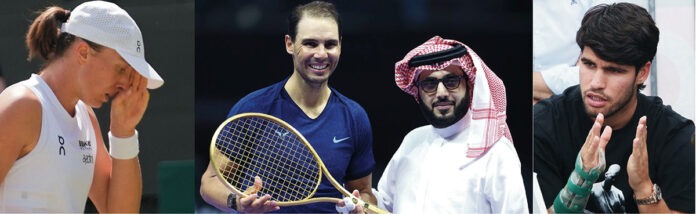
—For most of my childhood I was certain that the forest behind my house in Sag Harbor was, essentially, the Amazon. It went on forever. It held mysteries. Somewhere back there, I was confident, lived jaguars, uncontacted tribes, and quite possibly a lost galleon. Then one day, as a functioning six-year-old, I walked to the end of it in under four minutes and discovered that my personal Amazon was half an acre, and that the outer boundary of the known world was, in fact, Noyac Road.
—This is what age does. It measures things you were happier not measuring. The wilderness shrinks. The heroes shrink. You learn, exactly as the poets and the greeting cards warned you, that you can’t go home again and that you should never meet your heroes — to which I would now add a third rule: never watch your heroes attempt a topspin backhand at 38 on a surgically reconstructed hip. Which brings me, as most of my sorrows eventually do, to tennis.
—Tragedy No. 1: The King of Clay Abdicates for a Kingdom of Cash
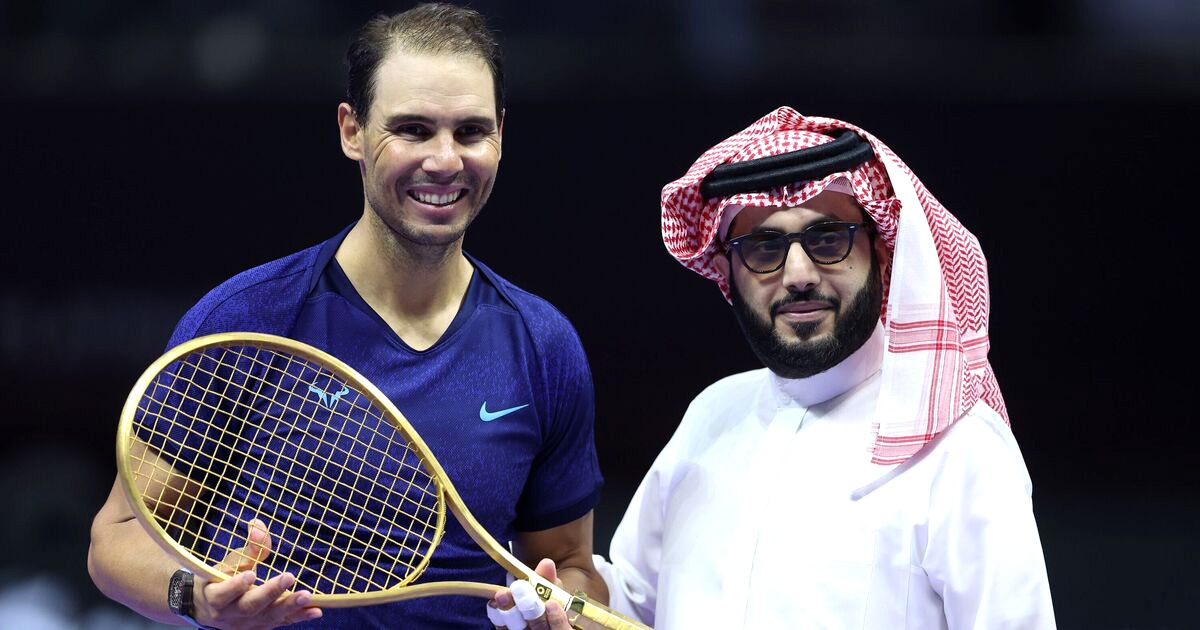
—My greatest hero — the man for whom I would set a 3 a.m. alarm to watch play literally anyone, anywhere, up to and including what I have to assume were exhibition matches against a folding chair in Bratislava — was Rafael Nadal.
—The intensity. The ferociousness. The power. Watching Rafa come back from injury, again and again, was like watching the Wright brothers get a plane off the ground: thrilling, faintly implausible, and you were never entirely sure the thing was going to stay in the air. There were always two Rafas who could show up. There was the one who was going to detonate a forehand and reduce a grown professional athlete to rubble, and there was the tentative, weakened Rafa who needed what the commentators delicately call “match confidence,” which is the official tennis term for “He ain’t gonna win anything playing like that.” And watching the long goodbye — the slow decline of the greatest clay-court player who ever lived — was, and I say this with love, a little like watching the United States leave Afghanistan. Everyone knew how it had to end. It took far longer and hurt far more than anyone wanted. There was a great deal of standing around on the tarmac.
—Then he retired — to make a fortune in Saudi Arabia, to be a father, to run his academy, to do all the reasonable things a beloved and staggeringly wealthy champion does. Good for him. I mean that. But the King of Clay now presides over a kingdom of appearance fees, and my 3 a.m. alarm stands silent.
—Tragedy No. 2: The Many Faces of Iga
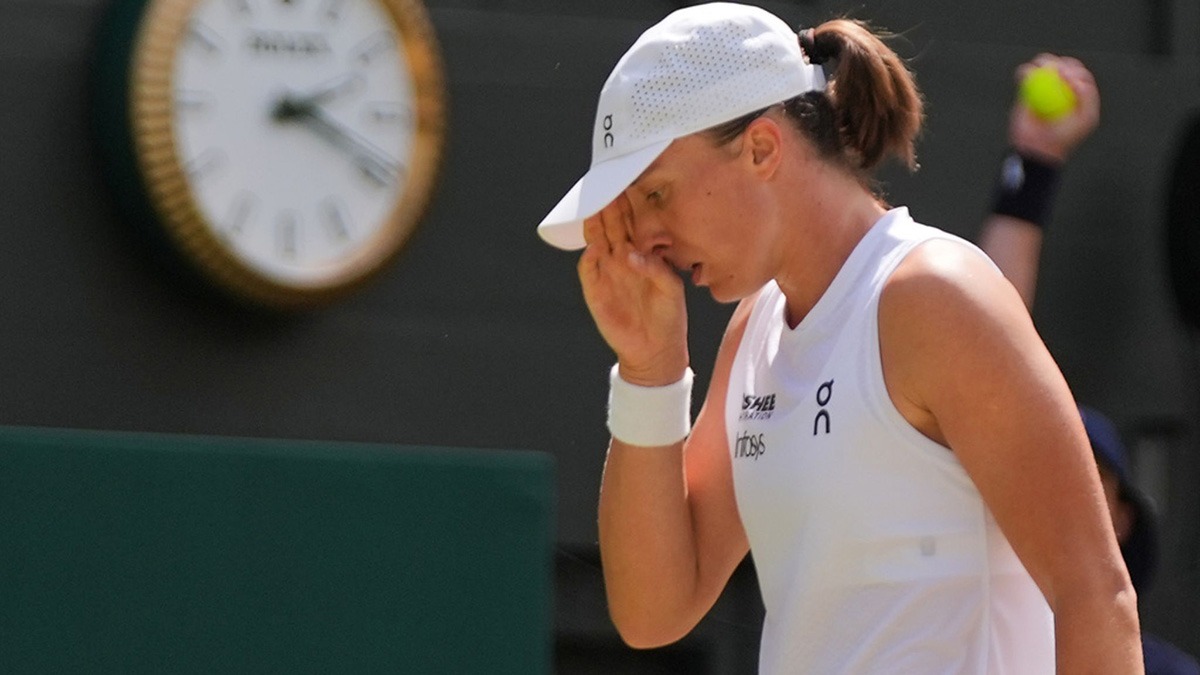
—I am half Polish. My mother is from Poland. This means that, as far as I am personally concerned, Iga Świątek is family — a cousin I have never met but whose defeats I absorb at the cellular level.
—Iga was going to be the Queen of Clay. Not a queen. THE Queen. She was dominant, ferocious, unstoppable, intimidating — the sort of player whose opponents appeared to concede somewhere around the coin toss. On clay she was a natural disaster with a ponytail.
—And now we have what I have come to think of as the Many Faces of Iga, because she seems to arrive at each match as a slightly different person.
—There is the confident, take-no-prisoners Iga.
—There is the Iga who turns mid-crisis to find Daria in her box, the way a small child scans a crowded room for a parent.
—There is the Iga who loves Rafa and clearly wants to be Rafa.
—And then there is the Iga we see most often now, who appears to be enjoying professional tennis marginally less than she would enjoy a tooth extraction — tense, frightened, visibly miserable, capable of plunging from “perfectly fine” to “existential collapse” in the span of a single dropped service game.
—And I understand it completely. The pressure is inhuman and I don’t blame her for one second. But I genuinely do not know whether we will ever see the old Iga again. I hate saying it. I think it is more likely that Nadal comes back on clay.
—And we have already discussed those odds.
—Tragedy No. 3: The Wrist (Please Let It Be a Pause)
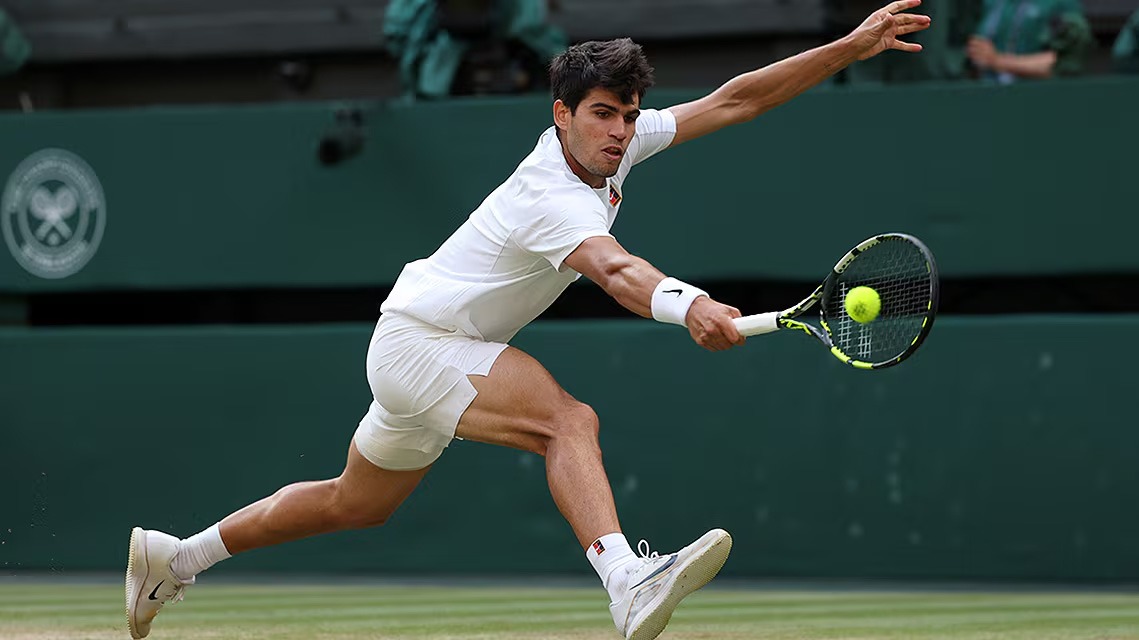
—Which brings us to the final tragedy — and let us all pray this one turns out to be a pause and not a tragedy at all — Carlos Alcaraz.
—I will admit this is a humble opinion, but men’s tennis is far less interesting without a high-personality, gloriously unpredictable player like Alcaraz. He brings energy and joy and invention and, crucially, an actual range of human facial expressions. Watching him play is like watching Jimi Hendrix play the guitar. Watching Sinner, brilliant as he is, is more like watching Eric Clapton: technically a god, undeniably a master — but you do not sit bolt upright at 3 a.m. wondering what Clapton is about to do, because you already know. With Hendrix you have no idea. Hendrix might set the guitar on fire.
—But I am terrified of the wrist.
—I am not a doctor. I want to be very clear about this. I hold no medical credential beyond the honorary degree I have awarded myself as part of my family health-care plan. But I remember Dominic Thiem’s wrist. The moment Thiem hurt his wrist it was as though he had contracted something — as though the tour began treating him like a leper — and his career simply eroded. I look at del Potro: never the same man again. And Alcaraz’s entire genius lives in his hands — the touch, the disguise, the way he sculpts the ball as if it were wet clay. So I worry. This was not a clean, dramatic, tidy break with a clear story attached. It was subtle. It grew. It sounds complicated, and the word out of his camp has been vague — and in my experience, when the people around you decline to share the medical news, it is rarely because the news is wonderful.
—So I watched Wimbledon a little dejected.
—The Women’s Draw Saves Us All
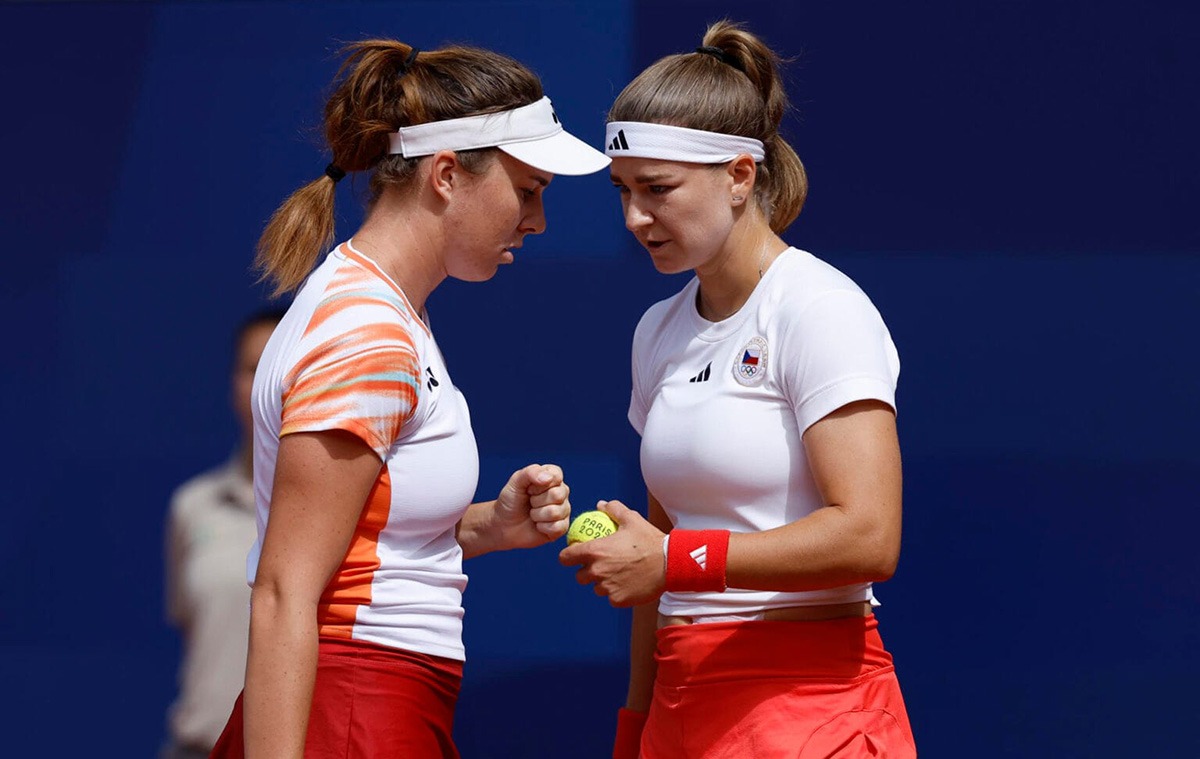
—And that leads us to right now, and if I’m honest, it is all about the women.
—The women’s game is the most fun it has been in years, precisely because it is unpredictable and gloriously varied. You have young Andreeva. You have the entire Czech powerhouse contingent, which I insist on calling Czechoslovakia because, as we have now firmly established, I am old and my personal map of the world stopped updating right around the time the forest behind my house did. You have Coco Gauff, who always seems to be one clean week away from annexing the entire sport. You have Jasmine Paolini, who plays as though tennis is the single most delightful thing that has ever happened to any human being. And you have the twin heiresses Emma Navarro and Jessica Pegula — two children of billionaires who do not, in any technical sense, need to be out there grinding through three-set thrillers in the July heat, and who go ahead and do it anyway, which I find moving.
—They are, every one of them, a joy to watch.
—A Closing Prayer, Directed at Ibiza

—So let us hope. Let us hope the wilderness grows back. Let us hope Iga finds whichever of her faces is capable of smiling. Let us hope Nadal is happy, and warm, and counting his money. And above all, let us hope that Carlos Alcaraz is somewhere quiet and boring, dutifully rehabbing that wrist — and not merely doing reps with red wine glasses on a yacht in Ibiza.

