
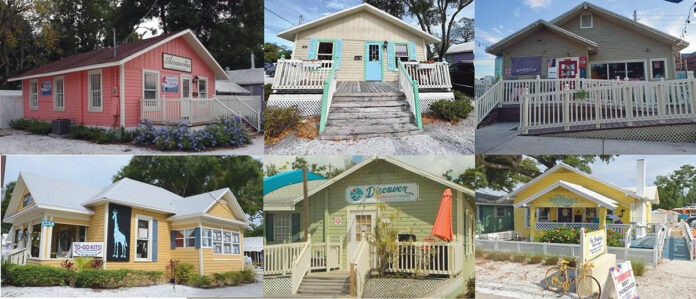
The block everyone assumed was finished is refusing to finish. The Breakfast House has bought its own land, developers are donating cottages, commissioners are cheering from the dais — and a brand-new Sarasota Bungalow Village is taking shape at Fruitville and Tuttle.
—When we last visited the riot of painted cottages at 1899 Fruitville Road in April, the story read like an elegy. Seventeen small businesses, two grand oaks and a block of 1920s bungalows sat under contract to a Tennessee developer planning a five-story, 324-unit apartment complex with a six-level parking garage. No rezoning required. No public vote. No obvious way out.
—Three months later, the tenants of that block walked into Sarasota City Hall and delivered an update nobody saw coming: they are not simply mourning the block. They are moving it.
—The Announcement at City Hall
—Tammy Hauser, owner of Discover Sarasota Tours, stepped to the podium at the July 20 City Commission meeting speaking not just for herself but, as she told commissioners, for “the other four businesses at the 1899 Fruitville location, which is Siegfried’s German Restaurant, The Breakfast House, Cookie Cottage, and The Artful Giraffe.”
—Then came the headline.
“We’re moving forward with our plans to create the Sarasota Bungalow Village a mile east at Fruitville and Tuttle Road,” Hauser announced.
—The concept is as audacious as it is charming: rather than watch the historic cottages fall to the wrecking ball, the businesses intend to physically relocate them — jack them up, roll them down Fruitville Road and cluster them into a new village where the pancakes, the biergarten, the trolley tours and the art gallery can carry on together.
—Cottages Coming Out of the Woodwork
—What began as a survival plan has started attracting donations of an unusual kind: entire houses.
“People are coming out of the woodwork and wanting to donate cottages to us that are part of another development, which is exciting,” Hauser told the commission.
—One of those cottages sits in the Rosemary District, on land slated for a new auto club project. Rather than raze it, the developer offered it up — and then some.
“The developer has said we can have the cottage and he’ll even contribute the cost of the demolishment towards our moving of the cottage,” Hauser said. “And it’s a really nice cottage from the 1920s. That’s exciting.”
—In other words, the money a developer would have spent tearing a historic house down is instead being redirected to hauling it to safety. It is the kind of arithmetic that almost never happens in Florida real estate — demolition budgets converted into preservation budgets, one bungalow at a time.
—A Breakthrough With the Fruitville Developer
—Perhaps the most consequential news Hauser delivered was about the developer holding the fate of the 1899 Fruitville block itself. After months of uncertainty, the two sides have finally connected.
“We have finally spoken to the developer. He was gracious enough to contact with us,” Hauser said. “He has agreed to sell us our current cottages once the development starts.”
—Then she made the ask, right there in open session.
“We are trying to negotiate that he might also consider doing what the other generous developers have done and help us with the costs that are going to cost him to demolish it, certainly with the asbestos abatement and all the other things involved with that,” she said. “If you would consider giving us that money that we can use towards moving those cottages.”
—It was a public invitation, delivered with the developer certainly listening: match the Rosemary District’s gesture. Put your demolition dollars toward relocation instead.
—The Fundraising Push Begins
—Moving houses is not cheap, and the village effort now has a price tag and a public campaign. Hauser told commissioners the group’s website had just launched — SarasotaBungalowVillage.com, designed by Tess Craig at The Artful Giraffe — with a QR code for donations in the works.
—She was candid about the fine print.
“We are not a nonprofit,” Hauser said. “These would not be tax deductible donations, but they would go toward the cost of the moving project which are quite extensive.”
—The campaign materials lay out a total goal of $2.43 million in three stages: an initial $250,000 for project development and entitlements, then engineering and site preparation, and finally the moving, restoration and reopening of the bungalows themselves.
—The group also put out a very specific help-wanted notice from the podium.
“We could really use a great real estate attorney who might provide some pro bono support for us because we have a lot of real estate issues related to the moving of the cottages and the creation of this new village,” Hauser said, inviting interested attorneys to reach her directly.
—Commissioners in the Cheering Section
—If the village effort needed a sign that City Hall is paying attention, it got one — twice in the same meeting.
—Hauser closed her remarks with gratitude for two commissioners in particular: “Very publicly say thank you to Commissioner Koch and Ohlrich who have stopped by weekly, kept us in the loop, helped us with resources. We’re very grateful for that.”
—Hours later, during commissioner reports, Jen Ahearn-Koch returned the favor. Fresh from a community workshop on the new auto club planned for the Gillespie Park area, she shared what she called good news from the neighborhood — carefully noting she was “not expressing an opinion whether I like it or not” on the project itself.
“They did hear of the Fruitville Road bungalows, and them needing historic structures and there is historic structure on their property,” Ahearn-Koch told her colleagues. “So they are not only donating the historic structure, they are also giving them the money that they would use to demolish it towards moving that building.”
“I thought that was a very positive community effort that was nice to share,” she added.
—Read that back slowly: a sitting city commissioner, on the record, celebrating developers who redirect demolition money into saving old Sarasota. If the Bungalow Village succeeds, that July 20 exchange may be remembered as the moment the model got its official blessing.
—The Breakfast House Buys Its Freedom
—While the collective village takes shape, the block’s most beloved tenant has already made its move — with a mortgage.
—The Breakfast House, the family restaurant that has served pancakes from a Fruitville bungalow for 17 years, has purchased roughly an acre at 128 N. Briggs Ave., just off Fruitville near Tuttle Avenue, for $1.15 million. Owner Wendy Goldberg is now asking the city to rezone the two parcels from Residential Single Family 2 to Urban Mixed-Use 1, so the modest 1956 house on the property can be renovated into the restaurant’s new home.
—The required community workshop — the first formal step in the rezoning process — was held Tuesday evening, July 28, at Selby Library, drawing neighbors, supporters and even the auto club founder donating a bungalow to the cause.
“We want to be in a house,” Goldberg told the crowd, distilling the entire philosophy of the enterprise into seven words. Not a plaza. Not a strip center. A house.
—The plans she described are a love letter to the original with the pain points fixed: seating growing from 78 to about 110, the cramped 300-square-foot kitchen replaced with room for a dedicated six-foot pancake griddle, a coffee and juice bar, a covered veranda converted from the carport so customers can wait out the rain, four bathrooms instead of two, and a circular drop-off drive so customers with walkers and wheelchairs can be delivered right to an accessible entrance.
—The timeline is aggressive. Goldberg hopes to close the original location Jan. 2 and reopen on Briggs Avenue around Jan. 15 — a schedule that depends entirely on a rezoning she estimates could take four to six months. She plans to shepherd much of the application herself rather than hire a big land-use firm, with the city’s initial rezoning fee running about $9,128 for a property this size.
—And unlike the bungalow the family has rented for nearly two decades, this one comes with a guarantee no landlord can revoke. The new building, Goldberg noted, cannot be torn down out from under them — as long as the family keeps paying the mortgage, they own it.
—The Village Question
—The tantalizing part of the Briggs Avenue purchase is what it makes possible. The property totals about 1.04 acres, and most of it — a 32,009-square-foot vacant parcel — sits empty next to the future restaurant. That open land is the envisioned home of the Sarasota Bungalow Village itself: Siegfried’s, The Artful Giraffe, Discover Sarasota Tours and the Cookie Cottage arranged around a community green with shaded walkways and mature trees.
—At Tuesday’s workshop, Goldberg was careful not to oversell it. The rezone application covers the restaurant; the village remains a hope, not a filing. She told attendees the group would love for it to happen but cannot yet promise that it will, and that her immediate priority is simply getting the property zoned for the restaurant.
—The first test case is already in motion. Sarasota Motor Club founder Scott Stevenson — the auto club developer Ahearn-Koch praised from the dais — attended the workshop and confirmed his plan to donate the 1920s bungalow at 1716 10th Way, along with his demolition budget, toward the move. The remaining question is delightfully practical: crews still need to measure the cottage’s attic height to confirm it can survive the journey down Fruitville Road.
—Why This Matters
—Step back and consider what is actually happening here. Sarasota has spent a generation watching its cracker cottages and quirky small businesses vanish beneath mid-rise math — land cost, density bonuses, construction financing. The 1899 Fruitville block was supposed to be the next casualty, and its 324-unit replacement is still grinding through administrative review, still aiming for construction in early 2027.
—But for the first time in memory, the displaced are not scattering. They are executing an organized, funded, developer-assisted, commissioner-applauded plan to pick up the physical fabric of old Sarasota and set it down somewhere it can survive — together, intact, still serving pancakes.
—If it works, Sarasota gets something no rendering can deliver: a living village of century-old buildings, saved not by ordinance but by neighbors, customers and a few developers willing to turn demolition checks into moving checks.
—What Comes Next
—The road ahead runs through paperwork. Goldberg’s formal rezone application follows the July 28 workshop, then winds through the Planning Board and ultimately the City Commission — a public process, with public hearings, unlike the administrative review carrying the apartment project. Property owners and neighborhood associations within 500 feet will be notified as hearings are scheduled.
—Meanwhile, the Bungalow Village campaign needs its first $250,000, its pro bono real estate attorney, an answer on one cottage’s attic height and, if Hauser’s open-session invitation lands, a demolition-budget pledge from the Fruitville developer himself.
—The cottages are still there. The oaks are still giving shade. And for the first time since the “under contract” news broke, the people inside those bungalows are not waiting to find out what happens to them. They are building what happens next.

