
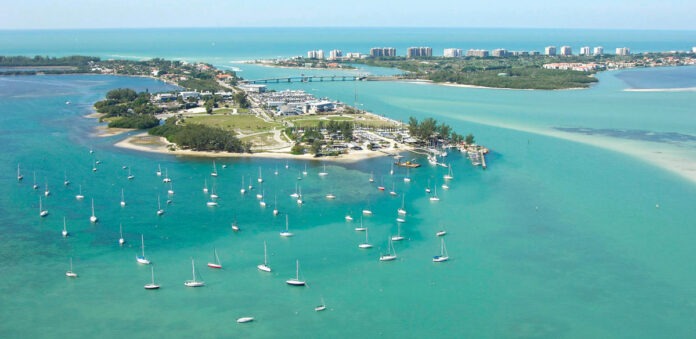
Some projects arrive at the Sarasota City Commission trailing lawyers, protesters and overflow seating. The Youth Sailing Center arrived trailing nothing but goodwill, and it showed. On Monday, July 20, the commission needed just 34 minutes to approve the new building on City Island and execute the lease that anchors the Sarasota Sailing Squadron to the waterfront through 2055. Both votes were unanimous. Not one member of the public rose to speak. The sharpest question of the afternoon concerned a 38-ton fire truck.
—The twin approvals close out a five-year regulatory voyage and clear the final municipal hurdle for the approximately $3 million, privately funded Youth Sailing Center at 1717 Ken Thompson Parkway, a two-story, roughly 4,230-square-foot educational facility that will replace the aging storage building and the motor home that currently serves as the youth program’s office.
—What the Commission Approved
—The first vote, taken as a quasi-judicial public hearing, approved the full land-use package: Site Plan 24-SP-19, Major Conditional Use 24-CU-04 and Government Zone Waiver 25-GZW-01, the last of which spares the club from paving the crushed shell lot it has parked on since 1958. The motion came from Vice Mayor Kathy Kelley Ohlrich, was seconded by Commissioner Kyle Battie, and passed 5-0 with the conditions in the staff report.
—The second vote, five minutes later, authorized Mayor Debbie Trice and City Auditor and Clerk Shayla Griggs to execute the Eighth Amendment and Restated Lease Agreement between the city and Sarasota Sailing Squadron, Inc. That motion came from Commissioner Jen Ahearn-Koch, was seconded by Ohlrich, and also passed unanimously.
—With the deferral of the day’s only other quasi-judicial item, the sailing hearing had the afternoon to itself. It hardly needed it.
—A Dais Full of Sailors
—Before the hearing could begin, the required ex parte disclosures revealed just how deep this project’s roots run at City Hall.
—Ohlrich disclosed a personal history with the site itself: “I used to be a member of the Sailing Squadron,” she told City Attorney Joe Polzak, affirming she could remain impartial. Commissioner Liz Alpert recalled attending an event at the Squadron around 2018, during her first turn as mayor, when members walked her through their hopes for a youth building. “I’m aware of them wanting to do this for a long time,” she said. Ahearn-Koch disclosed site visits both this cycle and when the concept first came before the commission, and Battie had visited during the earlier round as well.
—In other words, before a word of testimony was spoken, four of the five commissioners had already walked the shell lot at the end of Ken Thompson Parkway.
—The Applicant’s Case: Scholarships, Spectrum Sailing and a Big Miss
—Planning consultant Joel Freedman of Freedman Consulting and Development led the applicant’s team, joined by architect Derek Pirozzi of PS Design Workshop, engineer Bobbi Claybrooke of AM Engineering and Sarasota Youth Sailing board president Travis Yates, whom Freedman invited to open with the program’s story.
—Yates, who has served six years on the board and a little over two as president, traced the youth program to its founding in the 1970s and its incorporation as a 501(c)(3) in 1980, a timeline that produced the hearing’s biggest laugh when he glanced toward the dais and noted, “Our vice mayor could have been there as a youth, easily.”
—The substance of his pitch was access. “25 to 30 percent of our students are there on scholarship,” Yates told commissioners. “We aim to extend that.” The program serves more than 400 students a year, high school age and below, through teen programs, an advanced competitive track and community outreach partnerships including Spectrum Sailing, which brings sailing to children on the autism spectrum.
—Yates also planted a seed for the future, telling commissioners he sees untapped potential in connecting the program to the city’s own recreation offerings. “There is a big miss right now for us to access the city summer programs,” he said, describing his hope to “provide more opportunity for kids to get out in the water in this lovely bay at an early age so they get bonded with the city, bonded with the environment and hopefully become great citizens of our county, state and city.”
“I Still Love This Building”
—Pirozzi kept his design presentation brief, but the enthusiasm in the room needed no slides. “I still love this building,” Freedman volunteered as he handed off to his architect, later adding, “Personally, I think this is one of the best buildings I’ve seen. It’s still low scale.”
—The new structure rises on the footprint of the existing building slated for demolition, with boat and equipment storage on the easily accessed ground floor and offices, meeting rooms and mixed-use space above. The design, Pirozzi noted, has already collected two American Institute of Architects awards before a shovel has turned, “something that we can all be proud of.”
—Its signature roofs, long a topic of conversation through the review process, are shaped to throw ample shade and harvest rainwater, which is collected for washing salt off the boats. Solar panels top the structure. And for anyone worried that the sculptural form implies fragility, Pirozzi offered reassurance: the building “is actually a steel structure, very rigid,” clad in composite wood materials that give it its look, engineered to meet all current hurricane and flood standards.
—Trice, who otherwise let the presentation speak for itself, had one question and one verdict. “Beautiful building. I applaud you,” she said, before asking whether the second floor is ADA accessible. Told there is an elevator, the mayor allowed herself a dry aside about coastal reality: “Which if the area gets flooded may be a problem, but we’ll keep our fingers crossed.”
—The Shell Lot and the 38-Ton Fire Truck
—The one genuinely contested question of the entire five-year process, whether the club must pave its historic crushed shell lot, resolved into the afternoon’s most memorable condition of approval.
—Freedman was blunt about the stakes. Without the waiver, the cost of paving and its cascading design consequences “will probably make this project not feasible and create tremendous design issues out there,” he said. Claybrooke explained that the site’s stormwater strategy depends on the opposite approach: “One of the main ways we’re addressing a lot of the stormwater issues is by trying to minimize the impervious area. We do not exceed the existing thresholds that were already on site.” Elevations are being held at existing levels, she added, and rooftop runoff will be captured and reused for boat wash-downs.
—City Planner Camden Jenkins, presenting the staff recommendation, agreed on both counts, telling commissioners that paving the lot with asphalt “not only could arguably decrease the perviousness of the property, but also creates an expense that could potentially limit the applicant’s ability to succeed in this project.”
—The safeguard, Jenkins explained, came from a conversation between city staff and the Sarasota County fire departments, who blessed the shell surface with one ironclad string attached, written directly into the conditions of approval: “The roadway must be able to support a 38-ton fire truck.” If any inspection ever finds the crushed shell broken down or washed away, the club must restore the surface to fire-code compliance at its own expense.
—The Amusement Park That Wasn’t
—Freedman’s recap of the project’s community outreach doubled as a reminder of how quiet this file has been, with one strange exception. The lone attendee at the April 2024 community workshop, he recalled, showed up not because of the sailing center but because of a rumored amusement park on City Island. “He wanted to make sure we weren’t in favor of that,” Freedman said. “He didn’t have any problems with the project.” The second workshop, in August 2025, drew no one at all.
—The numbers backed up the serenity: seven parking spaces required, seven provided; a 30-foot waterfront setback met; a traffic impact deemed de minimis; and, as Freedman put it, “We’re not touching one tree.”
—Ohlrich Reads the Fine Print
—If the hearing had a working skeptic, it was Ohlrich, though her skepticism ran entirely toward procedural precision. The vice mayor pressed Jenkins to read every condition of approval into the record, then caught what appeared to be a missing condition on page 30 of the 153-page packet.
—The exchange prompted a clarification from the city attorney’s office: the conditional use resolution, with its site plan condition, had already been approved by the Planning Board, meaning the commission was technically affirming it, while the G-Zone waiver resolution, carrying the fire truck condition, required the commission’s own formal approval. Satisfied that all three conditions were accounted for, Ohlrich moved approval minutes later.
—Ahearn-Koch added a final statement for the quasi-judicial record before the vote: “I read the materials and find that this does comply with all the standards for review.”
—Five Minutes Later, a Lease to 2055
—The lease item that followed was, by design, anticlimactic. Julie Ryan of the city’s Economic Development and Real Estate office explained that the Eighth Amendment attaches the newly approved site plan to the lease as Exhibit C, while the restatement sweeps the 2010 agreement and its seven prior amendments into a single clean document, stripping outdated language and clarifying the rules for new construction.
“None of the terms or conditions changed,” Ryan assured commissioners. “They still have the same lease term, same lease revenue.”
—That term runs to November 28, 2055. The revenue includes the lease’s signature fiscal mechanism: non-resident members must be charged base membership and initiation fees 50 percent higher than city residents, with the differential remitted to the city quarterly. The club also carries every cost of occupying the island, from taxes and insurance to grounds maintenance, and every improvement built on the leasehold ultimately becomes city property.
—Ahearn-Koch Checks the City’s Homework
—Before the lease vote, Ahearn-Koch put the city’s own oversight under the lamp, walking Ryan through the document page by page. Does the city actually conduct the periodic compliance reviews the lease authorizes? “We do,” Ryan answered. “We get an annual report as well as quarterly reports to see what the activity is.” Does the city see the actual membership and initiation fee schedules behind the differential? Yes, Ryan said, noting, “We do get 50 percent of the non-Sarasota resident fee,” though she did not have the figures at hand. “I would be interested in those numbers,” Ahearn-Koch replied.
—The commissioner confirmed that any sublease must clear City Attorney review before the City Manager signs off, and learned the Squadron’s annual financial disclosure, due each year by July 30, is expected within weeks of the club closing its books July 31. She even flagged two clerical errors for correction, a missing street address in the notices section and a missing item in a list, before moving approval of the lease itself.
—Loose Ends: A Radio Tower and a Question About Shell
—The sailing items produced two ripples that outlasted the votes, both surfacing in Ahearn-Koch’s remarks at the end of the meeting.
—The first was the radio tower standing on a parcel carved out of the leasehold, which caught her eye during her site visit. “I was really taken aback by the radio tower that’s out there,” she said. “I would love to see inspections that have been done on it to make sure that it’s in good shape and it has been inspected,” she added, inviting staff to take a look at the structure’s condition and history.
—The second was a policy idea born directly from the afternoon’s waiver: if crushed shell works on City Island, why should applicants have to fight for special permission to use it? Recalling a city code requirement that forced asphalt on the airport’s new cell phone lots when a permeable surface might have served, she suggested the commission consider identifying situations where shell and other permeable surfaces could be allowed outright. “The idea being to not encourage asphalt, but to encourage other permeable surfaces when it makes sense to allow it,” she said, asking staff to bring the concept back for discussion.
—What Happens Next
—With the land-use approvals in hand and the lease executed, the Squadron and Sarasota Youth Sailing move into permitting and the final stretch of a private capital campaign, part of a broader investment plan estimated at roughly $4.1 million that also includes replacing the shoreline wave fence destroyed in the 2024 hurricane season. Construction of the center is expected to take 12 to 18 months once fundraising targets are met, with not a dollar drawn from city coffers.
—For the more than 400 children a year who learn to sail off the northern tip of City Island, the practical translation is simpler than any of it. The program that has taught three generations of Sarasota and Longboat Key kids to read the wind now has its ground secured to mid-century, its building approved and applauded from the dais, and nothing left between it and a real roof but fundraising and permits. As Monday’s hearing made clear, this is one project the entire city seems content to watch sail through.

