

When the snowbirds came down this season, I conducted what scientists call “an informal census” and what my wife calls “staring at people.” The results were alarming. My friends on the tennis court — once a proud and thundering herd of horse-like, big-bellied foodies, the kind of men who ordered the surf and the turf and then asked what came with it — had shrunk.
—This is the year of the GLP-1, the GLP-2, and presumably the GLP-3, which I assume is the sequel where they finally explain the plot. This is the year of Ozempic and all the drugs that have dissolved fat faster than global warming is dissolving the glaciers. And let me tell you, the comparison holds up, because you can see the runoff everywhere. Pants are pooling. Belts have new holes punched in them with the desperate enthusiasm of a man stabbing a voodoo doll. Entire wardrobes have been donated to Goodwill, where I assume there is now a section labeled Formerly Large Floridians, Slightly Used.
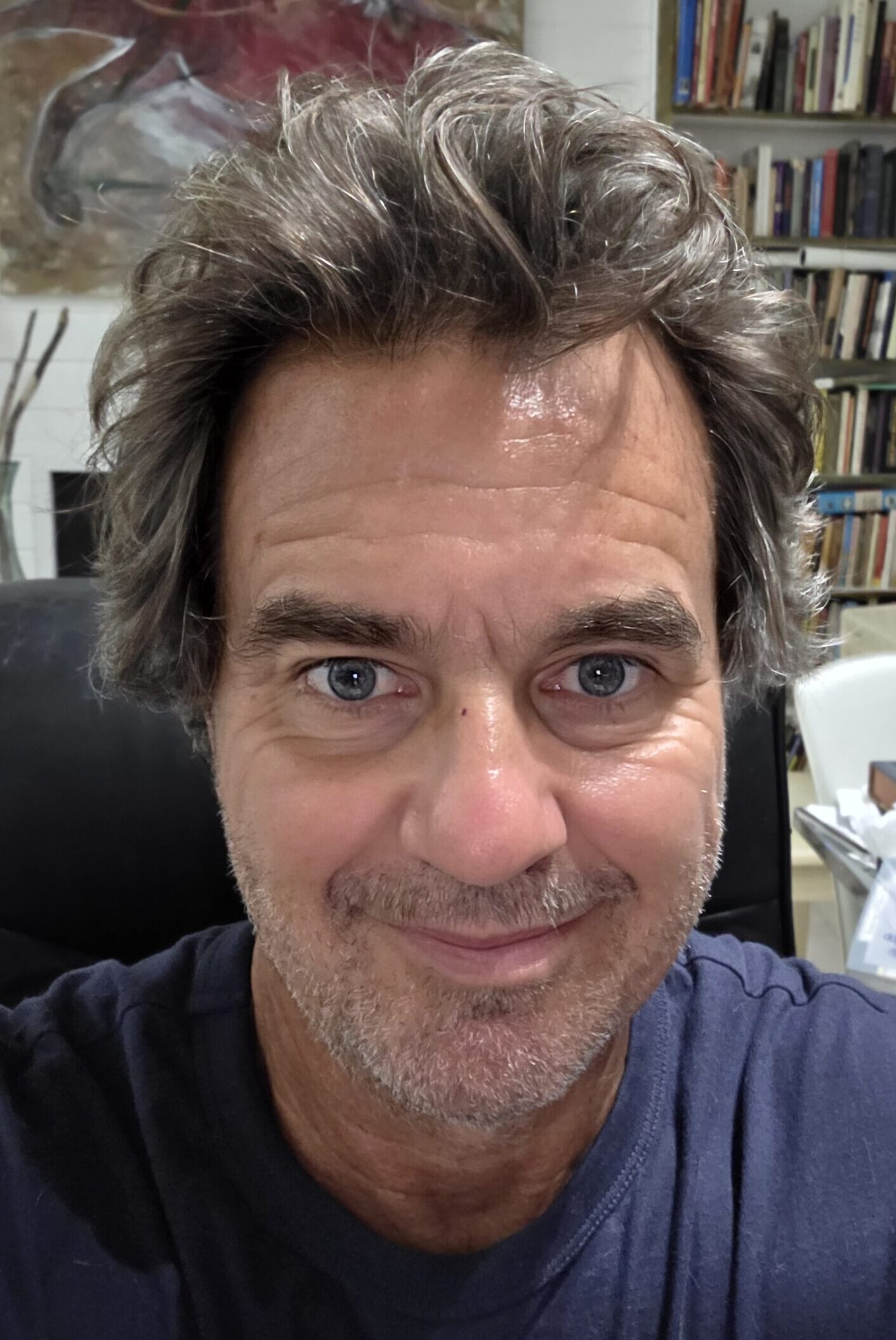
—A Census of the Vanished
—When the snowbirds came down this season, I conducted what scientists call “an informal census” and what my wife calls “staring at people.” The results were alarming. My friends on the tennis court — once a proud and thundering herd of horse-like, big-bellied foodies, the kind of men who ordered the surf and the turf and then asked what came with it — had shrunk.
—I am not exaggerating when I say roughly one out of three of them appeared to have shed at least half of their body. Gone. Vanished. Where there had once been a Gary, there was now a thin, vibrating outline suggesting a Gary, like a charcoal sketch of the original Gary done by an artist who’d never met him — a virtual Modigliani in moisture-wicking polyester. The whole population of Longboat and Sarasota, formerly a contented civilization of consumption, had quietly transformed into a slender new species, blinking in the sun with a new lease on life.
—It’s Only a Peptide
—Here is the part nobody warned me about: the evangelism.
—These newly slender people have found a religion, and the religion is themselves. One friend cornered me with the specific eyes of a man who has Seen The Light and would like to schedule a follow-up appointment for me to See It Too. He told me, wistfully, eyes wide open, that the drug had replaced his high-pressure pills. Replaced them! Then he leaned in and confided that the semaglutides may stop Alzheimer’s in its tracks. He said it the way other men announce the birth of a grandchild.
“This is the future,” he told me. “It’s only a peptide.”
—It’s only a peptide. I have not been able to stop thinking about this sentence. It has the cadence of a hymn. It is the kind of thing you’d embroider on a pillow if you were the sort of household that now exists, somehow, on 600 calories a day and pure spiritual radiance.
—The Matcha Prophet
—Late at night — and I want to be clear that nothing healthy has ever happened to anyone late at night — I would watch a certain Stanford professor. You know the one. The neuroscientist with the podcast, the matcha lattes, and the 1.5 million viewers per episode, all of them lying in bed at 1 a.m. getting more obsessed with optimizing their health, which is itself a kind of disorder we have not yet named.
—I would lie there in the blue glow, absorbing protocols, learning about my circadian rhythm, feeling my circadian rhythm get worse in real time, and I would think: this is the new church. The lattes are the communion. The morning sunlight is the sacrament. The supplements are the rosary, except the rosary costs $400 a month and ships from a warehouse in Utah.
—We Did Not Read the Book, But We Skimmed the Reel
—And here is where I get, briefly, almost serious, before I remember that’s against my contract.
—For years we filled the emptiness with food — the obesity, the consumerism, the consumption, the great American suspicion that if we just ordered one more appetizer the hole inside us would finally close. Now we have stopped eating, and the hole is still there, so we have filled it with content. People are thinner than they have ever been and flipping through videos faster than they have ever flipped. We are not book lovers. Let’s just be honest about that. Nobody is shedding half their body weight and then settling in with Middlemarch. We are scrolling. But we are thin while we scroll, and it is, I have to admit, a beautiful thing.
—I won’t say it’s become narcissistic. I won’t say self-referential. I’ll just note that we used to worship a casserole and now we worship the reflection, and the reflection is finally cooperating.
—On Becoming Eternal
—The pitch, in the end, is immortality. They’re going to last longer and longer and longer. Their presence will be around forever. The Alzheimer’s stopped in its tracks, the heart pressure regulated, the body returned to its factory settings. We are, my friend assured me, becoming eternal — through tides and peptides and technology.
—So that’s where we’ve landed. A whole coast of people who used to be horses, now slender and luminous and very possibly going to outlive the glaciers they’re outpacing. I look at them on the court, these new immortals, serving with the radiant calm of the recently saved, and I think two things at once.
—The first is: good for them, honestly. The second is that I am going to go get a cheeseburger, and I am going to enjoy it like a mortal, and somewhere a peptide is going to be very disappointed in me.
—It’s only an impulse. It’s the future too.
—The Gauntlet of Desire
—Most of our madness remains hidden at home. I have to survive my own kitchen, and I want to be clear that this is not a small thing. Every evening, my kitchen is a gauntlet of desire. It is harder to cross than it was for Clint Eastwood to drive that dilapidated bus through a hail of gunfire, and I am not being dramatic, I am being accurate.
—This is me, late at night, usually after a drink or two, when my will has been weakened and my testosterone has apparently drained out of my brain and pooled somewhere unhelpful, and every last molecule of willpower has dissolved. I scan the granite countertop and I do not see food. I see calories. Everywhere. A dozen sirens on the rocks, beckoning, singing my name.
“Since when have you become boring? You need dark chocolate…”
“You played tennis twice today and twice yesterday — you can definitely handle a plate of cheese and crackers.”
“It is ugly and narcissistic to simply care about your physicality. Enjoy life. Look at all the great cultures: France, Rome the Greeks — they knew how to live! Just pick the Brugal 1888 or the Cabernet — but make a decision!”
—My daughter has developed a fascination with baking. And not casual baking. She has gotten into dark chocolate chip cookies — and then, as if that alone were not a war crime against a man trying to stay a size medium, she makes a second batch with the good Ghirardelli cocoa powder, so now there are chocolate-chocolate-chip cookies sitting side by side with the regular vanilla-laden chocolate chip cookies, like twin demons offering me a choice that is not really a choice.
—And that is before the Talenti gelato starts screaming from the freezer. That is before the blackberry cobbler begins yelling at me from the counter. That is before the Manchego, and the bottle of Cabernet that so obviously needs to be opened that it practically files a formal request. It is, frankly, too much for one unmedicated human to walk through. No GLP. No peptide. Nothing whatsoever to shut the food noise down.
—I Love Conflict (I May Be a Classical Greek)
—But here is the thing about me: I don’t mind conflict. I love conflict. Maybe I’m a classical Greek at heart. I like the agonistic life. I like having a small war running in my psyche at all times — it is probably why I became a writer, why I like to dive into issues. So I step into the gauntlet, and I begin to negotiate, and the negotiations go roughly like this:
—First, I rationalize. I can rationalize eating literally anything. I pre-heat the calories in my mind and assure myself that I will play so much tennis tomorrow that I’ll burn them off like a welder searing the lipids right off my stretched stomach.
—Then I move on to the other lies — the tender ones. How long will my daughter even be into baking? This won’t last. Childhood is a fleeting moment. I can work myself into a full Rilke-grade argument in my own head, about the ever-moving nature of life and how we must be so present, so in the moment, bending each fleeting instant to its knees in submission — all of it, somehow, in service of eating a cookie.
—And then, perhaps, like every addicted personality who ever lived, I suspend rational thought entirely and just manically gorge them down. Nine cookies at once. Until the shame arrives, right on schedule, and I wander off to bed, bloated, curl up next to my wife, and put on Diary of a CEO to better myself as I fall asleep.
—It’s Not Noise. It’s Music.
—Many people, I know, prefer a simpler world. They take their SSRIs and their GLPs and they make the food noise stop.
—But I don’t even want to call it food noise. Calling it food noise is like calling the Beatles noise. It’s like calling Hendrix or Bach noise. I love the very particular sound of these words: blackberry cobbler. Chocolate chip cookies. Cabernet Sauvignon. Manchego. Avocados. Those are lyrics. That is music. Those are the words that stir my soul and keep me living — or at least, for today, they keep me living.
—So I will probably not be donating my medium clothes. I will probably not be slipping into the size small I wore in college. And if you see me on the tennis court next week with a slightly tortured look on my face, I want you to know exactly what it means. It means I had thirteen chocolate chip cookies, two glasses of wine, and a full plate of guilt and shame the night before.
—And I can live with that. I was born Catholic. The guilt was always going to be part of the recipe.
—This is my confession.

