
Residents could see roughly $10,000 assessments over 20 years, with the first bills targeted for November 2027.
The utility poles of St. Armands and Lido Key are now officially on the clock.
—At its July 20 meeting, the Sarasota City Commission voted unanimously to launch the largest infrastructure initiative the city’s barrier islands have seen in decades: a program to rip out every overhead electric and communications line from St. Armands Circle to the far reaches of Lido Key and bury the entire system underground, financed by the property owners who would benefit from it.
—Two separate votes made it real. First, commissioners approved a $7.95 million professional services agreement with Utility Consultants of Florida, Inc., the Largo-based firm that beat out national heavyweights Kimley-Horn and Bowman Consulting for the work. Second, they adopted Resolution 26R-3408, authorizing an $8 million tax-exempt line of credit with Regions Capital Advantage to front the money until special assessments can repay it.
—Both passed 5-0. Neither vote buries a single wire. What they do is set in motion an 18-month sprint of engineering, surveying and public persuasion that will end with a question put to the roughly 3,500 homes, condos and businesses on the islands: are you willing to pay about $10,000 per property, spread over two decades, to never again watch a hurricane take down your power lines?
—What Exactly the City Approved
—Public Works Director Nikesh Patel was careful to frame the July 20 actions narrowly. “Today’s actions do not create an assessment district,” Patel told commissioners. “They do not impose an assessment, and do not authorize construction.”
—Instead, the agreement is split into two distinct phases. Phase one, the “required services” priced at $3.17 million, begins immediately. It covers the unglamorous foundation work. This work includes topographic and boundary surveys of the entire barrier island chain, subsurface utility mapping, 30% preliminary engineering design, coordination with Florida Power & Light and the communications carriers. Also, a defensible assessment methodology under Florida law must be justified and an aggressive public outreach campaign that includes a website where every property owner will be able to click on their own parcel and see their estimated assessment.
“Essentially, we’re going to have a GIS layer for the public to access,” Patel explained, “and they will be able to click on a specific property and be able to know what the assessment would be.”
—Phase two, the remaining $4.77 million in “optional services,” is where the real construction machinery lives: final design, bid documents, easement acquisition, construction inspection, utility cutovers and the moment residents are actually waiting for, when FPL’s poles come out of the ground. None of that can proceed without a future vote of both the affected property owners and the City Commission.
—The consultant agreement was signed for Utility Consultants of Florida by Mark Porter, a name that will ring familiar across the New Pass bridge. Porter briefed Longboat Key residents on that town’s undergrounding rollout back in 2019, and his firm’s team for the Sarasota program includes CDM Smith on engineering, Wildan on assessment methodology and Valerin on public outreach.
—Born in the Floodwaters of 2024
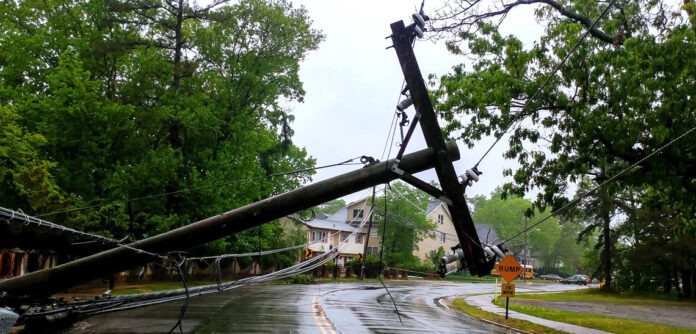
—Ask why this is happening now and every answer at City Hall leads back to the same season. In 2024, six separate weather events flooded the barrier islands, capped by the one-two punch of Hurricanes Helene and Milton, which left parts of Lido and St. Armands dark for extraordinary stretches.
“I’d say about a week, some about a month, roughly,” Patel said when Vice Mayor Debbie Trice pressed him on how long residents went without power. “There were contractors trying to get out there to get the work done and couldn’t get it done because they had no power out there.”
—The islands watched something else that season, too. Longboat Key, their neighbor to the north, was in the final stages of its own decade-long undergrounding project, and when Helene and Milton hit, Longboat’s new buried system held. The outages the town did experience were traced to FPL failures off the island, at mainland substations and subaqueous feeder lines, and power came back comparatively fast once those were fixed.
—The utility’s own data from that season is striking: FPL reported that its underground neighborhood lines performed roughly five to 14 times better than overhead lines during Hurricanes Debby, Helene and Milton, and about 50 percent better on ordinary days, when the leading cause of outages remains trees and debris hitting wires. The company has now buried some 2,000 miles of line statewide under the Storm Secure program it launched after Hurricane Irma in 2017.
—Barrier island residents did the math and came to City Hall. “People have been through a lot with these storms, and they know they need resiliency with their electricity,” said Chuck Haff, vice president of the St. Armands Residents Association, who told commissioners the association’s annual survey put support for undergrounding above 80 percent.
—Carl Shoffstall, president of the Lido Key Residents Association and a 24-year Lido resident, put his neighborhood’s number even higher. “From Lido Key, we were well over 90 percent,” he said. “It’s got to be done. It’s got to get done. It’s going to save money with storms on the back end of things, too.”
—What the Islands Would Actually Look Like
Picture the drive over the Ringling Bridge and around the Circle without a single wooden pole, crossarm or sagging bundle of cable in the frame. That is the end state the program describes: three proposed districts covering the St. Armands business area, the St. Armands residential streets and all of Lido Key, including Lido Shores, City Island’s Ken Thompson Park and Ted Sperling Park.
—Every primary feeder, lateral circuit and communications line would move below grade, served by pad-mounted transformers and switch cabinets. In their place would come new street lighting built to dark-sky and sea-turtle-protection standards, the amber, shielded fixtures required near nesting beaches, along with full restoration of pavement, sidewalks and landscaping torn up by the work. The recently installed, federally funded streetlights on St. Armands Circle itself would stay; the residential streets would get the new environmentally friendly fixtures.
—There is an economic argument buried in the aesthetics. Real estate research consistently finds that overhead lines cost property owners money: homes near visible power lines typically sell at discounts of 2 to 10 percent, while one of the most rigorous hedonic studies of undergrounding, examining neighborhoods in Canberra, Australia, found buried networks added about 2.9 percent to home prices, with utility-sponsored estimates running as high as 10 percent. On barrier islands where a modest home starts at seven figures, even the low end of that range would exceed the assessment many times over.
—Commissioner Kyle Battie tied the program directly to the islands’ commercial health, noting the struggle to fill storefronts on the Circle while Lido families are still rebuilding. “We’re trying to find people to lease space out there on St. Armands Circle, and there’s people on Lido still recovering from those storms,” Battie said. “They need it, not just that they want it. And it behooves us as a commission to go ahead and move this forward.”
—Who Pays, and How Much
—The honest answer to the question every property owner will ask is that nobody knows yet. Producing that number is precisely what the $3.17 million phase one buys.
—But a working figure has been circulating in association meetings for months. “The numbers that have been floated during these meetings is approximately $10,000, maybe a little higher,” Haff told commissioners, adding that residents surveyed were told to expect that cost spread over roughly 20 years. On a per-year basis that lands in the neighborhood of $500 to $600 per property, collected as a non-ad valorem assessment on the annual tax bill, the same mechanism Longboat Key used.
—Mayor Trice pressed staff on whether the $10,000 figure was realistic or whether residents should brace for another zero. Patel declined to speculate, saying only that the floated numbers “are comparable to the Town of Longboat Key.”
—The Longboat comparison is instructive. That town’s project, approved by voter referendum in 2015 and 2016, cost $49.1 million split between $25.25 million for Gulf of Mexico Drive and $23.85 million for the neighborhoods, repaid through 30-year assessments that varied by property. Construction began in 2019 and the island has been running entirely on its buried system since last year, with the town tracking a surplus of several million dollars against its original budget.
—Commissioner Jen Ahearn-Koch, who admitted to “sticker shock” when she first saw Sarasota’s consultant price, said she ran the numbers past Longboat Key’s town manager, Howard Tipton. “He did say that this is in line with what they had done,” she reported, adding that Longboat’s biggest headaches were permitting and interagency coordination, not construction. “What they projected and what they actually ended up with was very close.”
—One structural difference: Longboat ran two separate assessments, one for Gulf of Mexico Drive and one for the neighborhoods. Sarasota’s initial intent is a single, holistic barrier-island assessment, partly because government properties on City Island complicate a piecemeal approach, though Patel said the consultant will evaluate splitting the districts. Trice pushed to keep that option open so that if, say, Lido votes yes and St. Armands votes no, the city could proceed with one and prorate its recovery of the upfront costs.
—The Catch: If the Islands Say No, the City Pays
—The $8 million line of credit is the financial engine, and it comes with real risk. The city can draw funds through July 2028 at a floating tax-exempt rate currently estimated around 3.4 percent; whatever balance remains converts that August to a term loan maturing in 2038 at an estimated 3.9 percent. The intended repayment source is the special assessment revenue. But if property owners or a future commission kill the project after phase one, the assessments never materialize, and the city remains on the hook for up to $3.17 million plus interest, payable from non-ad valorem revenues.
—That prospect gave Commissioner Liz Alpert pause even as she voted yes. “I really want this to happen. I want the undergrounding,” Alpert said. “But $3 million to just explore it seems a lot of debt for the city to take on. If it gets rejected, we just spent $3 million for nothing.”
—Finance Director Kelly Strickland acknowledged the exposure. The city’s five-year capital plan sets aside $1.3 million in Penny surtax funding for undergrounding as a partial backstop, she said, but a failed district would force the city to “look at the general fund” and other sources for the balance. She noted the city’s debt capacity is comfortable, with non-ad valorem revenues covering maximum annual debt service at more than seven times the two-times coverage its own policy requires, and that the note carries no pledge of property taxes and no lien on city property.
—Patel offered a consolation prize: even in a worst case, the city would own a complete survey and subsurface utility map of its barrier islands, an asset for every future road, drainage and infrastructure project out there.
—The Flooding Question
—Undergrounding will not stop the water. Nothing about burying electric lines lowers storm surge on Ben Franklin Drive, and residents should not confuse the two. In fact, saltwater inundation is the one environment where buried systems face their own vulnerabilities, which is why modern designs like FPL’s rely on submersible transformers and flood-rated equipment, and why some utilities elsewhere reported mixed underground performance in surge zones during Helene.
—What the program does address is what happens after the water recedes: the weeks of darkness while crews rebuild pole lines, the contractors who cannot work in powerless neighborhoods, the restaurants on the Circle throwing out inventory. And the city is explicitly trying to avoid digging up the islands twice. Ahearn-Koch pressed staff to synchronize the undergrounding with the separate St. Armands drainage improvements now advancing through Sarasota County and a new state appropriation via FDOT, and Patel confirmed the consultant’s job includes coordinating all of it. “I want to make sure we’re not digging up, filling in and digging up again,” Ahearn-Koch said.
—What Happens Next
—The clock starts immediately. Stakeholder engagement is required to begin the moment the agreement is executed, and over the summer and fall the consultant will refine district boundaries, build planning-level cost estimates and stand up the program website with its parcel-by-parcel assessment lookup.
By the winter of 2026-27, staff expects to return to the commission with detailed parcel-level assessment ranges, at which point the community support process begins in earnest. There is no statutory minimum for how much support is required. “It’s up to the commission to decide on the amount of support, but a minimum 60 percent,” Patel said. “The commission can decide if they want 75 percent support or 60 percent.”
—If the islands say yes and the commission concurs, statutory assessment resolutions, mailed notices and public hearings would follow through 2027, with permanent financing arranged that year and the first assessments targeted for the November 2027 tax bill. The program’s working schedule calls for contractor procurement in late 2027 and construction rolling across the islands in three segments beginning in early 2028, with the final segment starting in 2030. Earlier city estimates put full completion as much as seven years out.
—For the residents who pushed this program into existence, the timeline is almost beside the point. As Shoffstall told the commission before the vote: “It’s got to get done.”

