
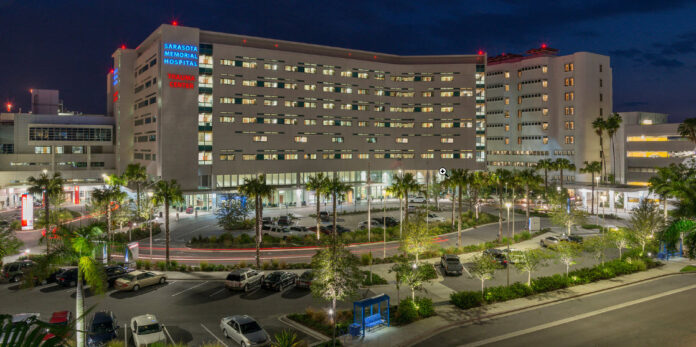
The taxpayer-owned hospital is opening cancer pavilions, floating bonds and pouring foundations in North Port. It is doing so because the market is forcing its hand: a patient base that is older than almost anywhere in the country, rich enough to fly to Rochester or Houston for treatment, and served by fire departments whose main job is driving heart attacks over the bridge. At the same time, it is the emergency room, the maternity ward and the family doctor for everyone who cannot pay. That is the tension, and it is playing out in real money.
—The fire stations on Longboat Key do not spend their days fighting fires.
—Longboat Key Fire Rescue is an all-paramedic advanced life support transport department, 38 people and two stations covering a 10-mile island where the median age is 73. It answers more than 2,000 calls a year, and the overwhelming majority of them are medical: the chest pain at 3 a.m., the fall in the condo bathroom, the slurred speech that a spouse recognizes as a stroke. Residents can walk into either station during business hours and get a free blood pressure check. Across the bay, Sarasota County’s fire department runs 29 ambulances a day and answers roughly 67,000 emergencies a year, of which only about 7,000 involve fire.
—When those crews load a stroke or a cardiac patient into the back of the rescue, there is exactly one destination: Sarasota Memorial Hospital on Tamiami Trail, home to the only comprehensive stroke center, the only trauma center, and the only around-the-clock cardiac catheterization capability that matters in Sarasota County. Every other choice is a longer drive or a helicopter ride.
—That single fact, that the county’s entire emergency medical system funnels into one taxpayer-owned hospital, is why Sarasota Memorial’s expansion is not a real estate story or a press-release story. It is a question of whether a public institution can simultaneously be a world-class destination for patients who can afford to go anywhere and the safety net for patients who can go nowhere else, in one of the oldest markets in the United States, while investor-owned chains circle the edges. The system is answering that question with more than $1 billion in construction, a $425 million bond program, a new hospital in North Port and a $220 million cancer pavilion that opened in June. The answer is not yet in, and the stakes are higher than the ribbon-cuttings suggest.
—The patient who can go anywhere
—Here is the problem Sarasota Memorial’s leadership lives with. A Longboat Key resident diagnosed with prostate cancer, or a bad aortic valve, or a glioblastoma, is statistically likely to be a retired executive, physician, attorney or entrepreneur with a Medicare Advantage or Medigap plan, a second home in a state with an academic medical center, and a lifelong relationship with somebody’s cardiologist in Boston or Cleveland. That patient can drive three hours to Moffitt in Tampa, fly to Mayo in Jacksonville or Rochester, or book MD Anderson in Houston, and pay whatever it costs. Nobody has to persuade that patient to seek the best. The hospital has to persuade that patient that the best is on Waldemere Street.
—Listen to how Sarasota Memorial talks about itself and you hear the strategy. CEO David Verinder’s standard line is that residents should have access to nationally recognized care “close to home.” When the Milman-Kover Cancer Pavilion opened June 12, Chief Operating Officer Jeff Limbocker said the new centers “have transformed our ability to deliver world-class oncology services right here at home in Sarasota.” The phrase is repeated so often that it functions as a mission statement, and it is aimed squarely at the patient who is already comparing the Sarasota experience against the one at Mayo.
—The competitive answer has been to build the institutions that a destination patient expects: named cancer and heart programs, fellowship-trained subspecialists, robotic surgery, a clinical trials portfolio and a research institute, all supported by independent quality rankings that a skeptical retiree can look up. It is expensive. The system’s 2026 community report says it has invested more than $2 billion in facilities, research and technology over the last several years, and the pace is accelerating.
—The patient who can go nowhere else
—The other half of the job never makes the glossy report. Sarasota Memorial is the only health system in Sarasota County that delivers babies, runs a neonatal intensive care unit, admits children, treats major trauma or provides inpatient psychiatric care for patients of any age. It runs a Community Specialty Clinic for uninsured and underinsured residents. And its 186,636 annual emergency visits include a large share of people for whom the ER is the family doctor, because they do not have one.
—The system puts a price on that role. In 2025 it counted $22.3 million in traditional charity care, $51.2 million in bad debt, $45.8 million in Medicaid losses, $29.6 million in indigent care fund payments, $15 million in trauma and emergency call-pay subsidies and $58 million to keep hospitalists, anesthesiologists and psychiatrists on duty. The largest single line is $129.8 million in Medicare losses, the gap between what the federal program pays and what care costs. The total, $354.7 million, is what Sarasota Memorial calls its mission services, and it is roughly what the hospital district collects in property taxes over almost four years.
—No investor-owned chain in the region carries that load. HCA’s Doctors Hospital does not deliver babies. Universal Health Services’ Lakewood Ranch Medical Center does not run a trauma center. Those systems can build freestanding ERs along University Parkway to skim the well-insured and let the rest flow downhill to Tamiami Trail. Sarasota Memorial has to catch it all, and then turn around and compete for the same affluent patient the chains are chasing.
—The demographic wave that makes it all urgent
—Sarasota County is a preview of the country’s future. About 180,900 residents, 38 percent of the population, are 65 or older, against 21.8 percent statewide and 18 percent nationally. The median age is 57.4. On Longboat Key it is 73.2, with per capita income around $174,000 and more than two-thirds of residents past 65. Those residents are also living longer, which means more valves, more joints, more strokes, more cancers and more rehab per capita than almost any hospital service area in the nation.
—This is what a hospital economist would call a captive, high-acuity, low-margin market. The wealth of the patients does not translate into wealthy reimbursement because the payer is Medicare, and Medicare pays below cost. Where the wealth does show up is in two places the chains cannot reach. The first is philanthropy: the Jellison, Milman-Kover, Boscia, Cornell and Kolschowsky names on the buildings reflect a foundation that reported $168 million in assets and $35 million in annual revenue in its most recent filing, and that paid for the 2011 hybrid operating room that launched the valve program. The second is the property tax.
—A public hospital with private-sector muscle
—Sarasota Memorial opened on Nov. 2, 1925, with 32 beds and canvas tents. A century later it is owned by the Sarasota County Public Hospital District, governed by nine unpaid citizens elected to four-year terms, and it is the only public health system on the Suncoast.
—The district levies 1.042 mills on every taxable parcel in the county, a rate the board has held flat for years and that is lower than the 1.086 mills charged in 2013. On a Longboat Key home with $2 million in taxable value, the hospital’s line on the tax bill is about $2,084. Because the county’s tax base is so valuable, that modest rate produced $93.8 million in the 2024 fiscal year.
—On top of the levy, the system reported $2.23 billion in operating revenue in 2025. It employs nearly 11,000 people, making it the county’s largest employer, and pays $1.1 billion in annual payroll. It handled more than 2 million patient registrations, 71,000 admissions, 34,131 surgeries and 4,817 births last year. In the quarter that ended Dec. 31, 2025, it posted a 9.9 percent operating margin, up from 6.2 percent a year earlier, and it holds roughly $1.4 billion in a fixed-income investment portfolio.
—Wall Street has noticed. In late January, Moody’s upgraded the district’s bond rating to Aa3 from A1, citing a track record of excellent performance, a leading market position and a tax levy that supports operations, and it projected operating cash flow margins of 12 to 15 percent over the next several years. Fitch affirmed its AA- rating. Days earlier the board had voted to issue up to $425 million in revenue bonds this year; in February the system priced the first $161 million through J.P. Morgan. Verinder’s summary of the strategy sounds like a CFO’s: balance mission and margin, lower the cost of borrowing, reinvest the savings.
—Heart: the program EMS is driving toward
—If one service line explains why the ambulance goes where it goes, it is cardiac care. Sarasota Memorial’s cardiothoracic team performs more than 1,000 cardiovascular surgeries and roughly 8,000 procedures a year and runs what it describes as the region’s largest robotic surgery program. The cardiac practices are consolidated in the Sarasota Memorial Heart Pavilion at 1540 S. Tamiami Trail.
—The inflection point came in 2011, when the foundation funded a hybrid operating room, a suite that merges a surgical theater with a catheterization lab so surgeons, interventional cardiologists and imaging specialists can work on one patient at once. The purpose was transcatheter aortic valve replacement, or TAVR, which allows patients too frail for open-heart surgery to have a failing aortic valve replaced through an artery, a procedure practically designed for a market where the median patient is in their 70s. In 2020 the hospital became the first in Southwest Florida certified by the American College of Cardiology for transcatheter valve care. By mid-2023 the structural heart team had performed its 2,000th TAVR.
—In February, Sarasota Memorial was named one of the nation’s 50 Top Cardiovascular Hospitals in the annual Premier Inc. study published in Modern Healthcare, based on Medicare outcomes from 2021 through 2024. Healthgrades has ranked it among America’s 50 Best Hospitals for Cardiac Surgery three years running. U.S. News rates it high performing in aortic valve surgery, abdominal aortic aneurysm repair, TAVR, heart attack, bypass, heart failure and arrhythmia treatment. For the paramedic in the back of a Longboat Key rescue, those rankings translate into a simple fact: the cath lab at the end of the bridge is one of the best in the country.
—Cancer: three buildings in six years to stop the leak
—Six years ago Sarasota Memorial did not have a cancer institute, and a wealthy patient with a serious diagnosis had every reason to leave town. The build-out since then has been explicitly about giving that patient a reason to stay.
—It began in 2020 with an outpatient radiation oncology center at University Parkway. In November 2021 the $193 million Oncology Tower opened on the Sarasota campus for inpatient and surgical cancer care. On June 12 of this year, several hundred people gathered for the ribbon-cutting of the Milman-Kover Cancer Pavilion: $220 million, seven stories, 200,000 square feet at 1941 Waldemere St., connected to the Oncology Tower by a skybridge and served by a garage of nearly 700 spaces.
—The pavilion consolidates what patients once chased across town: the Boscia Breast Health Center with mammography, ultrasound, stereotactic and nuclear medicine imaging; surgical oncology suites; an infusion center; radiation oncology including high-dose-rate brachytherapy; a high-risk oncology clinic; genetic testing and counseling; and oncology practices from First Physicians Group and Florida Cancer Specialists & Research Institute. Limbocker’s framing was integration, meaning subspecialists holding multidisciplinary clinics in one building rather than passing patients between offices, which is precisely what the major cancer centers sell.
—The clinical evidence is beginning to accumulate. This year the system reported that 75 percent of lung cancers found through its early-detection program were caught at an early stage, well above national norms. U.S. News rates the hospital high performing in colon, gynecological, lung and prostate cancer surgery, in gastroenterology and GI surgery, and in leukemia, lymphoma and myeloma. The Kolschowsky Research and Education Institute, opened in 2025, now runs more than 160 clinical trials, which is the specific thing a patient used to have to fly to Houston for.
—Orthopedics: the volume business of an aging coast
—Where nearly four in ten residents are past retirement age, joint replacement is not a specialty but a production line. The system’s own financial filings attribute rising surgical supply costs to increased cardiac and orthopedic volume. Its response has been to invest in what shortens recovery: the ROSA robotic surgical assistant for joint replacement, minimally invasive spine surgery, and same-day outpatient total joint programs.
—U.S. News ranks the orthopedic program in the top 10 percent nationally and rates it a top performer for hip and knee replacement, hip fracture care and spinal fusion. Healthgrades has given it an Outpatient Joint Replacement Excellence Award two years running. The surgical pedigree is long; Sarasota Memorial deployed the first commercially available da Vinci robot in Florida more than 20 years ago. The orthopedic program feeds into HealthFit, the system’s medically integrated fitness center on Rand Boulevard, designed to keep patients moving after the implant goes in.
—Neuro: the only comprehensive stroke center in the county
—Stroke is the emergency that most punishes distance, and it is the one where Sarasota Memorial’s position is a state-sanctioned monopoly. Since 2015 the Sarasota campus has held Comprehensive Stroke Center certification, the highest tier, reserved for facilities that can perform neurointerventional procedures such as mechanical clot retrieval and carotid stenting for patients too frail for surgery. It remains the only comprehensive stroke center in Sarasota County; SMH-Venice holds the Primary Stroke Center designation. When a Longboat Key paramedic calls a stroke alert, this is the team waiting.
—U.S. News rates the hospital high performing in stroke care and places its neurology and neurosurgery program among the top 10 percent nationally. The neuroscience lineup runs to a Parkinson’s disease clinic, a neuromuscular disorders clinic, a memory disorders program and neurosurgery, and it feeds directly into the rehabilitation pavilion next door, which carries its own stroke specialty certification.
—Trauma: from zero to 5,200 patients a year
—Until 2015, a critically injured Sarasota County resident was flown or driven out of the county, usually to Blake in Bradenton or Tampa General, the region’s only Level I center. That year the hospital board approved a $16 million, three-year investment to build a trauma program from nothing: dedicated trauma bays and operating rooms, a trauma ICU, eight trauma surgeons and two orthopedic traumatologists on call around the clock. The state granted provisional Level II status in May 2015 and full designation in 2016.
—In its first year the center treated about 1,000 patients. It now treats more than 5,200 a year with survival rates the system says run significantly better than national benchmarks; first-year mortality was 2.9 percent against a national figure above 4.3 percent. It has been continually re-designated after on-site reviews by the American College of Surgeons and remains the county’s only trauma center, covering state Trauma Service Area 13: Sarasota, Manatee and DeSoto counties. It is also a money-loser by design, subsidized to the tune of $15 million a year in call pay alone. The chains have no interest in it. The public hospital has no choice.
—Rehab: the program that keeps outgrowing its building
—The Rehabilitation Pavilion on the Sarasota campus opened in 2017 with 44 beds and has been full more or less since. It grew to 54 beds in 2018 and 60 in 2022, and last fall the board approved $5.6 million for seven more, to 67, when a new wing opens in early 2027. The 74,000-square-foot facility is physically attached to the hospital so that a patient who needs a scan or an emergency consult is a stretcher ride away, not an ambulance ride.
—U.S. News ranked the program 29th in the nation in 2024, the only top-50 listing for any hospital on the Suncoast, and Newsweek named it one of America’s Best Inpatient Physical Rehabilitation Centers for 2026. It holds CARF accreditation and a stroke specialty certification. Demand in south county has outrun even the Sarasota expansion, which is why the board approved an $82.5 million, four-story, 83,000-square-foot rehabilitation pavilion at the Venice campus with 50 private suites, therapy gyms and mock real-world environments for relearning daily living. Construction begins this year; opening is targeted for early 2028.
—The front door: seven urgent care centers and a barrier-island outpost
—For most residents the point of contact is not a tower but a storefront. Sarasota Memorial runs seven urgent care centers: Heritage Harbour in Bradenton, University Parkway, Bee Ridge, Stickney Point, Venice, South Venice and St. Armands, plus freestanding ERs at Lakewood Ranch, opened in January 2025, and Toledo Blade in North Port. All take walk-ins, all have on-site lab and X-ray, all connect to the hospital’s record, and patients can hold a place in line online through Save My Spot.
—The St. Armands center at 500 John Ringling Blvd. is the one that matters on the islands, and its origins show how the system thinks about this market. In December 2014 the hospital board paid $3.6 million for the site where Dr. Edward Carlston ran the St. Armands Medical Center. The old building came down and a new one went up with the clinic on the second floor above flood-elevated parking. It opened Oct. 1, 2016, as the system’s sixth urgent care center, with an explicit mission to serve Longboat Key, Lido, Bird Key, Plymouth Harbor and the neighborhoods west of the Trail, and a projection of 9,000 to 10,000 visits a year.
—It is open 8 a.m. to 8 p.m. every day. It treats fractures, sprains, lacerations and burns, colds, flu and infections; gives immunizations and physicals; and runs an anticoagulation clinic for the island’s many residents on blood thinners. What it does not do is emergency medicine, and the system is blunt about that. A heart attack or stroke still means 911 and the ride over the bridge. But for a population whose median age is over 70, the difference between a 15-minute trip to the Circle and a two-hour wait in an ER is not trivial. It is the kind of convenience that binds an affluent patient base to a system, and it is exactly what the chains are trying to replicate with the freestanding ERs sprouting across Lakewood Ranch.
—Filling in the map: Venice, North Port, Lakewood Ranch
—The last five years of expansion have been geographic as much as clinical. In November 2021, the same month the Oncology Tower opened, Sarasota Memorial opened its first new hospital in 96 years: SMH-Venice, 110 beds on Laurel Road. Within a year the investor-owned ShorePoint Health Venice hospital closed abruptly, weeks before Hurricane Ian, and SMH-Venice absorbed the surge while staying fully open through Ian and later Milton. The campus doubled in 2024 with a 102-bed tower and now holds 212 private suites and 61 emergency treatment rooms. An outpatient endoscopy and digestive health center is planned there for 2027, alongside the rehab pavilion in 2028.
—North Port is next. In January 2025 the board approved a $450 million hospital on 32 acres it owned on North Sumter Boulevard near I-75, then added $57 million for three floors of shell space, bringing the project to $507 million. Ground was broken in November 2025 and foundations are in. When it opens in late 2028, SMH-North Port will be nine stories with 100 private suites, six operating rooms, two cardiac cath labs and two endoscopy labs, expandable to 208 beds quickly and more than 400 over time. It will be the first acute-care hospital in the county’s largest city, and the system estimates it will need about 74 additional physicians to staff it. A second 28-acre site in Wellen Park is held in reserve for a freestanding ER and, eventually, a fourth hospital.
—Systemwide, the two hospitals hold 1,109 licensed beds, and First Physicians Group, the employed medical group, has grown to 750 providers in 53 specialties at 74 locations. This fall the entire enterprise converts to the Epic electronic health record and its MyChart portal, the same platform used at Mayo and Cleveland Clinic, which is not an accident of branding.
—The competition
—Sarasota Memorial is not alone, but nobody matches its scale. HCA Healthcare owns Doctors Hospital of Sarasota and Blake Hospital in Bradenton, which has Manatee County’s only Level II trauma center and one of Florida’s six burn units. Universal Health Services owns Manatee Memorial and Lakewood Ranch Medical Center, which is completing a $120 million expansion adding 60 beds with plans to reach 240. Every one of those systems has been planting freestanding ERs along University Parkway and State Road 64, and at least two more are coming. Forbes’ first hospital ranking this year listed four area facilities among Florida’s best; only SMH-Sarasota earned five stars.
—The chains have deeper corporate pockets, but they lack the tax levy, the local board and the willingness to run the services that lose money. Those money-losers are also Sarasota Memorial’s moat. When Fitch last published a market-share figure, in 2013, the public system held about 53 percent of the county’s hospital admissions, more than double its nearest rival; most of the remainder belonged to Venice-area hospitals that have since closed or been eclipsed. The real competitive threat is not another Sarasota hospital. It is the drive to Tampa and the flight to Rochester.
—The scorecard the destination patient checks
—The credentials are the ones a skeptical retiree looks up, and they are independently audited. SMH-Sarasota is the only hospital in Florida, and one of just 11 in the country, to earn the top five-star quality rating from the Centers for Medicare & Medicaid Services in every reporting period since the program began in 2016. It has received an “A” for patient safety from the Leapfrog Group on every report card since 2016. It has held Magnet nursing designation since 2003. U.S. News’ 2026-27 Best Hospitals report ranks it No. 1 in the Sarasota-Manatee metro area and tied for No. 11 in Florida, with 17 high-performing ratings at the Sarasota campus. Newsweek has placed it on its World’s Best Hospitals list eight years running, the only Suncoast hospital to make it.
—It also grows its own doctors. Sarasota County’s first graduate medical education program launched in 2017 with Florida State University’s College of Medicine, and nearly half the physicians who have completed residencies at Sarasota Memorial have stayed on staff, with about 70 percent remaining in Florida. In a physician-shortage market where every competitor is recruiting, that pipeline is an asset money cannot buy.
—The pressure points
—A public institution deserves scrutiny in proportion to its power, and the pressure on this one is real.
—Medicare. The same demographic that guarantees volume guarantees thin reimbursement, and the Medicare shortfall has grown to nearly $130 million a year. Any federal cut to hospital payments lands harder in Sarasota than almost anywhere in the country, and the North Port hospital will open into that environment.
—The property tax. The district’s $94 million levy is not pledged as bond security, but it underwrites the safety-net programs and much of the capital plan. The statewide push to overhaul or eliminate property taxes, which this newspaper has covered in the context of the library and the performing arts hall, would reach the hospital district too. The rating agencies count the levy as a credit strength; its loss would be a credit weakness at the precise moment the system has $425 million in new debt.
—Execution. More than $1 billion in projects, a new hospital that needs 74 physicians, a rehab pavilion, an endoscopy center and a systemwide Epic conversion this fall add up to a demanding stretch. Hospitals that stumble on Epic conversions have watched billing seize up for quarters.
—The patient who leaves. Every rankings cycle is a referendum with the affluent. A single high-profile bad outcome, a surgeon who decamps to Tampa, or a subspecialty gap can send a wealthy zip code’s worth of complex cases up I-75. The system has bet $220 million on a cancer pavilion to hold them. It will know within a few years whether it worked.
—Politics. The elected board that makes Sarasota Memorial accountable also makes it vulnerable. The 2022 elections seated candidates who campaigned on grievances over pandemic policy, and a former national security adviser living in Englewood publicly called for the hospital to be privatized. The temperature has fallen and the board has approved every major capital vote unanimously, but five of the nine seats turn over this cycle. A century-old public trust could, in theory, be sold by a majority of five.
—What it means on the islands
—For Longboat Key, Lido and St. Armands, the practical picture is this. The nearest urgent care is on the Circle, open every day until 8 p.m., with lab and imaging on site. The nearest emergency room, trauma center, comprehensive stroke center and cardiac cath lab are all on Tamiami Trail, where the rescue is headed the moment the paramedics decide it is serious. The heart, cancer and joint programs that once sent island residents to Tampa or back north are now within a few blocks of Waldemere Street, and a $220 million outpatient cancer pavilion opened in June with parking for 700 cars.
—The residents paying for all of it, at $1.04 per $1,000 of taxable value, are the ones most likely to use it and the ones most able to take their business elsewhere. That is the wager at the heart of Sarasota Memorial’s expansion: that a public hospital, funded by a wealthy tax base and answerable to local voters, can be good enough to keep the rich at home and open enough to catch everyone else. On a coast where the median resident is well past Medicare age, it may be the single most consequential piece of infrastructure in the region. It is worth knowing what it is spending, who is deciding, and what happens if the bet goes wrong.


This is a well researched and detailed piece. As a retiree in my early sixties that relocated to Sarasota County in the last few years, it’s heartening to learn about SMH’s efforts to provide quality care for the region’s aging population. As a believer in non-profit health systems, this is what right looks like. Good work.