
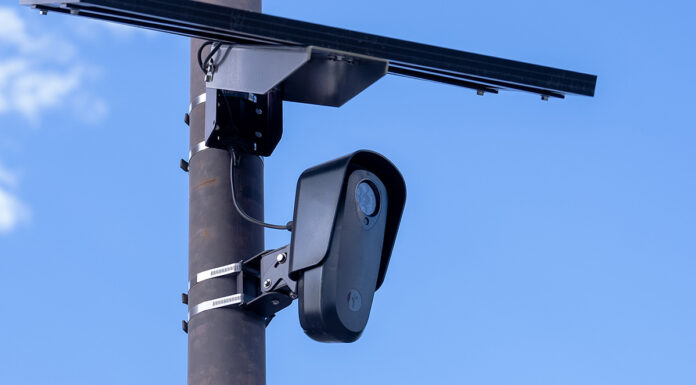
One of the city’s own officers sits charged with running a single license plate 358 times. The governor has ordered the cameras off state roads. Residents want them gone or leashed. The city’s answer on Monday: an open house, a media plan, and a blunt admission that there are fewer bodies to put on the street.
—Monday’s Sarasota City Commission meeting opened with a proclamation. Mayor Debbie Trice stood at the front of the chamber and declared October Domestic Violence Awareness Month, and an advocate from SPARCC reminded the room that one in three women will experience violence or stalking by an intimate partner.
—Minutes later, a resident named Jan Kapel was at the podium connecting the dots nobody on the dais wanted connected.
“You had an announcement about domestic violence which was commendable,” Kapel said. Then came the former Sarasota police officer arrested in August and accused of using the city’s Flock license plate cameras to track a woman. “If this was mere lip service, you won’t do anything. If you really mean that, you’ll take down the Flock cameras so it doesn’t happen again.”
—Kapel was not alone. Three separate speakers used their three minutes to go after the city’s surveillance network. A fourth, the reliably caustic Martin Hyde, tossed it into a list of city spending he finds indefensible: “Flock cameras to enable cops apparently to stalk their ex-girlfriends.”
—By the time the meeting adjourned just after noon, the commission had taken no vote, scheduled no hearing and asked for no ordinance. What the public got instead was a promise of better messaging.
“I’m Not Asking You to Remove Anything”
—The most disarming speaker of the morning was the first one. Luke O’Brien did not shout, did not accuse, and did not ask for a single camera to come down.
“I’m not saying you are surveilling innocent people and I’m not saying you’ve abused the system,” O’Brien told commissioners. “But I am saying that there was a mistake and there’s no ordinance that would stop it.”
—He then listed the questions he said the public cannot currently answer: Who can query the data? What standard has to be met before a search? Who reviews the audit logs? How long is the data kept? What do the sharing agreements with other agencies actually permit?
“If we can’t answer those questions, we don’t have oversight,” he said. “We just have trust. And trust isn’t a safeguard.”
—O’Brien argued that a network of plate readers, fixed cameras and private video feeds, all searchable from one room, amounts to a search “at a scale the framers never had to imagine.” He asked for six things in writing:
- A written policy on who may query the data and under what standard
- A warrant or documented probable cause for any query not tied to a specific active investigation
- Audit logs of every search, retained and reported publicly
- A retention limit with automatic deletion
- Full disclosure of vendor contracts and data-sharing agreements
- A public hearing and a vote before any expansion
“This is entirely within your authority,” he said. “I ask you to put these safeguards in writing before the next expansion, not after.”
358 Searches of One License Plate
The case hanging over the room belongs to Cory Waiters, 38, who joined the Sarasota Police Department in 2023. He was arrested and fired in mid-August and faces felony charges of official misconduct and computer-related offenses, plus a misdemeanor public records charge. He has not been convicted of anything.
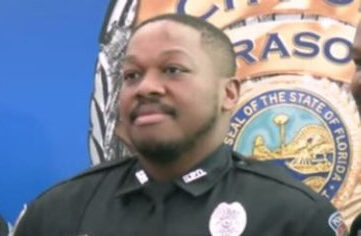
According to the probable cause affidavit, Waiters searched the same Florida plate 358 times through Flock between May and October 2025. Reporting by USA Today found that 121 of those searches came on a single day in June. Chief Rex Troche said in a statement at the time: “We take allegations of misconduct seriously.”
Here is the part that Logan Lopez, a longtime county resident, wanted commissioners to sit with on Monday. The department did not catch it.
Lopez told the commission the searches were “not caught by the police department” and that the officer “was discovered by a journalist from USA Today.” That matches published accounts: the department has said it learned of the allegations on Aug. 6, after a reporter who had been examining public records contacted its public information office.
An agency-wide audit followed. Lopez was unmoved. “No pointless and fruitless audits will assuage these concerns,” he said. “The public trust is lost.”
He also came with homework. Lopez said he had read the Flock contract and that Section 14 lets the city terminate with 30 days’ notice, at any time, for any reason. “I would implore the city to exercise this clause immediately,” he said, adding that the two at-large commission seats are on the ballot in November. “I’m sure that people will be taking this into consideration now that the question has been asked.”
“Is That What You Want?”
Kapel went further than anyone, calling the cameras “illegal and unconstitutional,” citing members of Congress from both parties who have called for investigations of the company, and running through cases in which drivers were pulled over at gunpoint or jailed after a camera hit pointed police at the wrong vehicle.
“If our police department does any of these things, you can be sure that the city will be sued,” Kapel said. “Is that what you want? We want you to take down these Flock cameras immediately.”
The mayor thanked her and called the next group of speakers.
City Hall’s Answer: A Media Plan and an Open House
The response came more than two and a half hours later, during commissioner comments, and it was not the one the speakers had asked for.
Mayor Trice noted the three comments about license plate readers and said Chief Troche “has communicated to the commissioners the value to public safety in our city.” She continued: “I believe he has a public relations, media relations plan, and I would encourage him to move forward with that because people need to understand the value of rather than the problems.”
It is worth remembering that when the commission unanimously approved the Flock agreement in January 2025, it was Trice who asked the department to address privacy and civil liberties concerns. Twenty-one months and one arrested officer later, the instruction from the center seat is to sell it harder.
City Manager Karie Friling followed with the administration’s position. Commissioners, she said, have all visited the department’s Real-Time Operations Center and watched live demonstrations of how the technology “not only saves lives and reduces crime but also prevents it.” The department is now planning an open house so the public can see the same simulations.
As for the safeguards residents asked for, Friling said they are handled.
“Some of the things that you heard today from the public regarding reviewing standard operating procedures and strengthening our license provisions with Flock, all those things have either already been done in the last 60 days or are in the process of being completed,” she said. “So we have checked those boxes.”
No documents were presented. No policy was read into the record. O’Brien’s request for a hearing and a vote before any expansion went unanswered.
Fewer Bodies, More Cameras
Then Friling said the quiet part, and it deserves to be read slowly.
“We cannot lose sight that as our resources continue to shrink and we have less bodies that we can put on the street, that we have to use technology in the most appropriate way possible to continue to keep Sarasota safe,” she said. “And that’s what we will continue to do.”
That is not a privacy argument or a constitutional argument. It is a budget argument. The cameras stay because the city says it cannot afford the officers they stand in for.
It is also a familiar tune. Earlier in the same set of remarks, Friling explained why Hart’s Landing and the bayfront parks still sit wrecked two years after the hurricanes: the city cannot spend even its own money without forfeiting federal reimbursement. And she confirmed that on Oct. 28 the Parking Division will be folded into the Police Department, the latest turn in a parking saga that began when the city extended paid hours to shore up its finances and ended with a merchant revolt and a suspended ordinance.
Parking, parks, policing. In each case the policy is being written by the balance sheet, and residents are told afterward why it had to be that way.
Where Are Sarasota’s 57 Cameras?
Sarasota police maintain 57 Flock plate readers inside the city limits, according to figures the department has given local media. The commission approved a two-year, $339,250 agreement with Flock Group Inc. in January 2025 to feed the Real-Time Operations Center, a facility budgeted at $690,581 for its first two phases. The center also taps city cameras and, with owners’ permission, privately owned ones.
The department has not published a map. One location became public in August when a reader on South Tuttle Avenue near Hibiscus Street was vandalized and knocked offline, the first such incident in the city.
The more pressing question is how many of the 57 were standing on state right of way. The state roads inside Sarasota are the ones nearly everyone drives: U.S. 41, U.S. 301, Fruitville Road and State Road 789, which carries the Ringling Causeway, John Ringling Boulevard and North Boulevard of the Presidents out to St. Armands and toward Longboat Key. When the state order came down, the number of city cameras on those roads was not available. The removal deadline passed on Sept. 30. Nobody on the dais Monday said how many came down, how many were moved, or where they went.
Tallahassee Flinched. Sarasota Didn’t.
That silence is striking because the loudest critic of these cameras in Florida is not an activist at a podium. It is the governor.
On Aug. 31 the Florida Department of Transportation revoked every approval for local license plate readers on state highway right of way and gave agencies 30 days to remove them, citing an explosion in deployments along with “misuse, data privacy concerns, and surveillance schemes.” Gov. Ron DeSantis has called the spread of the readers “out of control” and said he does not want Florida to become a “digital surveillance state.”
Across the state, sheriffs and city councils took the hint. Some suspended their programs outright. Pasco County’s sheriff said the value of the technology does not outweigh public trust.
In Sarasota, the state’s privacy alarm and the city’s posture now point in opposite directions. Tallahassee is pulling back and talking about legislation. City Hall is planning a demonstration day.
Three Feet to the Left on Longboat Key
Sarasota is not the only local government finding its way around the spirit of the order. As this newspaper wrote last month, Longboat Key’s response has been to evaluate moving its cameras just off the state right of way while keeping them trained on the same stretch of Gulf of Mexico Drive, feeding the same database. The state says not on our road. The town answers by stepping onto the grass.
Lopez, for his part, pointed commissioners to a different local example. Sarasota County, he noted, responded to public backlash over data centers with a moratorium. “Will you as a city be responsive here?”
The Other Cameras, and the $3.3 Million
Monday’s agenda held one more irony. The manager of that same Real-Time Operations Center, John Lake, presented the annual reports for the city’s two automated ticketing programs.
The numbers for the year ending June 30:
- School zone speed cameras: 34,038 violations issued, $1,037,868 to the city, $532,240 to the state, $558,852 to the vendor, RedSpeed
- Red light cameras: 32,946 violations issued, $2,249,574 to the city, $2,128,950 to the state
That is 66,984 automated violations in twelve months, more than 180 a day, and roughly $3.29 million to the city. The state’s share of the two programs came to about $2.66 million.
Lake reported real safety gains: speeding in school zones is down about 70 percent from a 2024 baseline, and violations at the original 20 red light locations fell 18 percent.
Twice the mayor asked whether the governor’s order put those programs at risk. Twice Lake said no. “This is not a license plate reader system at all,” he said, noting that state law specifically bars using the school zone cameras that way. They operate under a separate statute.
So the state’s position, taken as a whole, is this: cameras that track where you go are a threat to liberty, and cameras that mail you a $100 notice are a revenue-sharing partnership. And the city’s position is that all of it is necessary, because there are fewer officers to do the work.
Residents can be forgiven for seeing one system where the government sees three.
What Happens Next
Three things are now on the clock.
The Flock agreement approved in January 2025 was written for two years, which would put its future in front of whoever is sitting on the commission after the Nov. 3 election.
The Legislature convenes next year with a governor who has asked for laws limiting how plate reader data can be used, and a successor who could keep or reverse the highway order.
And the police department’s open house, whenever it is scheduled, will give residents a look inside the room where the feeds come together. It will be worth attending. It will also be worth noticing what kind of event it is. A demonstration is something you watch. O’Brien asked for something you vote on.
“Nobody is blind to what this system does,” he told the commission. He asked for the rules in writing. On Monday he was offered a tour.

