
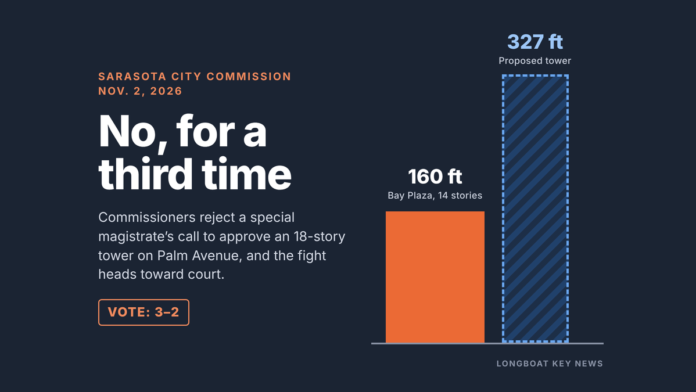
A 3-2 vote sides with Bay Plaza residents over a state-appointed special magistrate who called the city’s denial “unreasonable,” and starts a 30-day clock that leads straight to the courthouse.
—The red shirts filled the Sarasota City Commission chambers again on Nov. 2, the way they have for the better part of four years. Early in the hearing, the lawyer for the people wearing them told commissioners to put the threat of a lawsuit out of their minds.
“There’s probably going to be a lawsuit no matter what,” said attorney Morgan Bentley, who represents the Bay Plaza Owners Association. “You go their way, we’re going to sue; you go our way, they’re going to sue; there’s going to be a lawsuit, so put that to one side.”
—About two hours later, the commission did exactly that.
—By a 3-2 vote, commissioners rejected the recommendation of Special Magistrate Mark Bentley, a Tampa land use attorney appointed under the state’s Florida Land Use and Environmental Dispute Resolution Act. After months of hearings, he had concluded that the city’s 2025 denial of 1260 North Palm Residences, the 18-story, 327-foot condominium tower formerly known as Obsidian, was “unreasonable” and “unfairly burdened” the property. He urged the commission to reverse itself, deny Bay Plaza’s appeal and approve the project.
—The commission said no.
—Commissioner Jen Ahearn-Koch made the motion, Vice Mayor Kathy Kelley Ohlrich seconded it, and Mayor Debbie Trice, in one of her last acts as mayor, cast the deciding vote. Commissioners Liz Alpert and Kyle Battie, both citing the city’s legal exposure, voted to accept the magistrate’s findings.
—The magistrate and the lawyer who spent the afternoon dismantling his work share more than a last name.
“I do like my cousin Mark Bentley,” Morgan Bentley told the commission. “He’s a very smart guy. But even smart people get things wrong and miss the mark, and he missed it badly this time. He missed it on the law, and he missed it on the facts.”
—It was the commission’s third “no” to the tower in 18 months. It will almost certainly not be the last word.
—Robert Lincoln, the attorney for developer Matt Kihnke’s 1260 Palm Properties LLC, told commissioners that letting the denial stand means litigation that “will involve challenging the denials in court and will also involve challenging the validity of underlying ordinances.” Under the state statute, the city now has 30 days to issue a written decision describing, as specifically as possible, what uses remain available on the quarter-acre site. That document is the last step before the case is ripe for a judge.
—Nothing normal about it
—The hearing itself was something Sarasota had never quite done before.
“I’ll start by saying there is nothing normal about what we’re doing here today,” said Jay Daigneault, the special counsel handling the case for the city.
—The Florida Land Use and Environmental Dispute Resolution Act, known by the unlovely acronym FLUEDRA, lets a property owner who believes a local government treated him unfairly bypass the courthouse, at least at first, and take the dispute to a special magistrate. The magistrate mediates, takes evidence and then issues a recommendation. The local government must then accept it, modify it or reject it.
—The statute, Daigneault admitted, is thin on how to actually do that. So the lawyers for the city, the developer and Bay Plaza built what he called a “quasi-quasi-judicial process” for the afternoon: 10 minutes each for the principal presentations, public comment, rebuttal and then the usual round of commissioner “questions, comments, concerns, declarations and sarcastic remarks.”
—When Ohlrich asked whether the city’s normal site plan standards and adjustment criteria even applied anymore, Daigneault was candid.
“The role they play today, I’ll be very honest with you, is not entirely clear the way the statute is written,” he said. But one thing was clear. “Yes, you are limited today to this report. You got to do something with it.”
—The tower and the tight little lot
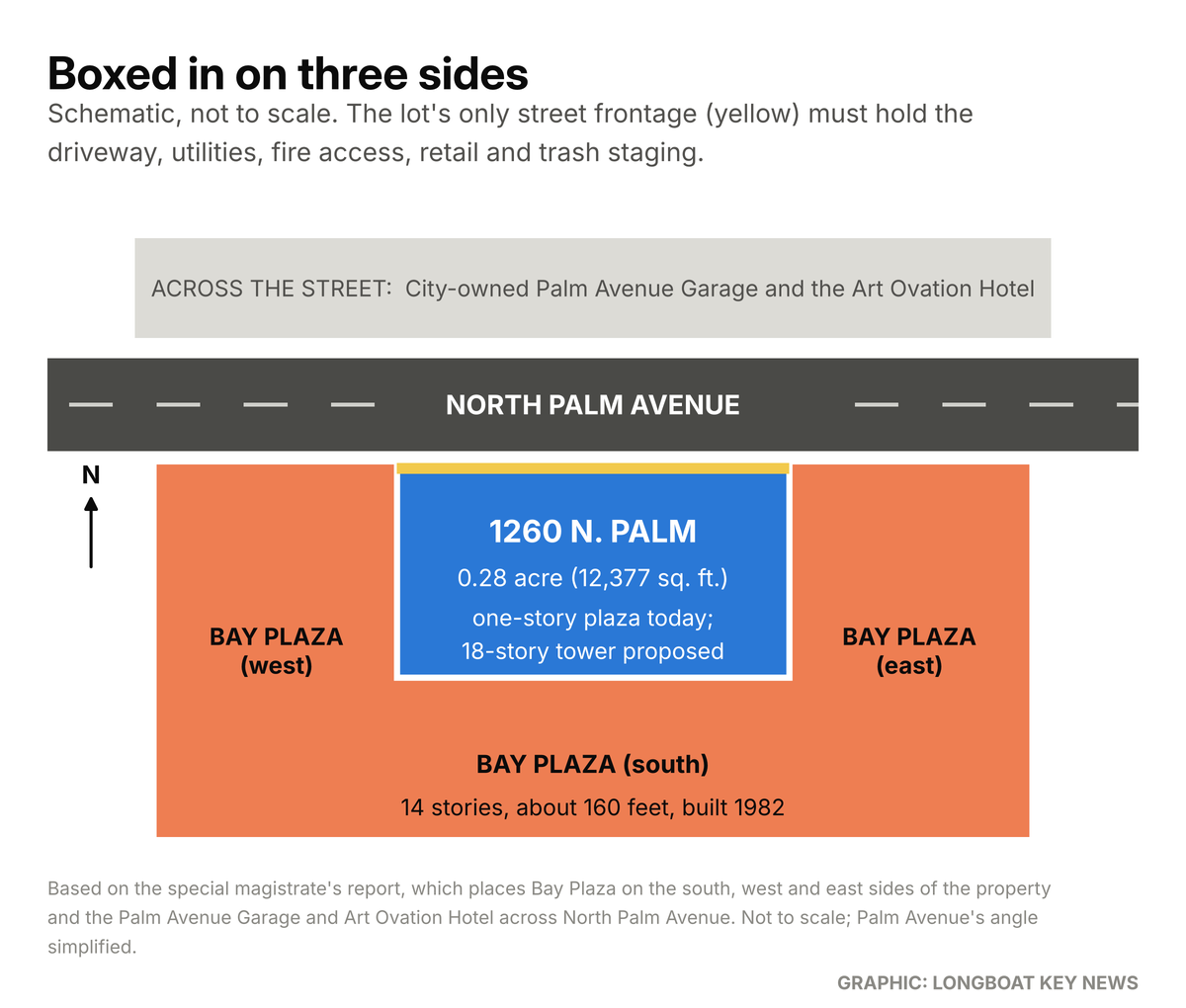
—The site is eight small lots at 1260 through 1274 North Palm Ave., combined into a single parcel of about 12,377 square feet, or 0.28 acre. It now holds a one-story, seven-unit commercial plaza. Kihnke’s company bought it in January 2022. Ron Shapiro, a leader of the opposition, put the price at $3.8 million.
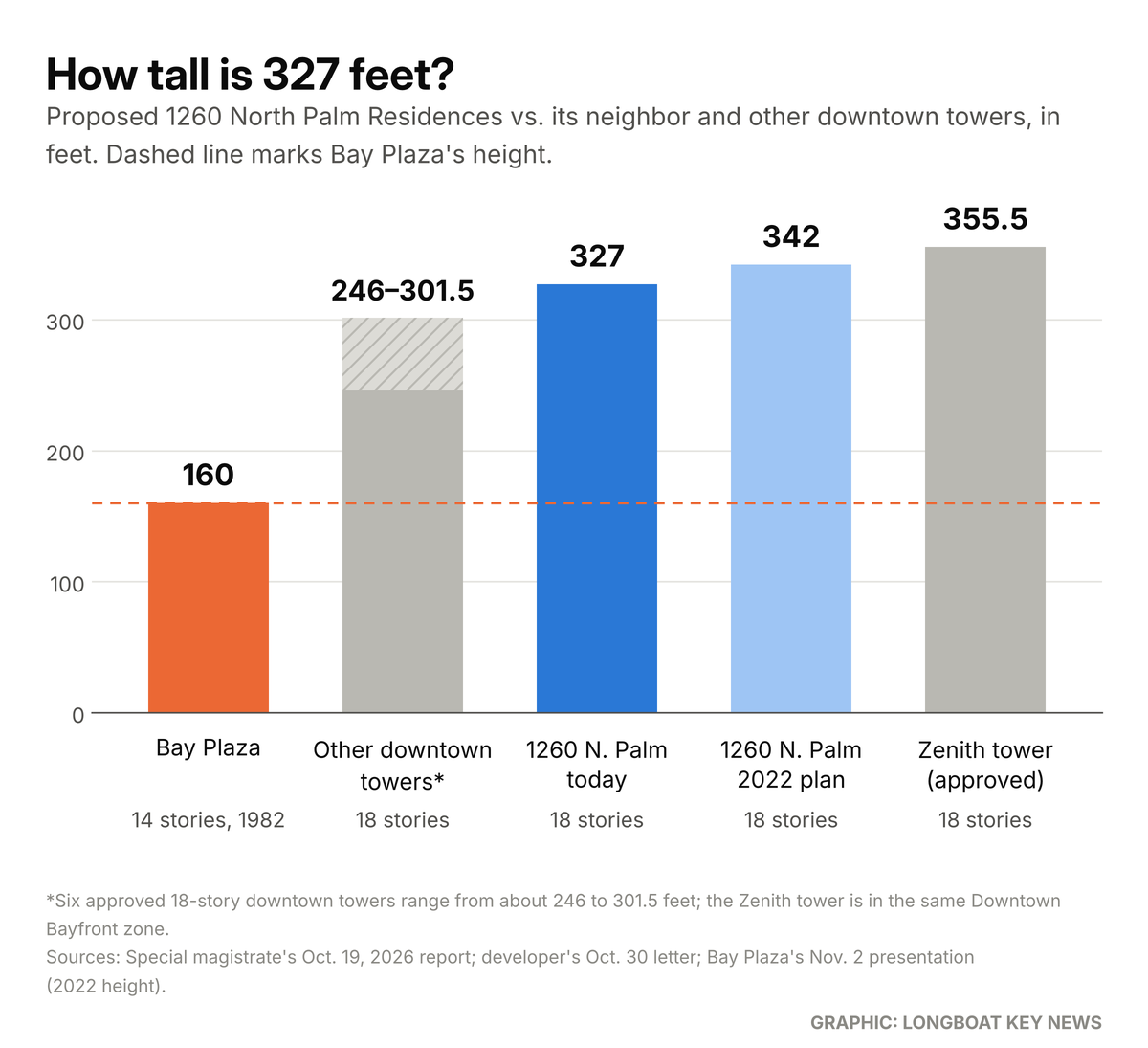
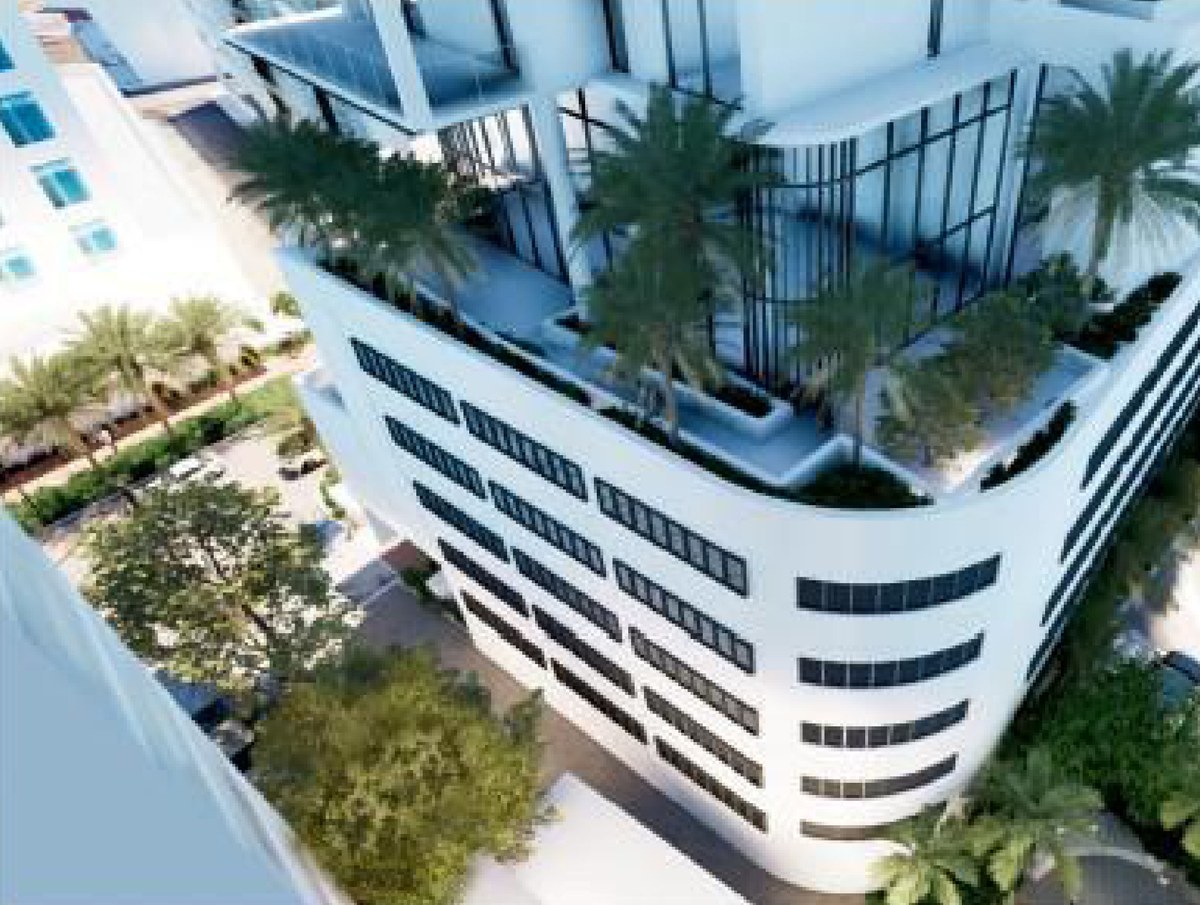
—The plan calls for 14 luxury condominiums, roughly 5,989 square feet of retail on the ground and second floors and a 39-space internal garage, all inside an 18-story building about 327 feet tall. The Downtown Bayfront zoning allows 18 stories, each up to 14 feet from floor to ceiling.
—Bay Plaza, a 14-story, roughly 160-foot condominium built in 1982, borders the site on the west, south and east. Across North Palm Avenue sit the city’s Palm Avenue Garage and the Art Ovation Hotel.
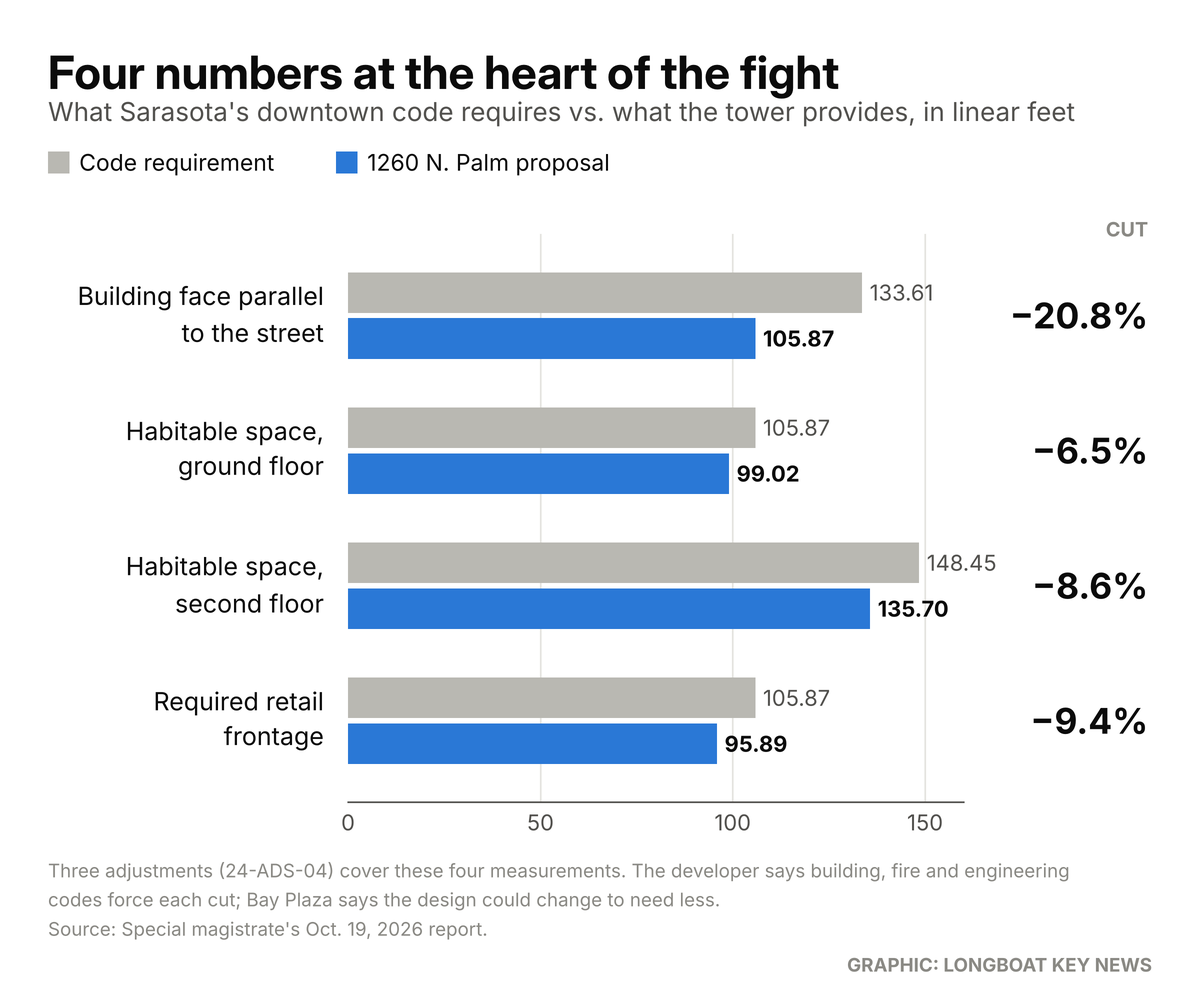
—To make the building work, the developer needed three administrative “adjustments” to the city’s downtown design rules, which together carve four numbers off the code:
- A 20.8% reduction in the building face that must sit parallel to the street, from 133.61 feet to 105.87 feet.
- A 6.5% reduction in required habitable space on the ground floor.
- An 8.6% reduction in required habitable space on the second floor.
- A 9.4% reduction in required retail frontage, from 105.87 feet to 95.89 feet.
—What the magistrate found
—Mark Bentley’s report, dated Oct. 19, read like a reversal of everything the commission had said in 2025.
—He found the denial was “substantively unreasonable,” meaning it “was excessive and went beyond what a fair-minded person would consider sensible.” He found it legally wrong, because the city flipped the burden of proof onto the applicant when, in his view, city staff and the developer had already shown the project met the code, shifting the burden to opponents who then offered no competent evidence to the contrary. And he found that the city’s own zoning code gives the Florida Building Code and the city’s Engineering Design Criteria Manual precedence over the downtown design standards the adjustments relaxed.
—Bay Plaza’s objections to the height, he wrote, “were generalized aesthetic preferences about height, not evidence of incompatibility.”
—He also wrote that the denial leaves the property “without an economically reasonable short-, medium-, or long-term use.” He credited Kihnke’s testimony that the old plaza’s tenants are month-to-month at below-market rents, that flood rules cap how much can be spent fixing the building, and that even a new one-story commercial building would not pencil out “even if the land were valued at $0.”
—His bottom line: “the City cannot reasonably refuse to apply” its adjustment process “to a 0.28-acre parcel surrounded on three sides by an existing 14-story building.”
—The only extra condition he recommended was a “green wall” of landscaping on the ground and second floors facing Bay Plaza, which the developer had offered during earlier settlement talks.
‘Egregious on a lot of fronts’
—Bay Plaza’s legal team had already gone to war with the report before the hearing began.
—In an Oct. 22 email to the city’s lawyers, which Bay Plaza later submitted for the record, Morgan Bentley wrote that he tends “to temper the more extreme comments about things,” but that “this report of his is egregious on a lot of fronts.”
“It is a massive affront to the independent power of the Commission to decide how its Code should apply,” he wrote. He said the magistrate’s concept was that “if a developer proposes an adjustment, the City has to accept it, which is nuts.” He signed off: “Very disappointed in my colleague. This analysis is cliched and not worthy of his talents.”
—A formal 12-page letter followed on Oct. 29. It called the special magistrate “just one person with an opinion” and said his dismissal of the commission’s conclusions was “condescending and patronizing” as well as “legally incorrect and unsupportable.” It took particular aim at the idea that residents’ testimony about parking, deliveries and trash pickup was not competent evidence.
“Every person who has taken out their trash, parked a car, or gotten a delivery knows how these things function,” the letter said. “If a member of the public can’t discuss where to put a garbage can, what can the public discuss?”
—Lincoln answered with a six-page letter of his own on Oct. 30, and commissioners voted 4-1 at the start of the hearing to accept both late-arriving letters into the record.
‘By definition, this project does not meet your code’
—At the podium, Morgan Bentley pressed the same themes, starting with the legal standard.
—The burden-shifting rule the magistrate relied on, he argued, applies to rezonings and special exceptions, not adjustments.
“These are adjustments which by definition involve requirements that they cannot meet,” he said. “Let me repeat that, by definition, this project does not meet your code. This is one of these, the emperor has no clothes arguments.”
—Under the city code, he said, an adjustment has to meet or exceed the purpose of the rule being relaxed, typically by offering something in return, such as public parking in exchange for lost street spaces. “Not one, not one is being proposed in this proposal,” he said.
—He also rejected the claim that Bay Plaza put on no experts, noting that architect Jonathan Parks testified at the Planning Board and that engineer Bill Carnes, a Bay Plaza resident, testified during the process. And he said lay testimony counts.
“I don’t need an advanced degree to see what my eyes tell me,” he said.
—He saved his sharpest words for the idea that the commission had been unreasonable.
“If there’s anything you can say about this project, it’s been well listened to,” he said. “To say that you are unreasonable, that no fair-minded person can consider your decision sensible, is kind of crazy.”
“Just because Mark Bentley from Tampa, Florida, thinks something doesn’t mean it is right,” he added. “You are the deciders and you have decided multiple times.”
—On the economic argument, he pointed to half a century of shops on the site.
“It’s had an economically viable use for 50 years,” he said. “Do they make more money doing something else? Of course. But that’s not what economic unreasonableness is.”
“Don’t let them bully you into thinking there’s some kind of taking here,” he warned. “We will defend that case every day of the week and twice on Sunday because it’s just not true.”
‘Going backwards’
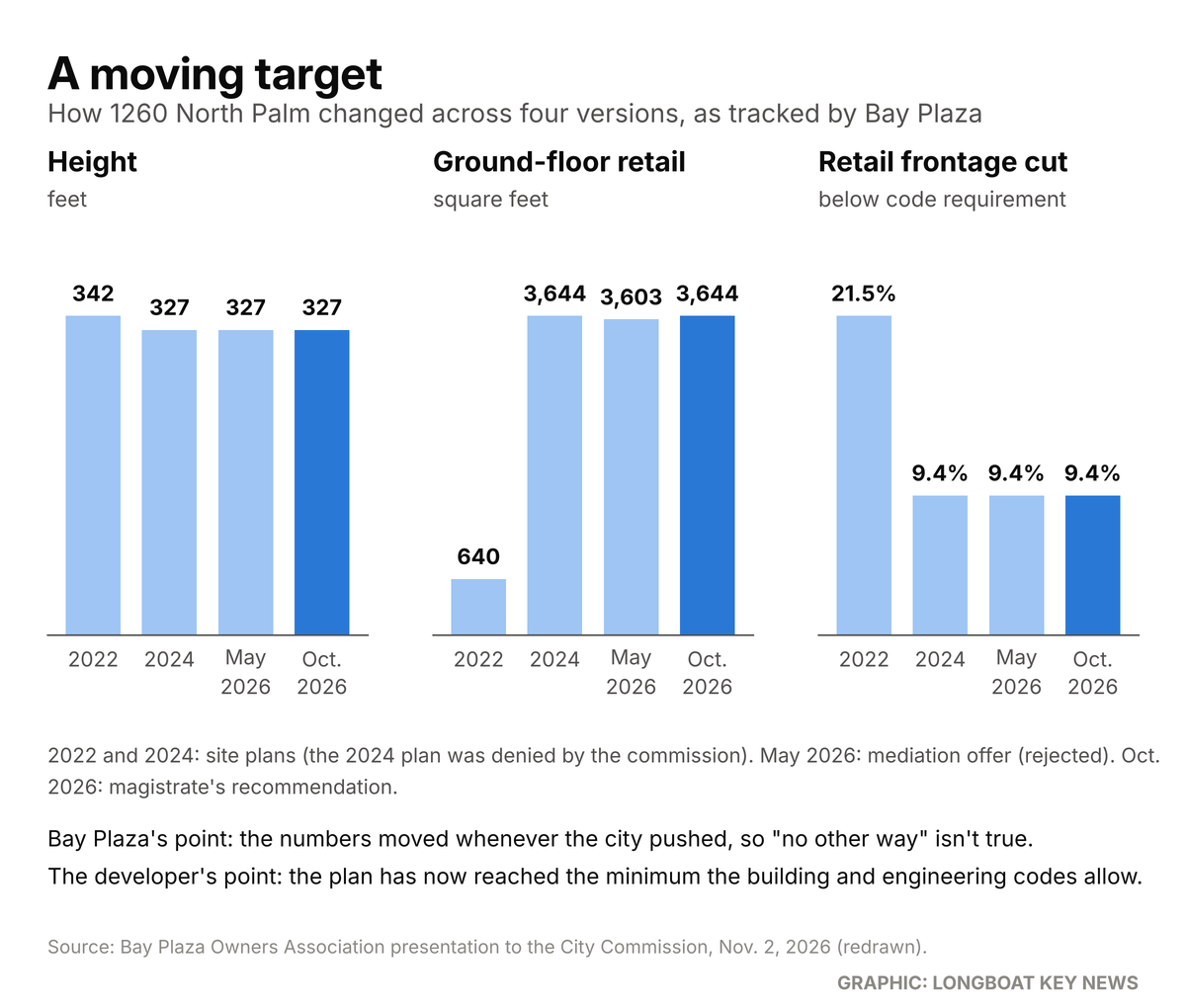
—Bay Plaza’s central exhibit was a chart tracking the project through four versions: the 2022 site plan, the 2024 site plan the commission denied, the settlement offered in mediation and the plan the magistrate recommended.
—The height dropped from 342 feet to 327 feet and stayed there. Ground-floor retail jumped from 640 square feet to 3,644, dipped to 3,603 in the mediation offer and went back to 3,644. The retail frontage reduction fell from 21.5% to 9.4%.
—To Morgan Bentley, the zigzag proved the developer could keep improving the design whenever it was pushed.
“This idea that there could be no modification to their site plan is belied by their own process,” he said. “We are actually going backwards. We are not going forward.”
—In rebuttal he offered what he called “four easy ways to fix it”: less space between floors, a two-story parking garage instead of four stories, a single-lane signalized driveway, and moving the fire command room to the back.
“I’m not even an architect and I can tell you, don’t have three feet of interstitial space between every floor and it will be a lot lower,” he said. “These are simple fixes.”
—He said he likes Kihnke personally. “I think he is a good guy. I think this is a very stubborn approach to this project,” he said. “This is really low-hanging fruit for you guys,” he added, before closing: “This is easy. Just deny it.”
‘He’s just freaking wrong about the law’
—Lincoln opened his case with a warning wrapped in courtesy.
“It is a recommendation. You are free to reject it. I have to say that. I don’t think it would be a good idea,” he said, calling the FLUEDRA process “an alternative to the litigation that would result if the denials stand and are not rescinded.”
—He vouched for the magistrate as a neutral, board-certified expert who has been doing this work for 40 years. Bentley was the second magistrate on the case; the first, Scott Steady, left to become Tampa’s city attorney, Lincoln said. “I’ve used him before and he’s ruled against me in another FLUEDRA proceeding,” Lincoln said. “So there’s no situation where I would have believed that he was biased.”
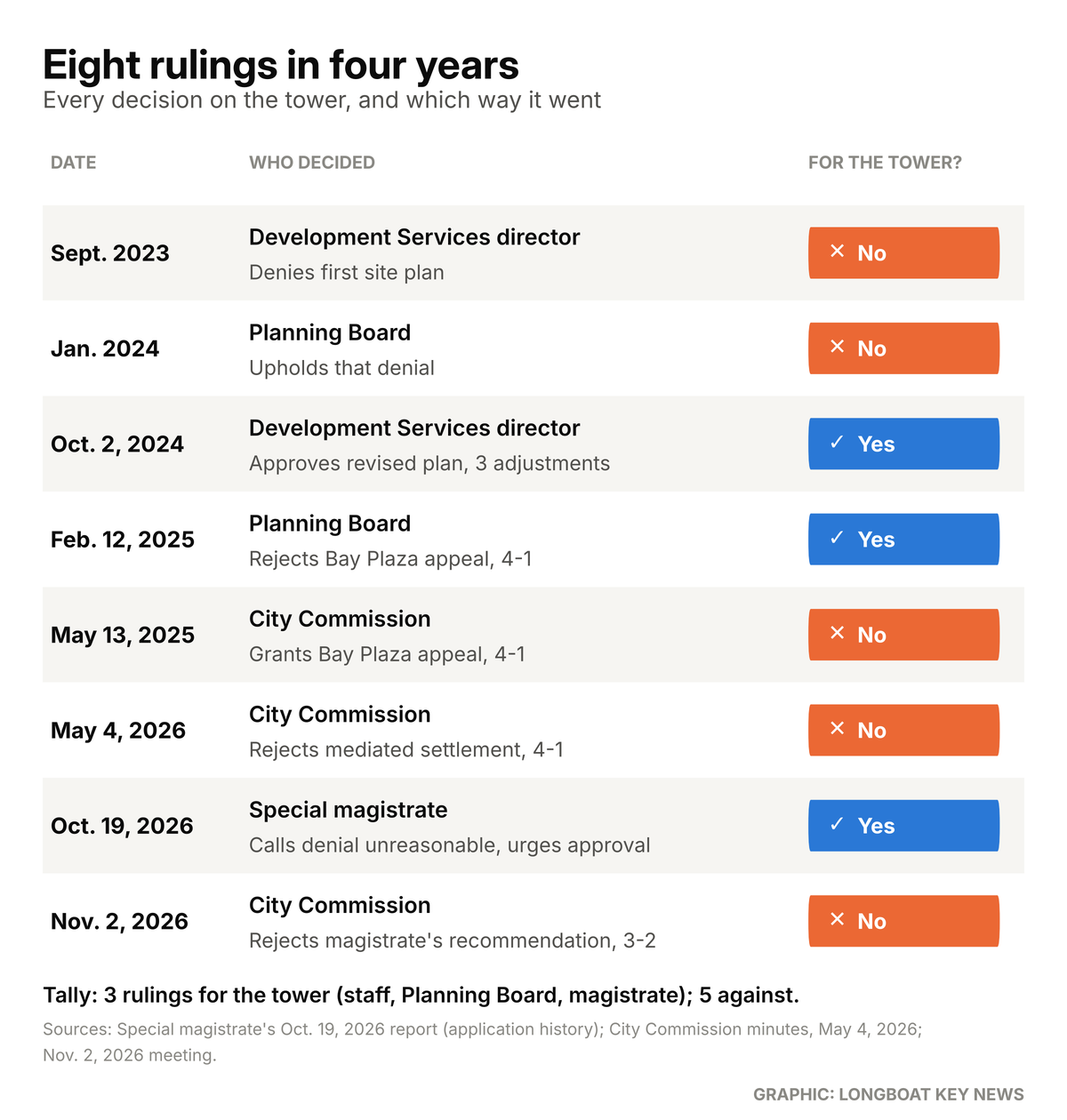
—His argument was that every professional who has reviewed the project agrees with the developer. Development Services Director Lucia Panica approved the plans on Oct. 2, 2024. The Planning Board upheld that approval 4-1 in February 2025. City staff recommended against Bay Plaza’s appeal at every stage. Lincoln’s Oct. 30 letter put it bluntly: “The two denials came only from the Commission.”
—Staff and the developer’s experts, he said, established that “no project more than two stories can go forward on this site without these same adjustments. It’s impossible.”
“They did put on lots of testimony, lay testimony, complaining about it,” he said, “but they didn’t put on a single architect or a single engineer to refute” that the adjustments were necessary.
—On height, he turned the argument back on the neighbors. Bay Plaza, he said, is more than 100 feet taller than the building on the site today and for years towered over everything around it.
“Height alone is not incompatibility, and that height is permitted by the code,” he said.
—On trash, he said the city manager approved curbside or nearby alley pickup after the developer showed staff that bringing a full-size city truck inside the building would create a worse project. “Simply saying that we don’t like the trash doesn’t cut it,” he said.
—In rebuttal, Lincoln aimed at his opponent directly.
“It’s always hard following Morgan. He’s funnier. He’s better looking. He’s better liked than I am, but in this case, there is a problem that, one, he’s just freaking wrong about the law,” Lincoln said. “He’s a great trial lawyer, but he’s not a land use lawyer.”
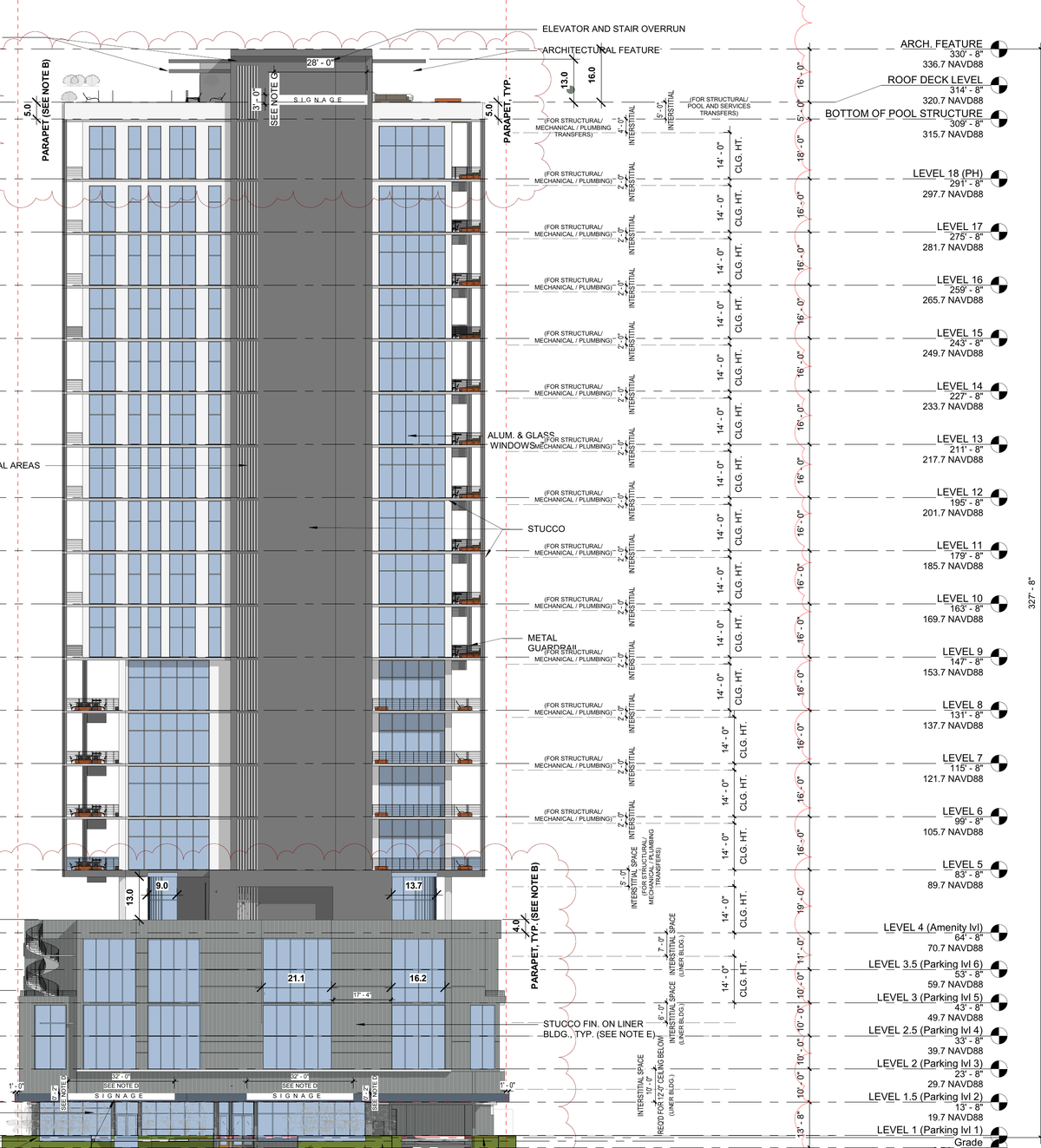
—The applicant’s team called a one-lane driveway “an absolute nonstarter,” and architect George Scarfe of Hoyt Architects disputed the interstitial space claim. “It’s not true. We have two feet,” Scarfe said, noting that Mira Mar and the Zenith tower each have more than three feet on their typical floors. Lincoln’s letter lists other approved downtown towers at 2 feet 6 inches and 1 foot 8 inches.
—Scarfe walked commissioners through a list of building, electrical and engineering code sections he said dictate the driveway width, transformer clearances, backflow preventers, fire command room, exit stairs and accessible exits.
—Lincoln also previewed the case he would bring to court. Because of its age and condition, he said, the existing plaza “can’t be rehabilitated under the flood codes. Just, it can’t,” and eventually it will have to come down.
“It’s not a taking yet,” he said of the magistrate’s finding. “He didn’t say that. It doesn’t need to be.”
—Laughter, and a lecture
—The afternoon had its lighter moments. When Ohlrich opened the questioning by announcing she wanted to speak to both lawyers, one of them said it sounded like they were being admonished.
“I am not your mother,” Ohlrich shot back, drawing laughter.
—Battie, after watching the attorneys spar over whether the trash could go into an alley across the street, summed up the experience.
“See them litigate this right here in front of us,” he said.
—Earlier he had been less delicate. “Like I said, this is a cluster you know what,” Battie said, adding that he has always thought of Palm Avenue and St. Armands as Sarasota’s version of “Rodeo Drive.”
—A wall of red
—Twelve people spoke during public comment. All but one opposed the tower, and nearly all of them wore red.
—Trice noticed the exception. “Mr. Hyde, you are the only one not wearing red,” she said to Martin Hyde, a familiar voice at City Hall.
—Hyde stood to make his point physically. “This is how much higher this building would be than its neighbors,” he said. “Right now, I felt uncomfortable and so do you.” He called that “evidence of the clearest possible type” and warned that approval would make the project a property right and “sound the death knell of the current skyline of this city.” His advice: “Say no to the magistrate’s opinion, let the courts decide.”
—Developer Jim Lampl, whose projects include Rosemary Square, said he never started a project without knowing the codes cold. “This project needs a huge shoehorn because it just doesn’t fit,” he said. “It is a bad project.”
—Shapiro compared 1260 North Palm to Mira Mar and the Adagio, both on larger corner lots, and to 46 South Palm, a similar 1950s retail building one block away that its owner chose to renovate instead of replace. “Developers have choices,” he said. “Some provide public good. Others respond to concerns from the city and their neighbors. 1260 even after four years does neither.”
—Andrew Hall, who lives near Selby Library, said he had “zero connection to Bay Plaza” and “no skin in the game,” but feared the tower would deal “a body blow to historic Palm Avenue’s residents, businesses, and visitors.”
—Carnes, a professional engineer registered in Florida and six other states and a 14-year Bay Plaza resident, said the tower would require about a thousand truckloads of concrete and seven acres of drywall, all delivered across Palm Avenue and its sidewalk, with deep foundations as close as five feet from Bay Plaza’s driven concrete piles.
“Sarasota doesn’t need a Space Needle for billionaires,” he said.
—Jim Atterholt, a Bay Plaza resident who retired at the end of 2025 as vice mayor of Fort Myers Beach, watched that town fight through zoning battle after zoning battle as it rebuilt from Hurricane Ian. “In my six years of serving on the Fort Myers Beach Town Council, I have never seen a project that is so incompatible both in size and in scope with the very small piece of property where it is proposed,” he said. “The applicant today is asking a great deal from the city and offering little.”
—Paul Hess, a retired lawyer and Bay Plaza resident, said the magistrate’s reasoning amounts to saying the commission can never overrule its own staff. “This is patently absurd,” he said. He told commissioners the Downtown Sarasota Condominium Association, the Coalition of City Neighborhood Associations and more than 4,000 petition signers oppose the project. “Height was never the sole basis for your decision,” he said.
—Bob Delaney, the former New Jersey state trooper who spent 25 years as an NBA referee, framed it as a matter of risk and reward. “The reward is 14 owners get to have a condo while hundreds upon hundreds upon hundreds are impacted,” he said. “The older I get, the more I understand the smart thing and the right thing are usually the same thing.”
—Gigi Silverberg, a city resident for 22 years, offered what she called her most important message. “Sarasota does not need to compromise its character to attract development,” she said. “Its character is precisely what attracts development.”
—John Harshman, a retired commercial real estate broker who has spent 52 years in Sarasota and was on the next day’s at-large commission ballot, spoke “for myself and only for myself.” He said he was amazed to hear Lincoln, whom he has known for about 50 years, talk “very cavalierly” about wheeling trash out to Palm Avenue. “It’s a primary street,” he said. “The code needs to be fixed,” he added, because people far from Palm Avenue “are afraid that it’s going to happen to them.”
—Linda Haller Sloan reminded commissioners that Architecture Sarasota has listed the existing Palm Avenue shops, designed by a Chicago father-and-son team named Zimmerman, among its “100 Sarasota Moderns That Matter.” She also argued the adjustments are cumulative, because the retail frontage reduction was calculated as if the facade adjustment had already been granted.
—The lone voice for building
—One speaker urged approval.
—Jonathan Abrams, a 25-year Sarasota resident and business owner whose son was born here, said he respects the Bay Plaza residents and understands their concerns.
“But there is a difference between protecting our community and preventing it from progressing,” he said. “Sarasota did not become the city we love by saying no.”
—He asked commissioners “to have the courage to build the Sarasota our children deserve to inherit.”
—Blue sky through the roof
—The most vivid testimony about the existing plaza came from its owner.
—Trice asked whether rents were low partly because tenants have known for four years that the building might be torn down. Kihnke said the bigger problem is the building itself.
“We’ve got holes in the roof that you literally walk inside, you look up and you see sky,” he said.
“I’m laughing,” Trice replied. “Should we call code enforcement on you?”
—Kihnke said he didn’t believe it either until a tenant asked him to come look. “Not kidding. Literally saw blue sky,” he said, describing a plumbing stack whose cap had blown off, with a bucket underneath. “When I say I subsidize rent, they are far under market value.”
—He said he ran the numbers on tearing down the plaza and building a new one-story building under 10,000 square feet, the threshold that triggers on-site parking. “Using some fairly conservative zero vacancy, the project lost about $640,000,” he said.
—Trice also put the key question to Planning General Manager Alison Christie, whose testimony the magistrate cited for the finding that nothing taller than two stories could be built without the same adjustments.
—Christie said most of the adjustments come from the driveway that any building with on-site parking must have off Palm Avenue. Under the code, that means any residential project or any commercial building over 10,000 square feet. Without parking, she said, a building about two stories tall and about 30 feet deep across the full frontage could meet the rules.
“So is this theoretically possible to replace the existing building, which was in the Architecture Sarasota book, with a two-story retail structure, restaurant, art gallery, ya-da ya-da ya-da?” Trice asked.
“Yes,” Christie said. Fitting that footprint? “Yes, less than 10,000 square feet.” With no variances or adjustments? “Potentially, yes.”
“I can’t speak to whether it would be economically viable,” Christie added, “but it could be possible with no adjustments.”
—The applicant’s team countered that her sketch left out the utilities and fire exits that would still have to reach the street.
—Ahearn-Koch raised another path entirely: historic designation, which under the code can exempt a building from the FEMA flood rule that caps improvements at 50% of a structure’s value. The plaza is not designated, and the applicant’s team said it is not eligible.
—Seven offers, one green wall
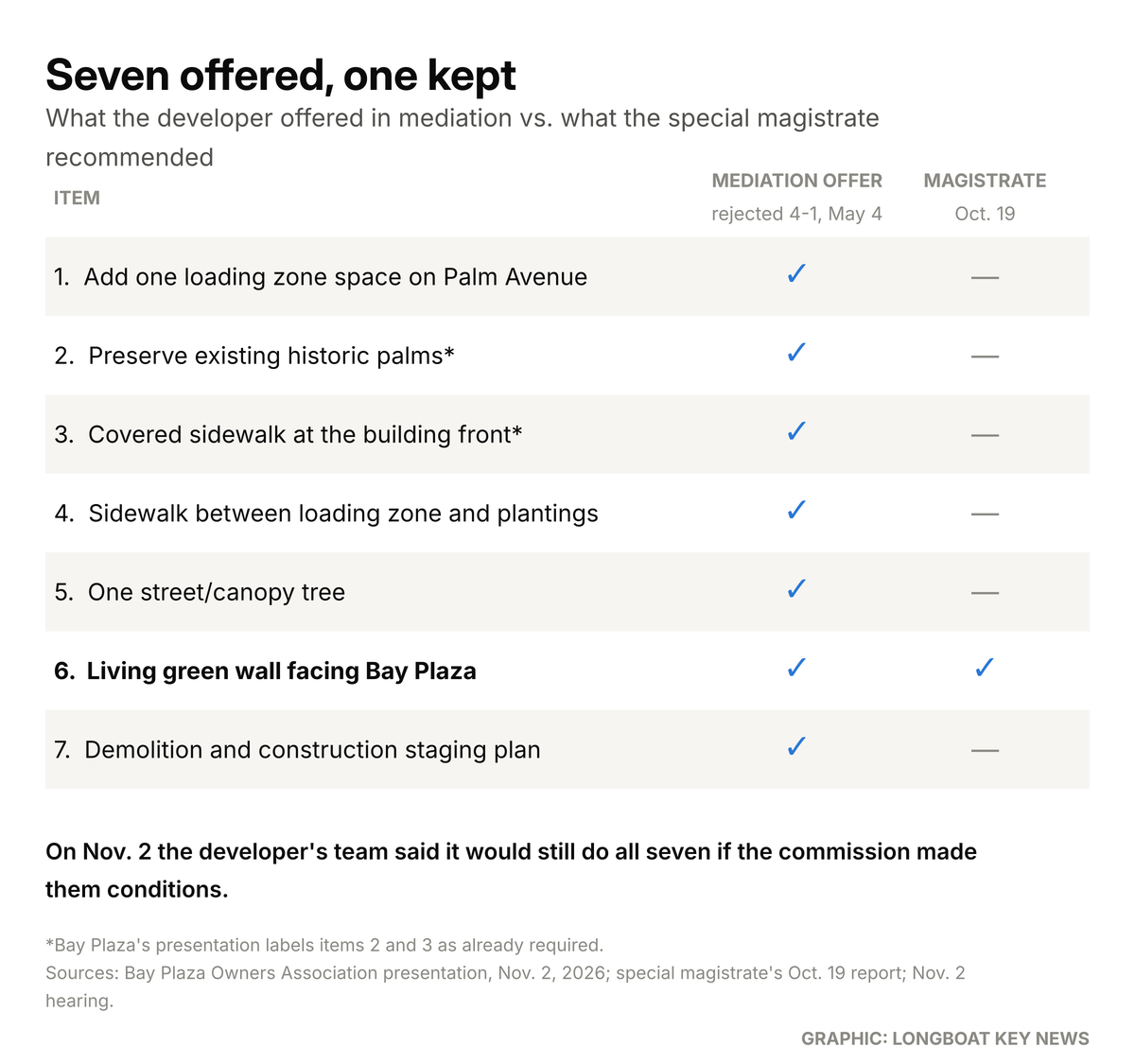
—Trice zeroed in on a chart showing seven items the developer offered during mediation, including a loading zone, a street tree, a sidewalk, a living green wall and a demolition and construction staging plan. The commission rejected that package 4-1 on May 4, with only Alpert in favor. The magistrate’s recommendation kept just one of the seven: the green wall.
“If we follow the magistrate’s recommendation with the addition of adding the living green wall, are all of the other six items excluded?” Trice asked. “Do we get none of the others?”
“That is correct,” came the answer.
—Then the applicant’s side changed the offer on the spot. “I just spoke with the developer, he’s willing to do everything on this list still,” a member of the applicant’s team told commissioners. If the commission made the items conditions, the developer would consent.
—Another member of the applicant’s team added a personal note. “For me selfishly, I don’t have to change my drawings again.”
—Lincoln said the loading zone and related items were dropped only because Bay Plaza objected and the commission rejected them in May. Bay Plaza’s letter called the recommendation a step backward, offering “fewer proposals to cure the grounds for denial.”
—Trash on the jewel box
—No topic consumed more of the afternoon than garbage.
—Because no city-compliant trash truck can turn around inside a building on a lot this size, the developer got City Manager approval in 2024 to roll bins to the curb on Palm Avenue or down to a nearby alley. Bay Plaza says that makes a mess of a primary pedestrian street. The developer notes that Bay Plaza’s trash and the existing plaza’s trash already go out to the street.
—Morgan Bentley suggested the alley behind the Palm Avenue Garage across the street. The applicant’s team said the city’s public works staff never considered that viable, but added that the commission could impose it as a condition and the developer would be bound by it.
—Alpert said she thought the trash was the easy part. “I think the trash is probably the least of our issues,” she said. “I think that can be resolved pretty easily.”
—Trice wasn’t so sure. “That section of downtown is a bit of a jewel box,” she said, worrying about tourists and Art Ovation guests seeing trash on the street “at least once a week, possibly more.”
—The money question
—Alpert, the only commissioner to support the project in 2025 and again in May, used her questions to probe the city’s risk.
—Christie told her the adjustments were the minimum needed based on the driveway width and utility space required by the building code and engineering manual, and that city engineers did not support a one-lane garage entrance during review. Panica explained that adjustments are built into Sarasota’s form-based downtown code because many lots cannot meet every rule.
“It’s hard for some properties to meet those requirements,” Panica said. “That’s why there is an adjustment process.”
—Then Alpert asked the lawyers about lawsuits. Would Bay Plaza be entitled to damages if it sued? Not in counsel’s opinion, she was told.
—And the developer?
“It depends what theory they litigate on,” Daigneault said. Generally, he said, the owner of the property being developed “would typically enjoy a greater range of rights than would adjacent property owner.”
—How much could the city owe?
“Potential damages can be fairly broad in their range,” Daigneault said, to laughter. “I don’t think this is a great forum to discuss it.”
—Asked whether the commission’s original denial was supported by legally sufficient evidence, Daigneault declined to opine. “Listen, you have a pending petition held in abeyance at this point,” he said. “Ultimately that will be determined by a circuit court anyway. My thoughts on it are academic.”
—Trice asked the question at the heart of the case. When staff has signed off, does the commission just rubber stamp?
“You don’t rubber stamp,” Daigneault said. “You are not legally required to find the same way, view evidence the same way as Planning Board or city staff.” What binds the commission, he said, is the criteria in its own code “and the evidence applicable to it. Period.”
—How they voted, and why
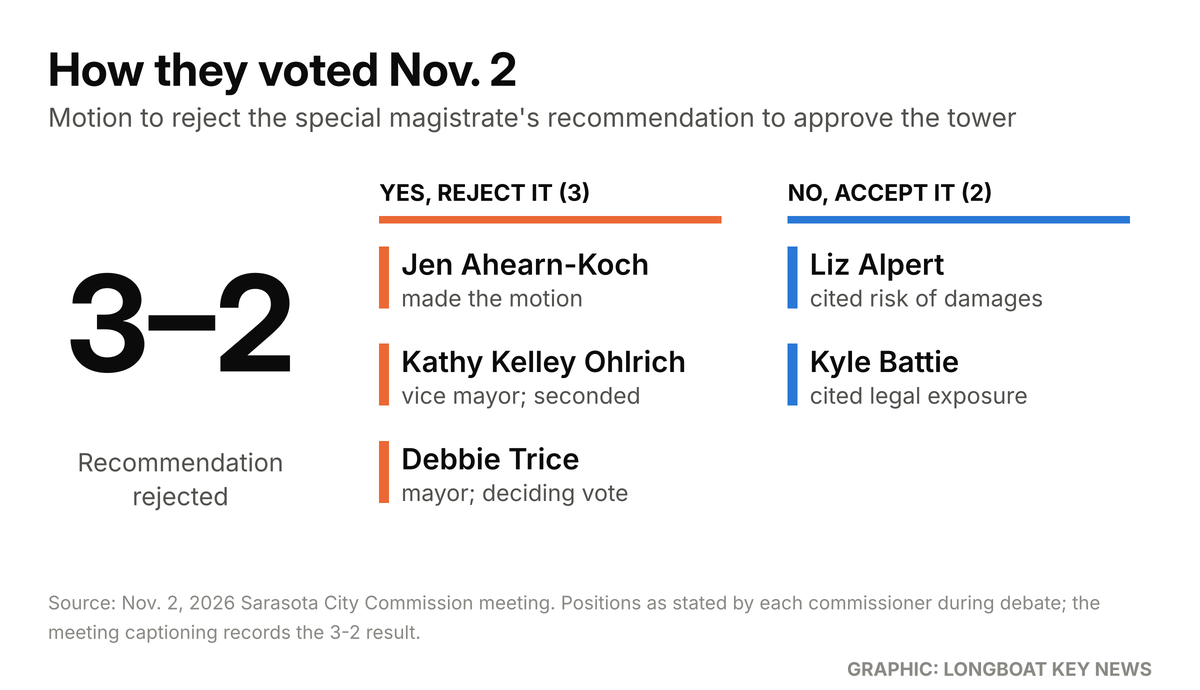
—Vice Mayor Kathy Kelley Ohlrich (reject): “To me, this is a matter of compatibility, lack of. The building to me is totally out of scale.” Reading from the city’s site plan review standard on whether a project’s configuration could be changed to lessen its impact on neighbors, she said, “We’ve been shown today there are ways that things could change.”
—Commissioner Jen Ahearn-Koch (reject, made the motion): “I have nothing to add except that we voted, and I stated the standards for review the last two times, and nothing has changed for me.”
—Commissioner Liz Alpert (accept): “I’m very torn,” she said. “They both make good arguments.” But she said commissioners “weren’t shown anything that was viable, that could be done in a different way,” and pointed to other downtown towers approved with similar adjustments. “My concern is that by rejecting this, we’re opening up the city to multiple millions of dollars in damages,” she said. “I worry about taking on that financial risk.”
—Commissioner Kyle Battie (accept): Battie said the height argument has faded now that the city has approved the Waldorf Astoria tower, which will be taller. “We could be in hot water, you know, when it comes to millions of dollars,” he said, adding, “Something is going to be built on this property, you know, at some point.” His conclusion: “I’m going to, you know, have to go with the upholding of the magistrate’s position.”
—Mayor Debbie Trice (reject, deciding vote): “I’m of two minds,” Trice said. She began with an apology. “My apologies to the Bay Plaza people. You are a small subset of the city. I have to be concerned about the entire population of the city.” She said she did not want to “jeopardize the financial stability” of the city. But the jewel box and the trash weighed on her, and she joined the majority.
‘A fait accompli’
—Trice used her final comments on the case to ask for something bigger than a vote.
—So much of the discussion over four years, she said, happened among the developer, city staff and the Planning Board that by the time the commission weighed in, its ideas came too late. “We are so far beyond that,” she said.
—She asked City Manager Karie Friling to consider a different process “to get the commissioners more involved early on so that we are not given a fait accompli to say, yes or no.”
—This tower, like other downtown projects, was approved administratively by staff and reached the commission only because Bay Plaza appealed.
—What happens now
—The vote did not end the fight. It moved it.
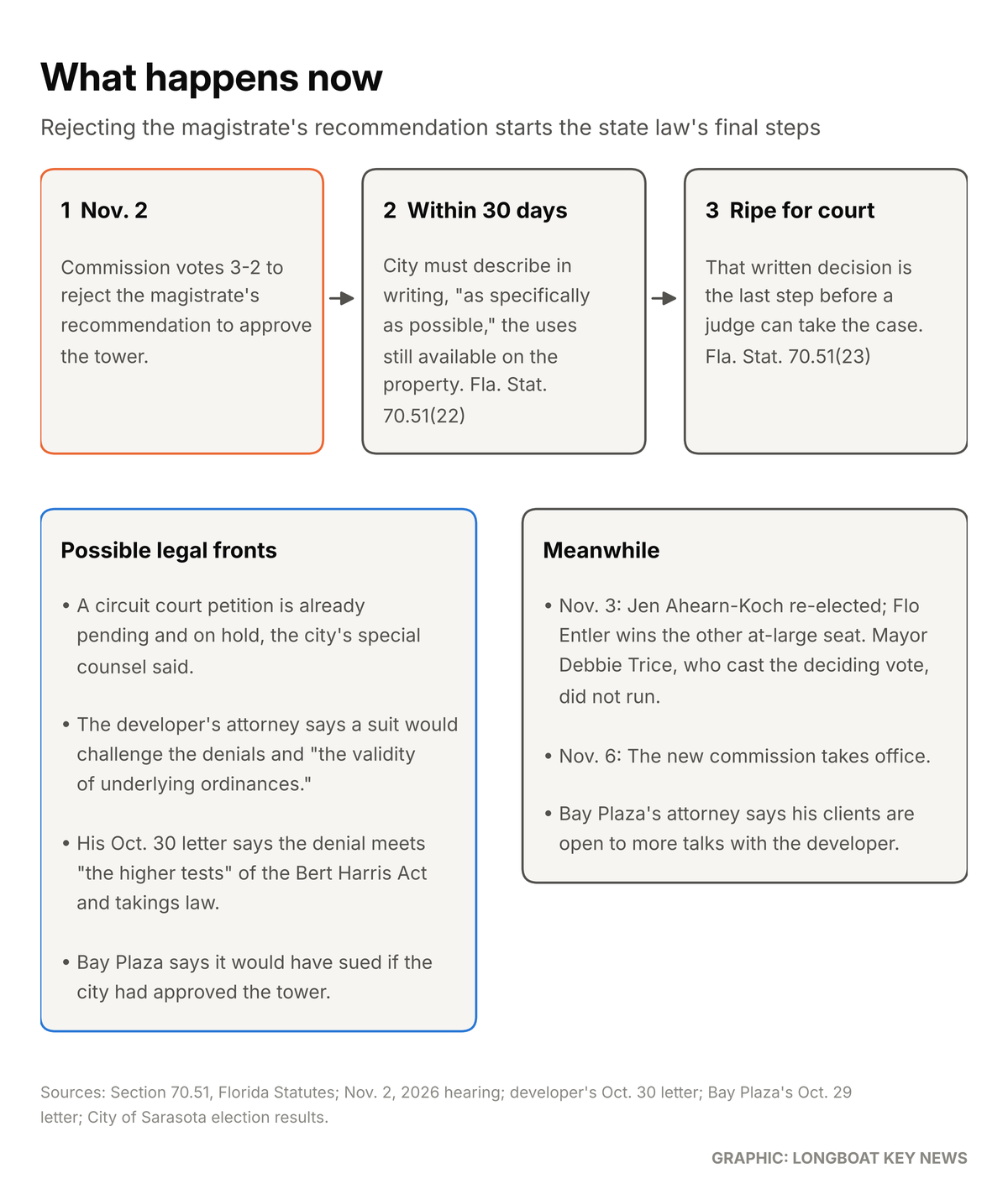
—A 30-day clock. Under Section 70.51 of the Florida Statutes, a government that rejects a special magistrate’s recommendation must issue a written decision within 30 days that describes, as specifically as possible, the uses still available on the property. Bay Plaza’s letter urged the commission to make that determination expressly. Christie’s testimony about a two-story building of less than 10,000 square feet is the most detailed description of a no-adjustment alternative now in the record.
—Ripe for court. That written decision is the final step before the dispute is ripe for a judge. Filing under FLUEDRA paused the clock for court challenges to the city’s original denial until the commission acted on the recommendation. Daigneault confirmed a petition is already pending and on hold. Lincoln’s Oct. 30 letter referred to “the pending litigation,” and he told commissioners a court fight would also challenge “the validity of underlying ordinances.”
—A bigger claim in reserve. Lincoln’s letter argues the denial not only meets FLUEDRA’s lower “unfair burden” standard but “also meets the higher tests,” a reference to the inordinate-burden standard of Florida’s Bert Harris private property rights law and to constitutional takings claims. Bay Plaza’s letter argues that being denied a discretionary adjustment is not a burden the city imposed at all.
—A door left open. Asked by Alpert whether any development would satisfy his clients, Morgan Bentley said yes, and pointed to a four-story concept with a restaurant and parking that came up earlier in the process. For this plan, though, he said, “This is a take this or leave it kind of proposal. So for right now, I think it’s leave it is the answer.” He added that his clients are “happy to have even more discussions” with Kihnke. “We want him to be successful because it makes us successful,” he said. The applicant’s team said that concept would have needed even more adjustments than the current plan.
—A different commission. Trice, who did not seek re-election, has left the dais. In the Nov. 3 election, the day after the vote, Ahearn-Koch won a third term and neighborhood advocate Flo Entler won the other at-large seat. Harshman, who spoke against the tower, finished third. The new commission of Ahearn-Koch, Entler, Ohlrich, Alpert and Battie took office Nov. 6.
—A demolition date on hold. The staging plan the developer filed for the May settlement pencilled in palm tree relocation for January 2027 and demolition of the plaza in the third week of March 2027.
—For now, the one-story shops with their mid-century lines and their leaky roof still sit on Palm Avenue, the tower still exists only on paper, and both sides agree on exactly one thing.
“There’s going to be a lawsuit,” Morgan Bentley said.
—How we got here
—January 2022: 1260 Palm Properties LLC buys eight lots at 1260–1274 N. Palm Ave.
—October 2022: First site plan filed; the tower is then known as Obsidian and planned at 342 feet.
—April 2023: City adopts a rule requiring the Development Services director to approve, with written justification, any interstitial space beyond what building equipment needs.
—September 2023: The director denies the first site plan.
—January 2024: Planning Board upholds that denial.
—February 2024: Revised plans add retail, reduce the adjustments and lower the tower to about 327 feet.
—Oct. 2, 2024: Director Lucia Panica approves the site plan and three adjustments.
—Feb. 12, 2025: Planning Board rejects Bay Plaza’s appeal, 4-1.
—May 13, 2025: City Commission grants Bay Plaza’s appeal, 4-1, with Alpert, then mayor, opposed.
—July 2025: Commission adopts the denial resolution.
—Aug. 11, 2025: Developer files for relief under FLUEDRA.
—January 2026: Mediation before Special Magistrate Mark Bentley fails; at a Jan. 23 hearing the city and developer begin negotiating a settlement, signed April 1.
—May 4, 2026: Commission rejects the mediated settlement, 4-1, with Alpert opposed.
—Sept. 4, 2026: Final FLUEDRA evidentiary hearing.
—Oct. 19, 2026: Magistrate finds the denial “unreasonable” and an unfair burden, recommends approval.
—Nov. 2, 2026: Commission rejects the recommendation, 3-2.
—Within 30 days: City must issue a written decision on the property’s available uses.
—By the numbers
—327 feet: Proposed height of 1260 North Palm Residences (342 feet as first filed).
—18: Stories allowed in the Downtown Bayfront zone.
—14: Condominium units planned.
—0.28 acre: Size of the site (12,377 square feet).
—160 feet: Height of Bay Plaza, the 14-story neighbor built in 1982.
—355.5 feet: Height of the Zenith tower the city approved in the same zone.
—39: Parking spaces in the planned garage.
—3: Adjustments sought (covering four code measurements).
—4,000+: Petition signers opposed, according to speaker Paul Hess.
—$640,000: Loss the developer projects on a new one-story building.
—30 days: Time the city has to describe the property’s remaining uses in writing.

