
Two months of extra review produced an arborist rule, a wind chart and two new escape hatches. It did not produce a single vote to restore the two-for-one replanting rule.
—Two months ago, Longboat Key commissioners slammed the brakes on the biggest rewrite of the town’s tree code since it was adopted in 1974, arguing that a document the Planning and Zoning Board spent more than a year building deserved more than a single afternoon.
—On Nov. 9 they got their closer look. It took about 16 minutes.
—What came back from staff was an arborist requirement for transplanted trees, a new wind-resistance column in the town’s list of recommended species, an open-ended way to extend the deadline for replanting after a hurricane, and the deletion of the one standard in the code that says a replacement tree has to grow up to be a real shade tree.
—What did not come back was the second tree.
—The change at the heart of Ordinance 2026-11, cutting the everyday replacement requirement from two trees planted for every one removed to a minimum of one, survived the review untouched. Not because a majority of commissioners voted to keep it. Because no majority asked to undo it.
“The Commission did not reach a consensus directing Staff to restore the existing 2:1 replacement ratio,” Planning, Zoning and Building Director Allen Parsons wrote in his Oct. 28 memo. “Accordingly, the proposed Ordinance continues to reflect the P&Z Board’s recommended 1:1 replacement requirement.”
—The memo asked commissioners for “further direction regarding the tree replacement ratio.” They gave none. Mayor Debra Williams then counted six of seven commissioners in agreement to send the ordinance to the Dec. 7 regular meeting for first reading and a public hearing. The draft sets second reading and final adoption for Jan. 11, 2027. Nobody from the public spoke.
—Where it stands
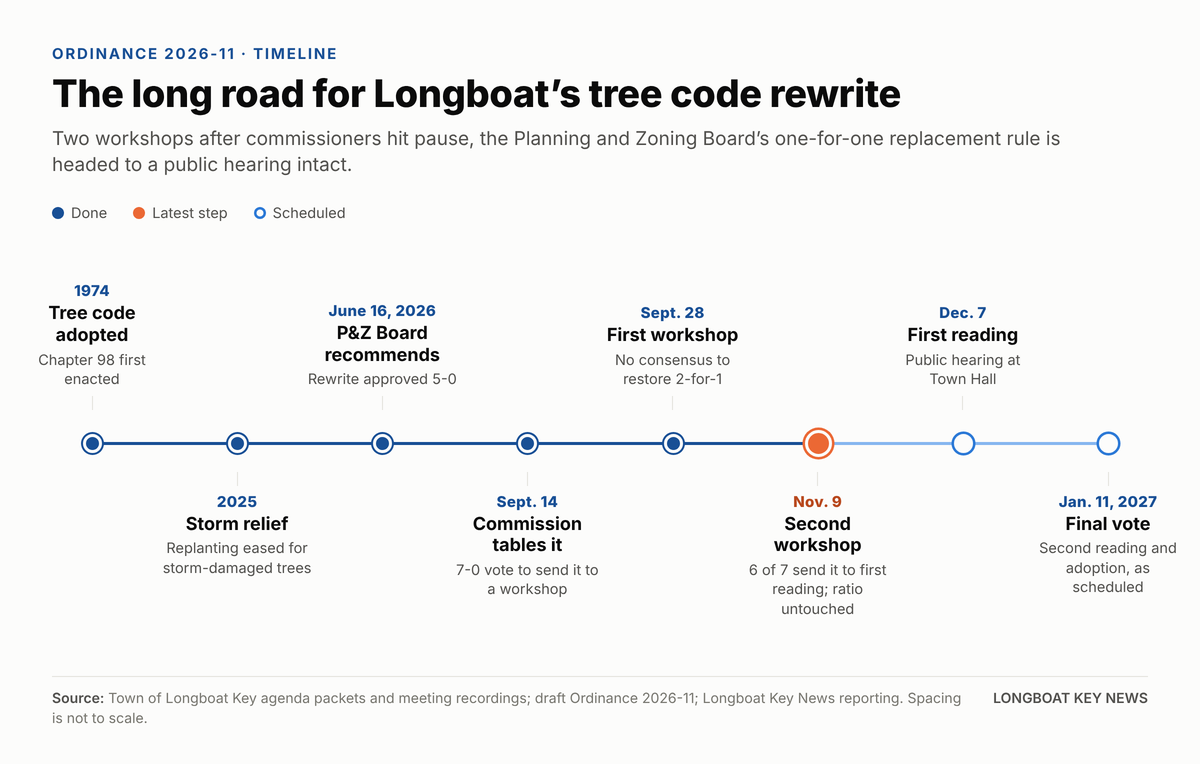
—The Planning and Zoning Board recommended the rewrite 5-0 on June 16. The commission tabled it 7-0 on Sept. 14 after Commissioner B.J. Bishop said it had “too many inconsistencies that I think deserve serious debate and discussion.” It went to a Sept. 28 workshop, where several commissioners voiced concern about the ratio but none of them won a consensus to restore it. Staff then came back Nov. 9 with four requested fixes and one of its own.
—In September, Commissioner Nick Gladding, who sat through many of the board’s meetings, predicted the delay would accomplish little. “I don’t think there are that many changes,” he said then. “I think we’re just putting it off.”
—On the ratio, at least, he was right.
—One no, one yes and a lot of quiet
—Bishop was the only commissioner to argue for the second tree.
“I don’t understand why we would lessen the number of trees that we are replacing,” she said. “The fact that we’re eliminating the two-for-one and taking it to one-for-one, I don’t think is a great idea for a community that prides itself in our trees and the quality of our neighborhoods.”
—Her neighborhood took serious hurricane damage, she said, and “no one is thinking, ‘Oh good, I can plant less trees now.’ I think it’s very shortsighted and I don’t think it serves Longboat Key’s interest.”
—Gladding asked David Lapovsky, who spoke for the Planning and Zoning Board from the audience, to explain the board’s reasoning.
“The conversation was around the arbitrariness of requiring two trees when only one needs to be replaced,” Lapovsky said. “I think it was that simple. A tree is damaged, you replace it with another tree. Why two? Why not four?”
—Bishop answered with arithmetic. The trees dying in the communities she knows “have been 50- to 75-foot trees,” she said, while “I have not seen anyone put in a hardwood tree more than 8 feet tall. So an 8-foot-tall tree is going to take a hell of a long time before it meets what the previous tree was.”
“It’s worked for the last 50 years for a good reason,” she said, “and I would urge us to leave it alone.”
—Vice Mayor Penny Gold made the case for the cut. The commission first talked about going to one-for-one after the hurricanes, she said, because of “the extra expense to the homeowners and the condo associations of trying to make up that difference with the extra trees that weren’t there before.”
“I think it was a significant financial burden on some of the homeowners and some of the condos,” Gold said. She recalled the town’s former manager, Howard Tipton, once telling the commission “we live in a jungle,” where things grow fast, and said there probably wasn’t a real need to double the number of trees replaced.
—Then the room went quiet. When Williams asked for further comments, none came. Commissioners Gary Coffin, Sarah Karon and Steve Branham did not speak on the item. The mayor’s only question concerned who would approve deadline extensions. No commissioner asked for a show of hands on the ratio, and none offered an alternative.
—Two-for-one was never as rigid as it sounds
—Lapovsky’s case against the ratio, that requiring two trees is arbitrary, runs into the language of the current code.
—Today’s Section 98.06(D) says that “generally” two mature replacement trees are required for each tree removed, and that “the site, size, and species of the trees being removed will be considered when determining the actual tree replacement ratio.” The town already has room to require fewer trees where two would not fit or would not make sense. The rewrite strikes that sentence entirely.
—In its place, the draft sets “a minimum ratio of one (1) replacement tree for each tree removed, depending upon species types.” That phrase implies some species would require more than one. But nothing in the ordinance says which species, or how many. As written, one is the floor, and no provision tells a property owner or a planner when the number goes higher.
—The draft does add a like-for-like rule: a removed tree must be replaced with one of a “similar mature size category,” small, medium or large, as defined in the town’s tree list. That is a real improvement. It also cannot make one tree into two.
—What two months of review bought
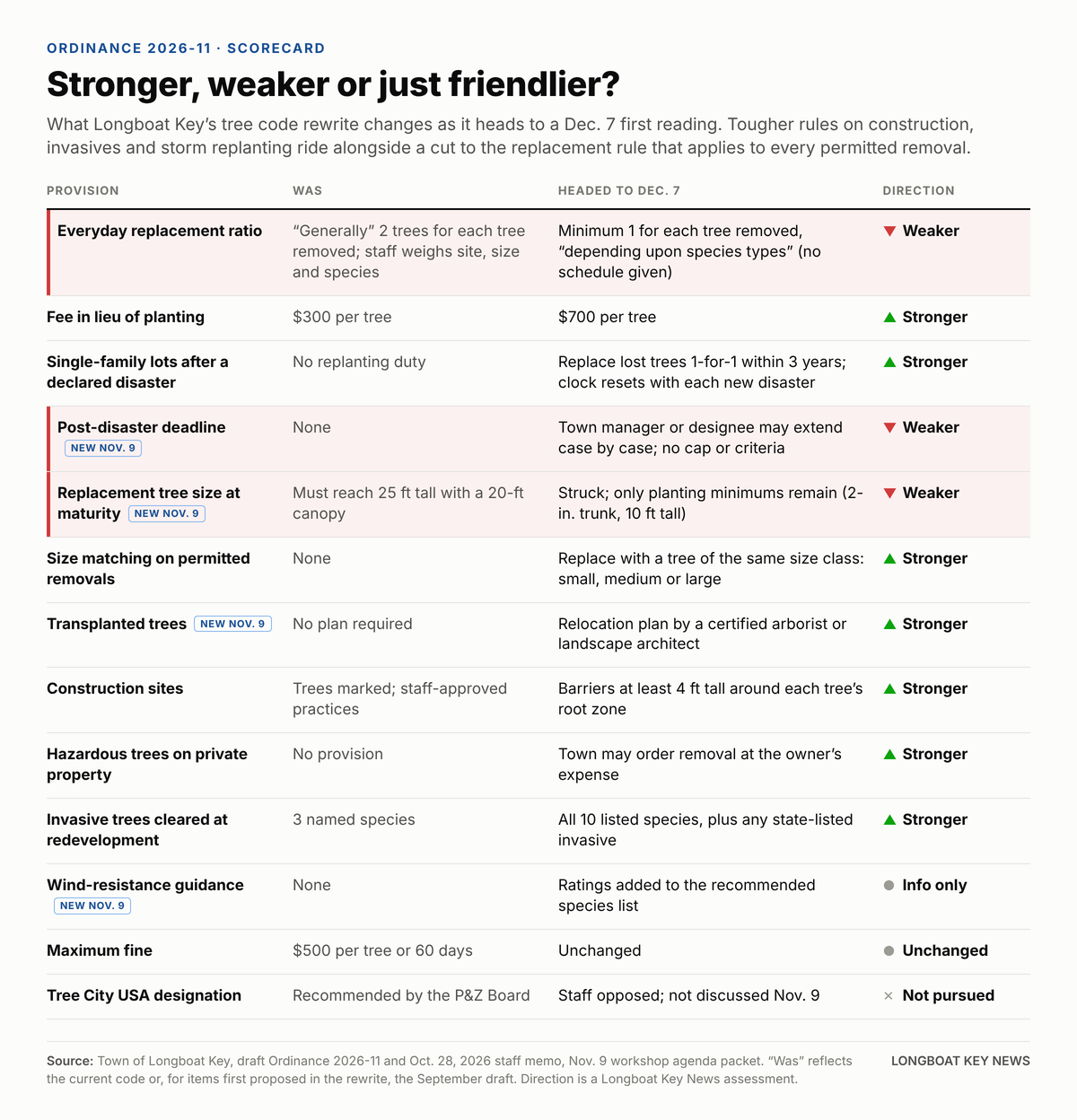
—Planning Manager Elma Glisson walked commissioners through five changes. Here is how each one cuts.
—Tighter: an arborist for transplanted trees
—Commissioners had asked whether trees moved rather than removed actually survive. Staff’s answer, from a subject matter expert: larger trees are less likely to survive relocation, and some that look fine at first decline after the first year from water stress.
—A new subsection, 98.06(B)(5), requires anyone relocating a tree to submit a plan “prepared or reviewed by a Certified Arborist or licensed landscape architect” covering methods, site suitability, irrigation and maintenance. Relocation stays on the menu, and relocated trees still require no replacement, but now someone qualified has to sign off.
—Looser: a deadline with no end date
—The draft’s new Section 98.10 requires every property owner on the island, including single-family homeowners who have never been covered by the tree code, to replace trees lost in a declared natural disaster within three years.
—Commissioners worried that three years might not be enough after a major storm. Staff’s fix: “The Town Manager or Designee may grant an extension of the replacement timeframe on a case-by-case basis.” The extension must be in writing and specify how much extra time is allowed.
—That’s it. There is no cap on how long an extension can run, no limit on how many can be granted, and no criteria for who qualifies. Layer that on the draft’s existing reset clause, which restarts the three-year clock for every unreplaced tree whenever a new disaster is declared, and a property in hurricane-prone Florida could in theory remain out of compliance indefinitely.
—Williams asked whether it was typical to have the town manager handle something like this. Town Attorney Maggie Mooney said the language appears throughout the town code and leaves the manager discretion to delegate to “whatever supervisor that the Town Manager wants to give that power to.”
—Looser: the 25-foot test disappears
—This is the change staff found on its own, and it deserves more attention than it got.
—The definition of a “mature replacement tree” includes a requirement that the tree reach at least 25 feet tall with a canopy spread of at least 20 feet at maturity. Staff noticed that some small and medium species on the town’s own recommended list can’t meet that test, which conflicts with the new like-for-like size rule. The fix: strike the 25-foot and 20-foot requirement and keep only the planting minimums, a trunk at least two inches in diameter and a height of at least 10 feet on the day it goes in the ground.
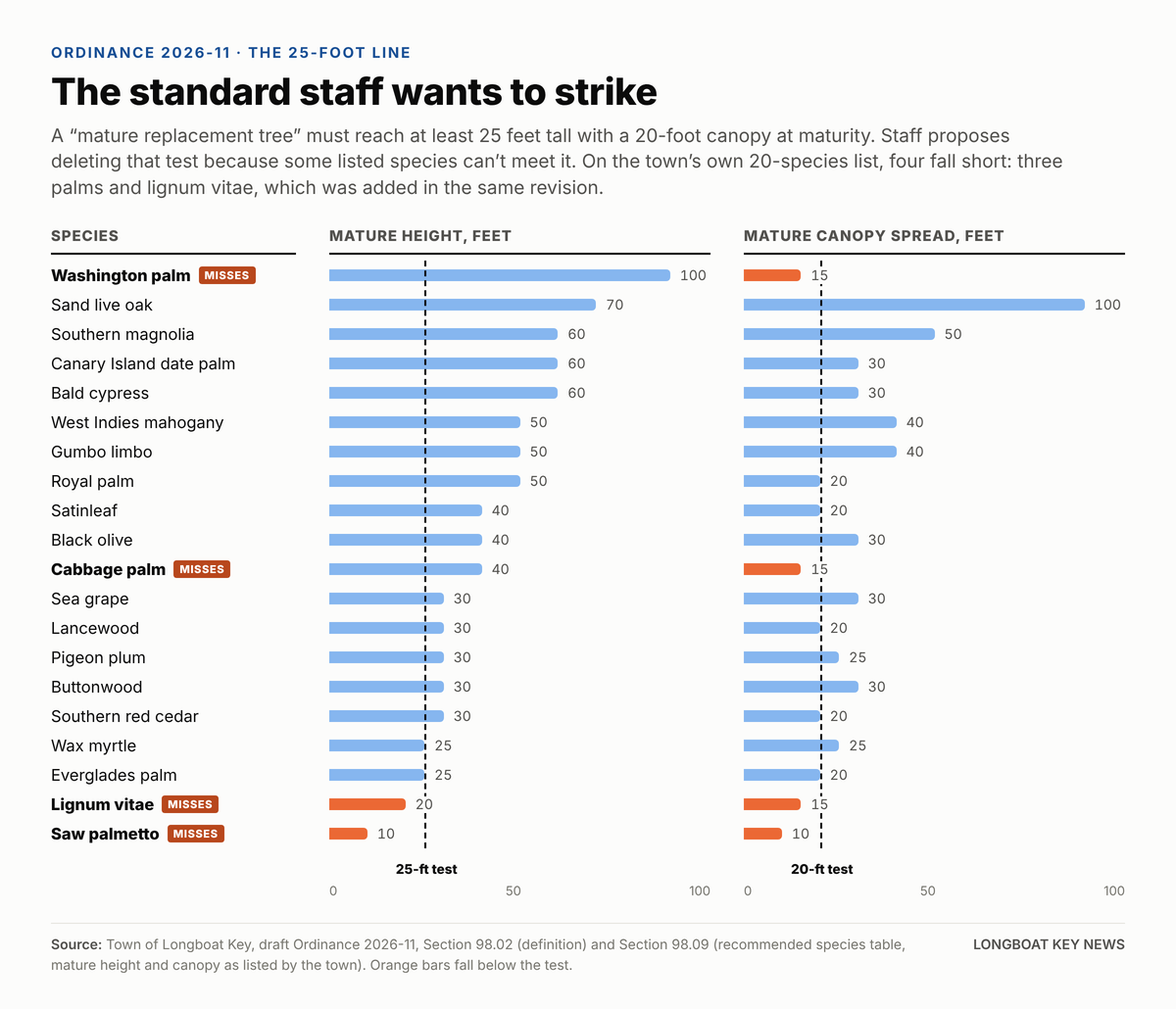
—The town’s own table shows how narrow the conflict is. Of the 20 species on the revised list, only four miss the mark: three palms and lignum vitae, a slow-growing native that staff added to the list in this same round of revisions.
—The bigger consequence is in the post-disaster section. The like-for-like size rule lives in Section 98.06, which governs permitted removals. Section 98.10, the new disaster replanting duty, requires only “a mature replacement tree.” With the maturity standard gone, the definition no longer asks how big a replacement will ever get. As drafted, nothing in the disaster section appears to stop a homeowner from replacing a 70-foot oak with a single 10-foot tree of a species that tops out at 20.
—For information only: wind ratings, with an asterisk
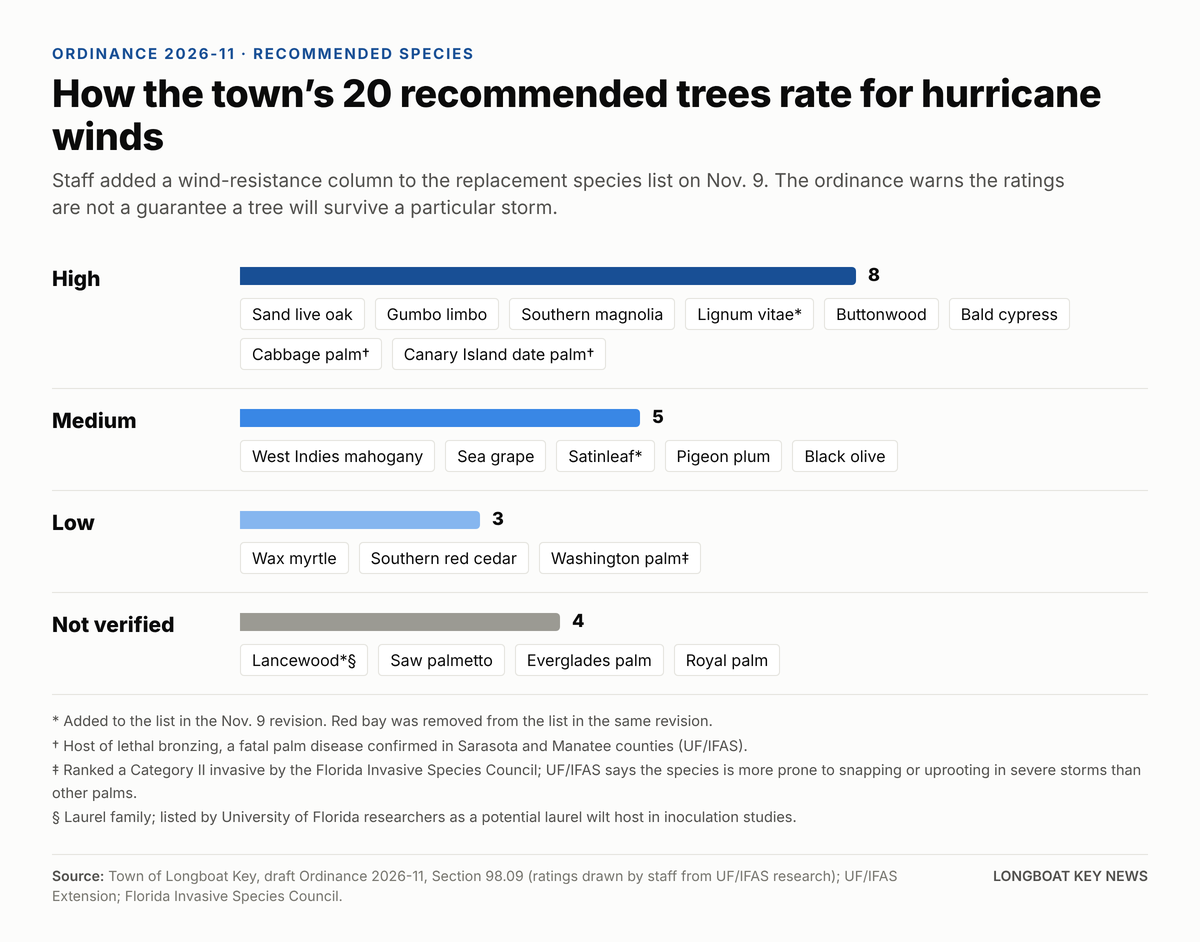
—At commissioners’ request, staff added a wind-resistance column to the recommended species list, drawing on University of Florida research. Sand live oak, gumbo limbo, southern magnolia, buttonwood, bald cypress, lignum vitae, cabbage palm and Canary Island date palm rate “High.” Wax myrtle, southern red cedar and Washington palm rate “Low.” Four species are listed as “Not Verified.”
—A new footnote warns that a wind rating is “not a guarantee that it will survive a particular storm.” Glisson stressed the same point Monday: pruning, tree health, root development and soil all matter.
—Not in the memo: three species in, one out
—The staff memo does not mention it, but the revised species table adds three trees, satinleaf, lancewood and lignum vitae, and strikes red bay entirely. Southern magnolia’s listing was also revised.
—The fine print in the tree list
—Some of those choices invite questions that the packet does not answer.
—The packet gives no reason for dropping red bay. Laurel wilt, the beetle-borne fungal disease that has devastated red bay across the Southeast, has been detected in all 67 Florida counties, according to UF/IFAS. Yet the newly added lancewood is a member of the same laurel family, and University of Florida researchers have listed it as a potential laurel wilt host in inoculation studies.
—Cabbage palm and Canary Island date palm both earned the top wind rating. Both are also hosts of lethal bronzing, a fatal palm disease that UF/IFAS has confirmed in both Sarasota and Manatee counties.
—And the list still recommends the Washington palm, also known as the Mexican fan palm. The town’s own table rates it “Low” for wind resistance. UF/IFAS notes that Mexican fan palms are more prone to snapping or uprooting in severe storms than other palms, and the Florida Invasive Species Council, the scientific panel that keeps Florida’s best-known invasive plant list, ranks it a Category II invasive. The same ordinance adds a new ban on planting “any other tree defined as noxious or invasive by the State of Florida.” Whether that catch-all reaches a palm on the council’s advisory list is exactly the kind of inconsistency a careful scrub was supposed to find.
—Stronger, weaker or just friendlier?
—Taken as a whole, Ordinance 2026-11 is not a simple rollback. It is tougher in several real ways.
—Single-family homes, exempt from the tree code for decades, would for the first time have to replant trees lost to declared disasters. The fee for owners who pay rather than plant would more than double, from $300 to $700 per tree. Construction sites would need sturdy barriers, at least four feet tall, around root zones. The town would gain power to order hazardous trees on private property removed at the owner’s expense. Redevelopment sites would have to clear every listed invasive tree, not just the three named in the current code, plus anything the state deems invasive. Transplants would need professional plans.
—But the provision that matters most, the one that applies every time a permitted tree comes down on a condo, commercial or other non-exempt property, storm or no storm, is being cut in half. And of the five changes made since September, the two with the most practical bite both add flexibility: an open-ended extension and the loss of a maturity standard.
—Is the town being accommodating? By its own account, yes. Gold’s case for one-for-one was about cost relief for homeowners and condo associations. Staff described the extension language as “administrative flexibility.” The P&Z Board’s case was that two-for-one is arbitrary.
—Why they’re doing it
—The ordinance’s own preamble says “hurricane and storm surge impacts have significantly affected the urban tree canopy” and that new standards are needed for “long-term environmental recovery and resilience.”
—The storm argument has a gap. As Longboat Key News reported in September, the commission already eased replanting for storm-damaged trees in 2025. And the new Section 98.10 sets its own one-for-one replanting duty for disaster losses. The everyday ratio in Section 98.06 is a separate rule. It governs ordinary permitted removals: redevelopment, renovation, a tree in the way of a project. Cutting it to one-for-one is not storm relief. It is permanent policy for every removal that follows.
—Tree City USA, quietly composted
—One recommendation from the Planning and Zoning Board did not come up at all during the tree discussion: pursuing Tree City USA designation, a recognition already held by Sarasota, Sarasota County, Manatee County, Bradenton and Venice. Staff recommended against it in September. The Nov. 9 memo does not mention it.
—The program’s only airing Monday came about an hour earlier, during the town lobbyist’s briefing on Amendment 3 and the property-tax squeeze ahead. Dave Ramba of Ramba Consulting Group cited Orange County spending “$50,000, $100,000 a year to count the number of trees they have within the county.”
“It’s called being a Tree City,” Bishop said.
—When Ramba allowed that maybe somebody needs to do it, Bishop came right back: “Yes, you too can spend the $100,000 just counting trees.”
—Ramba suggested the 4-H Club might take on the job and said counting trees is “definitely not something you can spend ad valorem on anymore.”
—For the record, none of the program’s four standards requires counting trees. According to the Arbor Day Foundation, a Tree City USA needs a tree board or department, a tree ordinance, at least $2 per resident each year in community tree care, with staff time counting toward the total, and an Arbor Day observance and proclamation. For a town of roughly 7,500 residents, that works out to about $15,000 a year. Longboat Key already has the ordinance. It is the one being rewritten.
—So the commission’s strongest voice for the second tree is also its sharpest wit against the program built to reward towns that take care of theirs.
—Questions for Dec. 7
—The public hearing is the next chance for residents and commissioners to press on what the workshop left alone.
—Will anyone move to restore the two-for-one ratio, or to write the species-based ratios the draft promises but never defines?
—What limits apply to deadline extensions? How long, how many and under what criteria?
—How will the town know what single-family owners lost? Those lots need no permit to remove a tree, so the town has no record of what came down.
—Without the 25-foot standard, what keeps a post-disaster replacement from being a tree that never grows into shade?
—Why does a $500 maximum fine, unchanged in the rewrite, sit below the new $700 in-lieu fee? Does it deter anyone?
—Why does the recommended list include a council-listed invasive palm, two palms vulnerable to a fatal disease confirmed in both counties, and a new laurel-family tree after red bay was dropped?
—What happens next
—Ordinance 2026-11 goes to the Town Commission’s Dec. 7 regular meeting at Town Hall, 501 Bay Isles Road, for first reading and a public hearing. Second reading and final adoption are scheduled for Jan. 11, 2027.
—Near the end of Monday’s exchange, Lapovsky offered one last thought about the replacement trees going in today.
“In 20 years there’ll be two 70-foot trees there,” he said.
“I hope so,” Bishop replied.
—Under the code on the books today, there could be. Under the one headed to a public hearing Dec. 7, the requirement is one.

