
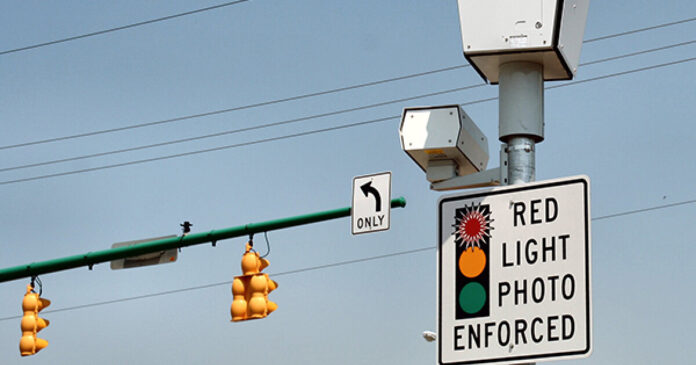
Longboat Key’s eight license plate readers are off, in permitting and coming back. At the first full public airing of the program in 13 years, commissioners praised it, pressed on a few soft spots and took no action. Nobody from the public spoke.
—Longboat Key’s license plate cameras are dark right now, and on Oct. 19 the officers who run them made their case for switching them back on as fast as the permits allow.
—They met no resistance. For nearly an hour in the Town Commission chambers, Police Chief Russ Mager and Capt. Bob Bourque walked commissioners through the first full public accounting of a plate-reader program the town has run for 13 years. Commissioners called the presentation “great” and “excellent.” One called himself “a big fan of the cameras.” Their questions ranged from pointed to friendly. None asked whether the cameras should come back. No member of the public came to the microphone. The item ended exactly as the agenda said it would, with no vote, no motion and no direction.
—“If you’re coming on our island and you want to have fun here, I’m not watching,” Mager told the commission. “Big Brother’s not watching you. It’s only when you come on here if you should bring some baggage with you.”
—And what counts as baggage? “Maybe you might be wanted, or you might have a suspended driver’s license or no registration or no insurance,” the chief said. “Those things are going to attract our attention, or if you come on our island to commit a crime. That’s it.”
—That answer settled one question this newspaper raised before the meeting. The hour left several others right where it found them.
—“We’re Not Circumventing Any System”
—After a brief introduction from Town Manager George Landry, five weeks into the job, Mager went straight at the criticism raised in this newspaper and elsewhere since the state’s crackdown: that the town would sidestep it by moving its cameras a few feet off state land while keeping them trained on Gulf of Mexico Drive.
—On Aug. 31, the Florida Department of Transportation revoked approvals for license plate readers on state road rights of way and gave local governments 30 days to remove them. Gov. Ron DeSantis warned that Florida must not become a “digital surveillance state.”
—“There was some confusion that went around in the media where they felt it meant taking cameras off the state roads, and that was not the case at all,” Mager said. “We have no cameras that are in the state’s right of way. We complied with the governor’s order, but I just wanted to make sure we all are aware that we’re not circumventing any system.”
—“Just to be abundantly clear,” he added, “there’s nothing illegal about putting cameras on Gulf of Mexico Drive or any state road. It’s just a matter of you can’t house them in the state’s right of way.”
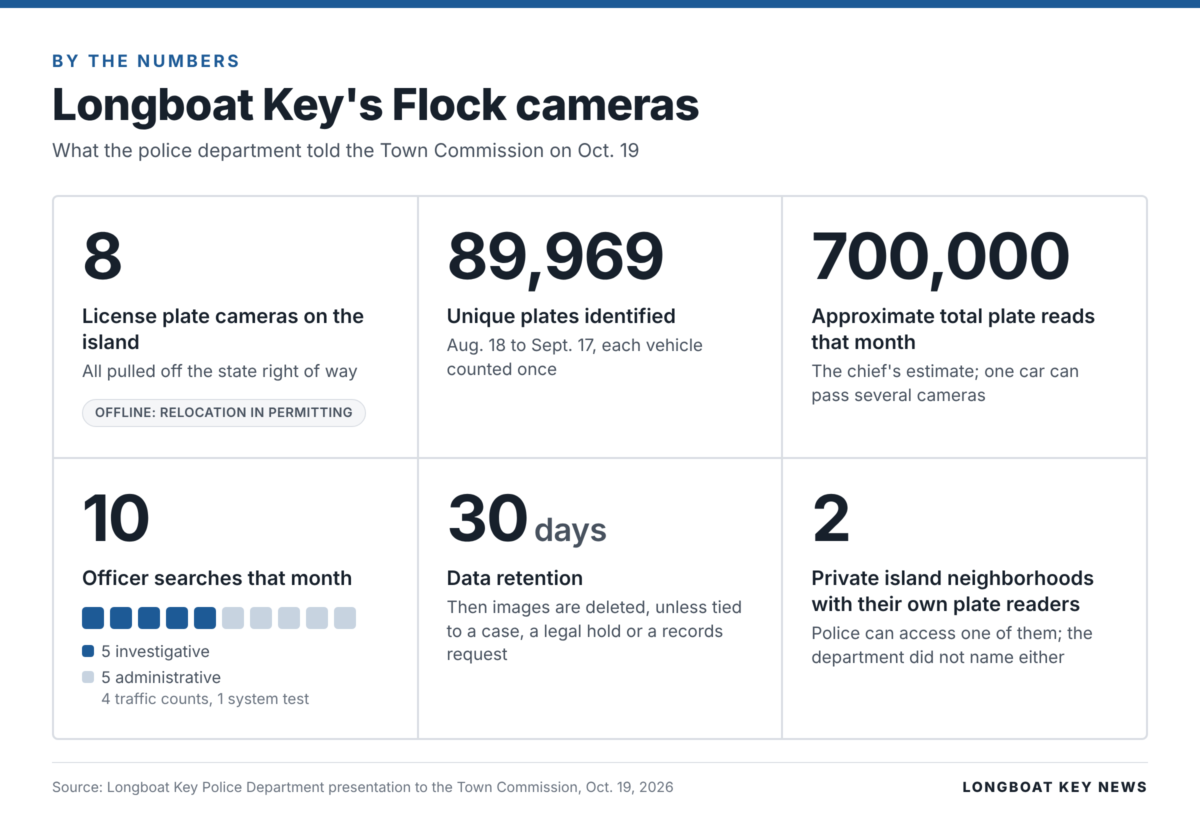
—Every camera the town had was housed there. Later in the meeting, Bourque told the commission the department runs eight readers, in pairs at the north end, the south end, mid-island and the Bay Isles Parkway entrance by Publix. Asked whether all of them sat in the state right of way, he answered in two words: “They were.”
—All of them came down. Mager said the department is now “in the permitting phase of relocating” and expects the cameras back up and running “sometime in the near future.” He said there are “other alternate locations” but did not say where, and no one asked.
—Commissioner Steve Branham asked where Longboat and the state stand on satisfying the governor’s order. “We’ve already satisfied what he put out,” Mager said. “He put out, get them out of the state’s right of way. Now it’s just a question of how quickly can we get them back in the ground in some other place where we’re in compliance, and then keeping our town and our residents safe.”
—He also offered a glimpse of how the order is landing among his peers. The state right of way was the best spot, he said, because it gave the best angle closest to the road, but most agencies have alternatives. “The chiefs that I’ve spoken to were just relocating them. Just not really overly talking about it,” Mager said. “You can use private property, you know, with permission. You can use your own town property, your own city property. We simply, we don’t want to be in non-compliance.”
—That is the department’s answer to the question this newspaper posed before the meeting. The town reads the state’s order as a rule about where a camera is mounted, not about whether it watches the road, and by that reading Longboat has complied in full. Whether that squares with what the governor meant by a “digital surveillance state” is a question nobody on the dais raised.
—What Happened While the Cameras Were Dark
—The department’s most vivid argument came from a case it is still working.
—Several weeks ago, Mager said, two cars were broken into near the Broadway beach access. “Unfortunately, it occurred while the cameras are down and removed,” he said.
—With no plate readers running, police had no vehicle to trace. A victim’s credit card turned up at a gas station outside town, and the store video showed someone trying to use it with a red car in the background. “But that’s all I have,” Mager said. “I don’t have a tag to associate.”
—A week later, a third car was hit in the same area. This time the owner walked up on the break-in and wrote down the red car’s tag number. “Now, they’re not the Flock people. They’re just somebody walking up and writing down a tag and witnessing it,” Mager said. “But great luck on our part.”
—The tag led police to a suspect, and the luck kept coming. The next day, Mager said, the man crashed his car with stolen Longboat property inside. “I can’t make that up,” the chief said. The suspect is in jail on unrelated charges, police have searched the car, and an arrest warrant is being written.
—“If we had our Flock cameras operating, we wouldn’t have needed the luck,” Mager said, “and we would have stopped it before that third time.”
—Bourque said the outage is being felt up and down the coast. Manatee County homicide investigators he works with “had to take down a lot of their cameras,” he said. The burglary suspect would have passed the Manatee camera at Cortez Road and 75th Street West, but that camera was already gone. “So we didn’t know which way he really went,” Bourque said. “Everybody’s struggling that cameras are down right now.”
—The Case for the Cameras
—Bourque, a 17-year veteran of the department and its Flock system administrator, put the program’s value bluntly. “We’ve solved dozens and dozens and dozens and dozens of criminal cases by using these LPR cameras,” he said. “Every major case that I’ve investigated here that we’ve solved … the Flock or the LPR cameras have had a part in that.”
—He walked the commission through two.
—In one, thieves hit a boat business overnight and made off with five GPS units. Police matched a dark vehicle on a surveillance video to their camera data, handed it off to Sarasota, and followed it through other agencies’ cameras “all the way to Miami.” The registered owner turned out to be the suspect, a man tied to a string of boat burglaries, and he was arrested. “Without the cameras, it just would have been a picture of some vehicle on a surveillance camera,” Bourque said. “So this stuff works.”
—In the other, a courier collected $100,000 in cash from a Longboat home in a common fraud scheme. A doorbell camera captured a man and a time, nothing more. Detectives combed “hundreds and hundreds of tags,” found a rental car picked up in Orlando by a man who had flown in from New York, and built the case with search warrants for phone tracking. “He’s sitting in jail right now on a $750,000 bond waiting to go to trial,” Bourque said.
—Vice Mayor Penny Gold later asked whether the victim who handed over “the $100,000 in the shoebox” ever got it back. “No, it’s in some foreign country,” came the answer. Police said the money in these schemes usually ends up in India or China, and more often than not it’s gold bars rather than cash.
—“That last example really makes me think that Longboat Key isn’t as boring as I usually think it is,” Mayor Debra Williams said. “Good and bad in that.”
—Mager made the economic case. Replicating the cameras with people, he said, would mean hiring “probably 20 more officers,” posted at every location around the clock. “He or she can’t use the bathroom, they can’t take a break and they can’t go to lunch. These cameras run 24/7,” he said. “And these cameras more than pay for themselves.”
—Branham agreed. “I don’t think you could even duplicate it even with humans,” he said.
—“This is an indispensable tool,” Mager answered.
—“I support the system, and I think it’s just another validation of the quality of policing that you provide,” Branham said. “This is a great trade-off between modern capability and old-fashioned policing.”
—Mager said the national backlash comes down to a handful of bad apples. “I think this whole thing is boiled down to the poor use or the illegal use, or those 1% or that small group that is using it for reasons that has shocked the public or upset the public,” he said. “We’re not trying to in any way, shape or form violate anybody’s personal private rights.”
—“Junk In, Junk Out”
—Mager described the system in the plainest terms he could. “Basically, the Flock system, fancy company name for tag readers,” he said. “They don’t do anything more than read your tag.”
—Between Aug. 18 and Sept. 17, the cameras identified 89,969 unique plates. Because a car crossing the island passes several readers, Mager said, the raw count of reads runs eight or nine times higher. “We’re talking 700,000,” he said, before clarifying that he meant reads, not separate cars. “That’s a lot for a small town like Longboat Key.”
—The vast majority, he said, are ignored. Plates are checked against a hot list fed several times a day from state motor vehicle records and the state and federal crime information centers. Only a match sets off an alarm in an officer’s car, and officers must confirm it in a separate database before stopping anyone. Everything else drops off after 30 days. “It’s kind of like junk in, junk out,” Mager said. “So when people say Big Brother’s watching you, we’re really not. We’re only watching the ones that when the alarm goes off.”
—The cameras capture no faces, no driver identity and no owner name, he said. “I can’t see who’s driving that vehicle,” Mager said. “I have no idea [of] ethnicity, I’ve no idea of faith, religion, anything. There’s no targeting of anything other than it’s a Texas tag with a black vehicle.”
—But the system does more than read tags, and the officers described those capabilities, too.
—It can search by “vehicle traits,” Mager said: “a certain color, it could be a sticker on the car, could be a dent in the side of the door, could be a car with Bondo.”
—It can search by the clock instead of by plate. “If we’re looking for a burglary suspect that was out here 3:00 in the morning, we don’t have a tag number,” Bourque said. “So we’re searching from 2:00 to 4:00 in the morning, looking at all the tags.”
—It counts visits. “If your car’s been on the island 600 times, you’re most likely not the burglar that came out here and did the one-time burglary,” Bourque said. “So we’re looking for cars that may have only been out here twice, three times, four times.”
—And it reveals routines. Wanted suspects “notoriously don’t have the right address on their driver’s license,” Bourque said, “but you’ll see them at a certain location every day at the same time. So, now you know where to go look for this person.”
—Each of those is sound police work, described with care. Taken together, they describe a tool that does considerably more than read your tag.
—The Mystery Truck Was the Captain’s
—This newspaper’s preview of the meeting followed a black pickup that appeared in the department’s slides, tracked from a Longboat camera to two Manatee County cameras over 39 minutes. We wrote that its owner was presumably just driving home.
—He was. “This is my truck. Okay, that’s my police truck,” Bourque told the commission. “Thank you, Longboat Key.” He lives in Manatee County east of Interstate 75, he said, and the demonstration simply traced his commute.
—He used it to make a point he returned to all afternoon. “This is the only information that’s shared. I just can’t stress that enough,” Bourque said. “We’re looking at a truck and a tag and where that truck was.”
—Public talk about data sharing is “misleading,” he said, because what moves between agencies is a plate, a picture and a location, not a name, a birth date or a registered owner. Longboat can search across hundreds of partner networks. “We can track a suspect from here to Miami and back,” he said. Other agencies do the same in reverse, calling Longboat when a car from one of their cases turns up on the island.
—“A bad guy in jail is a bad guy in jail, and he’s not coming back to Longboat Key until he’s out of jail,” Bourque said. “That’s our goal.”
—Ten Searches, Five of Them His
—Commissioner Sarah Karon said the monthly audits were reassuring, “so that we know and we can reassure our constituents this is happening,” but asked what all that oversight costs in time. “Obviously, it’s worth it or you wouldn’t like the system,” she said.
—Mager pointed to the figure that defined the pre-meeting debate: out of nearly 90,000 vehicles in a month, officers ran 10 searches. That “could be very typical,” he said.
—Bourque, as system administrator, broke them down. “Out of that 10, I was five of them,” he said. Four were traffic counts. One was a test of Flock’s new guardrails. Detective Ramsaier checked whether a car on a grand theft bulletin had come onto the island. Officer Castro looked for a driver who fled a traffic stop. Sgt. Mathis searched for a hit-and-run vehicle.
—“Yes, it is time-consuming, but it’s a necessary evil,” Bourque said. “The last thing that the chief wants, or I want, or anybody else wants is to try explaining two months after the fact to you and the town manager how somebody got away with running a tag 342 times and we didn’t catch it. … And that recently happened at a local agency. And we aren’t going to be in that position.”
—Bourque didn’t name the agency. The description fits the former Sarasota police officer charged in August with official misconduct, accused in a probable cause affidavit of searching a single plate 358 times over five months. The Sarasota department has said it learned of the allegations from a reporter, not from its audits. He has not been convicted.
—Longboat’s audits, Bourque said, now include a monthly review of every user log, a written report to the chief accounting for each search and an annual policy review. Every search requires an offense type from a drop-down menu, a case number or traceable reason, and a written explanation.
—Flock itself has added automated tripwires, about nine of them, that lock out a user whose search reasons don’t add up and force an administrator to review the case. Bourque said Flock applied the new checks retroactively, catching officers who had misused the system for years. “That’s why all of a sudden you see this influx of police officers getting arrested,” he said. “So, that’s a good thing, but we haven’t had a problem with that either.”
—Mager was candid that the scrutiny has changed his own shop. “I do say that this big push right now is actually a good thing, because it creates more guardrails,” he said. “We were doing audits along the way, but not to the extent that we’re doing now.”
—The forbidden list is specific. No personal curiosity searches on family, friends, co-workers, neighbors “or girlfriends and boyfriends, which you see the police officers getting in trouble for right now,” Bourque said. “It’s been mostly girlfriends. I’ve seen some boyfriend ones.”
—When misuse is suspected, the officer is locked out, every keystroke and IP address is preserved, the chain of command is notified and internal affairs investigates. Discipline runs up to termination and arrest. “Chief has no tolerance for that,” Bourque said.
—“The One Thing You Didn’t Talk About Is the Victim”
—Commissioner BJ Bishop began with a memory. “I remember August 2017 very well, as I know Bob does,” she said, “when the Zota murders happened, and without our cameras, we would not have had that immediate success.”
—She was referring to the Aug. 4, 2017, killings of night manager Timothy Hurley and security guard Kevin Carter at the Zota Beach Resort. The island’s plate readers helped police identify a suspect within days. Bourque, then a detective, has worked the case ever since.
—Then Bishop found the hole in the misuse procedure. “The misuse is not the problem of the cameras. It’s a problem with officers who have not been trained thoroughly enough, and that’s never our problem,” she said. “But when you talk about the chain of notifying people when it has been misused, you talked about notifying the supervisor and another person. The one thing you didn’t talk about is the victim.”
—“I have known victims of Flock camera abuse in Virginia,” she said. “So I’m wondering what you share with victims who are being inappropriately stalked.”
—Mager didn’t hesitate. “We would 100% be transparent and notify the victim,” he said. “I personally don’t stand for that, and I would want the victim to know 100%. … Truly, you don’t know what the impact is when somebody does something like that, when somebody does pry into your personal private life and take advantage of a system that they shouldn’t have.”
—It was a firm answer. It was also a spoken one. Telling the person who was tracked is not among the steps Bourque presented, and no one proposed writing it into the department’s policy.
—“There’s No Document”
—Commissioner Nick Gladding opened with an endorsement. “First of all, I’m a big fan of the cameras,” he said. “I think what we’re doing in the town, we’re doing it the right way. We have guardrails.”
—Then he asked about the “written policy or agreement” governing sharing with other agencies. Does Longboat’s 30-day retention rule bind them, too? “Can we get a copy of that policy or the written agreement so that we better understand what the sharing involves?”
—Mager said he could speak only for Longboat. “I can’t speak on what they do with it or when they actually destroy it,” he said. With thousands of agencies running plate readers, “I don’t know how we would police other jurisdictions. … I don’t know how knowing what their policies are would change anything for us or not. I would only hope, based on the sheer attention that this is getting, that there’s no reason for anybody to keep this information any longer than they have to and then destroy it.”
—Bourque added that once Longboat’s 30 days are up, the images are gone for everyone, Flock included. As for the written agreement Gladding asked to see, there isn’t one.
—“It’s not a written-out document,” Bourque said. “I’ll have a share request from Tampa Police Department, and I either approve it or I don’t approve it. There’s no document associated with it. And we approve almost all of those, because it expands our ability to watch where criminals may go.”
—So the answer to Gladding’s question is this: sharing is a click, it is granted almost every time, and what another agency does with a Longboat image it pulls during those 30 days is up to that agency.
—Is 30 Days Long Enough?
—The only retention question from the dais pushed the other direction. Gold asked whether 30 days is enough. “Have you had other cases that come along after the 30 days where it would have been helpful?”
—“I think it’s reasonable. I haven’t run into an issue just yet,” Mager said. He allowed one gap particular to the island. “The only issues we may run into is when people go home for the summer. Somebody might say my place was broken into, and it’s sometime between this month and that month, which could be beyond the 30 days,” he said. “So there is potentially some limitations to the 30 days, but right now … it has not hindered us from doing what we need to do.”
—The Gates Have Cameras, Too
—Commissioner Gary Coffin asked three questions that opened new doors.
—Can the system read boat registrations? No, Mager said. One of the Axon camera systems is developing something for boats, “but as far as I know, Flock doesn’t have that ability, and we have never had that ability.”
—Could the search logs double as a way to evaluate officers’ investigative work? Mager declined the idea. “I don’t want it to look like we’re looking at that and then measuring,” he said, worried it would push officers to “feel forced to have to create investigations” they otherwise wouldn’t. “I just think it’s a tool that we need to use.”
—And do any private neighborhoods on the island run their own plate readers? Mager said he wasn’t aware of any. Bourque was.
—“There’s one neighborhood that does have it. I don’t want to name who it is,” he said. “But we also have access to their data. So they don’t have access to ours, unlike law enforcement, but we have access to theirs. So anybody that drives past their guard shacks or guard gates … commits a crime in there, yes, we can look and see on their camera.”
—He then corrected himself: two neighborhoods have plate readers, and police can reach one of them from the station.
—Those private cameras sit outside the governor’s order, which covered state road rights of way, and outside the town’s own program. No one asked which neighborhoods, how long those systems keep their data or who else can see it.
—“According to Their Statement”
—Williams asked whether Flock sells anonymized data, noting that credit card companies sell that kind of metadata “all the time.” Bourque said Flock can’t even reach Longboat’s data. He knows, he said, because he recently called the company for help retrieving something and was told it had no ability to access it.
—“They absolutely do not sell it, according to their statement and according to their sales people, ’cause we’ve gone down that road with them,” Bourque said. “They said they don’t sell it to anybody.”
—That is the vendor’s assurance, relayed in good faith. No one cited a contract term that guarantees it.
—Williams also asked what an officer parked at a gas station knows about a car that drives past. Not its registration, Bourque said. But “if they’re wanted or they got a suspended driver’s license, yes, the officer at that gas station’s going to know before they get to them.”
—Those alerts don’t route through dispatch, which Branham had asked about, since Longboat moved dispatching off the island years ago. They go straight to the computer in each patrol car. Asked whether the off-island arrangement causes problems, Mager said it is functioning, then added that the town “lost a little bit of the community service aspect” because “most of the dispatchers outside of our town don’t know our streets and don’t know our businesses.”
—Branham steered him back. “I’m not really looking for a critique on the current system,” he said.
—What Went Unasked
—The hour answered a good deal. Several questions left the room the way they came in.
—Alerts. The 10-search figure counts only searches officers typed in. It does not count the automatic alarms that fire in patrol cars when a plate hits the hot list, and the chief’s own examples of what sets one off included suspended licenses, no registration and no insurance, alongside warrants and missing persons. How many of the month’s alarms involved stolen cars and wanted felons, and how many involved paperwork, was neither asked nor volunteered.
—The rules. The program runs on General Order 9011, a department policy the department can revise on its own. No commissioner suggested putting any of it, including the chief’s pledge to notify victims, into an ordinance or resolution.
—The new sites. Where the relocated cameras will stand, on town land or private property, wasn’t discussed.
—The cost. Mager said the cameras “more than pay for themselves.” No dollar figure was offered or requested.
—The public. No one spoke. Two weeks earlier, on Oct. 5, Sarasota residents filled their City Commission chambers demanding written safeguards and a public vote. On Longboat, the mayor asked whether anyone wished to speak or question the chief and, hearing no one, thanked the officers. “This is very informative,” Williams said. “Appreciate it.”
—Publix, and the Point
—Mager offered the line that best captures how the department sees its cameras. “We’re not here trying to track you if you went to CVS or to Publix or anything,” he said. “That’s not what it’s designed for, and I can tell you right now that’s not what we’re using it for.”
—There’s no reason to doubt him. Ten searches in a month is not a department rummaging through residents’ errands.
—But by the department’s own count, two of the island’s eight cameras stood at the Bay Isles entrance by Publix, and every car that passed them went into the database whether anyone looked or not. The town’s case rests on the looking. The worry its critics keep raising rests on the recording. On Oct. 19, the commission heard a thorough answer to the first and spent little time on the second.
—The cameras, Mager said, should be back “sometime in the near future.”

