
With one flat sentence in a new court filing, the St. Regis owner told Longboat Key where this is going. Where the arch case stands, where it is headed, and why the old Colony property keeps landing in front of a judge.
—Walk out on the old Colony groin near sunset and it is hard to imagine anyone fighting over anything.
—The concrete runs 156 feet from the sand into the Gulf, with timber posts and thick rope down both sides. Behind you is the ground where Murf Klauber built the most celebrated tennis resort in America, where a president slept the night before the world changed, and where a generation of Longboaters got married, got hired or learned a backhand. It is the ground the island then watched go dark for fourteen years, and the ground where the St. Regis finally rose.
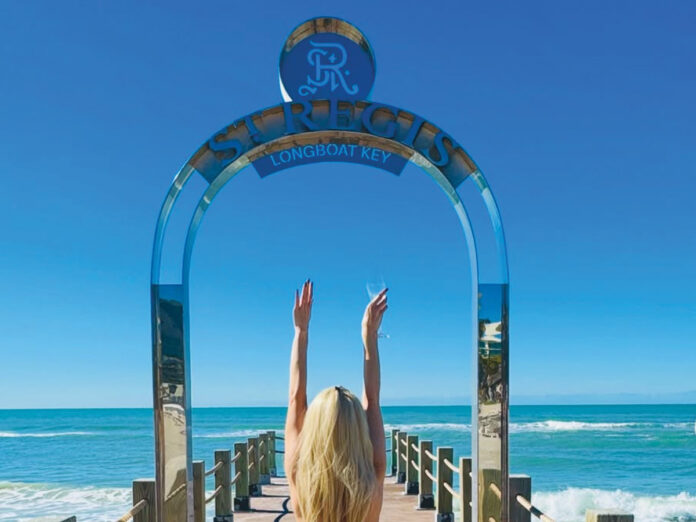
—Ahead of you there is only horizon, framed by an arch of polished stainless steel with ST. REGIS curving across the top.
—It is one of the prettiest spots on one of the prettiest beaches in the world. In a Sarasota courtroom, it is Exhibit 3.
—And the fight over it has just turned.
—On Oct. 15, the company that owns the St. Regis answered the Town of Longboat Key’s demand that it admit, one at a time, the facts behind the lawsuit to tear the arch down. It admitted most of them.
—Yes, the state permit it relies on said the structure “should be installed per local governmental ordinances.” Yes, Chuck Whittall signed a promise to get any municipal permit the work required. Yes, the drawing of the arch that was actually built never went to Town Hall. Yes, the Town told it to take the arch down.
—Then came the one flat sentence that tells you where this is headed: “Admit the arch structure and sign were not moved.”
—The company admits the facts and concedes nothing. Its position is that Longboat Key’s law stops at the waterline, that the State of Florida approved the arch, and that the Town itself signed off when it permitted the railing beside it. Whittall has already said how far he will carry that argument. “We will fight it on every level,” he told this newspaper, “whether it’s the Florida Supreme Court.”
—Circuit Judge Dana Moss has set the trial for January 2028. Until then, the arch stands.
—If it seems strange that an island that waited fourteen years for this resort is now suing it over twelve feet of steel, consider the ground. On this stretch of beach there is always a fight. The man who made the Colony famous sued the Town and collected millions. His own unit owners fought him into bankruptcy court, and the resort closed. The Town condemned the ruins and was sued for doing it. The developer who bought the wreckage spent years in court prying it loose from holdouts. Now the Town that approved his resort is suing his companies over something he built on the one piece of the old Colony that survived.
—Here is where the fight stands, where it is headed, and why this one strip of sand grows lawsuits the way the rest of the island grows sea grapes.
—Fifteen Times Yes
—In August the Town’s special counsel, Martin Garcia, put 28 statements of fact in front of SR LBK II, the company named as owner on the groin permits, and told it to admit or deny each one. It is the bluntest tool in a lawsuit. Under Florida’s rules, a fact admitted this way is settled for the rest of the case unless the judge lets it be taken back.
—The answers came back Oct. 15, signed by Brian D. Goodrich of the Sarasota firm Bentley Goodrich Kison. The score: fifteen admitted, five denied, eight the company said it could not answer.
—The admissions read like the Town’s opening statement:
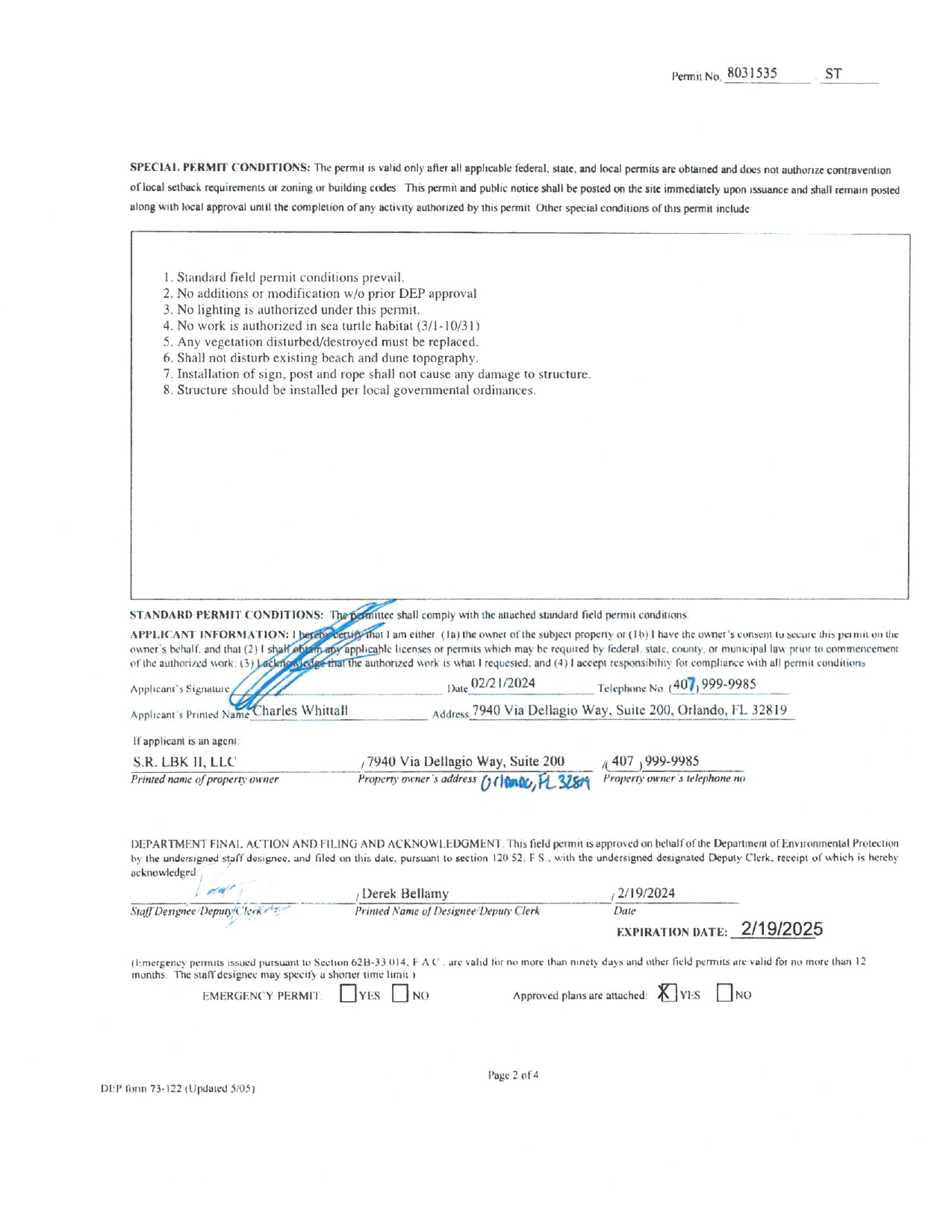
—The state permit “is valid only after all applicable federal, state and local permits are obtained and does not authorize contravention of local setback requirements or zoning or building codes.”
—Whittall, as the company’s agent, certified that he “shall obtain any applicable licenses or permits which may be required by federal, state, county or municipal law prior to commencement of the authorized work.”
—The one Town permit the company got for the groin in 2024 was for handrails. The contractor who pulled it did not build the arch.
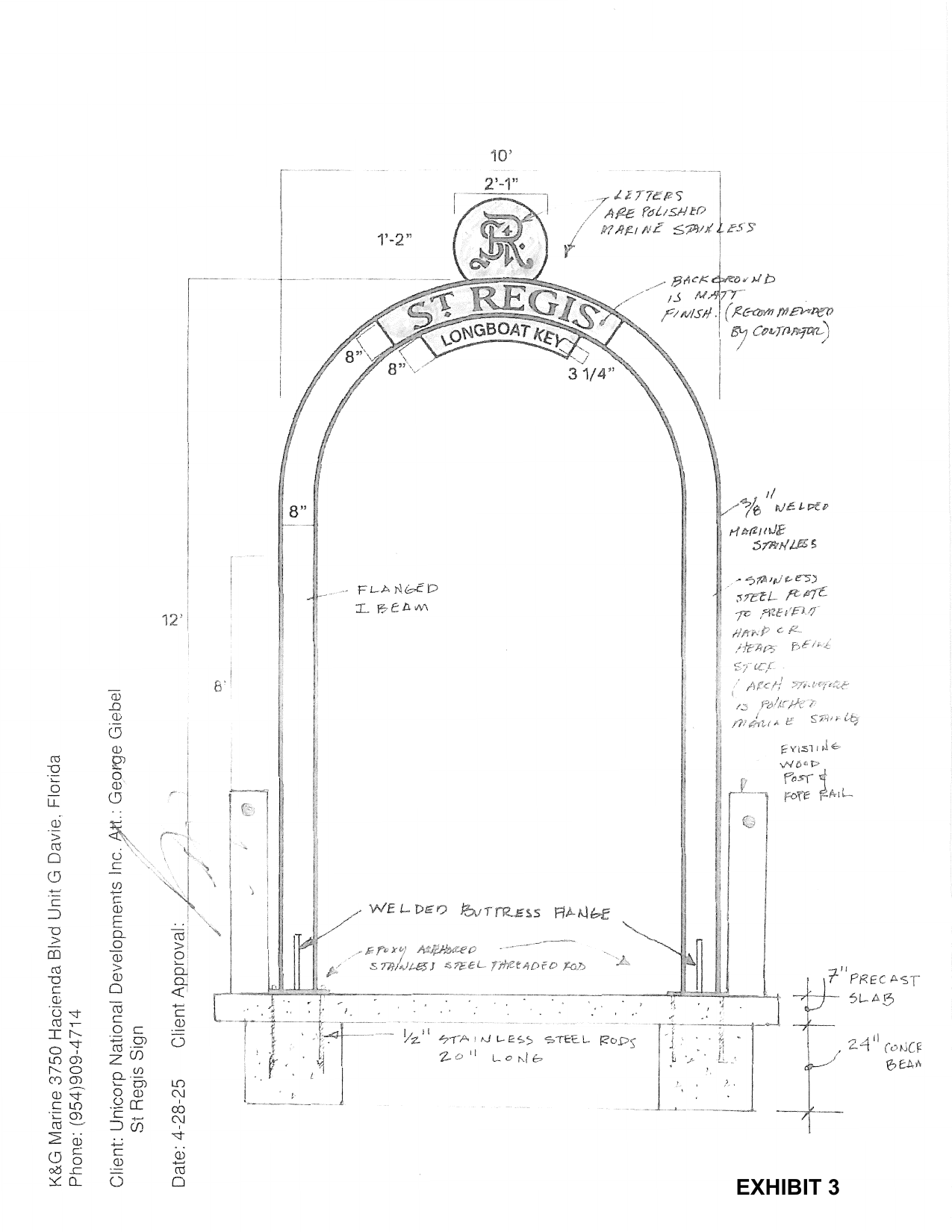
—The arch that stands today matches a fabricator’s sketch dated April 28, 2025. That sketch never went to the Town.
—The Town’s planning director, Allen Parsons, told the company the arch had to come down.
—The denials are where the company plants its flag. It denies that it never applied to the Town for an arch or sign permit. It denies that the 2024 handrail application left the arch out. It denies that it built the arch “without even having applied for a permit from the Town.”
—Put the two lists side by side and the defense comes into focus. Unicorp is not saying it hid the arch. It is saying the Town saw the arch, in a picture tucked into the handrail file, and approved it.
—Then there are the answers that are not answers. Four times the company said it could not respond because “Defendants do not have a copy of the application and plans filed with DEP.” Of its own state permit application, it said the defendants “do not have the application to DEP or know when it was filed.” The agent listed on that permit is Unicorp National Developments, the company Whittall runs.
—The Town wants the paper, too: every document on the state permits, every internal discussion of whether a Town permit was needed, every exchange with whoever designed and installed the arch. It made eleven requests and got eleven identical replies. “All responsive documents in Defendants’ possession, custody or control will be provided.”
—Whittall’s Stand: Your Law Stops at the Waterline
—Nobody has ever had to guess what Chuck Whittall thinks.
“It is not offensive — it is beautiful,” he told this newspaper in May. “It looks like a 1950s Monaco pier.” And on the permit: “The state gave us a permit to build a groin, do ropes and columns and put a sign on it.”
—His lawyers, Morgan R. Bentley and Goodrich, turned that into a legal position on June 18. Their Answer denies nearly everything in the Town’s complaint and raises six affirmative defenses. They run down two roads.
—Road one: the Town has no say.
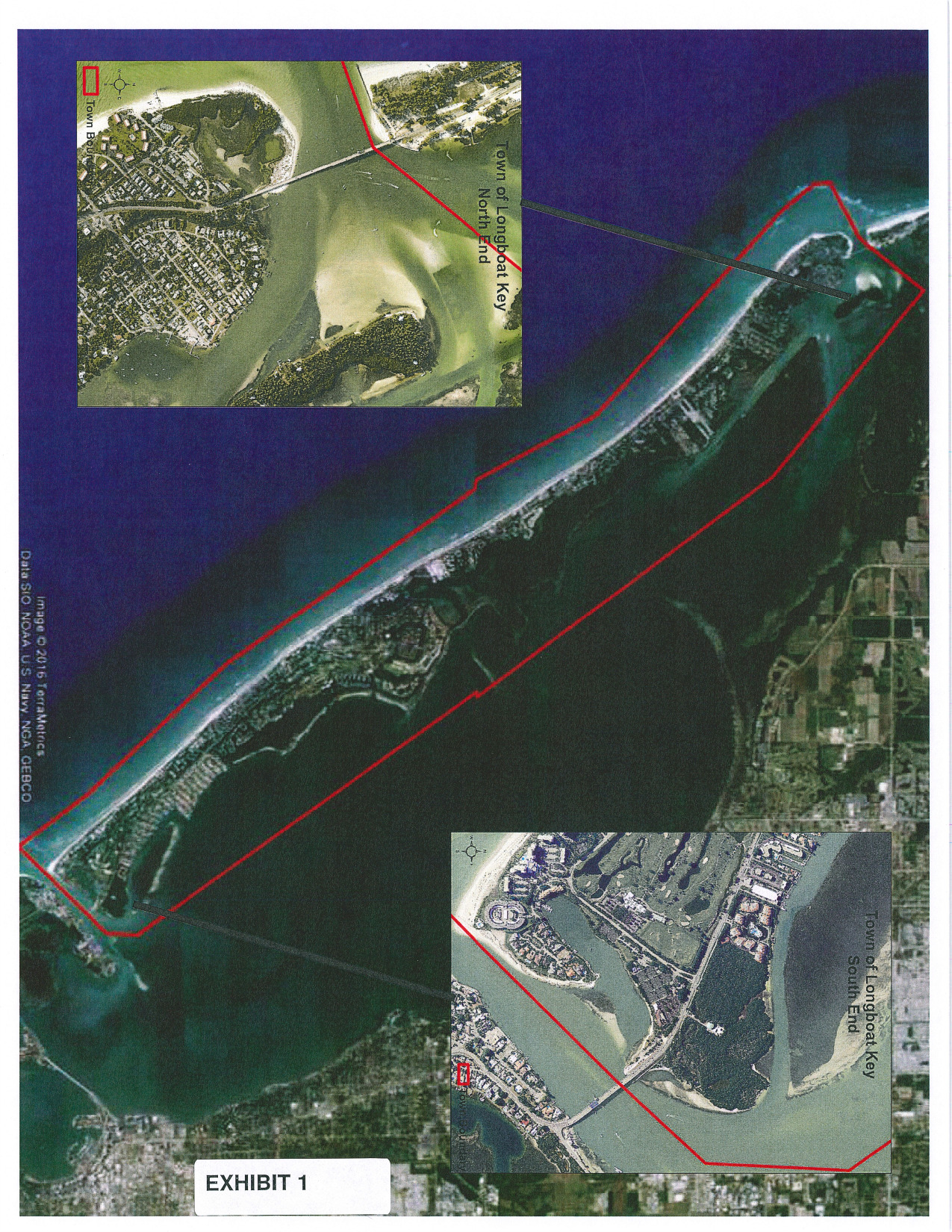
—The arch and sign are “outside the territorial boundaries of the Town.” Even if they are inside, the Town “has not enacted regulation to implement its jurisdiction over the arch and sign on the groin.”
—The Florida Constitution puts title to land under navigable waters in the state, which holds it “in trust for all the people.” State law requires a DEP permit for construction on groins below the mean high-water line. And the words “groins” and “jetties,” the Answer says, “do not appear at all” in the Town’s code.
—The Town’s waterfront yard rule is written for lots and yards, and its Sign Code is written for zoning districts. The Gulf is neither.
“The Town has not produced a survey proving that the groin lies within the territorial boundaries of the Town.”
—Road two: the Town already said yes. Longboat Key issued a permit in 2024 for posts, boots and ropes on the same groin. The defense argues that the Town is therefore barred from claiming its code forbids structures there. It also says the plans the state approved “showed an arch with an embedded sign.”
—To tie it together, the defense cites a rule from the Florida Supreme Court: when a zoning ordinance is unclear, it “should be interpreted in favor of the property owner.”
—One thing is missing. During the spring debate at Town Hall, part of the legal discussion turned on the First Amendment and how far a town may go in regulating what a sign says. The Answer raises no constitutional claim. The deadline to amend the pleadings is May 21, 2027.
—The Town’s Answer: You Asked Us Twice
—The Town’s case fits on an index card.
—The code was broken in four places. The arch is a structure seaward of the erosion control line, which the Town says violates Section 158.094(C) of the Zoning Code. It is a structure over water, which requires a permit under Section 158.099(A). And it is a permanent sign that was never permitted under Section 156.05 and is prohibited under Section 156.07 of the Sign Code.
—The owner already conceded jurisdiction. The company asked the Town for a building permit to rebuild the groin in 2022 and for another to put handrails on it in 2024. In the complaint’s words, it did so “recognizing that the groin was within the Town’s jurisdiction.”
—The state permit points back to Town Hall. The conditions the company has now admitted are printed on the very permit Whittall relies on, above his signature. A permit that tells its holder to follow local ordinances, the Town argues, cannot be a license to ignore them.
—On the question of whose water it is, the Town’s July 8 reply does not budge. Its boundaries are written into Section 10.16 of the code in a metes-and-bounds description, so “no survey is therefore necessary.” And: “While the State may own the submerged lands below the groin, the groin itself, and structures and/or signage placed on the groin, are subject to the regulatory requirements of both the FDEP and the Town.”
—Then comes the argument that may be hardest to answer. Unicorp asked the Town to change its law so the arch could stay. It withdrew the request the Friday before the vote. That conduct, the Town told the court, “evidences an awareness” that the code as written prohibits the arch. People do not ask permission for what they already have a right to do.
—A Picture, a Certificate and a Clock
—When the promised documents arrive, they should settle three questions that now sit at the center of the case.
—The picture. The engineering plans in the 2024 permit files show posts, rope and the hardware that holds them down, dimensioned to the inch. The only image of an arch in the exhibits is a single unscaled color rendering of a couple walking a boardwalk toward the horizon. The Town calls it a “digital artistic rendering.” The defense calls it approved plans. Judge Moss will have to decide whether a picture is an application.
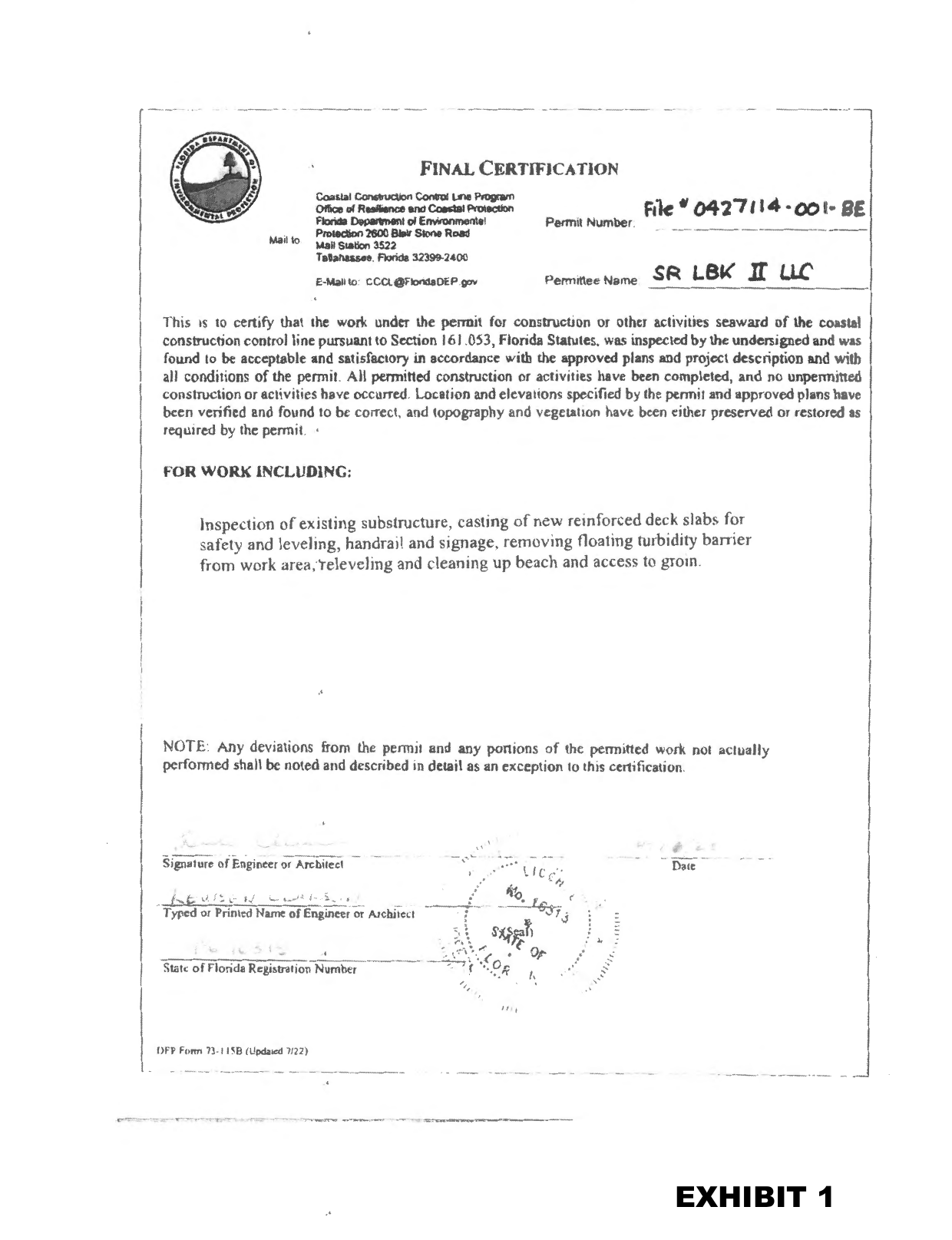
—The certificate. The defense says that after construction, the state certified the “handrail and signage” as acceptable. The Town attached the document to its reply and went after it. The form carries the file number of the 2022 groin repair, not the 2024 Field Permit. The Town says no such certification appears in DEP’s online file. And the copy the defense turned over, the Town told the court, “has covered up or otherwise redacted the name of the licensed engineer or architect who purportedly signed the Final Certification, as well as the day it was purportedly signed.” The form is one that a private engineer or architect signs and sends to the state. The Town says it “does not even appear to have been issued by FDEP.” Who signed it, and when, is unknown.
—The clock. The Field Permit’s expiration date is printed on its face: Feb. 19, 2025. The arch was drawn two months after that date and installed six months after it. Florida law lets some permits be extended after a declared emergency such as a hurricane, but the holder must notify the issuing agency in writing within 90 days after the emergency ends. The Town’s complaint says it presumes for now that the company used that law, but that it has seen no evidence the notice was ever sent. If it was not, the complaint says, reliance on the state permit is “wholly unfounded for the simple reason that the Field Permit had expired by August 2025.”
—That last one cuts deep. The defense’s strongest argument is that the state approved the sign. If the state’s approval had lapsed before the first weld, that argument rests on a permit that was no longer alive.
—Four Ways This Ends
—Judge Moss’s July 2 scheduling order sends discovery fights to Magistrate Medisa M. Turner, orders the two sides to mediate and sets a nonjury trial. There will be no jury. The judge decides everything.
—May 21, 2027: Last day to amend the pleadings.
—Sept. 23, 2027: Discovery closes.
—Oct. 22, 2027: Deadline for summary judgment motions to be heard.
—Nov. 23, 2027: Mediation must be finished.
—Jan. 24, 2028: The three-week trial period opens in Courtroom 7-C of the Silvertooth Judicial Center in Sarasota.
—The order warns that “these deadlines will be strictly enforced by the Court.” Nothing in the filings reviewed for this story shows a request for a temporary injunction, so the arch stays up while the calendar runs.
—From here the case can end four ways.
—A ruling on the law. The biggest question needs no witnesses. Either Longboat Key’s codes reach a groin seaward of the erosion control line or they do not. Either side can ask the judge to decide that on the papers. If the Town wins it, the defense falls back on road two: that the Town approved the arch when it approved the handrail. If Whittall wins it, the case is over and the Town has a hole in its code at the waterline.
—A deal. Mediation is mandatory, and the outline of a settlement already exists, because the two sides spent months drafting it: ordinances that would allow an identifying arch on a private groin under strict limits. Town staff recommended approving them. The Planning and Zoning Board recommended against. Any deal that changes the code would have to be voted on in public by a Commission that authorized this lawsuit 7-0.
—A trial. The Town’s burden would be lighter than in an ordinary injunction case. Under the appellate decision it cites, once a government proves a code violation, the harm is presumed. The Town does not have to show the arch hurt anyone. It has to show the code applies and was broken.
—An appeal. The road to the Florida Supreme Court runs first through the Second District Court of Appeal. A January 2028 trial followed by an appeal could keep the arch standing, or keep its removal on hold, into 2029 or beyond.
—By Whittall’s own account the arch cost about $16,000. The legal bills on both sides will almost certainly pass that figure many times over before a witness is sworn, and the Town’s complaint asks for its court costs but not its attorney’s fees. Money does not explain this case. The question underneath it is who decides what stands at the water’s edge.
—If the Town loses, it loses more than an arch. A ruling that the code stops at the erosion control line would raise questions about every structure that reaches past it. If Whittall loses, he takes down a structure he has called a landmark, on a property he spent years and a fortune assembling, at the order of a Town he has accused of saying no for its own sake.
—Neither side is built to fold. That is the history of this ground in a sentence.
—The Ground Beneath the Arch
—To understand why, go back to the beginning. Nearly everyone who has owned this property, lent against it or regulated it has ended up in front of a judge, and the pattern was set long before anyone welded an arch.
—Cottages, Tennis and an Orthodontist From Buffalo
—The ground was quiet once.
—In the early 1950s a Sarasota developer named Herb Field cleared a spot in the Longboat scrub and opened a cluster of beach cottages with a restaurant and a bar. He called it the Colony Beach Club.
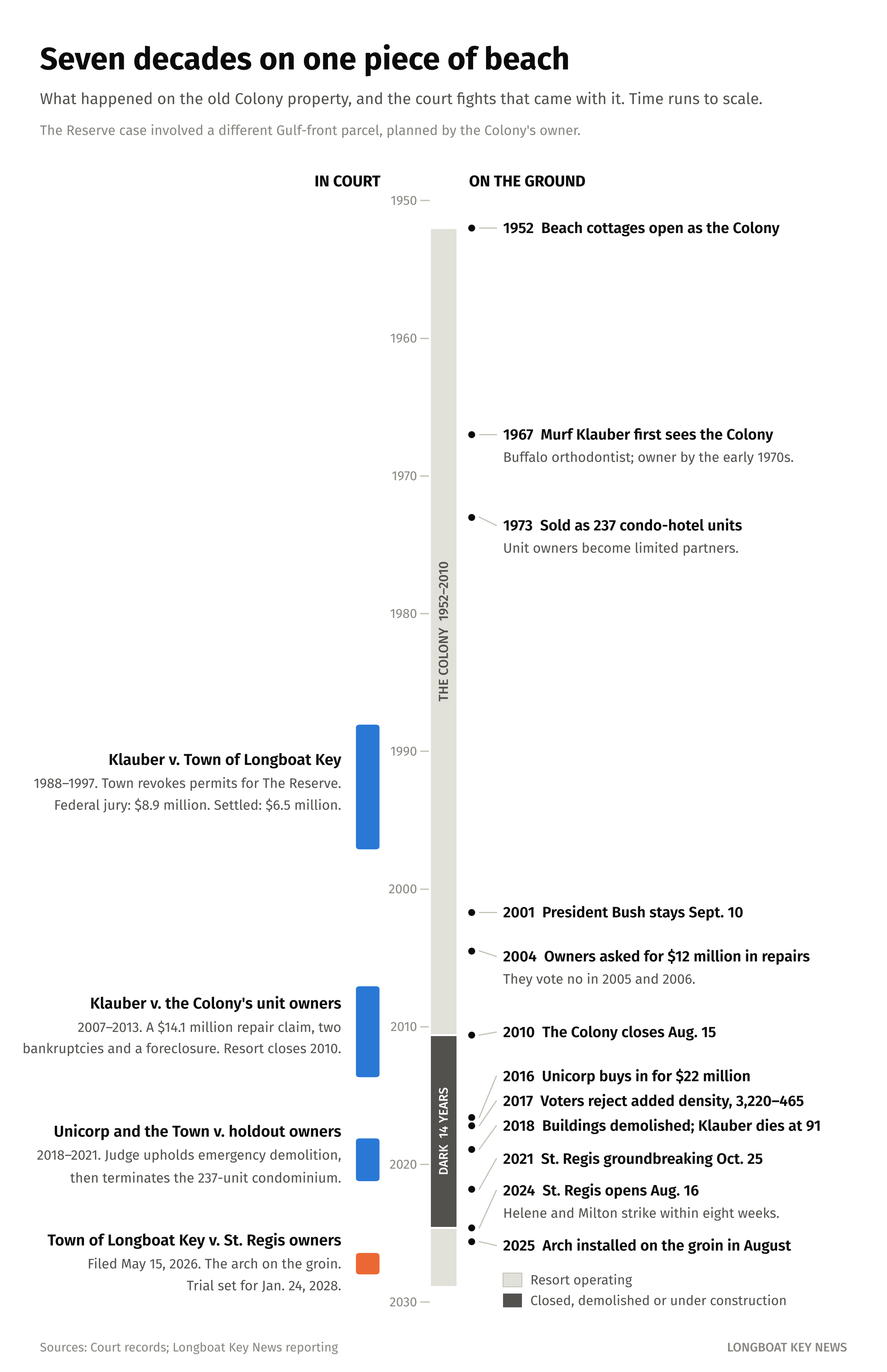
—In 1967 a 40-year-old orthodontist from Buffalo, N.Y., saw the place on a winter trip and never got over it. Dr. Murray Klauber was an investor within a year. By the early 1970s he owned the resort, and the man everyone called Murf set out to build something American travelers had not seen before: a beach hotel organized around tennis.
—It worked beyond anyone’s forecast. Tennis magazine ranked the Colony Beach & Tennis Resort the No. 1 tennis resort in the country eight years running. Nick Bollettieri started his academy on its courts. Bud Collins ran his annual hackers’ tournament there for the better part of two decades. On the night of Sept. 10, 2001, President George W. Bush slept at the Colony before leaving for a Sarasota classroom the next morning.
—For two generations the Colony was the reason a certain kind of visitor found Longboat Key at all. They came for a week of tennis, fell for the island and bought a place up the road.
—At the edge of it all sat the groin, a low finger of concrete reaching into the Gulf to hold the beach in place. The Town’s lawsuit describes it as a structure that “had existed for many years and which had been utilized by the former resort, the Colony.” It would outlast everything else Klauber touched.
—The Fine Print of 1973
—Every long war has a first cause. This one is a legal structure.
—In 1973 the Colony was organized as a condominium hotel and registered with the Securities and Exchange Commission as an investment. Its 237 units were sold to individual buyers, who also became limited partners in the hotel. An owner could stay in his unit about 30 days a year. The rest of the time it went into the rental pool. Klauber ran the operation as general partner and kept control of the pieces at the center of the property, including the restaurant complex and most of the recreational land.
—It was a clever way to finance a resort. It was also a way to guarantee that no one could ever again make a major decision about the property alone. From that year forward, eighteen acres of Gulf-front land belonged to one strong-willed operator and more than two hundred investors, each holding something the others needed.
—For thirty years the arrangement paid well enough that nobody tested it. Then the buildings got old.
—The First War: Klauber Against the Town
—Before the Colony came apart, its owner taught Town Hall an expensive lesson.
—In the 1980s Klauber planned a luxury spa condominium called The Reserve on a different Gulf-front parcel up the road, where the Vizcaya condominium stands today. The Town revoked his building permits. In 1988 he sued in federal court, claiming Longboat Key had violated his civil rights.
—The case ran eight years and traveled to the federal appeals court in Atlanta and back. A federal jury in Tampa finally awarded Klauber $8.9 million. In 1997 the Town settled for $6.5 million.
—That fight was over a different piece of beach. But it was the same owner and the same Town, and it was about the thing the two sides are arguing over today: a permit. Town Hall has not forgotten what it cost.
—When commissioners voted in May to take the St. Regis to court, Town Attorney Maggie Mooney gave them a plain warning. “I cannot guarantee this commission that we will recover attorney’s fees and costs,” she said.
—The Second War: The Owners Against Murf
—In 2004 Klauber and his daughter, Katie Klauber Moulton, who ran the resort with him, told the unit owners the Colony needed about $12 million in repairs. They proposed a one-time assessment of $50,000 a unit.
—The owners voted it down in 2005. They voted it down again in 2006. In 2007 a dissident slate took over the association board.
—Klauber sued. His claim for repair and operating costs reached $14.1 million. The association filed for Chapter 11 protection, and Klauber’s hotel partnership followed it into bankruptcy court. Bank of America moved to foreclose on Klauber’s own holdings.
—In 2009 a federal bankruptcy judge ruled that the owners did not have to pay. In August 2010 he converted the case to a Chapter 7 liquidation. The last guests checked out on Aug. 15, 2010.
—The litigation did not check out with them. A federal district judge, the same one who had handled The Reserve case years earlier, reversed key parts of the bankruptcy court’s rulings in Klauber’s favor. The lenders who had bought Klauber’s debt pressed their foreclosure. Not until 2013 did Klauber sign a settlement giving up what he still held at the Colony in exchange for a consulting agreement.
—By then the resort had been dark for three years. It would be eleven more before a guest slept on the property again.
—Fourteen Dark Years
—It is easy to forget now what Longboat Key lived with in between.
—The tennis courts went to weeds. The buildings went to mold, termites and graffiti. A fence went up around a property that had hosted a president. More than one developer came, studied the tangle of unit owners, liens and judgments, and left.
—In 2016 Whittall’s Unicorp National Developments bought the wreckage for $22 million and inherited the parcel’s talent for conflict.
—His first plan asked voters to let him add 180 residences to the Colony’s 237 tourism units. On March 14, 2017, Longboat Key said no, 3,220 to 465. He came back smaller. On March 16, 2018, the Town Commission approved a St. Regis hotel with 166 rooms and 78 condominiums on a 6-1 vote. A unit owner went to court to challenge the approval.
—Then came the summer that put the Town and the developer on the same side of a courtroom.
—In June 2018 Longboat Key issued an emergency order condemning nearly every building on the site as unsafe. Unit owners sued to stop it, among them Andy Adams, a Tennessee investor who controlled 75 units. Circuit Judge Hunter W. Carroll heard more than five hours of testimony and let the Town proceed. Unicorp offered to do the demolition at no cost to the taxpayers. The wrecking crews started that July.
—The last building, the beachfront mid-rise, came down in late November 2018.
—Murf Klauber died that same week, on Thanksgiving Day, Nov. 22. He was 91.
—Two details from that year deserve a second look today.
—The first is the alliance. In 2018 the Town of Longboat Key went to court to knock buildings down so that Chuck Whittall could build. In 2026 it went to court to knock down something Chuck Whittall built.
—The second is the lawyer. Mooney reminded commissioners in a memo this year that special counsel Martin Garcia represented the Town successfully in the Colony condemnation and demolition litigation. The attorney who helped Longboat Key clear the Colony so the St. Regis could rise is the attorney whose signature is on the complaint against the St. Regis.
—The Third War: The Developer Against the Holdouts
—Buying the Colony did not mean owning it.
—To build, Whittall needed every one of the 237 units or a way to dissolve the condominium that bound them together. Ending the association voluntarily took the consent of 95 percent of the owners. Adams alone held nearly a third of the units.
—In January 2018 Unicorp asked the circuit court to terminate the association by judicial order. In August 2019 Judge Carroll ruled that it was entitled to. In the spring of 2020 Whittall and Adams settled on confidential terms. This newspaper has reported the price at more than $15 million. The court signed off on the final termination plan in 2021.
—By his own estimate, Whittall had spent roughly $80 million on the property and its demolition before a single new wall went up.
—Ground was broken on Oct. 25, 2021. The St. Regis Longboat Key opened on Aug. 16, 2024, with 168 hotel rooms, 69 residences, a saltwater lagoon and a beach bar named for the Colony’s old Monkey Bar. Marriott counted it as the 9,000th property in its worldwide system. Klauber’s children were there for the opening.
—Six weeks later Hurricane Helene’s surge flattened the resort’s dune line and pushed the Gulf across the property. Hurricane Milton arrived two weeks after that. The resort cleaned up and kept going.
—For the first time in a long time, the news from 1601 Gulf of Mexico Drive was about room rates and not rulings.
—It lasted about a year.
—Twelve Feet of Stainless Steel
—The groin was the one piece of the Colony Whittall kept. It runs 156 feet from the beach into the Gulf and is eleven feet wide, according to his contractor’s plans.
—His company rebuilt it, and the paper trail of that work is now the heart of a lawsuit. According to the Town’s complaint:
—2022: SR LBK II obtained a De Minimis Exception from the Florida Department of Environmental Protection to rebuild the groin. It also applied for a Town building permit, which was issued Dec. 16, 2022. The work was inspected and approved April 12, 2023.
—Feb. 19, 2024: DEP approved a one-year Field Permit authorizing the company “to install post, rope and sign per the approved plans.” Whittall signed it as applicant two days later.
—March 5, 2024: The Town issued building permit PB24-0117 for the handrail, the timber posts and rope that now line the groin. That work was finished by July 17, 2024.
—April 28, 2025: K&G Marine of Davie, Fla., drew the arch for Unicorp. The sketch shows a frame ten feet wide and twelve feet tall, built of flanged I-beam in welded marine stainless, anchored with stainless rods through a precast slab into a concrete beam, with polished letters and a medallion a little over two feet across.
—August 2025: The arch went up.
—The Town says no one ever applied to it for a permit to build an arch or a sign. The company denies that. Its position is that the arch was shown in the 2024 handrail application and in the plans the state approved.
—Whittall has said the arch was fabricated in South Florida and is rated for 150-mile-an-hour winds.
—From a Favor to a Fight
—How did a wedding backdrop become a lawsuit? Slowly, and then in a single week.
—Shortly after the arch appeared, Parsons told the company it had to come down. According to the complaint, Whittall answered that he had been told the arch was covered by the master sign permit for the St. Regis. Parsons said it was not, and offered to talk about how the code might be amended.
—The arch stayed. Unicorp agreed to pursue amendments to the Zoning Code and the Sign Code that would make it legal, and it covered the lettering with faux greenery in the meantime.
—December 2025: After Whittall appeared in person, the Town Commission voted 4-3 to have staff draft the ordinances.
—Jan. 23, 2026: Unicorp’s land-use attorney filed the application with a footnote reserving the right to challenge the Town’s code in court if the answer was no.
—March 17, 2026: The Planning and Zoning Board recommended denial of both ordinances, 4-1 and 3-2. Board members noted that the application claimed the arch had withstood hurricanes Helene and Milton, storms that struck almost a year before it was installed. Whittall apologized and said his team had misinformed him.
—April 9, 2026: Town staff recommended approval anyway.
—Friday, May 1, 2026: Three days before the Commission was to vote, Unicorp withdrew.
—Monday, May 4, 2026: The Commission voted 7-0 to authorize special counsel to sue. Town Manager Howard Tipton gave the company until 5 p.m. Friday, May 8, to remove the arch.
—At 5 o’clock that Friday, Whittall called Tipton and told him it was not coming down.
—Tipton’s account of the call carried more weariness than heat. “I appreciate that he created a great resort out of the dilapidated Colony, and so much effort to buy the individual units,” the Town Manager said. “Chuck wants to work together. It is not going through Town Code Enforcement. It is going straight to circuit court.”
—The greenery came off the sign. The Town’s complaint says the company “doubled down.” The Town filed suit at 2:19 p.m. on Friday, May 15.
—Why This Ground?
—Other Gulf-front resorts on this coast have changed hands without a decade in court. Why does this one keep producing lawsuits? The record of the last forty years suggests five reasons.
—It was divided at birth. The 1973 condominium-hotel structure split the property among 237 owners and a general partner. Nothing could be repaired, sold or rebuilt without a majority that never formed. Almost every lawsuit from 2007 to 2021 traces back to that one piece of paperwork.
—It is too valuable to walk away from. Longboat Key is, in the words of its own Zoning Code, “predominantly built out.” Any increase in density has to go to the voters, as Whittall learned in 2017. Eighteen Gulf-front acres with resort rights do not come up twice in a lifetime. When a thing cannot be replaced, nobody settles cheap.
—The island regulates like it means it. The stated purpose of the Zoning Code is “to preserve the unique island character of the Town.” The Sign Code governs “the size, color, illumination, movement, materials, location, height, and condition” of every sign. On Longboat Key a sign is never just a sign. It is a test of whether the rules apply to everybody.
—It draws people who do not take no for an answer. Klauber fought the Town for the better part of a decade and his own investors for six years. Whittall lost a referendum by nearly seven to one and came back with a new plan four months later. The stubbornness it takes to build on this site is the same stubbornness that makes it hard to take an arch down because a planning director says so. The Town, for its part, has not blinked either.
—Its western edge is a seam in the law. This is the new one, and it is the reason the arch case matters beyond the arch. The Town’s complaint says the groin lies “entirely seaward of the Town’s Erosion Control Line and the Mean High Water Line.” That is the line where private land ends and state-owned submerged land begins. The Town says its municipal boundary keeps going, out over the water. So three layers of authority overlap on roughly 1,700 square feet of concrete: a private owner, the State of Florida and the Town of Longboat Key.
—Put those five together and the arch starts to look less like an accident than an appointment.
—What the Groin Was For
—The Colony’s buildings are gone. The man who made it famous is gone. The condominium that held the property in 237 pieces was dissolved by a judge. The developer who outlasted the lenders, the holdouts and two hurricanes built the resort the island waited fourteen years to see.
—All that is left of the old Colony is 156 feet of concrete in the Gulf, with a new railing, a new arch and a case number.
—It was put there to keep the sand from moving. It has never been able to do the same for the people who own it.

