

The Town Commission gave the Town Center Green library its final blessing the afternoon before Florida voters passed Amendment 3. Sarasota County, which would pay to run it, has not decided what happens next, and the clock is already running.
—On the afternoon of Nov. 2, the Longboat Key Town Commission settled a 20-year civic argument in a little over seven minutes.
—Planning Manager Elma Glisson ran through her slides. Sarasota County’s project manager, Brad Gaubatz, waved off most of the 20 minutes the rules allowed him. “I take no exception to your staff’s presentation or those conditions,” he said. “So, with your pleasure, I have no further presentation.” No one from the public came to the lectern. When the applicant passed on his five-minute rebuttal as well, Mayor Debra Williams summed up the mood of the room.
“We’ll just sail through,” she said.
—They did. Six commissioners voted yes on Ordinance 2026-13, which writes a county library into the zoning of the Town Center Green, and six voted yes on Site Development Plan Order 2026-02, which approves the building itself. Commissioner Sarah Karon was absent. For the whole hearing, from the time the public hearings opened to the last roll call, no one said the words Amendment 3.
—The polls opened the next morning.
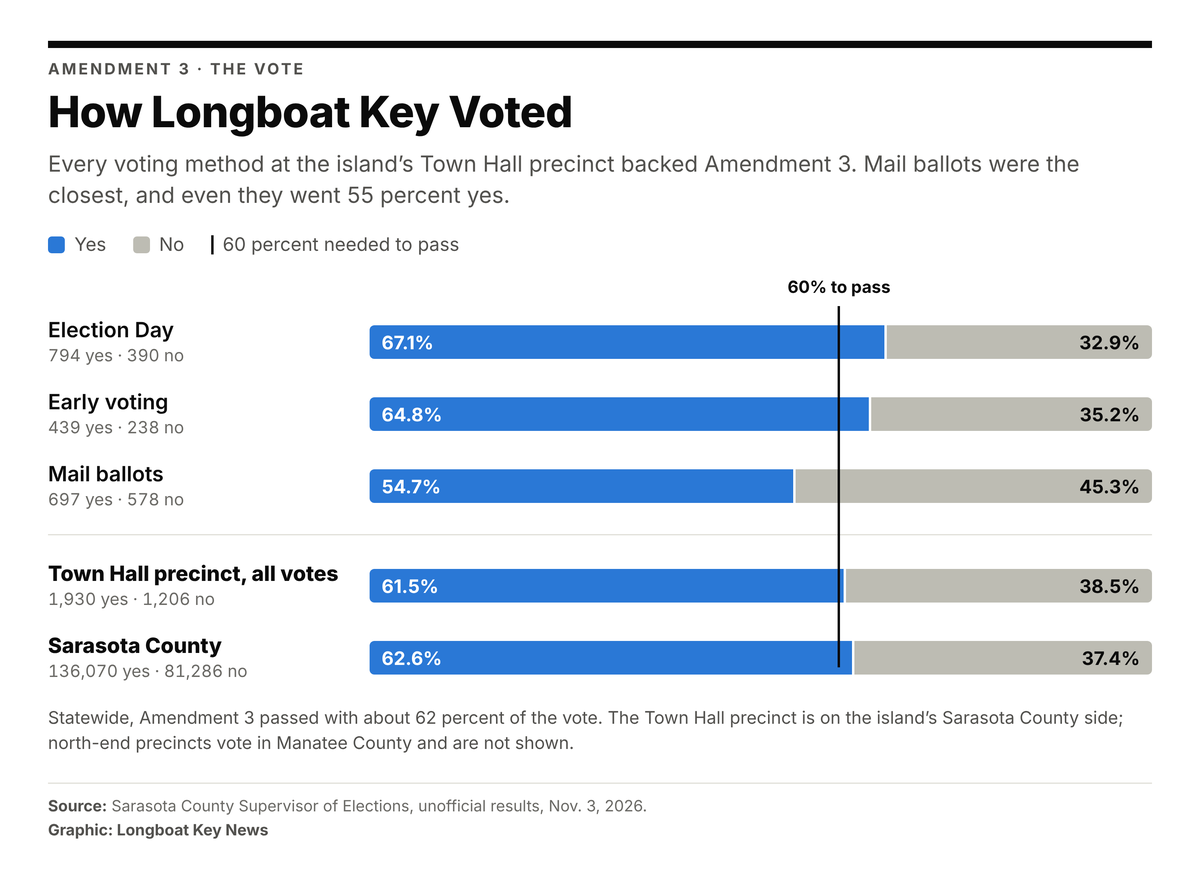
—By Tuesday night, about 62 percent of Florida voters had written a far larger homestead exemption into the state Constitution, clearing the 60 percent the measure needed. Sarasota County voted yes 136,070 to 81,286, or 62.6 percent. On Longboat Key, at the Town Hall precinct on the island’s Sarasota County side, where several sitting commissioners had spent the fall warning residents what the amendment could cost them, voters approved it 1,930 to 1,206. That is 61.5 percent, almost exactly the statewide figure.
—So the library now sits in the strangest place a public building can be. It is fully approved, nearly designed, paid for on the construction side and in real doubt.
—The Town of Longboat Key has done everything a town can do. What happens next is up to Sarasota County, which would own the building, staff it and pay every dollar of its operating cost. For months the county said it would not build the library at this time if Amendment 3 passed. It passed. But as of this week the County Commission has not voted to cancel the project, the drawings are still on the boards, the private money is in county hands, and the town’s own approval has handed the county a short deadline to accept it.
—It is not a done deal. It is not a dead one either.
—Seven Minutes on the Eve
—The short hearing was no sign of indifference. It showed how much had already been settled.
—Glisson’s presentation went through what Longboat donors paid for: “an enlarged community meeting space, covered outdoor terrace on the Green, and an enhanced entry.” The library meets the town code’s 39 required parking spaces on site. The county asked to depart from the 30-foot side-yard setback and build within 12 feet of the south property line, next to the Chase Bank and Publix parcels, to fit the larger community room. There are seven conditions of approval. Six are routine. The seventh requires a special event transportation management plan whenever the hall fills beyond what the lot can hold.
—Commissioner Steve Branham asked the one question of the afternoon: had Chase and Publix “been consulted all the way up through their organizations so that there’s no surprises at the top?”
“Yes, they have,” Glisson said.
—That was it. The first reading on Oct. 5 had run about half an hour, with questions about special event busing, the difference between a cooking kitchen and a catering kitchen, drainage on the west side of the property and how final the interior layout was. The minutes of that meeting also record that every commissioner disclosed a financial contribution to a nonprofit organization that is not the applicant. That disclosure shows how personal this project has become on the island.
—The Morning After
—Longboat Key’s vote on Amendment 3 broke down in a way that will interest anyone who studies the island’s politics.
—On Election Day, Town Hall precinct voters supported the amendment 794 to 390, about 67 percent. Early voters went 439 to 238, close to 65 percent. Mail ballots, the island’s most reliable bloc, were the most skeptical at 697 to 578, but that still came to 55 percent yes. Turnout was close to 77 percent. Results for the north end, which votes in Manatee County, were not available when this story was written. Manatee County as a whole approved the amendment by about 65 percent.
—Vice Mayor Penny Gold saw it coming. At the same Nov. 2 meeting, during a discussion about getting voters to the polls for a March charter referendum, she let some frustration show.
“Gary and I have been pounding the pavement on Amendment 3 for some time,” she said, “and we haven’t had a large group of other elected officials joining us for those beating on the pavement.”
—A week later, the town’s Tallahassee lobbyist, Dave Ramba of Ramba Consulting Group, explained to the commission why the island’s vote made no difference to the result anyway.
“Sixty-two percent of the voters statewide decided that this was something that had to be done,” he said in his opening remarks. Later, when he mentioned that he had meant to look up the island’s own numbers, he dismissed the question: “If you voted 40% on the island, it’s not going to change anything. It’s still required in every community of the state.”
—Longboat Key did not vote 40 percent. It voted like the rest of Florida.
—What the County Said Before the Vote
—Nobody at the county pretended the stakes were small.
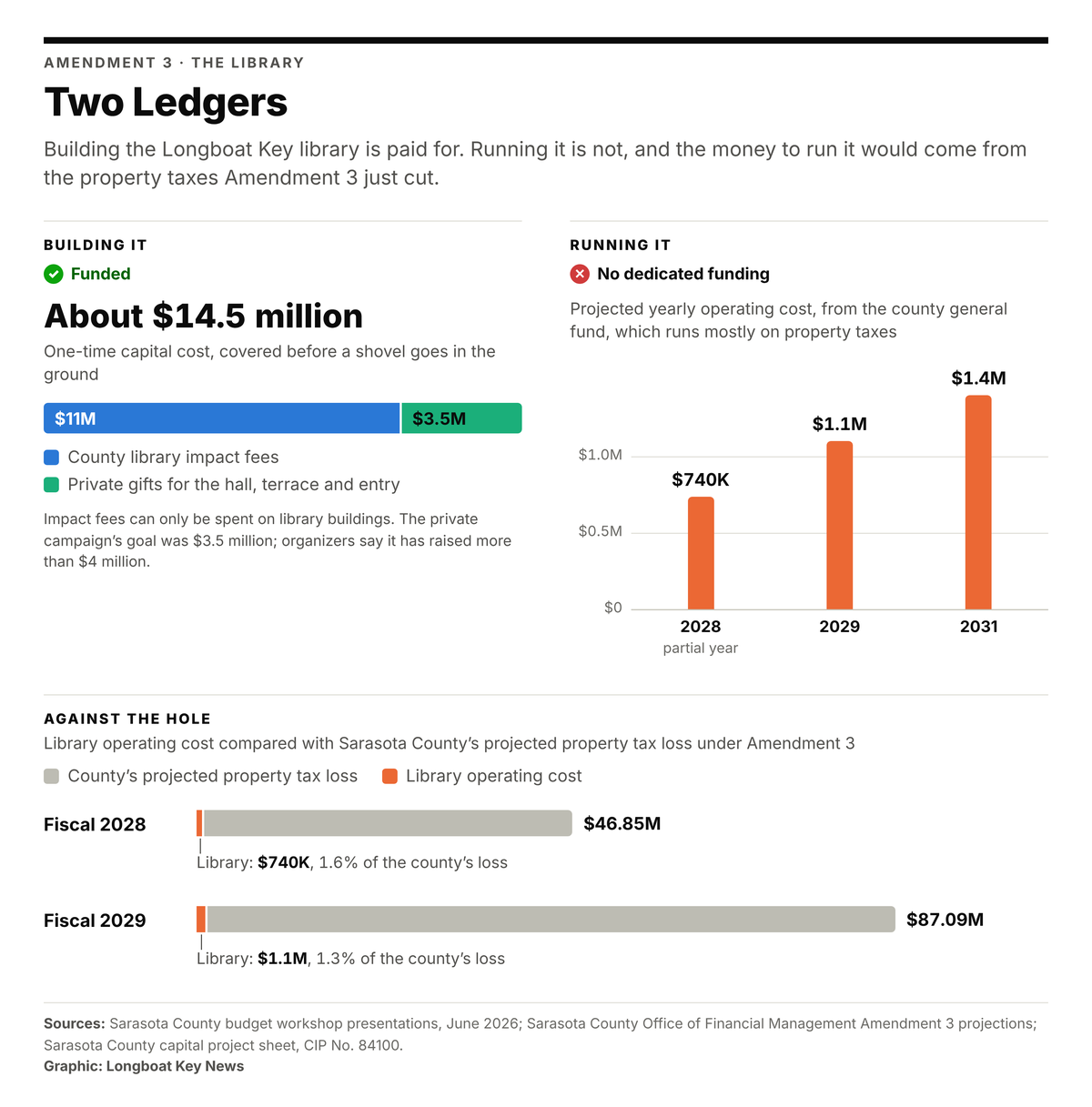
—At a June 17 budget workshop, Director of Capital Projects Carolyn Eastwood told county commissioners the library had reached 70 percent design and work would go on to completion. Deputy County Administrator and Chief Financial Management Officer Steve Botelho then laid out the operating bill: about $740,000 for a partial first year in 2028, about $1.1 million in 2029 and about $1.4 million by 2031. None of it can come from impact fees and none of it from donations. All of it would come from the general fund, which runs mostly on property taxes. County Administrator Jonathan Lewis told the board that no decision was needed until after the election.
—In September, Assistant Town Manager Isaac Brownman told Longboat commissioners the county had made clear that, given how large Amendment 3’s impacts would be, it would not build a library on Longboat Key at this time if the amendment passed. The county added the Longboat branch to its list of capital projects under review. Its own Amendment 3 webpage warned residents of possible “park fees, library fees, or increases to the bus system.” When Commissioner Gary Coffin wrote to the presidents of the Country Club Shores associations before the vote, he passed along the county’s warning that parks and libraries could face significant reductions, and that the Longboat Key branch was named specifically.
—And What It Has Not Said Since
—Since Nov. 3, the county has said nothing official.
—County Commission Chair Ron Cutsinger said the day after the election that the board would start working through what the amendment means at its Nov. 17 regular meeting. Lewis has compared the budgets ahead to the recession years. Commissioner Tom Knight has said he will budget as if the county were in a recession, with hiring freezes and possible layoffs. Knight has also proposed capping spending growth at 2.3 percent for fiscal 2028, a figure the board will consider at its December retreat.
—Town Manager George Landry has said publicly that the county has not taken formal action to kill the library or any other service. He says the town has asked the county when the question will go before its board, so the town can be in the room when it does.
—That gap between what was predicted and what has been decided is the whole story right now.
—A Building Paid For, an Institution Not
—To understand why the library is in doubt, look at two ledgers instead of one.
—The capital ledger is close to finished. Sarasota County has about $11 million in library impact fees committed to the core building. The private campaign led by the town and the Longboat Key Foundation set a $3.5 million goal for the enhancements, and its organizers say it has now raised more than $4 million. The lead gift of $1 million came from U.S. Rep. Vern Buchanan and his wife, Sandy, whose name the building is to carry. The county has a design contract worth $1,029,560 with Borrelli & Partners, and Jon F. Swift, Inc. is the contractor on its project sheet. The county’s published schedule calls for design to wrap up this fall, construction to start in early 2027 and the doors to open in summer 2028.
—The operating ledger is where the trouble is. The library’s first partial year of operation, fiscal 2028, is also the first county budget to absorb the $150,000 exemption. The county projects it will lose $46.85 million in property tax revenue that year. Fiscal 2029 brings the library’s first full year of operation and the full $250,000 exemption, and the county’s projected loss nearly doubles to $87.09 million.
—Measured against those losses, the library is small. Its $740,000 partial first year is about 1.6 percent of the county’s fiscal 2028 shortfall. Its $1.1 million cost in fiscal 2029 is about 1.3 percent of that year’s.
—Small, but permanent. A building can be paid for once. An institution has to be paid for every year, out of the tax that Florida voters just cut.
—Why Canceling It Saves Less Than It Sounds
—One fact has gotten lost in the pre-election talk about the library being “on the chopping block.” Canceling it would not move a single construction dollar to a deputy, a firefighter or a pothole.
—Florida law requires impact fees to be spent on the kind of capital facility they were collected for. Library impact fees build libraries. If the Longboat branch dies, the $11 million does not go into the sheriff’s budget. It sits in library capital and waits for some other library project somewhere else in a fast-growing county. The only money the county saves by walking away is the future operating cost: about $1.1 million to $1.4 million a year.
—Ramba, speaking in general terms, described this kind of decision to the commission on Nov. 9 as the easy cut that misses the real problem.
“Some people are doing the immediate fix: ‘Okay, we’re canning the new library. We’re not going to build a new library,'” he said. “Okay, that’s great. That’s just a one-year expense. That’s not a multi-year expense, and this homestead exemption’s forever. It’s in the Constitution.”
—Longboat’s case cuts both ways. For the county, a library that has not opened yet is the easiest recurring cost to avoid, because no employee has to be laid off and no existing branch has to close. For the island, the library is close to a free building, built with growth money and private gifts, and the only question is whether the county is willing to take on a yearly bill well under 2 percent of its new hole.
—Not on the List
—The amendment does more than shrink the money. Starting in 2028, it also limits how local governments may spend property tax revenue. It gives priority to a list of core functions such as public safety, infrastructure, debt service and retirement obligations.
—Libraries are not on that list.
—Ramba told the commission what he expects that to mean in practice: services left off the list will increasingly be expected to pay their own way.
“There are going to be some activities that they expect to have fees associated with,” he said, “be it libraries, parks … that were not included in the list of services that are allowed to be paid for with ad valorem taxes under the constitutional amendment. So they are going to expect taxes and fees to go up on those non-core services.”
—The county raised the same possibility before the vote with its warning about library fees. Library advocates call that a contradiction in terms. A Manatee library foundation board member told reporters after the election that fees would undercut the whole idea of a public library. EveryLibrary, a national advocacy group, says it hopes Florida’s Taxation and Budget Reform Commission, which meets in 2027, will set aside protected funding for libraries. Gov. Ron DeSantis has promised the Legislature will create a pool of grant money to help local governments with core needs. Under the amendment’s own terms, a library is not one.
“A Sledgehammer to Something That Probably Could Have Used a Scalpel”
—Ramba spent most of an hour on Nov. 9 explaining what Amendment 3 means for a town built like Longboat Key, and he did not soften it.
“It was not well thought out, in my opinion, what they put in the Constitution,” he said, “but it’s in there now. And so we all have to deal with it.”
—Whatever the Legislature does to implement it, he added, the core of the amendment is settled. “The base Amendment 3 you can’t change. It’s there.” It starts Jan. 1, he said, and “it’ll impact your next year’s budget fairly substantially. There’s not a lot of other places Longboat Key can shift money to.”
—The reason is how the island makes its money. “Longboat Key doesn’t have the commercial and the mixed use and some other things that would otherwise balance out your portfolio,” Ramba said. “You’re heavy ad valorem.” He noted that some South Florida cities get as little as 28 percent of their revenue from homestead property and can lean on commercial property and vacation rentals. A residential barrier island cannot.
—He also questioned how much relief homeowners here will actually feel. “I don’t know what an extra $100,000 is going to do to a home on the beach here,” he said. “Nothing.”
—He gave the other side its due. Voters were reacting to something real, he said: homeowners who had paid off their houses and use few public services watching their bills climb 70 to 80 percent over four years. “Gas is expensive, groceries are expensive, people were desperate for something, so they voted for this,” he said. But he called the remedy blunt: “They took a sledgehammer to something that probably could have used a scalpel, and they put it in the Constitution.”
—He also warned that the obvious workarounds will draw a reaction from Tallahassee. Local governments, he said, are “not going to just be able to take an assessment-based methodology on non-ad valorem assessments and use that to substitute for the losses.” That warning lands close to home. The town’s own Property Tax Facts page lists “consideration of alternative funding sources, such as special assessments” as one possible response. He added that the state’s chief financial officer, Blaise Ingoglia, whose audit teams have been making examples of local spending, will be watching. “Anybody who says there’s no way we can do this,” Ramba said, “I think he may show up at your door in a minute and a half.”
—The Same $1.4 Million
—One number in this story keeps coming back.
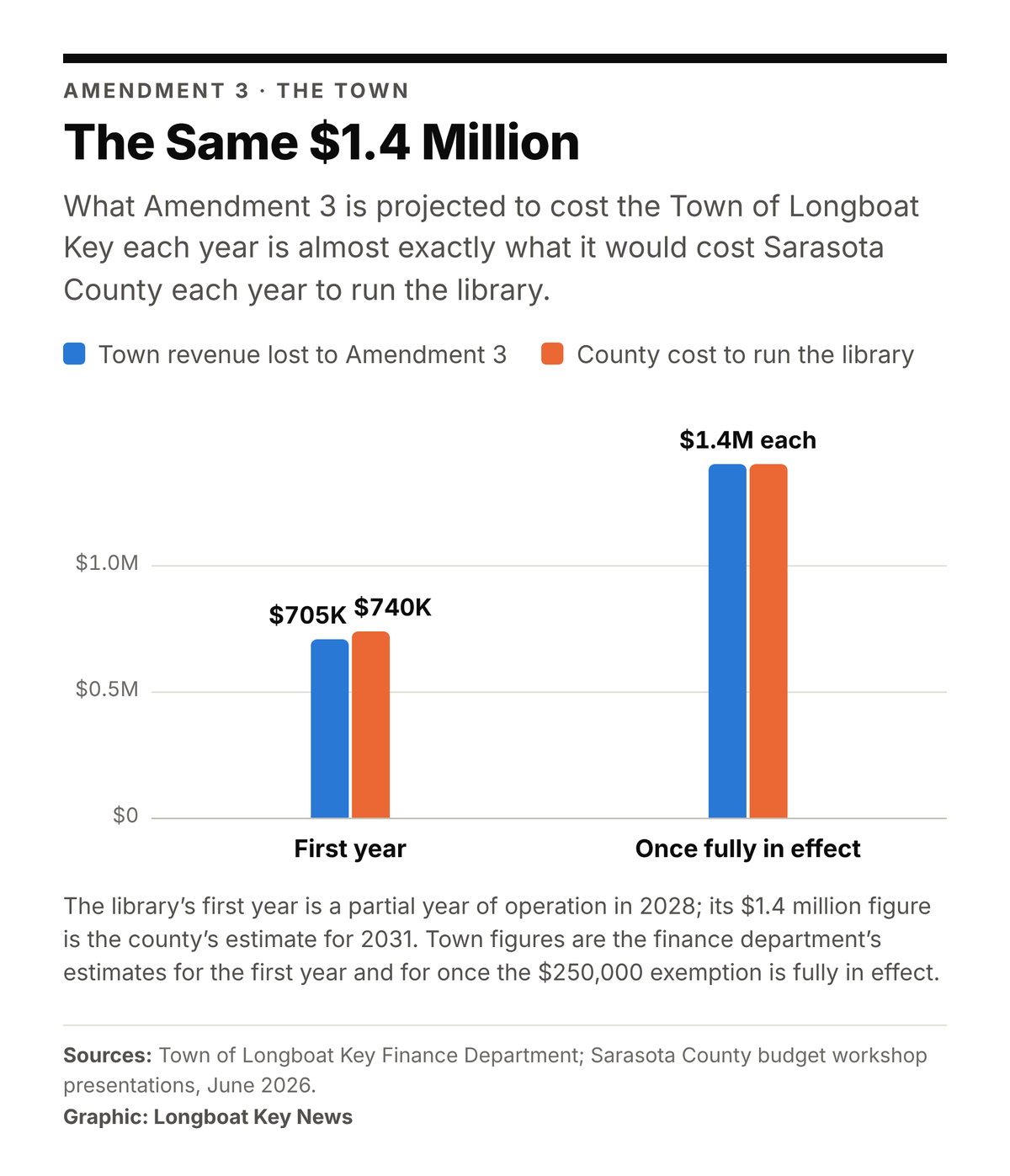
—Finance Director Sue Smith has estimated that Amendment 3 will cost the Town of Longboat Key about $705,000 in its first year and about $1.4 million a year once the $250,000 exemption is fully in effect. That is roughly 5 to 6 percent of a General Fund of about $25 million.
—The county’s projected annual cost to run the library by 2031 is also about $1.4 million.
—The town did not wait for the election to brace. In September, commissioners adopted an operating rate of 1.9999 mills and an aggregate rate of 2.3216 mills, 21.03 percent above the 1.9182-mill rollback rate, with the stated goal of rebuilding reserves drained by Hurricanes Helene and Milton. The town is still owed more than $28 million by FEMA. Gold reported on Nov. 2 that the town’s investment holdings stood at $40,971,000. Smith told commissioners the same afternoon that conservative department budgets “built up our fund balance over the period of years.”
—Could Longboat Key cover the library’s operations itself? On paper, perhaps, for a while. In practice, the town would be choosing to spend almost exactly the amount it is about to lose every year on a county function that the new constitutional language does not treat as essential, while the Legislature looks for local governments trying to dodge the amendment. Commissioner Nick Gladding asked Ramba on Nov. 9 whether, after Amendment 3, legislators will ask of every town request, “Well, what is the Town doing to contribute to this and where is their money going to come from?” That question applies at home too.
—Two Ends of the Island, One Amendment
—The library is not the only community space on Longboat Key that lost ground on Nov. 3.
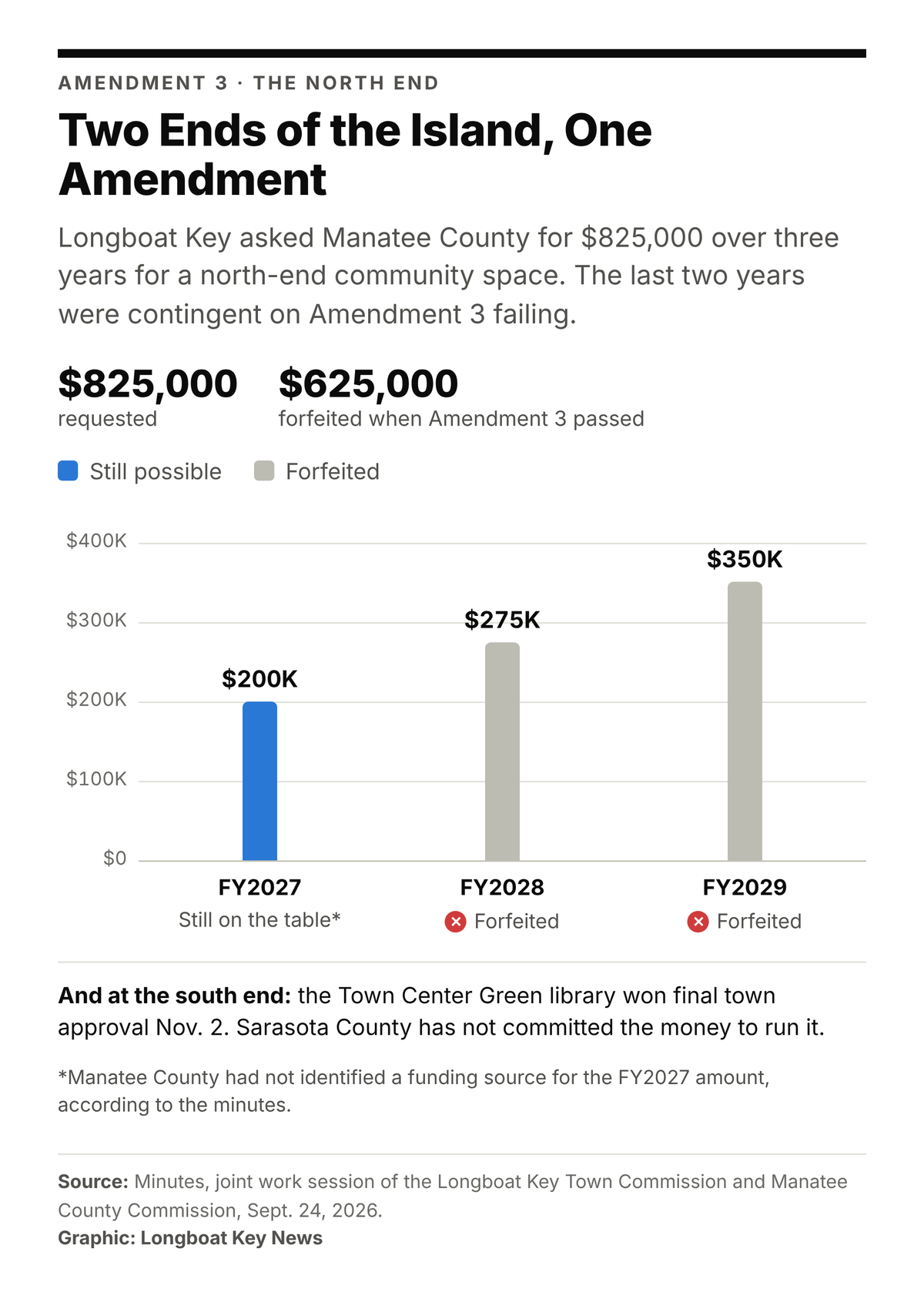
—At a Sept. 24 joint meeting with Manatee County, the town asked for $825,000 over three years to expand programming at a north-end community space, a partnership involving the Paradise Center and Longboat Island Chapel. The request was $200,000 in fiscal 2027, $275,000 in fiscal 2028 and $350,000 in fiscal 2029. The meeting minutes in the Nov. 2 packet say: “Funding for FY 2028 and FY 2029 was contingent on Amendment 3; if Amendment 3 passed, those future-year amounts would be forfeited, leaving only the FY 2027 amount of $200,000.” The minutes also note that the county “had not yet identified a funding source.” The item on that meeting’s agenda titled “Amendment 3 Impacts” was, according to the same minutes, not discussed.
—So on one election night the island’s long-sought gathering place at the south end and its long-sought gathering place at the north end lost their footing together.
—The damage reached off the island too. At an Oct. 7 joint meeting with the City of Sarasota, city staff listed the planned water transit project, which had considered a dock in Longboat Key’s jurisdiction, as “on pause due to Amendment 3.” Even the town’s charter rewrite reacted. The Charter Review Committee pushed any change to commissioner compensation to 2027, its report says, “in light of the potential fiscal implications of Amendment 3.”
—The Philanthropy Reflex
—When Longboat Key needs something, it reaches for its checkbook. The Nov. 2 meeting showed how automatic that has become.
—Before adjourning, Landry held up a check. Susan from the Longboat Key Foundation “has dropped off a check for $8,100 to go towards the Police Department’s Marine Patrol,” he said. She explained that the money finished a repair begun with $8,000 in July. “So this $16,100 puts that boat back into service,” she said, “and we all know how much we need that on the north end.”
—Earlier that afternoon, Commissioner B.J. Bishop had asked how the town’s books show the money the Friends of Tennis keep putting into the Tennis Center, including the new screens on the front of the building and furniture that needs replacing. Landry said future annual reports will list those gifts. At the Nov. 9 workshop, Branham promoted the Foundation’s Laughs on Longboat night on the Green, with more than 200 tickets sold. “Typically, we only have less than 70 or so tickets sold for an event like this,” he said. The Karon Family Pavilion that the library would face was itself built with private money, anchored by a $500,000 gift.
—The library campaign is the biggest example of that instinct. It survived two hurricanes, a shaky market and a four-month pause for recovery, and it beat its goal.
—But philanthropy pays for things once. A library has to be paid for every year. To cover $1.4 million a year from investment returns alone, at a 4 percent annual draw, the island would need an endowment of about $35 million, nearly nine times what the campaign raised. Library advocates have also said for years that public libraries were never meant to live on charity. Donors can build a library. Keeping one open for a decade is much harder for them.
—What the Donors Were Promised
—County officials have confirmed that if the project is abandoned, the private gifts held for it will go back to the donors. No one will lose money.
—That is real protection, and it is cold comfort. The worst case for the island is not a refund. It is the awkward outcome in between: a hall, a terrace and an upgraded entry fully paid for, with no county library left to attach them to.

—The hall was always the point. Town Hall’s commission chambers seat no more than about 80 people, and the island’s biggest public meetings have long been moved to borrowed rooms. Landry has pitched the hall as a place to gather residents and get information out after a storm. Former Town Manager Howard Tipton, who led the effort through every setback, sold it as space for lifelong learning and social connection in an older community. Longboat Key can fill a lawn with 200 people for comedians and food trucks. It still has no indoor public room that seats them.
—The Fine Print in Ordinance 2026-13
—Here is the detail that turns the library’s future from a matter of mood into a matter of dates.
—Section 5 of Ordinance 2026-13 says the ordinance takes effect “upon adoption by the Town Commission and approval within 30 days by the Applicant.” It goes on: “If the Town of Longboat Key has not received notification of approval and acceptance of this Ordinance within 30 days after the Applicant’s receipt, this Ordinance shall be deemed to have been denied.” The site plan order, in turn, takes effect only after the ordinance does.
—The ordinance’s own findings direct the town clerk to mail certified copies to the owner and the applicant within seven days of adoption. That puts the county’s acceptance deadline somewhere in the first half of December, depending on when the county received its copy.
—Signing the acceptance would not commit the county to build anything. Failing to sign would end the entitlement the town just granted, and the county would have to apply again. In other words, the first official sign of the county’s intentions may not be a vote at all. It may be whether a signed form arrives at Town Hall.
—If the county does sign, the approvals effectively become a two-year option. Under the conditions of approval, the site plan becomes “null and void” if, within 24 months, a complete building permit application has not been submitted and a permit issued. The county could accept the approvals, finish the drawings and put the project on the shelf until close to November 2028 without losing anything the town gave it.
—There are other signals to watch. The county’s tentative timeline called for construction documents to go to the town for building permits this month and for bidding and a guaranteed maximum price in March 2027. Whether either happens on schedule will say a lot.
—The Lobbying List Shrinks to the “Precious Few”
—Amendment 3 has already changed how Longboat Key goes to Tallahassee.
—When Brownman brought the town’s 2027 legislative priorities back to the commission on Nov. 9, Landry admitted the list had been written before anyone knew how the election would go. “We were wishful thinking on the outcome of the election,” he said, “and obviously things have changed.” He asked commissioners to treat the list as “an evolving, living, moving document” and to “keep our expectations low because it’s going to be an interesting year in changeover.”
—Bishop put home rule, the traditional top priority for Florida cities, at the bottom. “Home rule has become a joke in Tallahassee,” she said. “We have no more leverage on home rule issues than one of the mice crawling around in the woods out there.”
—Coffin argued for brevity: “Go with a list of 10, that doesn’t work for anybody because no one wants to read anything that long.” Branham called the shorter list “the precious few.” Ramba described how legislative budgeting works in plain terms: “When they say, ‘Pick one,’ and you pick it, that’s what you get.”
—The commission agreed on this order: the SUN Trail first, then evacuation routes and transportation, then beach renourishment, short-term rental protections and home rule. The library is not on the list. It is a county building, and the town’s lobbyist works for the town.
—Ramba also pointed out that Amendment 3 will hit agencies the island depends on more than most people realize. The West Coast Inland Navigation District and the water management districts also run on property taxes, he said, “they’re going to get cut,” and coastal dredging programs will slow down as a result. That is a serious concern for a town whose Public Works director reminded commissioners the same afternoon that its last beach renourishment was “100% grant funded.”
—The County Line Comes Back
—The most surprising result of Amendment 3 on Longboat Key may be the return of an old idea.
—On Nov. 9, Williams asked Ramba whether this was the moment to revisit the 2021 study of putting all of Longboat Key in a single county. “In light of the current economic and fiscal situations we’re looking at and creating efficiencies,” she asked, “would today or sometime in the not-so-far-off future be a good time to revisit that?”
—She described a conversation with Manatee County Commission Chairman Tal Siddique, who also represents the island’s north end. “He said, ‘You know, Longboat Key is contributing less and less to the overall county budget,'” Williams said. By numbers she said she ran herself, the island’s share of Manatee revenue has fallen from about 5.5 percent to a little over 4 percent between 2021 and 2026, overtaken by growth in Lakewood Ranch and points east.
—Ramba said the main savings for north-end residents would be the gap in school taxes between the two counties, and he told a story from the original study about Manatee officials defending the cost of busing what was then a single public school student from the island’s Manatee side. “Hire them a limo,” he recalled telling them. “Take that kid to school every day for what that entire north end of Longboat Key pays to the Manatee County school board.”
—The study draws no conclusions, he said, but anyone who reads it comes away thinking “it’d probably be much more efficient for Longboat Key to be in one county and not two.”
“Let’s do it!” Bishop said. “Let’s explore it!”
—Any change in county lines has to go through Tallahassee. Williams said Ramba will raise the idea with state Sen. Jim Boyd, who represents the island and is about to become the most powerful legislator in the state.
—Tallahassee’s Turn
—Boyd is scheduled to be elected Senate President on Nov. 17. That is the same day the state certifies the election results and the same day the Sarasota County Commission is expected to begin working through Amendment 3.
—The Legislature still has to write the rules that put the amendment into effect. DeSantis has said he wants a special session before he leaves office in January, in part to stop local governments from making up lost property tax revenue through other taxes and fees. Ramba told commissioners the likely window is the Legislature’s committee week beginning Dec. 1, but that many lawmakers would prefer to wait for the regular session under Governor-elect Byron Donalds, with nearly 50 House freshmen just arriving in Tallahassee.
“I can’t see the upside of them providing him yet another present under the Christmas tree by giving him everything he wants in a special session,” Ramba said. Rushing an implementing bill could create unintended consequences, he had warned earlier. “Hopefully cooler heads will prevail.”
—The Taxation and Budget Reform Commission also meets in 2027. Bishop passed along a warning she said Casey Cook gave at an August Florida League of Cities meeting: “as many as 40 municipalities” in the League could be, “in essence,” bankrupt in the amendment’s first years. Ramba’s own forecast was simpler: “62% is 62%, and people need to listen to what the voters said.”
—Whatever the Legislature decides about fees, assessments and spending limits will shape the county’s decision on the library as much as anything the county itself does.
—Five Ways This Could Go
—No official has laid out options in public yet. From the record, though, the possibilities are fairly clear.
—Build it and run it lean. The county accepts the approvals, builds with money it cannot spend on anything else and opens the branch with shorter hours and a smaller staff. The county’s library department already had 18 vacant positions in October, with hiring paused because of the amendment.
—Accept it and shelve it. The county signs the acceptance, finishes the drawings and lets the 24-month window run while the Legislature writes its rules and the first reduced tax rolls come in.
—Build it with local partners. The town, the Foundation or both help cover operations through a lease, a programming agreement or an endowment. Every version runs into the same math, the same constitutional limits and the town’s own $1.4 million problem.
—Charge for it. Ramba’s prediction, and the county’s own warning, point to fees for non-core services. Librarians say a library with fees is no longer really a public library.
—Walk away. The county lets the acceptance deadline pass or votes to cancel, the private gifts go back to the donors, the impact fees wait for a library somewhere else, and the Town Center Green stays a lawn.
—The Calendar That Decides It
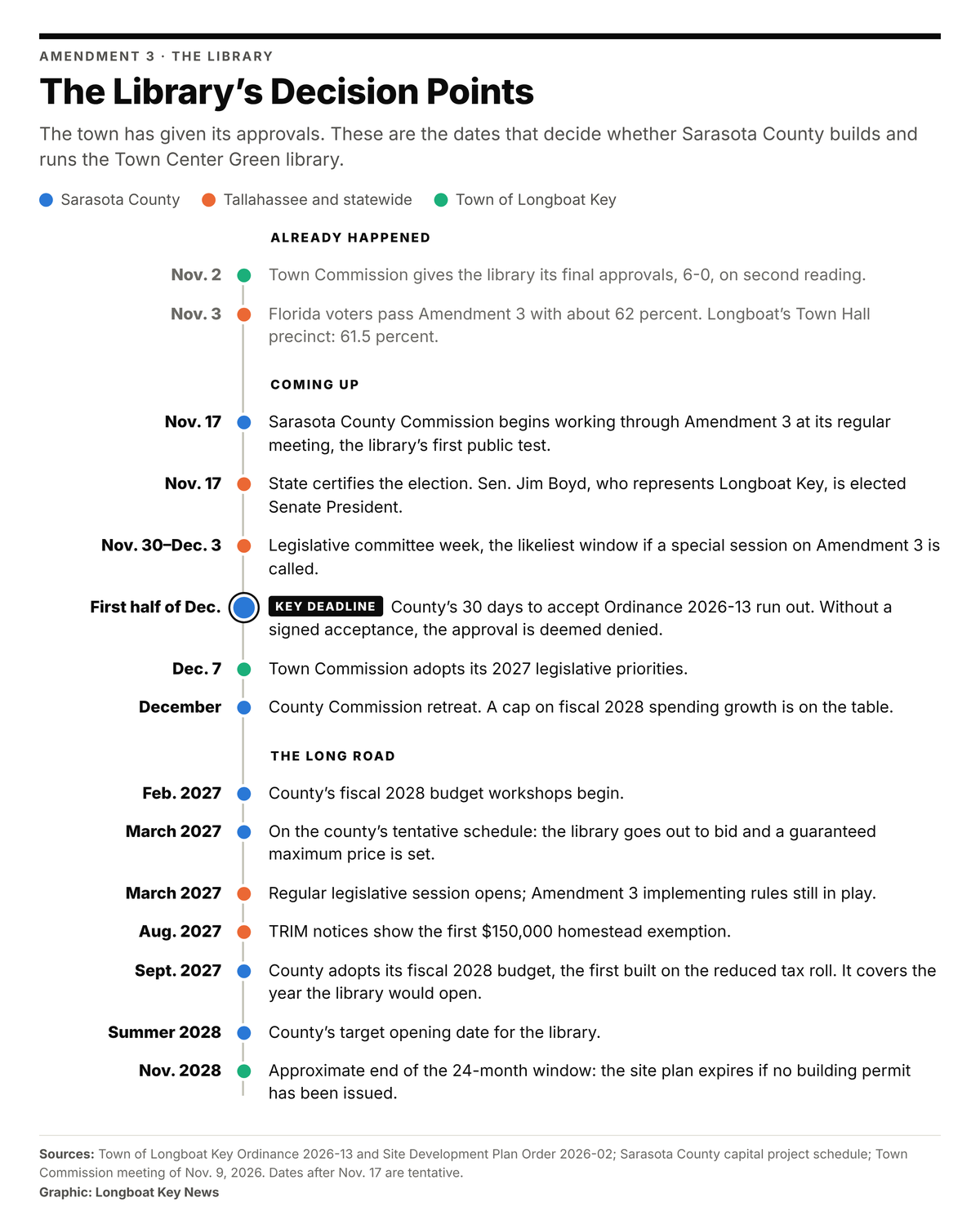
—Nov. 17, 2026: The state certifies the election. Sen. Jim Boyd is elected Senate President. The Sarasota County Commission begins working through Amendment 3 at its regular meeting, the first public test for the library.
—Week of Nov. 30–Dec. 3: The Legislature’s committee week, the most likely window for a special session if DeSantis and legislative leaders agree to hold one.
—First half of December: The county’s 30-day window to accept Ordinance 2026-13 closes, depending on when it received the certified copy.
—Dec. 7: The Town Commission adopts its 2027 legislative priorities and takes up the Whitney’s rezoning, the charter referendum and the tree code.
—December: The Sarasota County Commission’s annual retreat, where a cap on spending growth is on the table.
—February 2027: Sarasota County’s fiscal 2028 budget workshops begin.
—March 2027: On the county’s tentative timeline, the library goes out to bid and a guaranteed maximum price is set. The regular legislative session runs through spring.
—August 2027: TRIM notices show the first reduced homestead taxes.
—Summer 2028: The county’s target date for opening the doors.
—About November 2028: The 24-month window in the approval runs out if no building permit has been issued.
—A Building and a Belief
—The library has been a long time coming. For years the plan was an arts center, a successor to the cultural life the island lost when the Longboat Key Center for the Arts closed in 2017. A partnership with Ringling College of Art and Design fell apart. The town spent 2014 through 2017 buying the parcels that became the 4.8-acre Town Center Green and combined them into one property in January 2023. In 2024 it held workshops where residents said, clearly, that they wanted a real meeting hall. Since November 2023, the county’s pop-up library has visited the island on the first and third Thursdays of each month, a stand-in for a building that has never arrived. The county has not opened a new library anywhere since 2018, and it has never built one on a barrier island.
—A library is unusual among public buildings in that it asks almost nothing of the people who walk in. No ticket, no membership dues, no reservation, just a name on a card. That is why it is such an easy thing to promise and such a hard thing to keep. It earns no revenue and it requires a commitment every year, and Florida voters have just cut the money that pays for that kind of commitment, by 62 percent statewide and by 61.5 percent at Longboat Key’s own Town Hall.
—The Town Commission did its part on the afternoon of Nov. 2, quickly and unanimously. The rest of the decision now belongs to five county commissioners, a Legislature that has not written its rules yet and a budget that will not be adopted for another 10 months.
—The commission sailed through. The library is still at sea.

