

A joint letter asks FDOT for a drawbridge, or at worst a 65-foot span. The Nov. 9 debate over that letter showed how many sides this fight now has, and how little time and leverage anyone has to win it.
“I don’t want to absolutely burn that bridge,” Longboat Key Commissioner B.J. Bishop said. Then she added, “What an interesting irony that is.”
—The bridge she meant was a figurative one: the new partnership between the Town of Longboat Key and the Manatee County Commission. The real one sits at the island’s northern tip. It is 69 years old, it goes up and down over Longboat Pass 100 to 300 times a month, and on Nov. 9 the Town Commission took up the question that has hung over the north end for two years. How hard should the town push the state over what replaces it?
—On the table was something two years of hearings, petitions, drone demonstrations and letters had never produced: one letter from both governments. Manatee County drafted it on county letterhead. Tal Siddique, chair of the Manatee County Commission, and Mayor Debra Williams are to sign it. It asks the Florida Department of Transportation to drop its preferred 78-foot fixed span. The first choice is a bascule drawbridge. The fallback is a 65-foot fixed bridge.
—Commissioners agreed 6-1, with Gary Coffin dissenting, to send the letter as written rather than risk delay by editing it. The town will follow it with a sharper letter of its own. The joint letter goes to the Dec. 7 regular meeting for formal approval.
—That took about a dozen minutes, and those minutes showed why the Longboat Pass Bridge has become the great debate of the barrier islands. There are no longer two sides. The state wants a high fixed span that never opens. The town wants something low. The north end wants its horizon. Sailors want a door to the Gulf that stays open. Cyclists and wheelchair users want a hill they can climb. And across the pass, the neighbor at the other end of the bridge still hasn’t put its name on anything.
—What the Letter Says
—The draft is addressed to James M. Driggers Jr., FDOT’s interim District One secretary in Bartow. It is undated, and nothing marks it as a draft.

—It opens without hedging: “We write to urge the Florida Department of Transportation to reconsider its preferred 78-foot fixed-span alternative for the Longboat Pass Bridge replacement.”
—Most of the case is about the people who would have to cross the new bridge on foot or by bike. The letter says that for pedestrians, people using mobility devices and cyclists, “an approximately 80-foot climb would make the crossing substantially more difficult to use.” It calls the bridge an important link in the region’s future cycling network. It warns that “a steep, extended descent can increase bicycle speeds and reduce the margin for safe control.”
—Then comes the sentence the north end has been trying to get on the record for two years: “Compliance with minimum design requirements alone should not be the measure of success.” The design, it says, should be “genuinely usable and safe for the public it is intended to serve.”
—The ask comes in two tiers. First, a lower bascule bridge that meets Coast Guard and navigation requirements. Second: “If our first choice of a bascule bridge is not possible, we ask for a 65-foot fixed span bridge option to be considered.” The letter’s closing argument is about character. Replacing “the existing modest drawbridge with a substantially taller fixed structure over 65 feet would have lasting visual and quality-of-life impacts on the north end of Longboat Key and the surrounding community.”
—The letter leaves several things out. It says nothing about FDOT’s boat counts, the cost comparison, or the Northgate condominium, whose buffer from the road would shrink from about 95 feet to 36.5 feet. It also does not mention the sailors who say a 65-foot span would lock them out of Sarasota Bay.
—Manatee’s Pen, Longboat’s Fingerprints
—The letter grew out of the Sept. 24 joint meeting of the two commissions in Bradenton. Williams, Bishop and Vice Mayor Penny Gold asked there whether the county would sign on. Bishop, a serious cyclist, told county commissioners she doubted many riders wanted an 80-foot climb in the middle of the region’s trail network. That argument is now the heart of the letter.
—Another north-end argument made it in too, though not word for word. Richard Abuza, president of the Northgate condominium, wrote to Commissioner Sarah Karon this fall that “just because something is technically in compliance does not mean it is practically in compliance.” He asked anyone who has pushed a wheelchair up a long grade to imagine coming back down it. The county’s version of that point is the line about minimum design requirements.
—Town Manager George Landry asked commissioners to read the draft “understanding that it’s Manatee’s point of view based on our joint meeting.” Still, he said, “it is a step in the right direction.”
“As Forceful as We’re Going to Get”
—Not everyone thought the step went far enough.
—Coffin had spent the weekend on research. “There basically are 67 bridges along the waterway,” he said, referring to the Florida Intracoastal Waterway. “Forty-eight are drawbridges and 19 are fixed bridges. Those 19 fixed bridges, on average, are 65 feet.” He wanted that in the letter: 65 feet is the norm, and what FDOT proposes “is just way out of line.”
—Bishop told him the town didn’t hold the pen. “I think, Debra, you said this is probably about as forceful as we’re going to get from the Manatee County Commission,” she said. “If it were ours to write, we could certainly put our own forceful language in it, but we’re not in that position. We’re asking Tal to do something in partnership with us.” That is when she said she didn’t want to burn the bridge.
—Commissioner Steve Branham thought the county expected comments. His recollection of Sept. 24 was that the two boards had agreed to draft the letter together. He suggested a light touch: “Great letter, 95% of it we like, but let’s just add one sentence in there.”
—Coffin called the draft “just like a first draft.” Williams wondered aloud why it wasn’t watermarked as one. “I thought this was a done deal,” Bishop said.
—The Number 65, and Why It Keeps Coming Up
—Branham explained why 65 keeps coming up. “The 65-foot is really driven by the requirement for any bridge going across the Intracoastal Waterway,” he said. He allowed that the town should check whether the requirement is set in law.
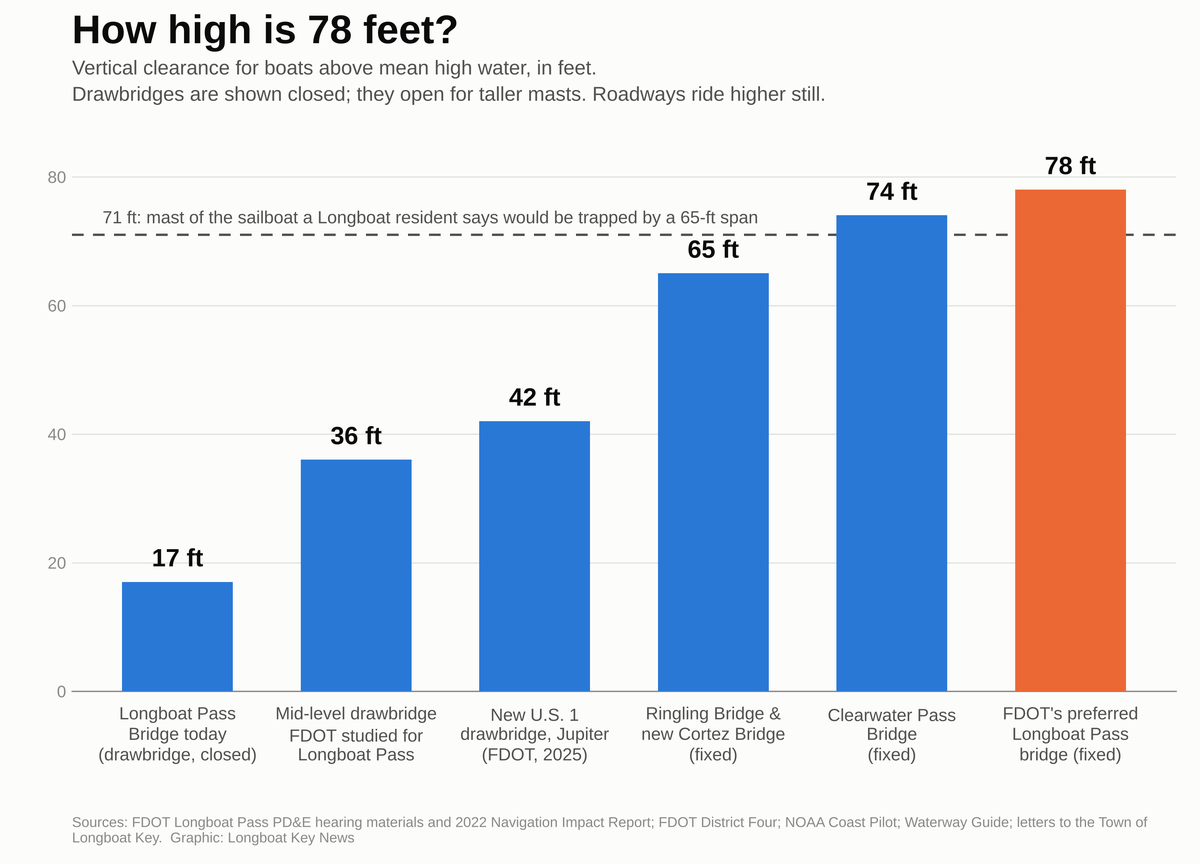
—The figure is real. Fixed bridges over the channel of the Atlantic Intracoastal Waterway in Florida are built to 65 feet, with one notable exception in Miami. The Ringling Causeway is a 65-foot span over the Gulf Intracoastal in Sarasota Bay. FDOT’s own 2022 navigation report for Longboat Pass lists 65 feet as the Coast Guard’s guide clearance for a fixed bridge there, and 21 feet for a drawbridge.
—The Coast Guard says those guide figures are not regulations. It sets clearances case by case, and it can require more or approve less depending on the boats that actually use a waterway. Longboat Pass is not the Intracoastal channel. It is a Gulf inlet, the opening between the open water and the bay. And this coast already has fixed spans taller than 65 feet: the Clearwater Pass Bridge and Clearwater’s Memorial Causeway are both charted at 74.
“That One Very Large Sailboat”
—The sharpest moment of the afternoon was also the shortest.
“Well, you know, we have to accommodate somebody’s very large sailboat,” Williams said after Coffin made his 65-foot pitch.
“Well, it’s that one,” Bishop said.
“That one very large sailboat. Not mentioning any names,” Williams said.
“Boats are sold on an average of every seven years,” Coffin added.
“I think everybody in this room agrees with what you’re saying,” the mayor told him.
—Nobody said a name. But the sailor who has pressed the commission hardest this fall is Mark Fishman, a year-round Longboat resident who has kept a cruising sailboat in Sarasota Bay for a decade. Its mast stands 71 feet above the water. In letters to the commission published in these pages, Fishman said he had just learned the town was pushing for a shorter fixed bridge and that he was “very much opposed.”
—His argument is about how boats get into the bay. The Ringling is fixed at 65 feet. The Cortez Bridge, now under construction, will be too. New Pass is too shallow to count on. With a 65-foot span at Longboat Pass, he wrote, “my boat will be permanently trapped in Sarasota Bay, or will never again be able to gain entry to it.” He has said he could accept the state’s 78 feet or a taller drawbridge. “If a lower fixed bridge is installed, I will likely have to sell my house and move elsewhere.”
—Karon had answered him carefully. “The bridge project as currently designed will speak to the needs of sailors like yourself,” she wrote, adding that “resident preferences run the gamut at this time.”
—The Last Tall-Mast Door
—Branham raised a fair point that cuts both ways. FDOT’s numbers on tall boats are four years old. “I’m sure that number’s changed,” he said, recalling a binder at the public meetings that listed seven sailboats that would be affected by a lower bridge. “We do know of one that’s recent, been vocal about it.”
—He wants the count redone. He also admitted the result might not help the town. “If we can get a study update that says there’s two boats now or nine or whatever, it may cut against us,” he said. “We don’t know.”
—The state’s 2022 navigation report is a public document, and it shows how small and how important that group of boats is. Consultants counted more than 260 boats passing the bridge over three days in March 2022. Nearly 92 percent were powerboats and pontoon boats less than 20 feet tall. The two tallest were listed at 71 and 78 feet. The state’s preferred bridge clears exactly 78. A separate survey of 18 marinas found seven boats taller than 64 feet, which matches the seven Branham remembered. Only two of them topped 70.
—Small numbers are the town’s argument. The report’s conclusion is the sailors’. Once the Cortez Bridge is replaced with a 65-foot span and the Army Corps stops maintaining the New Pass channel, the report says, “the Longboat Key Bridge will be the only means of access for vessels with air drafts greater than 65 feet.” It notes that Longboat Key Club Moorings, which it calls “the largest resort marina on the west coast of Florida,” routinely services “sailboats and catamarans with air drafts greater than 65 feet.”
—That is why the 65-foot fallback is harder to get than it sounds. The final word on the height belongs to the Coast Guard, not FDOT and not the town. FDOT’s environmental document lists the Coast Guard bridge permit as “to be acquired.” Any bridge has to meet the reasonable needs of the boats that actually use the pass, and FDOT’s own consultants have said which boats those are.
—The Paradox: The One Design Everyone Could Live With
—The joint letter’s own two tiers show the real puzzle at the heart of this fight.
—The town’s first choice, a drawbridge, is the only design that serves both the north end and the sailors. A bascule bridge sits low when it is down, keeping the cottage-and-mangrove scale the north end is fighting for. When it goes up, it has no height limit at all. Fishman has said he could accept a drawbridge; what he cannot accept is a fixed span lower than his mast. The Town Commission, Manatee County and the north end all list the drawbridge first.
—The fallback, a 65-foot fixed span, is the option that turns the town against its own sailors. It is also the one the state’s navigation report most directly undercuts.
—FDOT’s own documents make a case for a middle path. The 2022 report found that a mid-level drawbridge with 36 feet of clearance would let about 95 percent of the boats counted at the bridge, and nearly 70 percent of the boats in area marinas, pass underneath without an opening. In 2024, that mid-level drawbridge was the town’s formal recommendation.
—The state’s answer has been money and machinery. FDOT’s hearing materials put construction of the 78-foot fixed span at about $138 million, and the whole project at roughly $159 million. The agency has estimated a drawbridge at $176 million to $194 million, before decades of bridge tenders, motors and maintenance. In correspondence published here this spring, LBK North co-leader Jim Haft put it bluntly: “the primary (and perhaps only) reason for a fixed bridge is cost.” Resident Maureen Merrigan asked FDOT how cost could be the only criterion “when it will completely change the community character of the area for the worst?”
—Karon has been the most candid official on where things stand. “The bascule option would be my preference, but FDOT is not currently entertaining the thought,” she wrote this fall.
—The State Still Builds Drawbridges, When It Wants To
—Bishop asked for something the town’s own letter could include: “It may be equally useful to know the most recent bridges that FDOT has built in similar areas and what height those bridges are.”
—Williams had one in mind. “They did build a bascule bridge on the east coast. Was it Jupiter?”
—It was. FDOT finished replacing the 1958 U.S. 1 drawbridge over the Loxahatchee River and the Intracoastal Waterway in Jupiter late last year. It built another drawbridge, a twin double-leaf bascule with 42 feet of clearance, up from 25. The winning bid was about $122 million. The state said the added height would cut openings by about 44 percent.
—Branham and Bishop both cautioned that Jupiter was a special case. It carries four lanes of U.S. 1, and Branham said he didn’t believe there was room there for a taller span. “There were outstanding reasons why that bridge ended up at that height,” Bishop said. Still, the point stands: Florida has not stopped building drawbridges. It builds them where it decides they fit.
—The State’s Case, and the Residents Who Agree With It
—The tall bridge has local defenders, and their arguments are serious.
—A fixed span never opens. Today’s drawbridge stops the only road off the north end 100 to 300 times a month, according to FDOT’s engineering study, with peak-season openings driven mostly by sailboats. The state says a fixed span is the more reliable hurricane evacuation route. It would add a 12-foot protected shared-use path on the west side, where a pedestrian today has almost no room.
—In May, Longboat residents Ralph Haschke and Amy Holcombe wrote FDOT project manager David Turley in “strong support” of a modern fixed span that would “eliminate draw openings altogether.” They called the choice “a no-brainer” and urged the state to get started.
—On the grade, the state’s numbers are gentler than the rhetoric. In March, Assistant Town Manager Isaac Brownman relayed figures from FDOT’s project manager. The 78-foot span would have a maximum slope of 4.5 percent, against 5 percent on the Ringling Causeway, because much of the climb happens over land on the Manatee side. “The proposed Longboat Pass Bridge as a high fixed-span would actually have a lesser maximum slope than Ringling Causeway,” he wrote.
—The north end’s reply is Abuza’s: technically compliant and practically usable are not the same thing. The Ringling also lands in a downtown of towers. Longboat Pass lands next to a county beach, a mangrove island and a neighborhood of low condominiums and cottages.
—The Clock: New Commissioners, a New Chair, a Changing County
—The debate then turned to timing, and the room changed its mind.
—Karon warned that Manatee is seating two new commissioners after the Nov. 3 election who may not know the history. Sending the letter back for edits could add delay. Brownman pointed out that county policy requires its commissioners to approve any letter before it goes out. “The longer you wait, the more it could get bogged down in their process or not make it across the finish line,” he said.
—Landry expected the county to reorganize within weeks and not return to regular business until December or January. “So far we don’t have any meeting on the books with Coast Guard or FDOT right now,” he said, “so we’re okay.”
—Town Attorney Maggie Mooney was blunter. “You might have to stomach the existing format if you want it out sooner rather than later,” she said. “The more back-and-forth, the longer it’s going to take to actually get issued.”
—There is a calendar issue nobody mentioned. Siddique was elected chair for 2026 last December, with the term starting Jan. 1. If the county follows the same calendar this year and the letter slips into January, the name on the signature line could change.
—Coffin wasn’t convinced the rush was real. “Is timing an issue? I mean, the bridge is years and years out.” Bishop answered: “Because the Commission’s changing.”
—The bridge, the pass and the north end all sit in Manatee County, which is why the county’s name on the letter matters. On the same afternoon, Williams floated reviving the 2021 state study of whether Longboat Key should be in one county instead of two. Bishop said, “Let’s do it! Let’s explore it!” Whatever comes of that, for this bridge the island is in two counties, and the county that holds the pass is the one being asked to sign.
—Two Bites at the Apple
—Gold proposed the way out. Would it be stronger, she asked, to send a follow-up letter, “two bites at the apple instead of one”?
—Landry agreed. The town will draft its own letter, approved by the commission and signed by the mayor, to go along with the joint one. That way staff is ready, he said, because “there might be opportunity for a meeting that pops up.” It is the natural home for Coffin’s 65-foot average, Branham’s call for a new boat count, and Bishop’s list of recent FDOT bridges.
—Branham, who started by wanting edits, came around: “If there is a timing issue, by all means send this. It’s not perfect, but we need to get on the board with it.”
“We’ve Asked.” “Many Times.”
—Karon saw one more chance in a second letter. “It gives us an opportunity to see if Bradenton Beach will co-sign that letter with us,” she said.
“We can ask. Doesn’t hurt to ask,” Williams said.
“Yeah, we’ve asked,” Bishop said.
“Many times,” Coffin said.
—The exchange explains a lot. Bradenton Beach owns the other end of the bridge, and its leaders have said plenty about it. Mayor John Chappie and Commissioner Scott Bear have warned that the high span would move access to the Coquina boat ramp and send trucks and trailers across traffic on both islands. But north-end residents and Bishop spent the spring asking the city to put its opposition in a letter to FDOT. In June, Chappie wrote that “at our next commission meeting, I will be asking the commission if they would like to have an official position on the proposed height of the LBK Bridge.” Five months later, Longboat’s commissioners are still asking.
—A New Cast in Tallahassee
—Whatever the two governments send, it lands at an agency about to change hands.
—The town’s lobbyist, Dave Ramba, opened the same workshop with a forecast. With Gov.-elect Byron Donalds taking office Jan. 5, “we do expect some wholesale changes to the agency’s heads across the board between now and the first week in January.” The letter is addressed to an interim district secretary, at a department whose secretary was appointed by the outgoing governor.
—The island’s best-placed ally is about to become far more powerful and far harder to reach. Sen. Jim Boyd, R-Bradenton, whom Ramba called “our Senator from here at Longboat Key,” becomes Senate President on Nov. 17. Ramba said Boyd knows the island so well that “you don’t have to walk in and explain to him that Longboat Key’s in two counties.” But, he warned, “we used to get half an hour with him, it’ll probably be five minutes now.”
—In those five minutes, Ramba said, legislators tend to ask a town to pick one thing. On Nov. 9 the commission settled the order of its 2027 legislative priorities, due for final approval Dec. 7: SUN Trail and Gulf of Mexico Drive improvements first, then relief for congested evacuation routes. Brownman reminded the commission that “every single route coming off Longboat Key that experiences seasonal congestion is a state road.” Ramba made the same point more simply: “We have a big old state road that runs north to south and it’s all we got.”
—The bridge itself is not on the list.
—What Happens Next
—Dec. 7. The Town Commission votes on the joint letter and authorizes the mayor to sign it.
—Manatee County. The County Commission must approve the letter at a future meeting, with two new members and possibly a new chair. No date is set.
—The town’s own letter. Staff will draft a companion letter. It could ask for an updated boat survey, compare recent FDOT bridges and cite the 65-foot standard. Bradenton Beach will be asked, again, to sign it.
—FDOT’s decision. The state’s $2.125 million study has not formally closed. The project page still lists completion in “mid 2026” and has not been updated since March 18. FDOT’s hearing materials pushed that to late 2026.
—The Coast Guard. No bridge gets built without a Coast Guard permit, and none has been issued. That agency, not FDOT, decides how much clearance the pass needs.
—The money. FDOT has design money programmed but no construction money. Its environmental document says construction is “not programmed within the FDOT Five-Year Work Program.” At the September joint meeting, Siddique said he doubted the bridge would come up for real consideration before the mid-2030s.
—Cortez. A few miles up Gulf Drive, the state’s $123 million, 65-foot Cortez Bridge is under construction. This fall the county gave the contractor a four-year license to stage cranes, materials and office trailers on county land at the foot of the bridge. When that span opens, Longboat Pass becomes the last tall-mast door into Sarasota Bay, just as the state’s report predicted.
—Residents can send comments to FDOT Project Manager David Turley at David.Turley@dot.state.fl.us or (863) 519-2255, or through the project page at swflroads.com.
—A Door, a Hill and a Horizon
—Most bridge fights are about getting across. This one is about everything a bridge does besides carry cars.
—At Longboat Pass, the bridge is a door for the tallest masts on this stretch of coast. It is a hill for every cyclist, runner and wheelchair user headed for Coquina Beach. And it is the first thing anyone sees of the island from the north: a low gray line across the water, the way it has looked since 1957.
—The state can build one bridge that is low enough for the horizon and high enough, when it opens, for any mast. It is a drawbridge. Two governments now ask for it in one voice, in a one-page letter that is unsigned, undated and headed for a state agency about to get a new boss. The state has spent two years making clear it would rather not build one.
“It’s not perfect,” Branham said of the letter. “But we need to get on the board with it.”

